Research Flags Bitcoin Nation-State FOMO—27 In, 13 About To Join

bitcoinistPublicado em 2025-09-24Última atualização em 2025-09-24

Resumo

A new Bitcoin Policy Institute (BPI) report argues that nation-state engagement with Bitcoin has moved beyond legal-tender experiments into a...

Trusted Editorial content, reviewed by leading industry experts and seasoned editors. Ad Disclosure

A new Bitcoin Policy Institute (BPI) report argues that nation-state engagement with Bitcoin has moved beyond legal-tender experiments into a broader set of “exposure” pathways—from strategic reserves and sovereign mining to pensions, sovereign wealth funds and tax acceptance—marking what the authors describe as a game-theoretic race among governments.

Nation-State Bitcoin Adoption Accelerates

The study, authored by Jake Langenkamp and Renee Sorchik and on September 22, 2025, concludes that “27 countries currently have some measure of exposure to bitcoin—approximately one in seven worldwide,” with a further “13 countries [that] have proposed adoption measures through legislation or policy initiatives.”

The report is explicit about scope and definitions. “Exposure was defined as any official path a government may take to own, earn, or generally benefit from bitcoin,” a framework that deliberately looks beyond the narrow question of legal tender to capture the diversity of sovereign approaches now evident across regions and political systems.
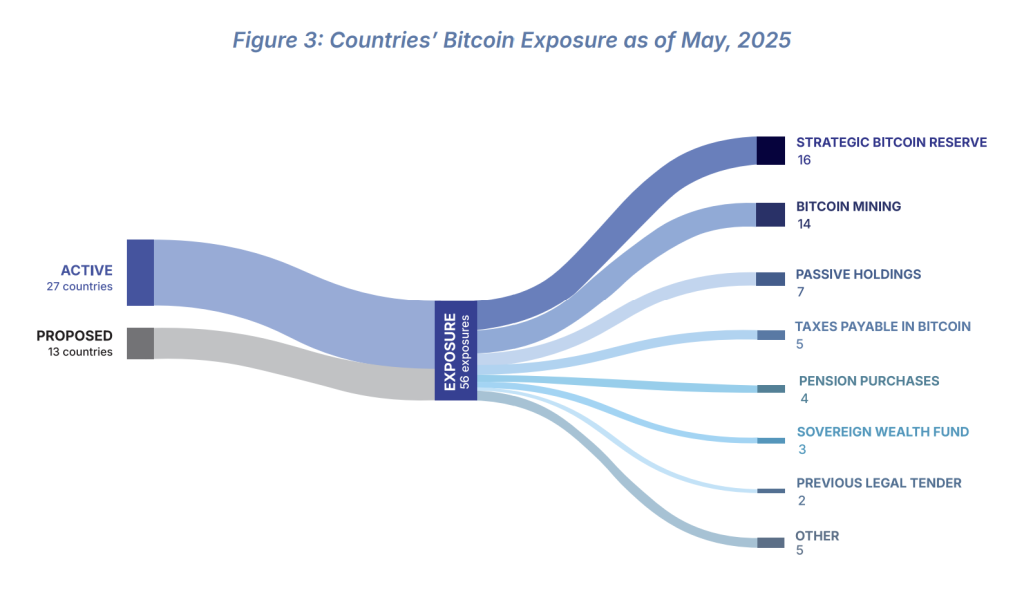
Countries’ Bitcoin Exposure as of May, 2025
Countries’ Bitcoin Exposure as of May, 2025 | Source: BPI

The authors treat sub-national pilots—such as state-level reserves or municipal tax programs—as valid instances of nation-state exposure because they can scale into national policy. Data collection closed on June 6, 2025, with first-half 2025 events aggregated as a single period to reflect the late-quarter cadence of announcements.

The topline counts underpin a larger narrative of acceleration. As of end-May 2025, the dataset covers “32 countries—roughly one out of every six nations on Earth—[that] either already had bitcoin exposure or was actively pursuing it through legislation or policy,” subdivided into 27 active and 13 proposed. The authors caution that categories can overlap, with individual countries appearing in multiple modalities; the United Arab Emirates, for example, is noted as combining government-backed mining, sovereign wealth fund ETF purchases, and tax acceptance.

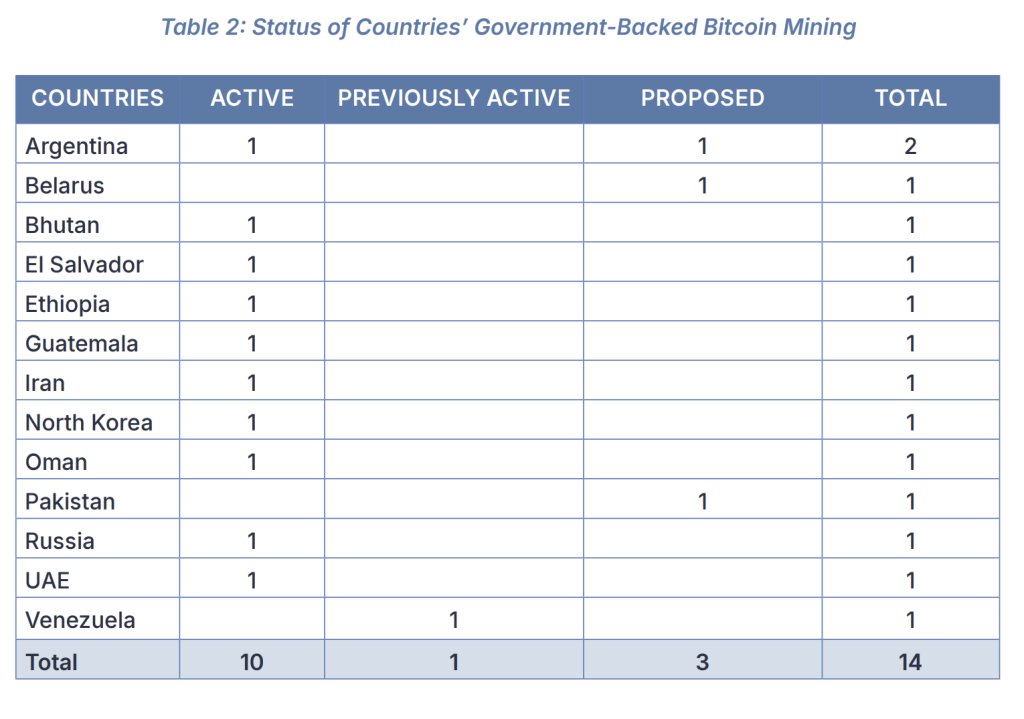
Modalities cluster around a few dominant channels. Counting both active and proposed, the most common is a Strategic Bitcoin Reserve (SBR), identified in 16 countries, followed by government-backed mining (14).
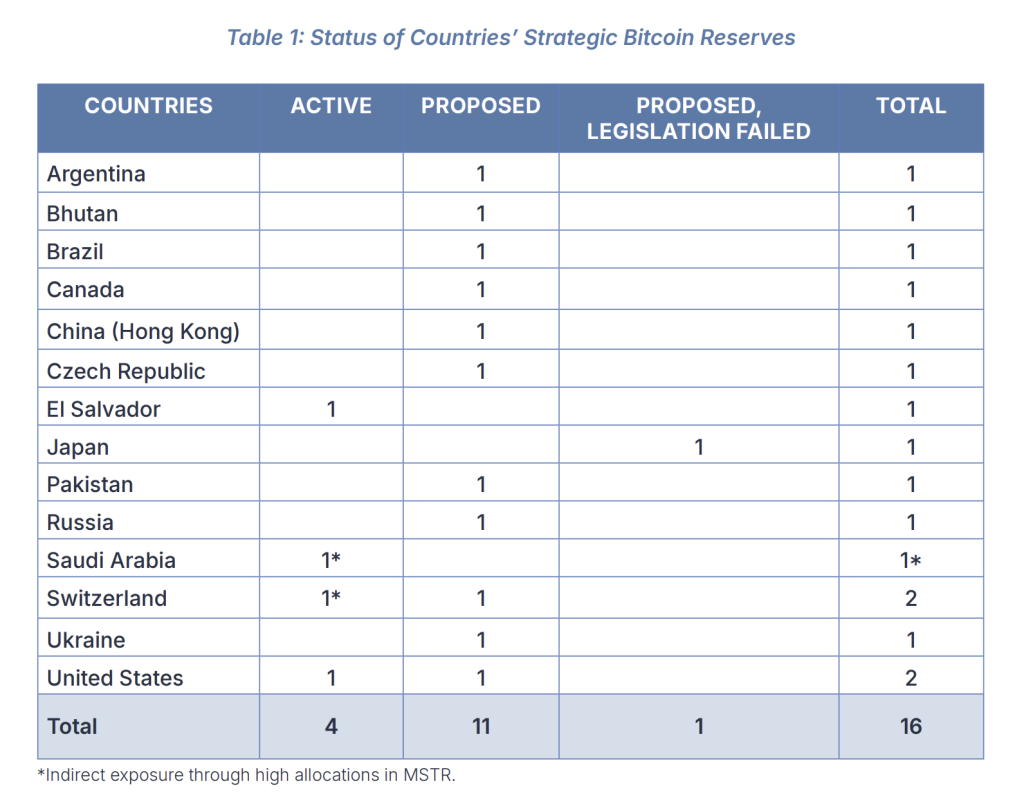
Status of Countries’ Strategic Bitcoin Reserves
Status of Countries’ Strategic Bitcoin Reserves | Source: BPI
Status of Countries’ Government-Backed Bitcoin Mining
Status of Countries’ Government-Backed Bitcoin Mining Source: BPI

Passive holdings—typically seized assets that authorities have elected not to sell—are recorded in seven countries, while five countries accept certain taxes in bitcoin. Government money managers appear on both sides of the balance sheet: four pension systems and three sovereign wealth funds show direct or indirect exposure, including via equity in BTC-treasury companies.
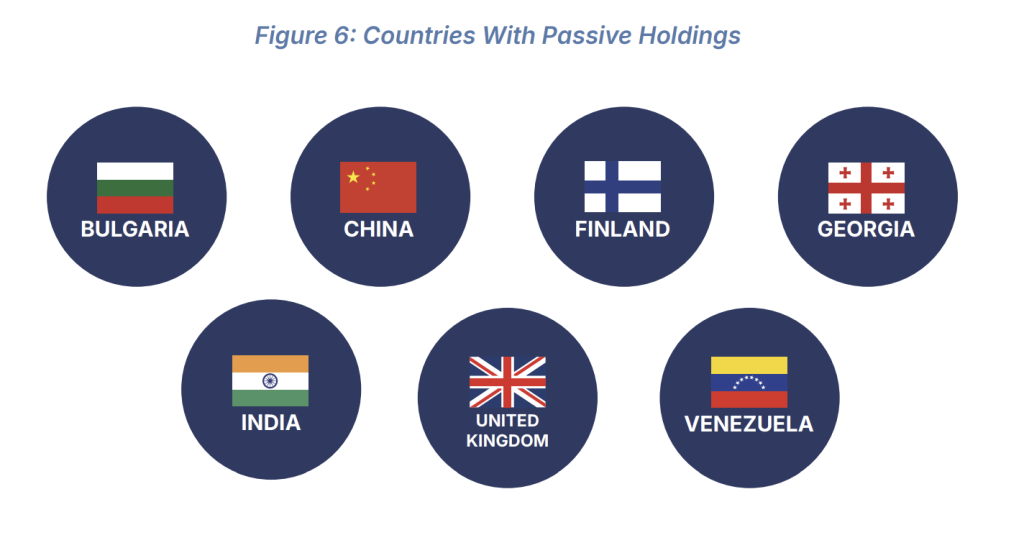
Countries With Passive Holdings
Countries With Passive Holdings | Source: BPI

Two countries are recorded for prior legal-tender status (El Salvador and the Central African Republic), and a handful of country-specific outliers include a government-backed crypto exchange pilot (Russia), a special economic zone recognizing bitcoin as a unit of account (Honduras), and the use of seized BTC for public debt (North Korea).

Different Options For Bitcoin Exposure

The authors disaggregate what is active today versus what remains on the drawing board. Among active exposures, they identify 11 countries with government-backed mining, seven with passive holdings, four with SBRs, four taking tax payments in bitcoin, and sovereign wealth funds or pensions in a smaller but notable role. Proposed measures skew even more heavily toward SBRs: “12 of the 13 countries” with proposals target a reserve model, alongside limited proposals for mining, pensions and tax acceptance.

A short list illustrates the reserve spectrum the report captures. “Four countries were classified as having active strategic bitcoin reserves.” In the United States and El Salvador, reserves are “more traditional,” with direct holding and/or accumulation. By contrast, the central banks of Switzerland and Saudi Arabia are classified as having indirect reserves through “large positions in MSTR,” reflecting the authors’ broader definition of indirect exposure via equity in bitcoin-treasury companies.

The study situates El Salvador as an early legal-tender mover that subsequently emphasized balance-sheet accumulation. It recounts that El Salvador “has amassed approximately 6,100 BTC,” and notes policy adjustments around merchant acceptance, underscoring the authors’ point that legal tender is only one, and not necessarily the most durable, channel for national adoption. “As these examples show, legal tender status is not the only route for nation state adoption. Sovereign custody, institutional purchasing, and strategic program design may prove more durable paths.”

The United States anchors a separate thread in the dataset. The authors describe US President Donald Trump’s Executive Order that “differentiated bitcoin from other cryptocurrencies and set a policy of retaining, rather than selling, bitcoin holdings,” framing an SBR architecture and, per the report’s executive summary, catalyzing copy-cat proposals abroad. They add that “sixteen nations have now proposed or enacted legislation for SBRs in a similar context to the US,” and that multiple North American municipalities and international cities have moved to accept taxes in BTC.

Passive holdings, while not proactive policy, are treated as policy-relevant because non-liquidation signals an evolving treasury stance. The report lists Bulgaria, China, Finland, Georgia, India, the United Kingdom and Venezuela as countries with seized BTC presumed to remain on government books. “While accumulation through seizure is not a proactive strategy, the noteworthy aspect of passive holdings is that they have yet sold the bitcoin,” the authors write.

The taxonomy is complemented by a methodological note on inclusions and exclusions. Rumors and campaign-only promises are filtered out, and the study introduces a direct versus indirect exposure lens: direct holdings, ETFs or mining on one side; on the other, exposures “such as equity positions in bitcoin-treasury companies like MicroStrategy (MSTR).” This framework allows Switzerland and Saudi Arabia to appear as reserve holders despite the route being portfolio equity rather than on-chain coins.

The report’s conclusion elevates the macro implications. Bitcoin, it argues, is “a new macroeconomic asset, the first of its kind in more than a century.” Early adopters may reap portfolio and financing advantages: the authors discuss “Bit-Bonds,” in which BTC functions as partial collateral to attract institutional demand and potentially lower sovereign borrowing costs, and posit that bitcoin-based settlement bridges could reduce cross-border frictions. The underlying thesis is that momentum in 2024–2025—captured in the study’s timeline and counts—makes a wholesale reversal improbable as more jurisdictions institutionalize bitcoin in public-finance workflows.

At press time, BTC traded at $112,490.
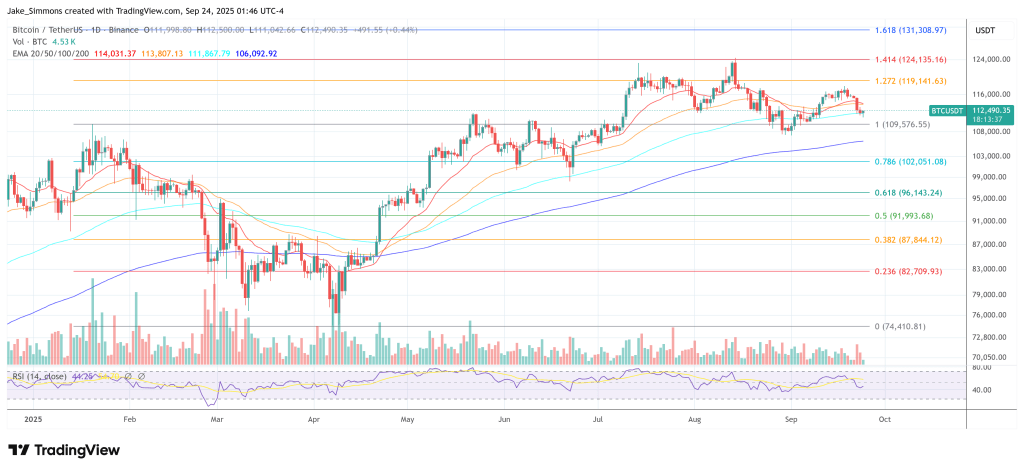
Bitcoin price
BTC hovers above $112,000, 1-day chart | Source: BTCUSDT on TradingView.com
Featured image created with DALL.E, chart from TradingView.com
Editorial Process for bitcoinist is centered on delivering thoroughly researched, accurate, and unbiased content. We uphold strict sourcing standards, and each page undergoes diligent review by our team of top technology experts and seasoned editors. This process ensures the integrity, relevance, and value of our content for our readers.

Jake Simmons has been a Bitcoin enthusiast since 2016. Ever since he heard about Bitcoin, he has been studying the topic every day and trying to share his knowledge with others. His goal is to contribute to Bitcoin's financial revolution, which will replace the fiat money system. Besides BTC and crypto, Jake studied Business Informatics at a university. After graduation in 2017, he has been working in the blockchain and crypto sector. You can follow Jake on Twitter at @realJakeSimmons.

Leituras Relacionadas

Precious Metals Decline Alongside, What Signal is Gold Sending to the Market?

Gold and silver prices have declined recently, moving in tandem with a sell-off in risk assets like South Korean semiconductor stocks. This is unusual, as gold typically rises when equities fall due to its safe-haven status. The synchronized drop signals a shift in market focus: it's not about finding safety, but about the rising cost of holding assets that do not yield interest. This cost is the real interest rate. The key driver is a change in Federal Reserve policy expectations under new Chair Kevin Warsh. Despite holding rates steady, the Fed's rhetoric has turned more hawkish, emphasizing persistent inflation risks. This has led markets to price in a "higher for longer" rate environment, increasing the appeal of cash and bonds while pressuring zero-yield assets like gold and tech stocks with high future cash flow valuations. Technically, gold breached the $4,100/oz support level, approaching the critical $4,000 psychological and technical zone. A break below could trigger accelerated selling from momentum traders and ETFs. While long-term supportive factors like central bank buying and geopolitical risks remain, short-term price action is dominated by liquidity and opportunity cost dynamics. The South Korean market meltdown, driven by crowded AI-trade unwinding, is a symptom—not the cause—of this broader macro repricing. Both markets are reacting to the same pressures: higher real rates and a stronger US dollar. In summary, the concurrent decline in equities and precious metals highlights that diverse assets can share exposure to a common macro variable—the price of money. The near-term path for gold and silver depends primarily on the persistence of Fed hawkishness, dollar strength, and real yields, which currently override their traditional safe-haven narratives.

marsbitHá 4m

Precious Metals Decline Alongside, What Signal is Gold Sending to the Market?

marsbitHá 4m

Chip Stocks Lead U.S. Market Decline: Is AI Trading Being Hit by Both Interest Rates and Returns?

Chip stocks led a broad decline in US markets, with the Nasdaq dropping 2.2% and the S&P 500 falling 1.4%. This selloff reflects a dual challenge for the once-high-flying AI hardware trade: rising interest rate expectations and growing investor impatience for clear returns from massive AI capital expenditures. The pressure was most acute on hardware leaders. Nvidia fell about 4%, dipping below a $5 trillion market cap, while Micron plunged 13.2% ahead of its earnings report. Declines across memory, storage, AI, and mobile chips indicated a sector-wide retreat. The selloff spread globally, with South Korea's KOSPI index dropping nearly 10% as key suppliers SK Hynix and Samsung recorded double-digit losses. Investors appeared to be taking profits from the most crowded trades first. Macro headwinds intensified as market expectations shifted toward a more aggressive Federal Reserve. Forecasts for multiple rate hikes in 2026 pressured high-valuation tech stocks, which rely on long-term growth projections that become less attractive as discount rates rise. Concurrently, investors are scrutinizing the profit potential of the immense AI spending by cloud giants like Alphabet, Amazon, and Meta. While these expenditures drive demand for chips and hardware, the market is now questioning whether AI services will generate sufficient returns to justify the ongoing costs. This adjustment is not necessarily a bubble burst but a recalibration. AI demand fundamentals remain, but the narrative of endless growth can no longer fully offset concerns over higher interest rates and a longer path to profitability. Near-term direction may hinge on Micron's upcoming earnings guidance and incoming inflation data, which will influence both the AI demand outlook and the Fed's policy path. The market is transitioning from blindly buying growth to demanding clearer visibility on returns.

marsbitHá 1h

Chip Stocks Lead U.S. Market Decline: Is AI Trading Being Hit by Both Interest Rates and Returns?

marsbitHá 1h

OpenAI's New Paper: How to Train an AI that "Doesn't Deteriorate Under Pressure"?

OpenAI's new paper "Reinforcement Learning Towards Broadly and Persistently Beneficial Models" explores training AI to maintain safe, helpful, and honest behavior even under pressure, in unseen scenarios, or after being fine-tuned for harmful purposes. Moving beyond simple rule-based "don'ts," the research focuses on cultivating "beneficial traits" like honesty, risk-awareness, corrigibility, and transparency. It investigates if reinforcement learning (RL), often prone to "reward hacking" where models exploit loopholes, can instead be used to instill robust, generalized positive behaviors. Researchers created a multi-domain synthetic dialogue dataset covering areas like healthcare and law. They trained a model by replacing 5% of standard RL data with "beneficial trait" data. This model outperformed the baseline in 83% of 53 evaluations, showing average gains of 9.1% in alignment, safety, and helpfulness. Crucially, improvements generalized: a model trained only on healthcare "good behavior" data also performed better in 17 out of 19 non-healthcare alignment tests. The paper also tests "alignment persistence." When subjected to adversarial prompts or harmful fine-tuning, the beneficial trait model showed greater resilience, with smaller performance drops and less "spillover" of bad behavior to unrelated tasks. While not a complete solution, this work suggests a shift from post-hoc correction to proactively shaping robust, principled AI behavior, a critical step for deploying models in high-stakes, complex decision-making scenarios.

marsbitHá 1h

OpenAI's New Paper: How to Train an AI that "Doesn't Deteriorate Under Pressure"?

marsbitHá 1h

Trading

Spot
Futuros
活动图片