Tether And Circle Print $1.5B In Hours: Fresh Liquidity Incoming

bitcoinistPublicado em 2025-09-24Última atualização em 2025-09-24

Resumo

The stablecoin market is once again making headlines as two of the largest issuers, Tether (USDT) and Circle (USDC), significantly...

Trusted Editorial content, reviewed by leading industry experts and seasoned editors. Ad Disclosure

The stablecoin market is once again making headlines as two of the largest issuers, Tether (USDT) and Circle (USDC), significantly expanded supply in just hours. According to data shared by Lookonchain, Tether minted another 1 billion USDT, while Circle printed 500 million USDC only seven hours earlier. These issuances highlight how stablecoins continue to play a central role in fueling market liquidity, often acting as precursors to major shifts in crypto price action.

Stablecoins are widely used as dry powder, giving traders and institutions instant exposure to digital assets without relying on traditional banking rails. Large-scale minting events like this are typically interpreted as a sign that capital is flowing into the ecosystem, positioning the market for heightened volatility and potentially a new wave of demand. Historically, such moves have coincided with phases of increased activity across Bitcoin, Ethereum, and major altcoins.

As crypto investors brace for the next leg of market action, the timing of this combined $1.5 billion injection into USDT and USDC supply has sparked speculation. Many analysts believe the market is preparing to absorb this liquidity, setting the stage for what could be a decisive period in the weeks ahead.

Tether $1B Mint | Source: Lookonchain

Stablecoin Expansion And Market Implications

According to CryptoQuant, the combined circulating supply of Tether (USDT) and Circle’s USD Coin (USDC) now forms a significant portion of the global stablecoin market, which sits at around $147 billion. This dominance underscores the pivotal role both issuers play in shaping crypto liquidity. With Tether minting another $1 billion and Circle adding $500 million in supply, these issuances are not random — they reflect growing demand for stable trading capital and often precede decisive market moves.

Stablecoins act as a bridge between traditional finance and the crypto ecosystem, serving as the backbone for trading activity on centralized and decentralized exchanges. When supply expands rapidly, it typically signals an increase in available liquidity, providing investors with the ability to deploy capital into risk assets quickly. For Bitcoin, which recently faced heavy volatility and a sharp pullback below $115K, this influx could offer support for a continuation trend, particularly if bulls regain momentum.

For altcoins, the impact may be even more pronounced. Historically, stablecoin inflows have fueled periods of explosive growth in non-BTC assets, as traders rotate capital in search of higher returns. With USDT and USDC issuance climbing, analysts suggest that the coming days could define whether altcoins recover strongly or remain under pressure.

Stablecoin Market Cap Dominance Analysis

The chart shows that stablecoin dominance has risen sharply to 7.99%, signaling a renewed demand for safety amid recent volatility. After weeks of consolidation between 7.4% and 7.8%, the breakout above the short-term moving averages (50-day at 7.60% and 100-day at 7.63%) confirms stronger capital rotation into stable assets. This pattern often reflects heightened investor caution, with participants opting to sit in stablecoins while waiting for clearer market direction.
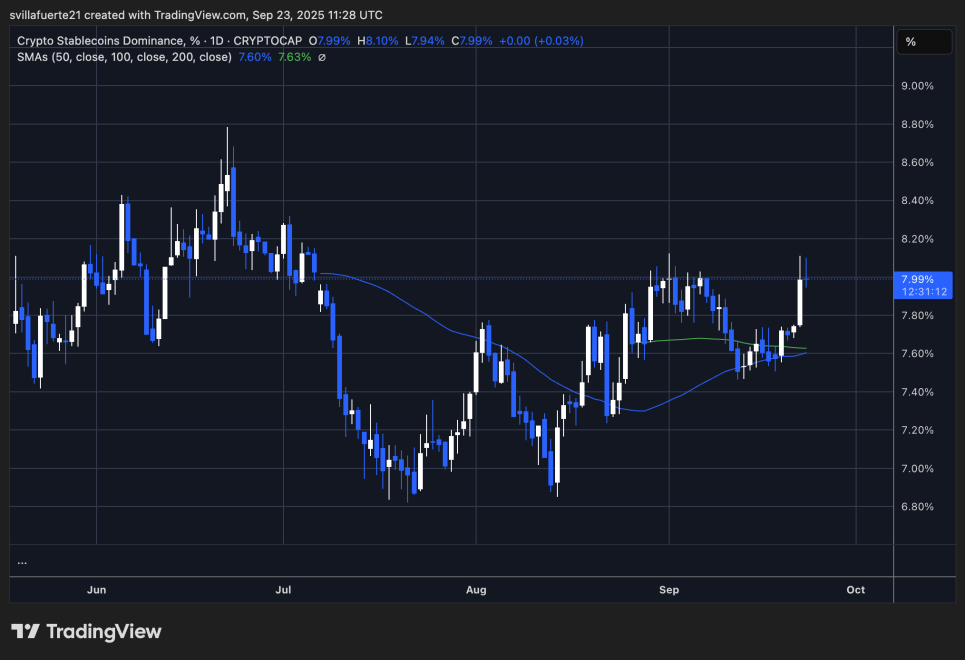
Crypto Stablecoin Dominance | Source: STABLE.C.D chart on TradingView

The move higher coincides with recent liquidations across Bitcoin and altcoins, where leveraged traders were wiped out. Historically, spikes in stablecoin dominance occur when traders de-risk, pulling capital from volatile assets. However, rising stablecoin reserves also indicate available liquidity that could quickly re-enter the market and fuel recovery once sentiment shifts.

If dominance continues to climb toward the 8.2–8.4% range, it may suggest further downside for risk assets in the short term. Conversely, stabilization below this level could mark a base for renewed inflows into Bitcoin and altcoins. The coming sessions will be key in determining whether this rise is a temporary flight to safety or the start of a deeper risk-off trend.

Featured image from Dall-E, chart from TradingView

Editorial Process for bitcoinist is centered on delivering thoroughly researched, accurate, and unbiased content. We uphold strict sourcing standards, and each page undergoes diligent review by our team of top technology experts and seasoned editors. This process ensures the integrity, relevance, and value of our content for our readers.

Sebastian's journey into the world of crypto began four years ago, driven by a fascination with the potential of blockchain technology to revolutionize financial systems. His initial exploration focused on understanding the intricacies of various crypto projects, particularly those focused on building innovative financial solutions. Through countless hours of research and learning, Sebastian developed a deep understanding of the underlying technologies, market dynamics, and potential applications of cryptocurrencies. As his knowledge grew, Sebastian felt compelled to share his insights with others. He began actively contributing to online discussions on platforms like X and LinkedIn, focusing on fintech and crypto-related content. His goal was to expose valuable trends and insights to a wider audience, fostering a deeper understanding of the rapidly evolving crypto landscape. Sebastian's contributions quickly gained recognition, and he became a trusted voice in the online crypto community. To further enhance his expertise, Sebastian pursued a UC Berkeley Fintech: Frameworks, Applications, and Strategies certification. This rigorous program equipped him with valuable skills and knowledge regarding Financial Technology, bridging the gap between traditional finance (TradFi) and decentralized finance (DeFi). The certification deepened his understanding of the broader financial landscape and its intersection with blockchain technology. Sebastian's passion for finance and writing is evident in his work. He enjoys delving into financial research, analyzing market trends, and exploring the latest developments in the crypto space. In his spare time, Sebastian can often be found immersed in charts, studying 10-K forms, or engaging in thought-provoking discussions about the future of finance. Sebastian's journey as a crypto analyst and investor has been marked by a relentless pursuit of knowledge and a dedication to sharing his insights. His ability to navigate the complex world of crypto, combined with his passion for financial research and communication, makes him a valuable asset to the industry. As the crypto landscape continues to evolve, Sebastian remains at the forefront, providing valuable insights and contributing to the growth of this revolutionary technology.

Leituras Relacionadas

Mysterious "Ox Alpha" Large Model Goes Viral with Limited-Time Free Access

A mysterious anonymous AI model named "Ox Alpha," nicknamed "Cow is Coming" by Chinese netizens, has appeared on OpenRouter, sparking widespread speculation. The model offers a 1 million token context, supports text, image, and video inputs, can call tools, and is currently free. Its standout feature is strong coding ability. Initial tests on the DeepSWE benchmark, which evaluates real-world software engineering tasks, showed an 80% pass rate on a subset of tasks, reportedly nearing top-tier code models. However, follow-up tests yielded a 63% score, with variations attributed to different task sets and configurations. The model's true developer is a major topic of debate. The prevailing theory points to Zhipu AI's unreleased GLM-5.3 Flash or its multimodal variant. Evidence cited includes identical visual token consumption patterns with GLM-5V-Turbo for videos, a consistent offset in text token counts compared to GLM-5.3, and similar behavioral traits like refusing audio processing. Zhipu has a precedent of anonymous testing. Simultaneously, another anonymous model, "korrine," appeared on Code Arena, with guesses ranging from Moonshot's Kimi K3.1 to models from Qwen or MiMo, adding to the industry's guessing game. This trend of anonymous "undercover" testing allows for unbiased performance evaluation in platforms like Arena and provides real-world, high-pressure testing through tools like OpenRouter before official release. It also serves as an effective marketing tactic, prolonging discussion through suspense. If Ox Alpha is indeed a "Flash" model, its performance raises expectations for the full-scale version's potential.

marsbitHá 4h

Mysterious "Ox Alpha" Large Model Goes Viral with Limited-Time Free Access

marsbitHá 4h

Breaking News: DeepSeek Announces All-Day Off-Peak Pricing on Weekends, Making Weekend Work More Cost-Effective?

DeepSeek has announced a significant change to its API pricing model, effective August 23. The new policy removes peak/off-peak distinctions on weekends (Saturdays and Sundays), charging the lower off-peak rate for the entire two-day period. This adjustment has sparked mixed reactions within the developer and professional communities. For developers and businesses heavily reliant on DeepSeek's V4-Flash and V4-Pro APIs, this is welcome news. It allows them to schedule bulk processing tasks on weekends without the higher peak-hour costs, potentially halving their API bills for such workloads. Some users have celebrated the move for making weekend work more cost-effective. However, the announcement has also raised concerns among employees. There is apprehension that companies, particularly in cost-sensitive sectors like AI-powered short drama production, might reorganize work schedules to align with these new cost incentives. Instances are already emerging where teams schedule high-token tasks during cheaper nighttime hours or adjust staff shifts. This has led to worries about a potential shift towards weekend workdays and weekday time-off, prioritizing cost savings over traditional work-life balance. Debate has ensued regarding the practicality of such schedule changes, with questions about increased communication overhead and overall efficiency. Speculation about DeepSeek's motives for the change includes theories that peak pricing correlates with internal model training schedules, though others counter that training is largely automated. The new pricing structure is now in effect, prompting users to reconsider their task scheduling strategies.

marsbitHá 5h

Breaking News: DeepSeek Announces All-Day Off-Peak Pricing on Weekends, Making Weekend Work More Cost-Effective?

marsbitHá 5h

Trading

Spot
活动图片