Helius Takes First Step In Solana Treasury With $175 Million Purchase

bitcoinistPublicado em 2025-09-24Última atualização em 2025-09-24

Resumo

Helius Medical Technologies has officially kick-started its Solana (SOL) treasury strategy with an initial acquisition of 760,190 tokens. Helius Has...

Trusted Editorial content, reviewed by leading industry experts and seasoned editors. Ad Disclosure

Helius Medical Technologies has officially kick-started its Solana (SOL) treasury strategy with an initial acquisition of 760,190 tokens.

Helius Has Started Buying Solana With Its $500 Million Raise

As announced in a press release, Helius Medical Technologies has completed its first Solana purchase for its digital asset treasury strategy. In total, the company has acquired 760,190 SOL at an average price of $231 per token, spending about $175 million.

Originally a neurotech company, Helius Medical Technologies adopted a strategy focused on accumulating SOL earlier this month. Just a few days ago, the firm revealed that it had raised over $500 million for its digital asset treasury through a private placement offering.

Among the key backers were Pantera Capital, an American venture capital and hedge fund specializing in blockchain and digital assets, and Summer Capital, a Hong Kong-headquartered investment firm.

Joseph Chee, Executive Chairman at Helius, said:

It has been gratifying to receive shows of support from multiple stakeholders across the Solana ecosystem, including staking providers, DeFi protocols and others. We take our responsibility to maximize shareholder value seriously and are eager to execute against our plan.

With the latest purchase, Helius has begun deploying the raised capital into Solana. The company still has $335 million sitting in cash reserves for further treasury expansions, along with the potential to raise another $750 million if the stapled warrants from its private placement are exercised.

The press release noted that, besides SOL being among the top coins in on-chain activity-related metrics, it’s also financially productive by design, thanks to its 7% native staking yield.

Helius added:

As an independent treasury company, HSDT’s mission is to support the growth and security of tokenized networks by serving as a long-term holder of $SOL, in addition to continuing the development of its neurotech and medical device operations

The NASDAQ-listed neurotech firm isn’t the only one to pivot to a Solana treasury this month. Forward Industries, a company focused on design and manufacturing, also adopted a SOL strategy and closed a private investment in public equity (PIPE) earlier in September, raising $1.65 billion.

The financing was led by three key players in Galaxy Digital, Multicoin Capital, and Jump Crypto. Last Monday, the firm executed its first purchase worth $1.58 billion, instantly becoming the largest SOL treasury holder in the world.

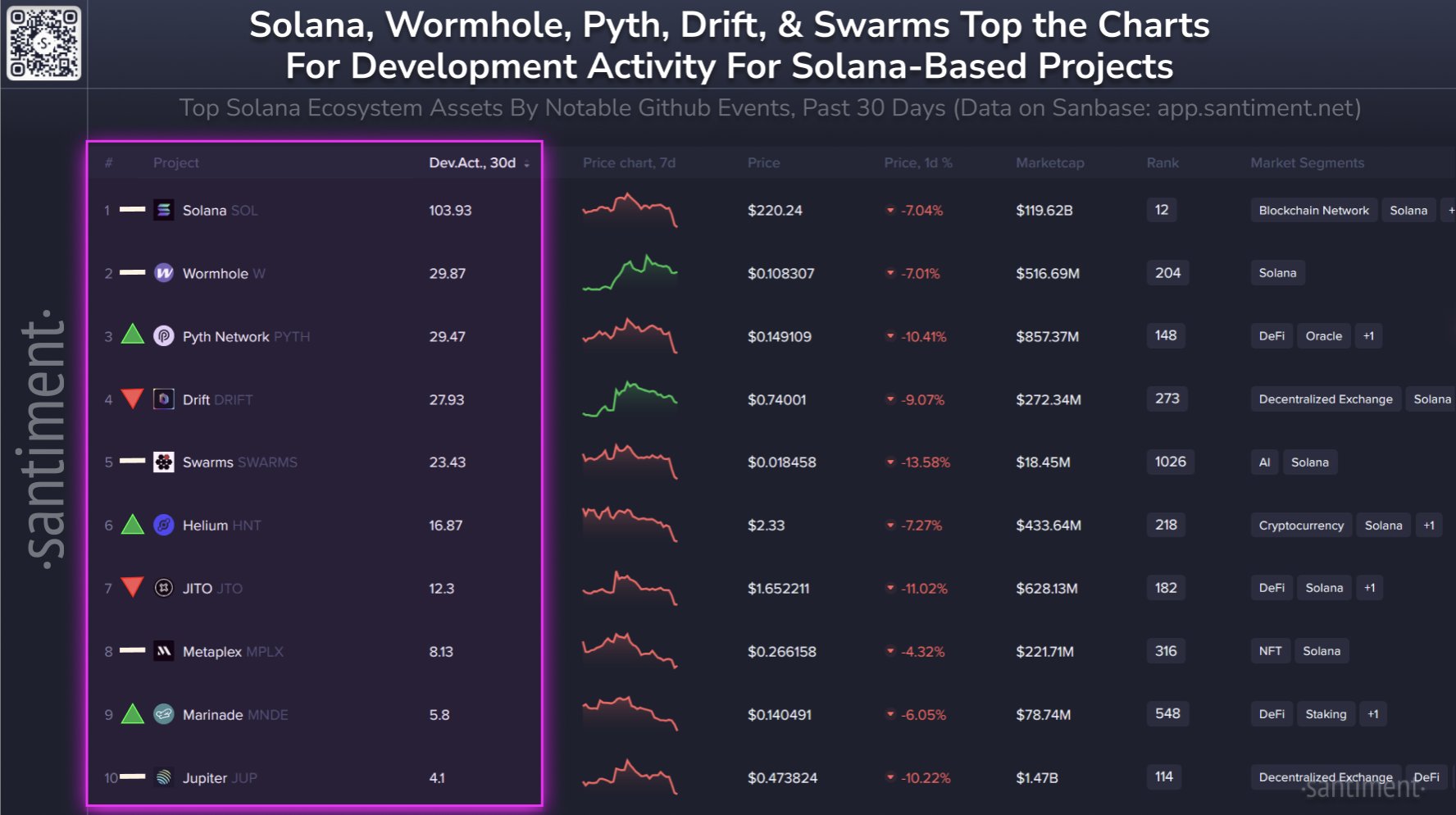
In some other news, analytics firm Santiment has shared an update on how projects in the Solana ecosystem compare against each other in terms of the Development Activity metric.
Solana Development Activity

The ranking of the SOL ecosystem projects on the basis of 30-day Development Activity | Source: Santiment on X

From the table, it’s visible that SOL continues to be the top-ranked coin with its developers putting in the most work on the project’s public GitHub repositories. Wormhole (W) and Pyth Network (PYTH) follow in second and third, respectively.

SOL Price

At the time of writing, Solana is trading around $218, down over 7% in the last week.

Solana Price Chart

Looks like the price of the coin has slipped down over the last few days | Source: SOLUSDT on TradingView
Featured image from Dall-E, Santiment.net, chart from TradingView.com
Editorial Process for bitcoinist is centered on delivering thoroughly researched, accurate, and unbiased content. We uphold strict sourcing standards, and each page undergoes diligent review by our team of top technology experts and seasoned editors. This process ensures the integrity, relevance, and value of our content for our readers.

Keshav is a Physics graduate who has been employed as a writer with Bitcoinist since June 2021. He is passionate about writing and through the years, he has gained experience working in a variety of niches. Keshav holds an active interest in the cryptocurrency market, with on-chain analysis being an area he particularly likes to research and write about.

Leituras Relacionadas

DRAM ETF Issuer: Samsung, SK Hynix, Micron All Surpass $1 Trillion, the AI Era of Memory Chips Has Only Just Begun

Authors: Dave Mazza, Thomas DiFazio | Source: Deep Tide TechFlow The article, written by Roundhill Investments (issuer of the DRAM ETF), responds to Morningstar's caution about investing in memory chip stocks. Morningstar warns of the sector's history of boom-bust cycles, a lack of economic moats, and potential momentum-driven overvaluation. Roundhill argues the current situation is structurally different due to AI. Key points in Roundhill's rebuttal include: * **Changed Demand & Supply Dynamics:** AI infrastructure, not consumer electronics, is now the primary growth driver for memory demand. New, strict long-term supply agreements with hyperscalers reflect the high capital intensity of advanced manufacturing. * **Existence of a Moat:** High-Bandwidth Memory (HBM), essential for AI, has extremely high manufacturing barriers. The market is dominated by Samsung, SK Hynix, and Micron, with new entrants blocked by technological complexity and long lead times for equipment like ASML's EUV machines. * **Strong Fundamental Outlook:** Analyst consensus projects the three companies will rank among the world's most profitable by 2027, with combined profits of $704 billion on over $1 trillion in revenue. Their operating margins have already reached record highs. * **Valuation Re-rating:** Despite significant stock price gains, memory stocks trade at attractive valuations (e.g., a median NTM P/E of 8.37x for the DRAM ETF) relative to projected explosive EPS growth. Roundhill suggests historical valuation frameworks may no longer apply given the new profitability paradigm. Conclusion: Roundhill contends the rally is justified by fundamentals, marking a structural shift for the memory industry into a new era of sustained, AI-driven demand against constrained supply, rather than a repeat of past cycles.

marsbitHá 9m

DRAM ETF Issuer: Samsung, SK Hynix, Micron All Surpass $1 Trillion, the AI Era of Memory Chips Has Only Just Begun

marsbitHá 9m

EF's Epic Reorganization: 20% Layoffs, Budget Halved, Is Ethereum Gearing Up for a Leaner Future?

The Ethereum Foundation (EF) has announced a major organizational restructuring, involving a 20% staff reduction (approx. 54 employees) and a division into functional clusters like Protocol, Access, User, Community, and Institutional layers. Co-founder Vitalik Buterin further revealed plans to cut the EF's budget by around 40% over the coming years, aiming to reduce its annual spending rate from about 15% to roughly 5% by 2030, transitioning to an endowment-driven model. This overhaul is seen as a long-overdue correction to the EF's ambiguous role. As Ethereum grew, the foundation faced persistent criticism over ETH sales, perceived lack of execution, and unclear strategy, often becoming a focal point for community frustration amid ETH's price stagnation. The reform aims to redefine the EF's boundaries, narrowing its focus to core protocol research, public goods funding, and ecosystem coordination, while offloading more applied development work to the broader market. Concurrently, ecosystem forces like the newly formed Ethlabs (founded by ex-EF researchers) and other independent groups are stepping in to fill the space, signaling a shift from a centralized model to a more distributed, collaborative ecosystem structure. The move was notably praised by Solana co-founder toly, who viewed a "leaner" EF as potentially more decisive and agile.

Odaily星球日报Há 50m

EF's Epic Reorganization: 20% Layoffs, Budget Halved, Is Ethereum Gearing Up for a Leaner Future?

Odaily星球日报Há 50m

Dragonfly Partner Haseeb: The Fastest-Growing Companies of the Future May All Get Stuck at 149 Employees

Dragonfly partner Haseeb explores the distorted economics of AI model pricing, drawing parallels to tax policy. He notes that startups and small teams (under 150 users) enjoy heavily subsidized, fixed-price AI subscriptions (like Claude Code), where the marginal cost of an additional token is effectively zero. This creates a powerful incentive for them to maximize token usage ("token-maxxing") and innovate aggressively with AI automation. In contrast, large enterprises (over 150 users) are forced onto "Enterprise" plans, paying per-token API fees with high (~75%) markups. This acts like a steep "tax" on AI-powered labor, disincentivizing marginal automation and experimental use, and encouraging them to retain more human workers. Haseeb argues this pricing creates a "150-person cliff," a regulatory notch similar to labor laws in France that discourage firms from growing past 50 employees. He predicts the fastest-growing future companies may deliberately cap their headcount at 149 to avoid the punitive enterprise pricing. This would foster an "AI-first" management philosophy obsessed with automation and outsourcing to stay lean. While not intentionally designed, this bifurcated pricing could become one of the most influential de facto tax policies, shaping how AI replaces labor—not through mass layoffs at big firms, but through agile, AI-native startups outcompeting them.

marsbitHá 1h

Dragonfly Partner Haseeb: The Fastest-Growing Companies of the Future May All Get Stuck at 149 Employees

marsbitHá 1h

How xBubble Breaks Through in the VC-Heavily-Backed OPC Economy

xBubble: Addressing the Structural Gap in the VC-Backed OPC Economy The concept of OPC (One Person Company) is evolving from a buzzword to a significant AI-driven market. While AI coding tools like Replit and Lovable have validated demand from non-technical users wanting to build applications, a key gap remains: the leap from creating a demo to running a stable, evolving business. These tools still require users to manage the development process, including technical judgments for integrations, modifications, and deployments—a major hurdle for OPCs. xBubble, by DAPPOS, tackles this by shifting from "Prompt-to-Code" to "SOP-to-Business." Instead of generating code from instructions, its core is a system of pre-organized SOPs (Standard Operating Procedures) that translate business goals—like "sell World Cup merchandise"—into complete, executable workflows. This includes generating cohesive assets, pages, payment systems, and backend logic. The platform is augmented by a network of third-party service providers who handle infrastructure (hosting, domains, payment setup), acting like "on-site service engineers." Users can pay for these services directly with xBubble credits, simplifying onboarding. This ecosystem aims to deliver not just an app, but a complete, modifiable business launch path. xBubble targets a clear OPC segment: small commercial nodes (e.g., creators, merchants) with existing products, customers, or channels, but for whom a full tech team is unjustifiable. Its potential lies in SOPs accumulating expertise from real cases, improving reliability and reducing delivery costs over time. Additionally, its native support for crypto payments caters to global or digital-native OPCs. In summary, as AI democratizes software creation, xBubble's opportunity is to prove that "SOP-to-Business" provides more immediate value for launching a real, operational business than a powerful but unstructured AI coding tool.

链捕手Há 1h

How xBubble Breaks Through in the VC-Heavily-Backed OPC Economy

链捕手Há 1h

Trading

Spot
Futuros
活动图片