Ripple Vs. SEC Battle Update: Lawsuit Officially Over As $125M Receipt Of Payment To Regulator Surfaces

bitcoinistPublicado em 2025-09-23Última atualização em 2025-09-23

Resumo

Former SEC lawyer Marc Fagel has revealed that the $125 million monetary penalty in the Ripple Vs. SEC case has...

Trusted Editorial content, reviewed by leading industry experts and seasoned editors. Ad Disclosure

Former SEC lawyer Marc Fagel has revealed that the $125 million monetary penalty in the Ripple Vs. SEC case has been paid to the U.S. Treasury. This officially ends the long-running legal battle between the crypto firm and the regulator. 

Ripple Vs. SEC Case Ends As Crypto Firm Pays Monetary Judgment

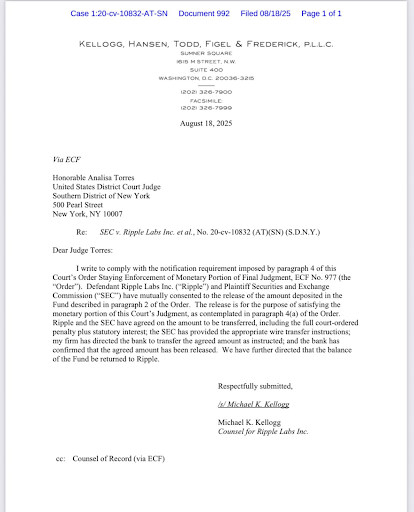
In an X post, Fagel confirmed that the $125 million penalty in the Ripple vs. SEC case was paid to the U.S. Treasury last month. He shared a letter addressed to Judge Analisa Torres, which stated that both parties had agreed to the release of the funds from escrow for the crypto firm to pay the full court-ordered penalty plus statutory interest. 

Furthermore, the letter revealed that the SEC had provided the appropriate wire transfer instructions after which Ripple directed the bank to make the payment, and the bank confirmed that the agreed amount had been released. Meanwhile, the balance of the fund was returned to the crypto firm, with all these procedures formally ending the Ripple vs. SEC case. 
Ripple
Source: Document from Marc Fagel on X

Notably, this payment follows the Court of Appeals’ approval of both parties’ motion to dismiss their respective appeals in the Ripple vs. SEC case last month. The $125 million had been kept in escrow around the time when Ripple and the SEC filed their appeals. The crypto firm had asked for this as an injunction to prevent having to pay the SEC while the appeal was ongoing, since there was the possibility of the sum being reduced. 

The appeal didn’t proceed as planned, as the emergence of a pro-crypto SEC administration following Trump’s return to the White House led to a settlement between both parties. However, Judge Torres opted against adopting the settlement agreement and ordered that Ripple must still pay the $125 million penalty. Both parties agreed to dismiss their respective appeals in the Ripple vs. SEC and simply adhere to Judge Torres’ judgment.  

Lawsuit No Longer Responsible For Price Action 

In an X post, legal expert Bill Morgan remarked that the Ripple vs. SEC lawsuit excuse has run its course for any further lack of XRP adoption or flat price action. Basically, the lawsuit cannot be held responsible if the XRP price underperforms moving forward. The altcoin had rallied to as high as $3.4 following the joint motion to dismiss the case, but has traded below this level since then. 

The XRP price is currently on a downtrend amid the broader crypto market correction. Morgan pointed out that the current XRP decline is due to the heavy correlation with Bitcoin. This came as he made light of the fact that the altcoin has been down during this period despite several bullish fundamentals that have emerged. 

At the time of writing, the XRP price is trading at around $2.87, down in the last 24 hours, according to data from CoinMarketCap.

XRP
XRP trading at $2.86 on the 1D chart | Source: XRPUSDT on Tradingview.com
Featured image from Getty Images, chart from Tradingview.com
Editorial Process for bitcoinist is centered on delivering thoroughly researched, accurate, and unbiased content. We uphold strict sourcing standards, and each page undergoes diligent review by our team of top technology experts and seasoned editors. This process ensures the integrity, relevance, and value of our content for our readers.

Scott Matherson is a leading crypto writer at Bitcoinist, who possesses a sharp analytical mind and a deep understanding of the digital currency landscape. Scott has earned a reputation for delivering thought-provoking and well-researched articles that resonate with both newcomers and seasoned crypto enthusiasts. Outside of his writing, Scott is passionate about promoting crypto literacy and often works to educate the public on the potential of blockchain.

Leituras Relacionadas

Google Starts Selling TPUs, Big Tech Aims to Produce "Low-Cost Tokens" with AI Chips

Google has begun selling its proprietary TPU chips and AI computing hardware directly to third-party data centers and clients, marking a strategic shift. Previously only accessible via cloud rentals, TPUs are specialized processors designed for the matrix and tensor operations central to AI models. By combining thousands into supercomputing clusters managed by CPUs, Google achieves high-efficiency AI processing. This move enables Google’s Gemini AI to offer competitive token pricing, challenging rivals like OpenAI. It also signals a broader industry trend where AI compute is becoming a commoditized resource like electricity. While NVIDIA remains dominant with its CUDA ecosystem and high-performance GPUs, the focus is shifting from raw power to cost efficiency and system integration. Google’s approach mirrors NVIDIA’s by selling an entire ecosystem—hardware, software, and data center expertise—rather than just chips. This threatens NVIDIA’s grip on the mid-range inference market, where lower-cost, efficient solutions are increasingly demanded. Similarly, cloud providers like Huawei Cloud and Alibaba Cloud in China are developing their own AI chip ecosystems (e.g., Ascend, Zhenwu), packaging chips, clusters, and tools into full-stack solutions. They aim to reduce token costs and capture market share through integrated systems. In summary, the AI infrastructure race is evolving from a competition for the strongest chips to a contest for the most efficient and cost-effective systems. Google’s TPU sales highlight this transition, emphasizing that future success lies in delivering affordable, scalable AI compute as a foundational service.

marsbitHá 2m

Google Starts Selling TPUs, Big Tech Aims to Produce "Low-Cost Tokens" with AI Chips

marsbitHá 2m

Trading

Spot
Futuros
活动图片