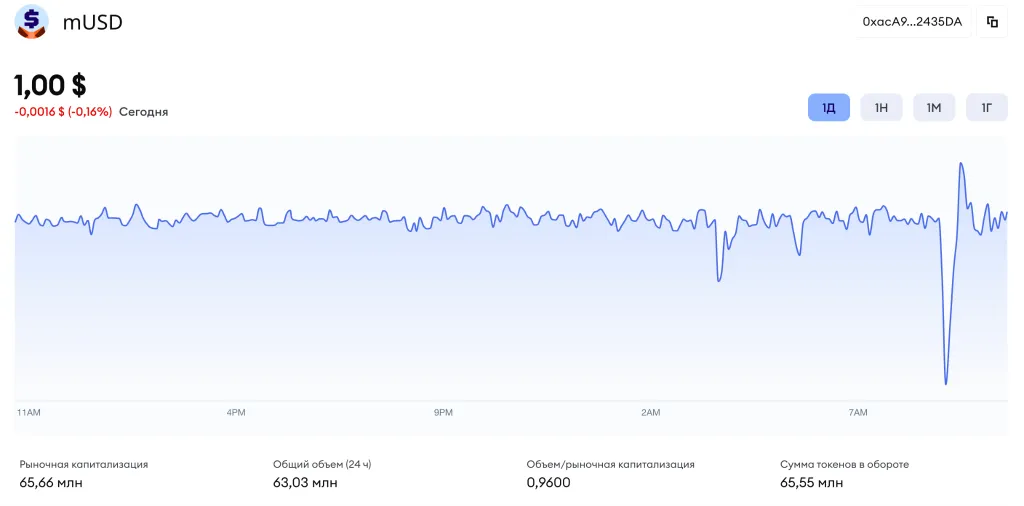
Объем выпуска стейблкоина MetaMask превысил $65 млн

cryptonews.ruPublicado em 2025-03-21Última atualização em 2025-09-22

Предложение «стабильной монеты» mUSD от MetaMask выросло с $15 млн до $65 млн за неделю после запуска. Об этом свидетельствуют данные с сайта Web3-кошелька.
Источник: MetaMask.

Большая часть эмиссии «стабильной монеты» находится в сети Linea — 88,2%. Оставшиеся 11,8% размещены в Ethereum.
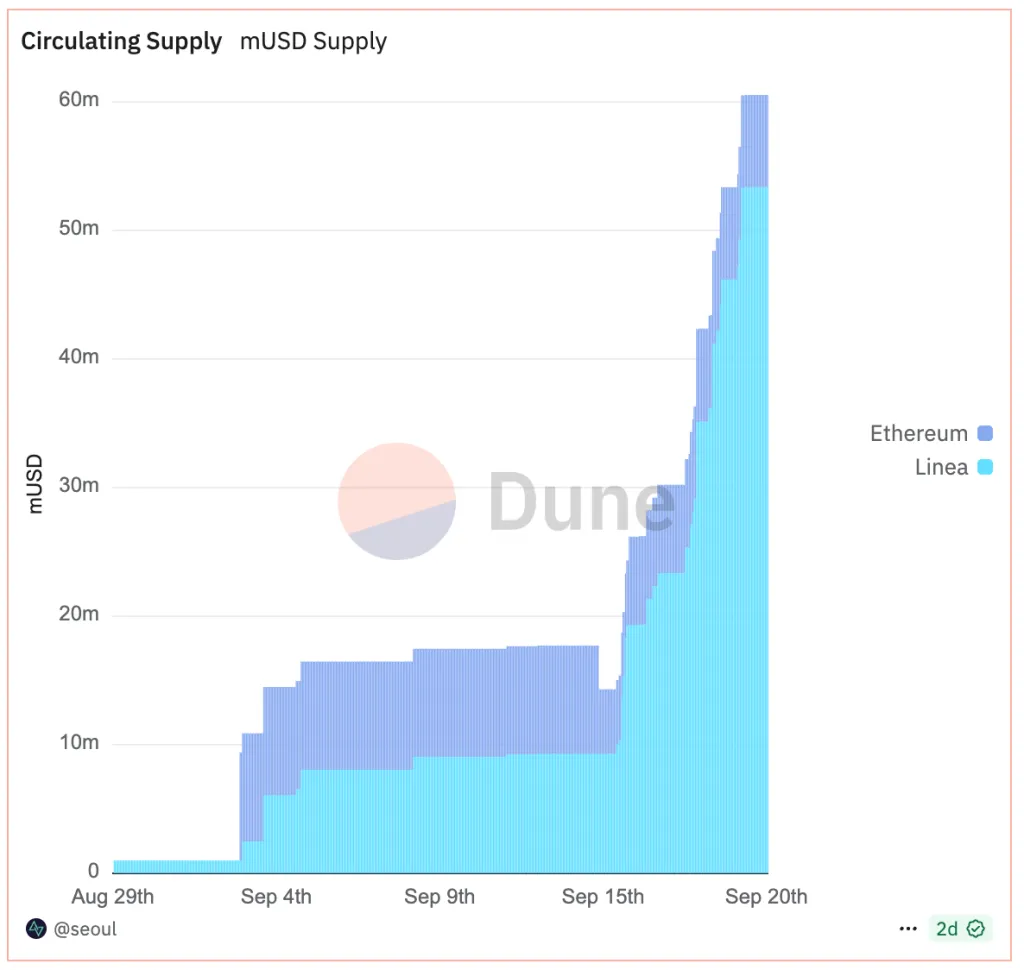
Источник: Dune.

Команда MetaMask объявила о запуске mUSD в конце августа. Релиз состоялся 15 сентября.

MetaMask USD ($mUSD) is now live. 🦊

The best way in and out of crypto is here. pic.twitter.com/h6zSUao7Ka

— MetaMask.eth 🦊 (@MetaMask) September 15, 2025

mUSD выпускается через платформу Bridge от Stripe с использованием децентрализованной инфраструктуры M0. Стейблкоин полностью обеспечен ликвидными эквивалентами доллара США — денежными средствами и краткосрочными казначейскими облигациями — в соотношении 1:1.

19 сентября сооснователь Ethereum и CEO компании ConsenSys Джозеф Любин заявил, что MetaMask также готовится к запуску нативного токена в ближайшем будущем.

Ситуация на рынке стейблкоинов

Рост эмиссии mUSD совпал с общим увеличением предложения привязанных к доллару США «стабильных монет». Показатель достиг $279,8 млрд. Лидером остается USDT от Tether, на который приходится $172,3 млрд.

21 сентября капитализация сектора стейблкоинов впервые превысила $292,8 млрд.
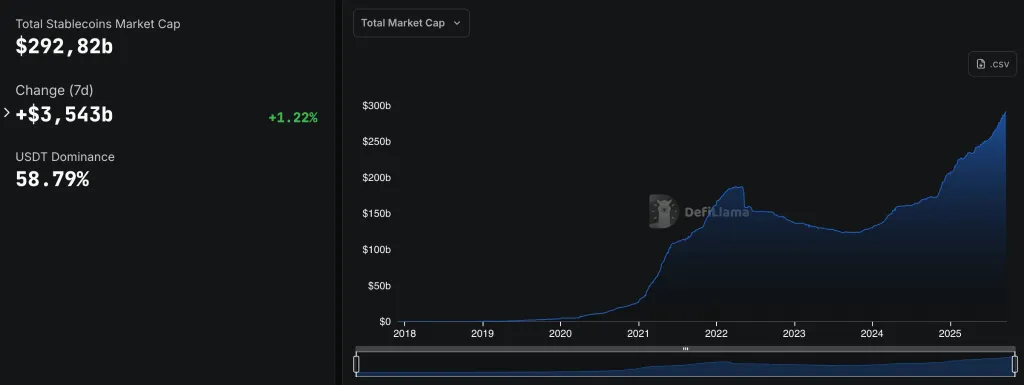
Источник: DeFi Llama.

22 сентября стало известно о партнерстве блокчейн-платформы Kaia и LINE NEXT — Web3-подразделения южнокорейского мессенджера LINE. Стороны объявили о запуске «суперприложения» для работы со стейблкоинами под названием Project Unify.

Asia's waking up to the trillion-dollar stablecoin puzzle

Every day, millions of people across this continent move money the same way their grandparents did, through systems built decades before the internet existed.

But something is different. Let us tell you what's really…

— Kaia (@KaiaChain) September 22, 2025

Новый сервис объединит платежи, переводы и фиатные шлюзы в одном интерфейсе. Пользователи смогут:

  • получать вознаграждения за хранение стейблкоинов;
  • переводить средства через мессенджер;
  • оплачивать покупки по всему миру с кешбэком.

Разработчики также представят SDK для интеграции «стабильных монет» в сторонние приложения. Платформа будет поддерживать стейблкоины, привязанные к доллару США, японской иене, тайскому бату и другим азиатским валютам.

Запуск бета-версии Unify намечен на конец года.

Напомним, аналитики JPMorgan назвали проблему «гонки стейблкоинов». По их словам, прогнозируемая волна запуска «стабильных монет» в США может превратиться в соревнование с нулевой суммой.


Leituras Relacionadas

STRC Must Re-Anchor for a BTC Bull Market to Happen

Title: STRC's Depegging Threatens MicroStrategy's Bitcoin-Buying Machine, and Thus the BTC Bull Run Summary: The sustained depegging of MicroStrategy's priority share STRC (trading ~25% below its $100 target) is severely disrupting the company's core business model and poses a major risk to Bitcoin (BTC) price support. STRC was MicroStrategy's most efficient and low-cost funding tool, designed to allow continuous capital raises near its $100 par value to fuel relentless BTC accumulation. Its depegging has effectively blocked this primary funding channel. The situation creates a severe cash flow crisis. STRC and other priority shares now obligate MicroStrategy to pay approximately $1.7 billion in annual cash dividends, while the company's cash reserves are only about $1.4 billion — insufficient to cover one year of payments. To raise cash, MicroStrategy is increasingly resorting to issuing common stock (MSTR) through ATM offerings. However, recent raises show most proceeds (around 90% in one week) are now used to bolster cash reserves rather than buy Bitcoin. This dilutes the key metric of Bitcoin per MSTR share, eroding the fundamental value proposition for equity investors. The company faces grim alternatives: issuing high-cost debt or selling its massive Bitcoin holdings. The latter, though hinted at, would likely trigger significant negative market reactions. Conclusion: As BTC's largest corporate holder and a major marginal buyer, MicroStrategy's funding woes mean reduced, and potentially reversing, institutional buy-side pressure. The company has shifted from being a guaranteed source of BTC demand to a significant overhang on the market. The article argues that without STRC re-anchoring to restore its funding engine, a sustained BTC bull market is in jeopardy.

marsbitHá 11m

STRC Must Re-Anchor for a BTC Bull Market to Happen

marsbitHá 11m

No Bull Market for BTC Without STRC Re-pegging

Summary: The sustained de-pegging of MicroStrategy's (MSTR) Strategy Preferred Shares (STRC) poses a severe threat to Bitcoin (BTC) and could prevent a bull market. STRC, designed to trade near a $100 target, has plunged to around $75, effectively shutting down MicroStrategy's cheapest and most efficient funding channel. This channel was critical for its "raise funds, buy BTC" business model. More critically, MicroStrategy now faces a massive cash outflow from these preferred shares. With approximately $10.49 billion of STRC outstanding at an 11.5% dividend yield, the annual cash obligation exceeds $1.2 billion. Combined with other preferred shares, the total annual payout nears $1.7 billion, depleting its current ~$1.4 billion cash reserve within a year. To address this, MicroStrategy is increasingly relying on common stock (MSTR) offerings via its ATM program. However, recent sales show most raised capital is now used to bolster cash reserves rather than buy more Bitcoin. This dilutes the key metric of BTC per share for common stockholders, eroding the foundation of its premium valuation. If STRC cannot re-peg, this costly dilution may continue. Worse, if cash pressure intensifies, selling Bitcoin becomes a real risk. As the largest corporate BTC holder (~847,363 BTC), any significant sales could crash the market. Thus, MicroStrategy is transforming from BTC's most reliable institutional buyer into a major potential seller, casting a significant shadow over Bitcoin's price prospects.

Odaily星球日报Há 12m

No Bull Market for BTC Without STRC Re-pegging

Odaily星球日报Há 12m

Tornado Cash Suffers Another Governance Attack: A Fake Proposal Targets $23 Million Community Treasury

On June 25, 2026, a deceptive governance proposal (#67) appeared in the Tornado Cash DAO, masquerading as an upgrade to implement fee adjustments and token burns. Security researchers, including Sergey Shemyakov and Pascal Caversaccio, quickly identified it as malicious. The proposal's unverified code contained a hidden function designed to stealthily replace the protocol's legitimate governance address (0x5efda50f22d34F262c29268506C5Fa42cB56A1Ce) with an attacker-controlled address (0x5efda50f22d34f272c7077689d6abc42f15e285f). If passed, this would have granted the attacker control over the DAO's treasury, containing approximately $23 million in TORN tokens, and the ability to drain all relayers. The attacker's wallet (0xd4eca8c9242b9f9faa3cf19a78defc21dc97a925) was funded via the privacy protocol Railgun four days prior, obscuring the source. The community response was swift, with the proposal receiving 27,163 TORN votes against (100%) and 0 for, far below the 100,000 TORN quorum required for validity. It is set to expire on June 30. This incident marks the second major governance attack on Tornado Cash, following a May 2023 exploit that stole $2.17 million. It highlights persistent vulnerabilities in DAO structures where power derives from token ownership. The article advises users to follow security researchers, vote against unverified proposals, and delegate voting power. For developers, implementing timelocks—a delay between proposal approval and execution—is presented as a critical security measure to allow for community review and intervention.

Foresight NewsHá 32m

Tornado Cash Suffers Another Governance Attack: A Fake Proposal Targets $23 Million Community Treasury

Foresight NewsHá 32m

Trading

Spot
Futuros
活动图片