PayPal Expands PYUSD Stablecoin To 9 More Blockchains With LayerZero

bitcoinistPublicado em 2025-09-20Última atualização em 2025-09-20

Resumo

PayPal's stablecoin PYUSD is now available on nine more blockchains, thanks to integration with LayerZero's interoperability protocol. PayPal's Stablecoin Now...

Trusted Editorial content, reviewed by leading industry experts and seasoned editors. Ad Disclosure

PayPal’s stablecoin PYUSD is now available on nine more blockchains, thanks to integration with LayerZero’s interoperability protocol.

PayPal’s Stablecoin Now On Tron, Avalanche, & Seven Other Networks

As announced by LayerZero in a blog post, PayPal USD (PYUSD) is getting a major expansion through integration with its Stargate Hydra system, allowing users to move the stablecoin to blockchains on which it is natively unavailable. This is made possible with PYUSD0, a new permissionless token that’s fully fungible with the original PYUSD.

Currently, PayPal’s stablecoin is natively issued by Paxos on Abritrum, Solana, Ethereum, and Stellar. With PYUSD0, it will now also be transferable to Abstract, Aptos, Avalanche, Ink, Sei, Stable, and Tron. According to LayerZero, more networks beyond these are also set to come.

Previously, PYUSD was already bridged to two other networks, Berachain (BYUSD) and Flow (USDF), and both will now be receiving upgrades to PYUSD0. This makes a total of nine networks on which the new token will be accessible.

“As the stablecoin market continues its rapid growth beyond $270 billion, innovations like this are essential for creating the seamless, interoperable financial infrastructure that users and developers demand,” says David Weber, Head of Ecosystem, PayPal USD.

PayPal launched its stablecoin back in 2023, becoming one of the first payment processing giants to embrace fiat-tied tokens. Since then, the firm has been taking measures to increase the reach of its coin, most recently with the Stellar version launch on Thursday.

Now, with the LayerZero integration, the company has taken another step toward its goal. “By working together, we will enable PYUSD to reach new markets faster while maintaining compliance and composability from day one,” notes Weber.

The PYUSD0 system is built on three pieces of infrastructure: PayPal’s stablecoin itself, Stargate Hydra, and LayerZero. Stargate, which was acquired by LayerZero last month, acts as the transfer interface, while LayerZero handles minting, burning, and deployment of PYUSD0 to the new blockchains.

“With PYUSD0, PayPal USD expands its reach and flexibility to work across today’s networks and tomorrow’s,” says Bryan Pellegrino, Co-Founder and CEO at LayerZero Labs. “Launches like this make it obvious that we are at the start of a global financial market that breaks down borders and works around the clock.”

Besides its stablecoin, PayPal has also been making developments in its cryptocurrency payments ecosystem lately. In late July, the payments processor firm unveiled a “Pay with Crypto” service to help merchants receive digital asset payments, and earlier this week, it also announced cryptocurrency integration into its peer-to-peer (P2P) payments system.

Bitcoin Has Seen A Pullback During The Past Day

Bitcoin recovered to $117,900 on Thursday, but the asset has since gone down as its price is back at $116,400. The below chart shows how the coin’s recent trajectory has looked.

Bitcoin Price Chart

The price of the asset seems to have overall moved sideways over the last five days | Source: BTCUSDT on TradingView

The pullback in Bitcoin and other digital assets has induced $133 million in long liquidations over the last 24 hours, according to data from CoinGlass.
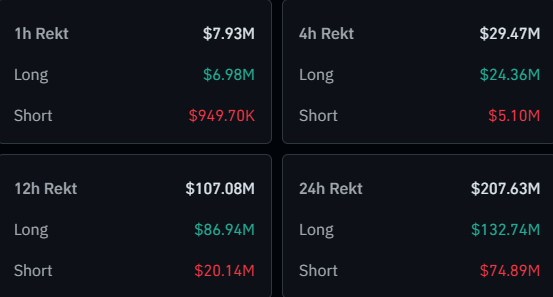
Bitcoin Liquidations

The data for the cryptocurrency liquidations during the past day | Source: CoinGlass
Featured image from Dall-E, CoinGlass.com, chart from TradingView.com
Editorial Process for bitcoinist is centered on delivering thoroughly researched, accurate, and unbiased content. We uphold strict sourcing standards, and each page undergoes diligent review by our team of top technology experts and seasoned editors. This process ensures the integrity, relevance, and value of our content for our readers.

Keshav is a Physics graduate who has been employed as a writer with Bitcoinist since June 2021. He is passionate about writing and through the years, he has gained experience working in a variety of niches. Keshav holds an active interest in the cryptocurrency market, with on-chain analysis being an area he particularly likes to research and write about.

Leituras Relacionadas

When Billions Begin to Operate Everything by Voice, How Far is ‘All Assets on Chain’?

In June 2026, WeChat began a limited rollout of "Xiaowei," its native AI assistant. This move is more than an upgrade to a smarter chatbot; it signals a crucial step from "universal internet access" toward the broader vision of "full asset tokenization." Xiaowei, powered primarily by WeChat's in-house WeLM model, demonstrates four key capabilities: 1) direct voice/web chat control of app functions, 2) automated access to mini-programs for services, 3) instant comprehension and summarization of complex documents like PDFs, and 4) generating functional mini-program prototypes from simple natural language requests. This represents a fundamental shift from GUI (Graphical User Interface) to LUI (Language User Interface), eliminating friction in human-digital interaction. The rollout is pivotal because it brings AI Agents to China's massive user base with zero friction—no new app downloads or accounts needed. This "seamless access" mirrors past platform revolutions like the App Store or WeChat Mini-Programs, potentially unlocking a global AI Agent market projected to grow from $7.92 billion in 2025 to nearly $295 billion by 2035. The article argues that China's internet evolution has moved from "connecting everyone" to "putting all services online." The next phase is "tokenizing all assets"—a concept broader than just Real World Assets (RWA) like real estate. It encompasses tokenizing personal assets like social influence, attention, and credit history. RWA tokenization itself is forecast to explode from $35 billion in 2025 to over $500 billion in 2026. The convergence of ubiquitous AI Agents and rapidly tokenizing assets points to a future paradigm for wealth management. Your AI Agent could autonomously manage a globally diversified, tokenized portfolio based on your preferences. Initiatives like EXIO Group's full-stack RWA services aim to lower investment barriers, paralleling WeChat's democratization of AI access. In conclusion, the launch of Xiaowei is not merely a technical upgrade but a historic inflection point. It marks AI Agents' transition from niche tools to essential utilities and accelerates the movement toward a future where voice commands seamlessly interact with tokenized value, redefining humanity's relationship with the digital and financial worlds.

marsbitHá 1h

When Billions Begin to Operate Everything by Voice, How Far is ‘All Assets on Chain’?

marsbitHá 1h

SoftBank CEO Masayoshi Son's New Trillion-Dollar "Gamble"

SoftBank founder Masayoshi Son is embroiled in a new trillion-dollar "bet" on Physical AI and humanoid robotics, even as his massive wager on OpenAI faces uncertainty ahead of its potential IPO. Recent reports reveal OpenAI's steep losses—$85 billion net loss by Q1 2026 and a $38.5 billion loss in 2025—casting doubt on its path to a trillion-dollar valuation. SoftBank, OpenAI's second-largest external shareholder with a planned 13% stake, stands to gain hugely if OpenAI succeeds. Undeterred, Son is already pushing forward with his next ambitious venture: consolidating SoftBank's AI and robotics assets into a new U.S.-based company named "Roze," targeting a $100 billion IPO as early as late 2026. This move aligns with his belief that Physical AI, merging AI cognition with robotic physical execution, is the next trillion-dollar frontier. Son's confidence stems from recent AI wins; SoftBank's stock surged and he briefly regained the title of Asia's richest person, largely due to OpenAI's soaring valuation. However, his aggressive strategy has raised internal concerns about over-reliance on OpenAI and strained finances. With competitors like Anthropic advancing rapidly and OpenAI's IPO timing uncertain, Son is racing to capitalize on the AI boom. His long-term vision for Physical AI includes a decade of investments in robotics, from Boston Dynamics to recent acquisitions like ABB's robotics unit, and a planned $1 trillion investment in U.S.-based AI robotics industrial parks. Yet, challenges remain: humanoid robotics firms like Figure AI lack the clear revenue paths of AI software companies, and Roze's lofty valuation faces skepticism. For Son, these bets are also driven by an unfulfilled promise of massive returns to key investors like Saudi Arabia's PIF. Despite risks, he continues to double down, betting that the fusion of AI and physical machines will define the next technological era.

marsbitHá 1h

SoftBank CEO Masayoshi Son's New Trillion-Dollar "Gamble"

marsbitHá 1h

Trading

Spot
Futuros
活动图片