Police Confirms Largest Crypto Seizure In Canadian History

bitcoinistPublicado em 2025-09-20Última atualização em 2025-09-20

Resumo

The Royal Canadian Mounted Police (RCMP) has confirmed a record-breaking seizure of cryptocurrency linked to the centralized exchange TradeOgre, taking...

Trusted Editorial content, reviewed by leading industry experts and seasoned editors. Ad Disclosure

The Royal Canadian Mounted Police (RCMP) has confirmed a record-breaking seizure of cryptocurrency linked to the centralized exchange TradeOgre, taking control of assets worth more than 56 million Canadian dollars—about 40 million US dollars—following a federal policing investigation in Quebec. The agency described the operation as “the largest cryptocurrency seizure in Canadian history,” and said it dismantled the platform’s Canadian infrastructure. The news was announced on September 18 from Montréal.

Canadian Police Confirms $40 Million Crypto Seizure

According to details released by Canadian media quoting the RCMP, investigators seized servers in Beauharnois in the Montérégie region, which supported TradeOgre’s operations. RCMP Sgt. Mathieu Lagarde said: “The servers that allowed this platform to conduct these transactions were located in Canada. So we seized these servers and then seized the crypto assets controlled by the exchange.” Authorities added that this marks the first time a cryptocurrency exchange has been dismantled by police in Canada.

The yearlong probe was run by the RCMP Federal Policing – Eastern Region’s Money Laundering Investigative Team and began in June 2024 after a tip from Europol, according to the accounts of the investigation provided by authorities and reported by national outlets. The RCMP alleges TradeOgre failed to register with the Financial Transactions and Reports Analysis Centre of Canada (FINTRAC) as a money services business and did not identify its customers, conditions that investigators say allowed criminal organizations to conceal the origins of funds.

Open-source blockchain intelligence platform Arkham said its tooling was used in the case. In a public post, Arkham wrote that “as per the RCMP’s website, Arkham was used as part of the investigation,” and in a research note the firm documented earlier on-chain indicators—specifically messages embedded in Bitcoin transactions—signaling that Canadian police had claimed ownership of funds. Arkham’s report also noted TradeOgre’s social and site activity had gone dark earlier this summer (X account inactive since May; website offline since July 30).

The RCMP said it is now analyzing transaction data from the platform and that enforcement actions may follow: “The transaction data obtained from the platform will be analyzed and charges may follow. The investigation is ongoing.” Authorities emphasized that no arrests had been announced as of the release and encouraged anyone with relevant information to contact investigators.

While the RCMP’s statement framed TradeOgre as an unregistered venue used to launder proceeds of crime, the seizure has already prompted a broader debate among some users who claim legitimate balances were swept up with illicit funds. What is clear, however, is that Canadian law enforcement has established a new high-water mark for domestic crypto enforcement and, for the first time, has taken down the Canadian infrastructure of a cryptocurrency exchange as part of a money-laundering investigation.

At press time, the total crypto market cap stood at $4 trillion.
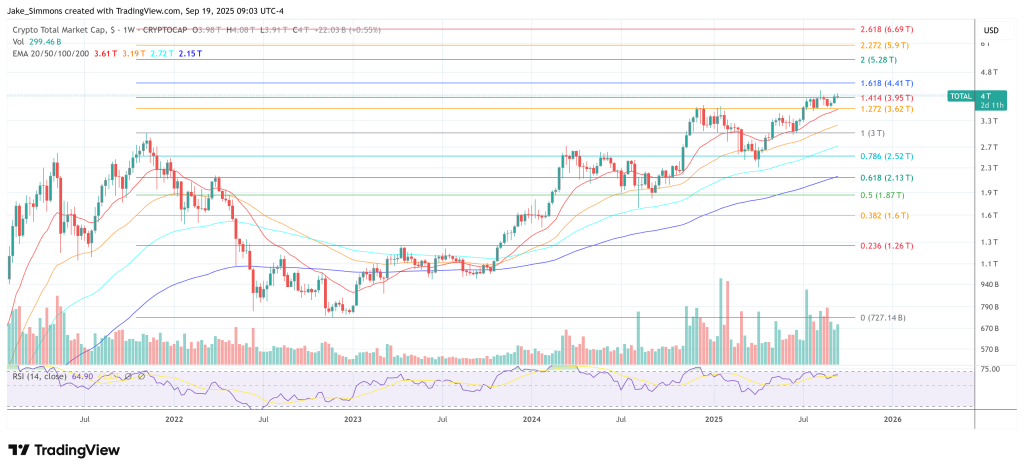
Total crypto market cap
Total crypto market cap breaks above $4 trillion, 1-week chart | Source: TOTAL on TradingView.com
Featured image created with DALL.E, chart from TradingView.com
Editorial Process for bitcoinist is centered on delivering thoroughly researched, accurate, and unbiased content. We uphold strict sourcing standards, and each page undergoes diligent review by our team of top technology experts and seasoned editors. This process ensures the integrity, relevance, and value of our content for our readers.

Jake Simmons has been a Bitcoin enthusiast since 2016. Ever since he heard about Bitcoin, he has been studying the topic every day and trying to share his knowledge with others. His goal is to contribute to Bitcoin's financial revolution, which will replace the fiat money system. Besides BTC and crypto, Jake studied Business Informatics at a university. After graduation in 2017, he has been working in the blockchain and crypto sector. You can follow Jake on Twitter at @realJakeSimmons.

Leituras Relacionadas

When Billions Begin to Operate Everything by Voice, How Far is ‘All Assets on Chain’?

In June 2026, WeChat began a limited rollout of "Xiaowei," its native AI assistant. This move is more than an upgrade to a smarter chatbot; it signals a crucial step from "universal internet access" toward the broader vision of "full asset tokenization." Xiaowei, powered primarily by WeChat's in-house WeLM model, demonstrates four key capabilities: 1) direct voice/web chat control of app functions, 2) automated access to mini-programs for services, 3) instant comprehension and summarization of complex documents like PDFs, and 4) generating functional mini-program prototypes from simple natural language requests. This represents a fundamental shift from GUI (Graphical User Interface) to LUI (Language User Interface), eliminating friction in human-digital interaction. The rollout is pivotal because it brings AI Agents to China's massive user base with zero friction—no new app downloads or accounts needed. This "seamless access" mirrors past platform revolutions like the App Store or WeChat Mini-Programs, potentially unlocking a global AI Agent market projected to grow from $7.92 billion in 2025 to nearly $295 billion by 2035. The article argues that China's internet evolution has moved from "connecting everyone" to "putting all services online." The next phase is "tokenizing all assets"—a concept broader than just Real World Assets (RWA) like real estate. It encompasses tokenizing personal assets like social influence, attention, and credit history. RWA tokenization itself is forecast to explode from $35 billion in 2025 to over $500 billion in 2026. The convergence of ubiquitous AI Agents and rapidly tokenizing assets points to a future paradigm for wealth management. Your AI Agent could autonomously manage a globally diversified, tokenized portfolio based on your preferences. Initiatives like EXIO Group's full-stack RWA services aim to lower investment barriers, paralleling WeChat's democratization of AI access. In conclusion, the launch of Xiaowei is not merely a technical upgrade but a historic inflection point. It marks AI Agents' transition from niche tools to essential utilities and accelerates the movement toward a future where voice commands seamlessly interact with tokenized value, redefining humanity's relationship with the digital and financial worlds.

marsbitHá 1h

When Billions Begin to Operate Everything by Voice, How Far is ‘All Assets on Chain’?

marsbitHá 1h

SoftBank CEO Masayoshi Son's New Trillion-Dollar "Gamble"

SoftBank founder Masayoshi Son is embroiled in a new trillion-dollar "bet" on Physical AI and humanoid robotics, even as his massive wager on OpenAI faces uncertainty ahead of its potential IPO. Recent reports reveal OpenAI's steep losses—$85 billion net loss by Q1 2026 and a $38.5 billion loss in 2025—casting doubt on its path to a trillion-dollar valuation. SoftBank, OpenAI's second-largest external shareholder with a planned 13% stake, stands to gain hugely if OpenAI succeeds. Undeterred, Son is already pushing forward with his next ambitious venture: consolidating SoftBank's AI and robotics assets into a new U.S.-based company named "Roze," targeting a $100 billion IPO as early as late 2026. This move aligns with his belief that Physical AI, merging AI cognition with robotic physical execution, is the next trillion-dollar frontier. Son's confidence stems from recent AI wins; SoftBank's stock surged and he briefly regained the title of Asia's richest person, largely due to OpenAI's soaring valuation. However, his aggressive strategy has raised internal concerns about over-reliance on OpenAI and strained finances. With competitors like Anthropic advancing rapidly and OpenAI's IPO timing uncertain, Son is racing to capitalize on the AI boom. His long-term vision for Physical AI includes a decade of investments in robotics, from Boston Dynamics to recent acquisitions like ABB's robotics unit, and a planned $1 trillion investment in U.S.-based AI robotics industrial parks. Yet, challenges remain: humanoid robotics firms like Figure AI lack the clear revenue paths of AI software companies, and Roze's lofty valuation faces skepticism. For Son, these bets are also driven by an unfulfilled promise of massive returns to key investors like Saudi Arabia's PIF. Despite risks, he continues to double down, betting that the fusion of AI and physical machines will define the next technological era.

marsbitHá 1h

SoftBank CEO Masayoshi Son's New Trillion-Dollar "Gamble"

marsbitHá 1h

Trading

Spot
Futuros
活动图片