Sui Network Gains Wall Street Attention: Could Google Deal Push SUI Into The Top 10?

bitcoinistPublicado em 2025-09-18Última atualização em 2025-09-18

Resumo

Sui Network (SUI) has become one of the first launch partners for Google’s Agentic Payments Protocol (AP2). This open-source standard...

Trusted Editorial content, reviewed by leading industry experts and seasoned editors. Ad Disclosure

Sui Network (SUI) has become one of the first launch partners for Google’s Agentic Payments Protocol (AP2). This open-source standard enables AI-driven agents to perform secure, programmable payments without human intervention.

Developed by Mysten Labs, Sui’s Move-based architecture and zkLogin privacy solution made it a natural fit for Google’s initiative. AP2 is already supported by over 60 industry giants, including PayPal, Salesforce, and American Express, signaling its potential to become a cornerstone of automated commerce.

By integrating privacy-first identity and programmable transactions, AP2 could improve how AI interacts with payments, from subscriptions and paywalls to real-world purchases, while positioning Sui at the heart of this technological shift.

ETF Filings Signal Wall Street’s Growing Interest

Adding to the momentum, several ETF issuers have filed applications with the U.S. Securities and Exchange Commission (SEC) that include Sui. Among them is Tuttle Capital’s proposed “SUI Income Blast ETF,” designed to give both institutional and retail investors exposure to the token.

This move follows a broader wave of crypto ETF filings across assets like Avalanche (AVAX) and Bonk (BONK), highlighting Wall Street’s increasing appetite for altcoins. Analysts note that infrastructure-focused projects such as Sui and Avax have stronger chances of approval compared to riskier memecoin-linked products.

If greenlit, a SUI ETF could channel significant liquidity into the network, bracing demand at a time when adoption of AI-driven payments is expected to accelerate.

Price Outlook: Can SUI Break Into the Top 10?

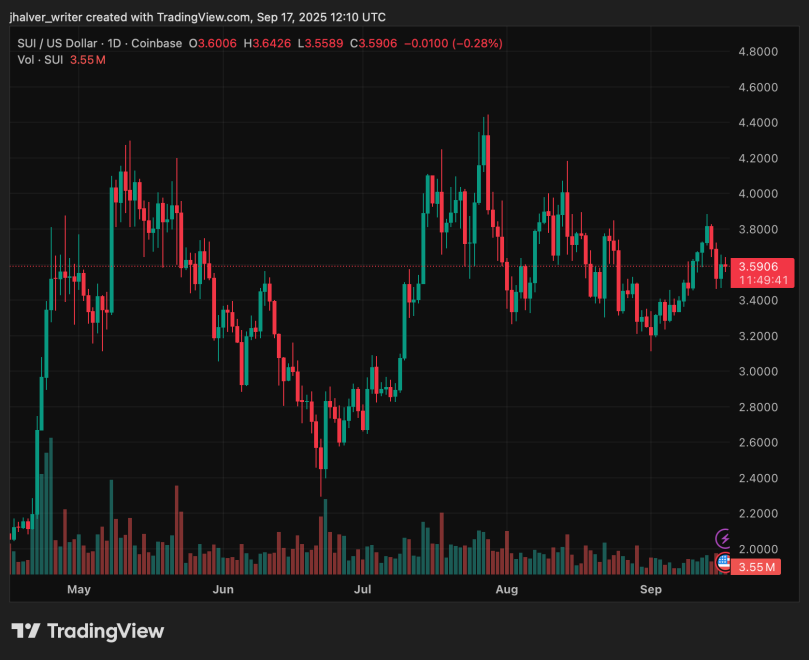
SUI currently trades around $3.58, marking steady gains since the Google announcement.

Technical analysts point to historically tight Bollinger Bands, a pattern that preceded Sui’s 250% rally in December 2023 and a 404% surge in September 2024. If history repeats, SUI could see a 150–200% breakout, targeting prices between $6 and $8.
SUI SUI Network SUIUSD

SUI's price trending sideways on the daily chart. Source: SUIUSD on Tradingview

Market watchers are also considering wider factors, including potential Bitcoin volatility, token unlocks, and regulatory scrutiny over AI-payment integrations. Nevertheless, the rise of Google’s AP2 partnership, ETF filings, and bullish technical signals indicates that Sui could ascend the ranks of major cryptocurrencies.

If momentum persists, analysts believe Sui has a real chance of entering the top 10 digital assets by market capitalisation before 2026, boosting its position in AI-driven finance.

Cover image from ChatGPT, SUIUSD chart from Tradingview

Editorial Process for bitcoinist is centered on delivering thoroughly researched, accurate, and unbiased content. We uphold strict sourcing standards, and each page undergoes diligent review by our team of top technology experts and seasoned editors. This process ensures the integrity, relevance, and value of our content for our readers.

Criptomoedas em alta

Leituras Relacionadas

Standard Chartered Bank’s 50-Fold Fantasy: Predicting AAVE to Reach $3,500

Standard Chartered Bank has issued an optimistic research report predicting that the AAVE token could surge 50-fold to $3,500 by 2030. This forecast is based on the projection that the total value locked (TVL) in DeFi will grow 37x to approximately $2.7 trillion, driven by stablecoin expansion and the tokenization of real-world assets (RWA). The bank's model links Aave's potential valuation directly to its protocol revenue, which is primarily driven by net interest margins. The report highlights Aave's current dominant position, noting it captures over 80% of the net earnings ("protocol retained earnings") in the lending sector while holding only about half of its TVL. It also points to the recent launch of the Aave V4 architecture and a healthy revenue stream of $142 million in 2025 as positive fundamentals. Grayscale's separate analysis, applying traditional valuation metrics like DCF, concluded AAVE is currently undervalued. However, the article notes significant challenges. Aave's peer-to-pool lending model suffers from inherent capital inefficiency, with an estimated $52 million annual "deadweight loss" due to idle funds needed for liquidity buffers. This structural flaw was exposed during the April KelpDAO exploit, which locked a WETH pool at 100% utilization for days. Emerging protocols like Morpho, with more efficient point-to-point models, are cited as growing competitive threats. In summary, while institutional forecasts paint a macro picture of massive growth fueled by RWA adoption, Aave's path forward hinges on addressing its core structural limitations and competitive pressures within the evolving DeFi lending landscape.

链捕手Há 45m

Standard Chartered Bank’s 50-Fold Fantasy: Predicting AAVE to Reach $3,500

链捕手Há 45m

Tidal Investment: We Remain Bullish on the AI Industry Chain, But the Reasons Have Changed

Tidal Investment remains optimistic about the AI industry chain, but the rationale has shifted. The market narrative has changed. While recent large-scale IPOs (e.g., SpaceX) and major fundraising plans by tech giants like Alphabet and Meta have caused some nervousness, this isn't a sign of an AI peak. The focus has moved from the initial question of AI's viability to the sustainability of massive investment cycles. The key players—primarily the major cloud providers—are not slowing down; their capital expenditure (Capex) guidance for 2026 has been increased across the board (e.g., Alphabet to $180B, Amazon to $200B). This investment cycle is proving resilient and difficult to stop. Unlike traditional hardware cycles, current AI Capex is distributed across multiple physical layers—computing, memory, networking, and critically, power infrastructure. Bottlenecks are shifting from chips to elements like electricity, transformers, and cooling systems, which have much longer lead times and cannot be easily pre-built like fiber optics during the dot-com bubble. Supply chain data (e.g., Eaton's 240% YoY data center orders) confirms this broad-based, project-driven expansion. Market concerns are acknowledged but viewed differently. First, while Capex growth currently outpaces revenue growth, raising ROI questions, this mirrors the early scaling phase of cloud computing itself. A change in view would require concrete signals like downward Capex revisions or missed AI product targets, which haven't materialized by mid-2026. Second, comparisons to the 2000 dot-com bust are flawed. That crash was driven by a massive, parallel oversupply of cheap capacity (fiber). The current cycle faces *supply constraints* in critical, capital-intensive physical infrastructure that cannot be overbuilt as easily. In conclusion, the wave of fundraising reflects the next, more complex act of the AI story. Physical bottlenecks and sustained high Capex plans suggest this is not the finale but an ongoing, capital-intensive build-out phase. The script has changed, but the play is far from over.

marsbitHá 1h

Tidal Investment: We Remain Bullish on the AI Industry Chain, But the Reasons Have Changed

marsbitHá 1h

Tidal Investment: We Remain Bullish on the AI Industry Chain, But for Different Reasons Now

Tidal Investments remains optimistic about the AI industry chain, but the rationale has shifted. The market is concerned about massive concurrent fundraising by tech giants like SpaceX, OpenAI, Alphabet, and Meta, fearing an AI peak. However, the authors argue this signals the next act of AI development, not its end. Capital expenditure (Capex) from major cloud providers (Alphabet, Amazon, Meta, Microsoft, Oracle) continues to surge aggressively into 2026. This investment cycle is more resilient than past hardware cycles due to its scale and complexity. Bottlenecks have shifted from chips to critical physical infrastructure like power grids, transformers, cooling, and data center construction—areas with long lead times and limited capacity for rapid expansion. Supply chain data (e.g., Eaton's orders) confirms substantial, tangible progress. Key market concerns are addressed: 1. **ROI vs. Capex Growth**: While Capex growth outpaces revenue, the authors note cloud giants have historically overcome similar phases through scale. The cycle will only be in danger if Capex guidance is cut, orders are canceled, or AI product demand falters—none of which are currently observed. 2. **Comparison to the 2000 Dot-com Bubble**: Unlike the telecom bubble, where cheap, oversupplied fiber crashed prices, AI infrastructure (especially power) is constrained, customized, and subject to lengthy approvals, making a similar supply glut and crash unlikely. In conclusion, the wave of fundraising reflects the immense, ongoing capital needs for AI's next phase, constrained by slow-moving physical bottlenecks. The AI cycle is not over; the script has simply changed.

链捕手Há 1h

Tidal Investment: We Remain Bullish on the AI Industry Chain, But for Different Reasons Now

链捕手Há 1h

Grayscale: These 15 Profitable Crypto Protocols Are Severely Undervalued

Grayscale Research identifies 15 top-revenue crypto protocols trading at significant valuation discounts, with many at single-digit or even 1x revenue multiples. Protocols like Pump.fun, PancakeSwap, and Meteora have market capitalizations roughly equal to their annual revenue. The report argues these financially-focused protocols (DEXs, lending, staking) are fundamentally undervalued and could benefit from the potential passage of the CLARITY Act, expected as soon as next month. This legislation aims to clarify digital asset regulation, potentially reducing institutional barriers and driving on-chain activity. The analysis breaks down the protocols into three groups: the "1x Club" (market cap ≈ revenue), mid-tier protocols with 3-9x multiples (e.g., Aave, Lido, Jupiter), and high-multiple protocols like Hyperliquid (15x) and Uniswap (37x), where valuation reflects future potential rather than current cash flows. Grayscale applies a traditional DCF model to Aave, suggesting a one-year price target of ~$175, representing ~130% upside from current levels. The report notes a risk-off macro environment since the Iran conflict has further compressed valuations, creating a potential entry window. The conclusion highlights that while the valuation data presents an intriguing opportunity, the investment thesis is contingent on the CLARITY Act's passage and subsequent institutional capital flows. Investors are cautioned to consider Grayscale's inherent conflict of interest as a crypto asset manager with products tied to these assets.

marsbitHá 2h

Grayscale: These 15 Profitable Crypto Protocols Are Severely Undervalued

marsbitHá 2h

Trading

Spot
Futuros

Artigos em Destaque

Como comprar SUI

Bem-vindo à HTX.com!Tornámos a compra de SUI Network (SUI) simples e conveniente.Segue o nosso guia passo a passo para iniciar a tua jornada no mundo das criptos.Passo 1: cria a tua conta HTXUtiliza o teu e-mail ou número de telefone para te inscreveres numa conta gratuita na HTX.Desfruta de um processo de inscrição sem complicações e desbloqueia todas as funcionalidades.Obter a minha contaPasso 2: vai para Comprar Cripto e escolhe o teu método de pagamentoCartão de crédito/débito: usa o teu visa ou mastercard para comprar SUI Network (SUI) instantaneamente.Saldo: usa os fundos da tua conta HTX para transacionar sem problemas.Terceiros: adicionamos métodos de pagamento populares, como Google Pay e Apple Pay, para aumentar a conveniência.P2P: transaciona diretamente com outros utilizadores na HTX.Mercado de balcão (OTC): oferecemos serviços personalizados e taxas de câmbio competitivas para os traders.Passo 3: armazena teu SUI Network (SUI)Depois de comprar o teu SUI Network (SUI), armazena-o na tua conta HTX.Alternativamente, podes enviá-lo para outro lugar através de transferência blockchain ou usá-lo para transacionar outras criptomoedas.Passo 4: transaciona SUI Network (SUI)Transaciona facilmente SUI Network (SUI) no mercado à vista da HTX.Acede simplesmente à tua conta, seleciona o teu par de trading, executa as tuas transações e monitoriza em tempo real.Oferecemos uma experiência de fácil utilização tanto para principiantes como para traders experientes.

603 Visualizações TotaisPublicado em {updateTime}Atualizado em 2026.06.02

Como comprar SUI

Discussões

Bem-vindo à Comunidade HTX. Aqui, pode manter-se informado sobre os mais recentes desenvolvimentos da plataforma e obter acesso a análises profissionais de mercado. As opiniões dos utilizadores sobre o preço de SUI (SUI) são apresentadas abaixo.

活动图片