Cardano L2 Midgard Hits Major Milestone As Hoskinson Says ‘All Foreseen’

bitcoinistPublicado em 2025-09-17Última atualização em 2025-09-17

Resumo

Cardano’s scaling roadmap took a concrete step forward after Anastasia Labs CEO Philip DiSarro reported on September 16 that Midgard—the...

Trusted Editorial content, reviewed by leading industry experts and seasoned editors. Ad Disclosure

Cardano’s scaling roadmap took a concrete step forward after Anastasia Labs CEO Philip DiSarro reported on September 16 that Midgard—the project’s native Layer-2—now runs a “functional node” with live pathways for settling state on Layer-1 and finalizing state commitments.

In a post on X, DiSarro summarized the status succinctly: “Update on Midgard: We have a functional node, with support for state settlement on the L1, and state commitment finalization. You can transact on the L2 at lightning speeds with low latency and the results are displayed in your wallet (a fork of Lace) in real-time.”

He added that the next engineering checkpoints are “the delivery of L1 deposits and withdrawals, and the forced transaction inclusion mechanism,” concluding, “Things are coming together nicely and we’re extremely excited to bring this into the hands of the community.”

Charles Hoskinson amplified the development with a tongue-in-cheek meme—“Everything is proceeding as I have foreseen”—a line that underscored how closely the Cardano founder has tied Midgard to the network’s broader scaling narrative this cycle. While lighthearted in tone, the post signals executive-level attention on progress that, if sustained, could materially change Cardano’s throughput profile.

What Is Cardano L2 Midgard?

At a technical level, DiSarro’s note points to three pillars that matter for any rollup-style L2: settlement, commitments, and inclusion. “State settlement on the L1” refers to the process by which the L2’s canonical state is anchored to Cardano’s base layer, ensuring that, even though transactions execute off-chain, ultimate security and finality derive from the L1.

“State commitment finalization” describes recording cryptographic commitments to L2 state so that disputes can be resolved and the correct state can be proven against the L1. The mention of a forthcoming “forced transaction inclusion mechanism” is equally significant, as such mechanisms are widely used in rollup ecosystems to mitigate sequencer censorship by giving users an escape hatch that compels inclusion via the base chain when necessary. DiSarro did not publish specs in this update, but these terms map cleanly to the rollup design goals Midgard has articulated publicly since its unveiling.

Midgard’s positioning has consistently been that of a Cardano-native optimistic rollup that is “tokenless,” avoids cross-chain bridges, and aims to let developers redeploy existing dApps without rewriting for a new execution environment. The project’s X profile describes it as “a tokenless Layer 2 using optimistic rollups to bring throughput and efficiency to Cardano. No bridges. No chain switching. Just ADA, smart contracts, and …” a framing that aligns with the practical focus on developer ergonomics and minimizing surface area for trust.

Beyond social updates, Midgard has been tracked through Cardano’s community treasury process. In Fund12 of Project Catalyst, Anastasia Labs secured ₳500,000 for an open-source build-out, publishing milestone plans that ranged from architecture specifications to an L2 node MVP.

The public Catalyst page, last updated in mid-2025, lists the workstreams and partial disbursements and emphasizes isomorphism with Cardano’s eUTxO model—meaning dApps should be able to redeploy to Midgard using the same code and tooling. While a Catalyst milestone plan is not a launch schedule, it provides additional documentary evidence that Midgard’s engineering artifacts have been progressing under a transparent grant framework.

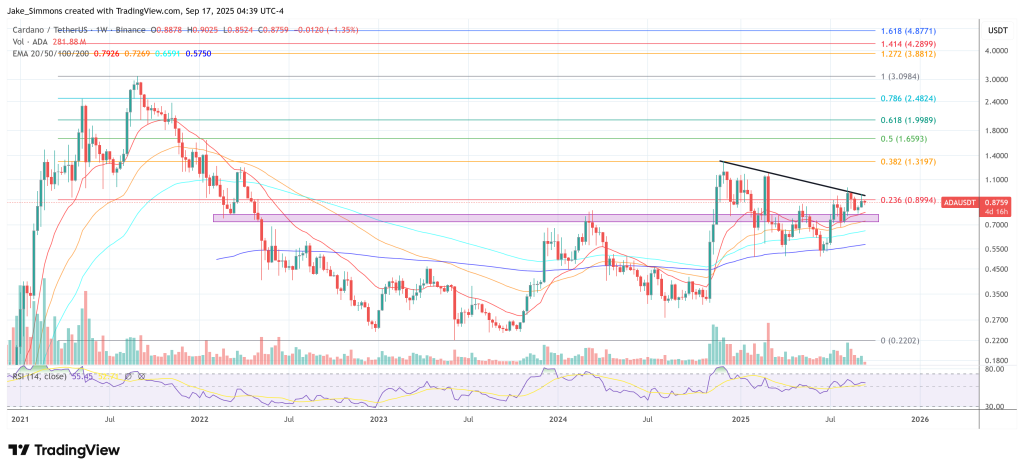
At press time, ADA traded at $0.8759.
Cardano price
ADA remains below key resistance (black line), 1-week chart | Source: ADAUSDT on TradingView.com
Featured image created with DALL.E, chart from TradingView.com
Editorial Process for bitcoinist is centered on delivering thoroughly researched, accurate, and unbiased content. We uphold strict sourcing standards, and each page undergoes diligent review by our team of top technology experts and seasoned editors. This process ensures the integrity, relevance, and value of our content for our readers.

Jake Simmons has been a Bitcoin enthusiast since 2016. Ever since he heard about Bitcoin, he has been studying the topic every day and trying to share his knowledge with others. His goal is to contribute to Bitcoin's financial revolution, which will replace the fiat money system. Besides BTC and crypto, Jake studied Business Informatics at a university. After graduation in 2017, he has been working in the blockchain and crypto sector. You can follow Jake on Twitter at @realJakeSimmons.

Criptomoedas em alta

Leituras Relacionadas

Jensen Huang: Prompts are Becoming Obsolete, Loops are the New Paradigm

Jensen Huang, alongside AI leaders like Peter Norvig, Boris Cherny, and Andrew Ng, is advocating for a shift from "prompt engineering" to "loop engineering" as the new paradigm for AI development. Instead of manually crafting individual prompts, the focus is now on designing autonomous loops—systems where AI agents execute tasks, self-validate results, and iterate until completion without constant human oversight. A loop is a management framework that enables agents to operate independently. Key implementations are seen in Claude Code (with features like /loop, /goal, and /schedule) and OpenAI Codex, which employ multiple agents working in parallel within isolated environments. A core principle is the separation of roles: one agent (or model) performs the task, while an independent agent (or a smaller, separate model) validates the output to ensure objectivity. The article outlines a practical roadmap for implementing loops, starting with a "four-condition test" to assess suitability, building a minimal viable loop, and emphasizing critical pitfalls to avoid, such as lacking hard stop conditions or allowing loops to handle tasks requiring human judgment. This evolution is framed as the fourth major shift in AI interaction: from Prompt Engineering (crafting instructions) to Context Engineering (providing background information), then to Harness Engineering (building tool-enabled environments), and finally to Loop Engineering (creating self-sustaining systems). This progression reflects a consistent trend of increasing abstraction, moving human involvement from direct instruction to system design and rule-setting. The concept has academic roots in frameworks like ReAct, which formalized the "reason-act-observe" cycle. While loop engineering promises greater automation, experts caution about managing token costs and warn against outsourcing understanding—AI can assist, but deep problem comprehension remains essential.

marsbitHá 1h

Jensen Huang: Prompts are Becoming Obsolete, Loops are the New Paradigm

marsbitHá 1h

Trading

Spot
Futuros

Artigos em Destaque

Como comprar ADA

Bem-vindo à HTX.com!Tornámos a compra de Cardano (ADA) simples e conveniente.Segue o nosso guia passo a passo para iniciar a tua jornada no mundo das criptos.Passo 1: cria a tua conta HTXUtiliza o teu e-mail ou número de telefone para te inscreveres numa conta gratuita na HTX.Desfruta de um processo de inscrição sem complicações e desbloqueia todas as funcionalidades.Obter a minha contaPasso 2: vai para Comprar Cripto e escolhe o teu método de pagamentoCartão de crédito/débito: usa o teu visa ou mastercard para comprar Cardano (ADA) instantaneamente.Saldo: usa os fundos da tua conta HTX para transacionar sem problemas.Terceiros: adicionamos métodos de pagamento populares, como Google Pay e Apple Pay, para aumentar a conveniência.P2P: transaciona diretamente com outros utilizadores na HTX.Mercado de balcão (OTC): oferecemos serviços personalizados e taxas de câmbio competitivas para os traders.Passo 3: armazena teu Cardano (ADA)Depois de comprar o teu Cardano (ADA), armazena-o na tua conta HTX.Alternativamente, podes enviá-lo para outro lugar através de transferência blockchain ou usá-lo para transacionar outras criptomoedas.Passo 4: transaciona Cardano (ADA)Transaciona facilmente Cardano (ADA) no mercado à vista da HTX.Acede simplesmente à tua conta, seleciona o teu par de trading, executa as tuas transações e monitoriza em tempo real.Oferecemos uma experiência de fácil utilização tanto para principiantes como para traders experientes.

1.3k Visualizações TotaisPublicado em {updateTime}Atualizado em 2026.06.02

Como comprar ADA

Discussões

Bem-vindo à Comunidade HTX. Aqui, pode manter-se informado sobre os mais recentes desenvolvimentos da plataforma e obter acesso a análises profissionais de mercado. As opiniões dos utilizadores sobre o preço de ADA (ADA) são apresentadas abaixo.

活动图片