Ripple Won’t Get Fed Master Account, Says Caitlin Long

bitcoinistPublicado em 2025-09-16Última atualização em 2025-09-16

Resumo

Caitlin Long, the CEO of Wyoming-chartered Custodia Bank, delivered a stark assessment of crypto’s path to the Federal Reserve’s rails,...

Trusted Editorial content, reviewed by leading industry experts and seasoned editors. Ad Disclosure

Caitlin Long, the CEO of Wyoming-chartered Custodia Bank, delivered a stark assessment of crypto’s path to the Federal Reserve’s rails, arguing that firms operating under trust charters—including Ripple—will not be granted direct access to the Fed’s payment system unless they become true depository institutions.

“Stablecoin issuers are not legally depository institutions,” she said. “To be able to use Fedwire and ACH, the Fed has taken the position that you have to be a depository institution… A trust company by law is prohibited from accepting a US dollar deposit.” She added that while some trust companies have historically had limited master-account arrangements, it was “not for moving money in the payment system,” and the key prize—“the par guarantee”—belongs to banks alone. “You’ve got to legally be a depository institution,” Long said, concluding, “I firmly do believe… the Fed is not going to change that.”

Long’s view arrives as Ripple pushes deeper into bank-grade infrastructure. Ripple closed its acquisition of Standard Custody & Trust Company in June 2024, positioning the New York-chartered trust company at the center of its stablecoin stack, and has continued to expand its regulated footprint since then.

In early July 2025, Ripple applied for a US national bank charter and is pursuing a Federal Reserve master account—moves that would, if approved, put Ripple USD (RLUSD) reserves and settlement closer to the Fed’s balance sheet and its payment services. Long’s message to that strategy is unambiguous: trust status is an “intermediary stop.” “There have been several now who have applied for Fed master accounts,” she said, but access to Fedwire/ACH “is the distinction,” and “the stablecoin market, I firmly believe, will go entirely to the banks.

Can Ripple Get A Fed Masters Account?

The Fed’s legal and policy framework backs up the distinction Long describes. In August 2022, the Board finalized its Account Access Guidelines, which formalized a three-tier review system and made clear that Reserve Banks evaluate requests for access to “master accounts and services” against safety-and-soundness, legal eligibility, and systemic-risk criteria. The framework subjects non-insured, novel charters to the most stringent review.

Separately, the Federal Reserve defines a master account as “the record of financial rights and obligations” between an account holder and its Administrative Reserve Bank—precisely the ledger relationship that enables par settlement on Fed rails.

Courts have since affirmed broad Fed discretion to deny master-account requests even for legally eligible institutions, a precedent set in 2024 rulings that rejected arguments the Fed must grant access upon request. That judicial backdrop is central to Long’s claim that policy won’t bend for trust companies: “I have had very extensive conversations with the actual decision makers,” she said, and the line drawn around deposit-taking banks “is not going to change.”

Naming names clarifies where crypto stands today. The Federal Reserve’s public Master Account and Services Database—updated most recently with data current as of May 31, 2025—lists new “access requests” and their status, offering an official window into who is asking to join the payment system directly. A Congressional Research Service report, citing that database, notes that Kraken Financial and Protego Trust have pending applications, while Bankwyse, Commercium Financial (a Wyoming SPDI) and Paxos withdrew theirs; Custodia’s request was denied.

After that, Standard Custody & Trust (Ripple-owned) and WisdomTree Digital Trust have entered the crypto-adjacent access requests, underscoring the sector’s shift toward bank-grade plumbing even as eligibility questions remain for trust companies.

Long, for her part, emphasized the legal dividing line those lists reveal: “All these trust companies, including OCC trust companies, [are] not eligible to get access to the payment system for moving US dollar deposits… Getting access to Fedwire and ACH at the Fed, you’ve got to legally be a depository institution.”

Her argument turns on first principles rather than policy mood. “What is a depository institution? It is a financial institution that is legally authorized to accept a US dollar deposit,” Long explained. Because trust companies are “prohibited from accepting a US dollar deposit,” the Fed’s payment system remains a bank-only lane. The consequence, she said, is structural: “These trust companies… are intermediary stops. That’s great… [they] give companies the ability to do business nationwide” without fifty separate money-transmitter licenses. “But… not for moving money in the payment system.”

In Long’s telling, stablecoin-issuance will ultimately consolidate “entirely” inside banks—some of which may be crypto-founded but will nevertheless be banks—because only banks can tap the Fed’s par-clearing privilege at scale. For Ripple, the path forward therefore looks binary. The trust-company architecture around Ripple USD can support custody and fiduciary functions; it cannot, in Long’s reading and the Fed’s rule set, unlock direct Fedwire/ACH access on its own.

That explains Ripple’s pivot toward a national bank charter and a master-account application—steps that, even if they clear eligibility, must still pass the Fed’s risk-based scrutiny that tripped other applicants. In the meantime, Long’s bottom line hangs over every trust-charter strategy in crypto: “The value of moving money in the payment system? It’s the par guarantee.” And that, she insists, “won’t” be available to trust companies—Ripple included—unless they become banks.

At press time, XRP traded at $2.98.
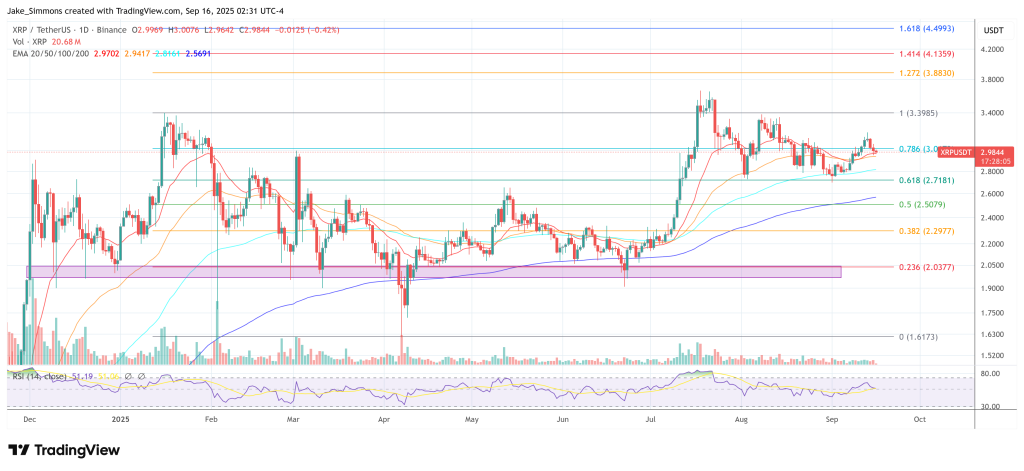
XRP price
XRP price, 1-day chart | Source: XRPUSDT on TradingView.com
Featured image created with DALL.E, chart from TradingView.com
Editorial Process for bitcoinist is centered on delivering thoroughly researched, accurate, and unbiased content. We uphold strict sourcing standards, and each page undergoes diligent review by our team of top technology experts and seasoned editors. This process ensures the integrity, relevance, and value of our content for our readers.

Jake Simmons has been a Bitcoin enthusiast since 2016. Ever since he heard about Bitcoin, he has been studying the topic every day and trying to share his knowledge with others. His goal is to contribute to Bitcoin's financial revolution, which will replace the fiat money system. Besides BTC and crypto, Jake studied Business Informatics at a university. After graduation in 2017, he has been working in the blockchain and crypto sector. You can follow Jake on Twitter at @realJakeSimmons.

Criptomoedas em alta

Leituras Relacionadas

19 New Decacorns in Half a Year: Why is the Primary Market Chasing 'Certainty'?

In the first half of 2026, China’s primary market saw a notable increase in unicorns, adding 19 new companies each valued over 100 billion RMB, particularly in sectors like embodied AI and large language models (LLMs). Firms such as Galaxy General, Zibian, and ZhiPingFang even surpassed 200 billion RMB valuations within months. Moonshot AI's valuation surged from around $10 billion to $35 billion by July 2026, with a pre-IPO target of $50 billion. This concentration of capital into a few "certain" sectors highlights a market shift. The driving force is not a general abundance of capital but a chase for "certainty"—primarily clearer exit pathways like imminent IPOs. Companies with defined public listing timelines attract intense investment despite higher valuations, as they reduce exit uncertainty for investors. Secondary market valuations of listed peers also serve as new anchors, boosting the perceived value of private companies in similar fields, though this creates dependency on public market sentiment. Another form of certainty comes from the expectation of rising valuations in subsequent funding rounds. The investment logic has shifted in some cases from assessing long-term fundamental value to betting on the next round attracting higher prices. This dynamic is also seen in deep-tech areas like nuclear fusion, where firms like NeoFusion secured a 10.6 billion RMB valuation despite early commercial stages, driven by scarcity and strategic bets. However, this trend signals a risk transfer: technical uncertainties remain but are temporarily masked by valuation inflation. As valuations climb—50 billion to 200 billion or 500 billion RMB—companies face increasing pressure to demonstrate real revenue, profit, and sustainable business models. The danger lies not in the rise of unicorns itself, but if valuations become detached from value creation and rely merely on the expectation of future funding or exits. Ultimately, the surge reflects investors seeking perceived safety in shorter-term exit certainty and transactional momentum, rather than a renewed appetite for risk. The true test will come when the market inevitably refocuses on fundamentals, questioning how many of today’s high valuations are backed by genuine economic value.

marsbitHá 2m

19 New Decacorns in Half a Year: Why is the Primary Market Chasing 'Certainty'?

marsbitHá 2m

Just Now, Sam Altman Blasts Dario Amodei as 'Anti-Human', Secret Model Exposed the Same Day

Just now, Sam Altman strongly criticized Dario (Amodei, co-founder of Anthropic), denouncing his "doomsday marketing" as "anti-human dictator rhetoric." This came alongside the accidental exposure of OpenAI's next-generation model, codenamed "gpt-nathree," hinting at the imminent release of GPT-6 Astra. The leak occurred when an OpenAI employee's public GitHub commit mentioned the codename. Combined with previous leaks of "gpt-mewfour," it suggests these are iterative checkpoints for OpenAI's upcoming agent model, Astra. Astra is known for multi-agent collaboration and long-duration task handling, having reportedly solved previously unsolved mathematical problems. Meanwhile, two new Anthropic model codenames, "claude-marshmallow-eap" and "claude-melon-eap," were also exposed but are believed to be iterations of the Claude 5 series, not a new flagship. In a wide-ranging podcast interview, Altman admitted he was wrong about the speed of AI-driven disruption, acknowledging societal inertia slows adoption. He fiercely criticized rivals' marketing that simultaneously promises immense benefits (like curing cancer) and warns of existential risk, calling it a dangerous "benevolent dictator" narrative that seeks to concentrate power. He emphasized that people are the ultimate purpose of AI. Altman also revealed OpenAI's unconventional, consensus-defying path: spending four and a half years in the "dark" without a public product before ChatGPT's breakthrough, driven by scaling laws rather than early customer feedback. He concluded that even with superintelligent AI, genuine human connection will remain irreplaceably valuable.

marsbitHá 42m

Just Now, Sam Altman Blasts Dario Amodei as 'Anti-Human', Secret Model Exposed the Same Day

marsbitHá 42m

The 'Saving U.S. Treasuries' Baton Pass: Bessent Fumbled Last Week, This Week It's Wash's Turn

"Rescuing US Treasuries" Relay: After Bessent's Miss, All Eyes Are on Walsh Last week, US Treasury Secretary Bessent's announcement to at least double long-term Treasury buybacks failed to sustainably lower yields, which quickly rebounded. The market response saw a drop in the dollar alongside surges in gold and Bitcoin, interpreted as a "pressure release valve" for anxiety. The focus now shifts to Fed Chairman Walsh's upcoming Jackson Hole speech. Markets are highly sensitive to his message, seeking clarity on the Fed's policy response to stubborn inflation and worsening fiscal conditions. Analysts warn that a lack of new guidance could disappoint markets and worsen the sell-off in long-dated bonds. Analysts question the scale of Bessent's operations, noting they are too small relative to the overall debt market and do not constitute quantitative easing. A key issue is the Fed's massive holdings of long-term bonds, which distorts the market. With the Fed holding low-yielding short-term bonds that are losing money relative to its policy rate, discussion is growing around a potential Fed-led "Operation Twist." This would involve selling short-term bonds to buy long-term ones, aiming to lower long-end yields without expanding the balance sheet. The upcoming PCE inflation data will set the stage for Walsh's speech. However, the window for action is narrowing amid political pressures. A critical threshold is the 30-year yield at 5%; holding above it could increase stress on the dollar and leveraged sectors. Overall, the article suggests that without coordinated Fed action to anchor inflation expectations, Treasury interventions may ultimately fail, with investors increasingly looking to assets like gold as hedges.

marsbitHá 1h

The 'Saving U.S. Treasuries' Baton Pass: Bessent Fumbled Last Week, This Week It's Wash's Turn

marsbitHá 1h

Hyperliquid's Compliance Journey: From Permissionless to Permissioned via HIP-3

Hyperliquid’s Compliance Path: From Permissionless to Permissioned HIP-3 Hyperliquid currently blocks U.S. access because its permissionless, on-chain infrastructure conflicts with U.S. market structure laws, which restrict futures trading to registered exchanges, clearinghouses, and brokers. Through its Hyperliquid Policy Center (HPC), the project is advocating for regulatory modernization, proposing that regulated entities be allowed to build products on HyperCore (its exchange and clearing layer) while fulfilling their compliance obligations. The platform’s modular stack separates roles like a traditional exchange (DCM), clearinghouse (DCO), and broker (FCM), but reconstructs them on-chain with code. This enables permissionless access, self-custody, and 24/7 global trading, but clashes with U.S. rules requiring KYC, specific margin models, and custodial arrangements. To resolve this, HPC is engaging with U.S. regulators (CFTC, SEC) to seek clarity that deploying on-chain software does not itself trigger licensing, and to establish exemptions allowing non-custodial wallets to route users to regulated derivatives. Recent political signals suggest openness to this approach. On the technical side, Hyperliquid Labs has introduced permissioned HIP-3 deployers on testnet. These allow regulated entities to launch markets, perform KYC, and whitelist compliant users. While these create separate order books, whitelisted market makers can bridge liquidity between them, ensuring deep, shared liquidity across the same L1. Features like payload-based “PA” permissions enable DEX-level account controls (e.g., reduce-only orders), mirroring traditional broker authorities. The strategy is not to open the native, permissionless front-end to U.S. users, but to position Hyperliquid as neutral infrastructure that U.S. regulated firms can use while meeting their legal duties. This paves a compliant path for U.S. investor access while preserving the protocol’s core, permissionless nature.

marsbitHá 1h

Hyperliquid's Compliance Journey: From Permissionless to Permissioned via HIP-3

marsbitHá 1h

Trading

Spot

Artigos em Destaque

Como comprar T

Bem-vindo à HTX.com!Tornámos a compra de Threshold Network Token (T) simples e conveniente.Segue o nosso guia passo a passo para iniciar a tua jornada no mundo das criptos.Passo 1: cria a tua conta HTXUtiliza o teu e-mail ou número de telefone para te inscreveres numa conta gratuita na HTX.Desfruta de um processo de inscrição sem complicações e desbloqueia todas as funcionalidades.Obter a minha contaPasso 2: vai para Comprar Cripto e escolhe o teu método de pagamentoCartão de crédito/débito: usa o teu visa ou mastercard para comprar Threshold Network Token (T) instantaneamente.Saldo: usa os fundos da tua conta HTX para transacionar sem problemas.Terceiros: adicionamos métodos de pagamento populares, como Google Pay e Apple Pay, para aumentar a conveniência.P2P: transaciona diretamente com outros utilizadores na HTX.Mercado de balcão (OTC): oferecemos serviços personalizados e taxas de câmbio competitivas para os traders.Passo 3: armazena teu Threshold Network Token (T)Depois de comprar o teu Threshold Network Token (T), armazena-o na tua conta HTX.Alternativamente, podes enviá-lo para outro lugar através de transferência blockchain ou usá-lo para transacionar outras criptomoedas.Passo 4: transaciona Threshold Network Token (T)Transaciona facilmente Threshold Network Token (T) no mercado à vista da HTX.Acede simplesmente à tua conta, seleciona o teu par de trading, executa as tuas transações e monitoriza em tempo real.Oferecemos uma experiência de fácil utilização tanto para principiantes como para traders experientes.

710 Visualizações TotaisPublicado em {updateTime}Atualizado em 2026.06.02

Como comprar T

Discussões

Bem-vindo à Comunidade HTX. Aqui, pode manter-se informado sobre os mais recentes desenvolvimentos da plataforma e obter acesso a análises profissionais de mercado. As opiniões dos utilizadores sobre o preço de T (T) são apresentadas abaixo.

活动图片