Altcoin Season Index Sets New 2025 High, What This Means For The Crypto Market

bitcoinistPublicado em 2025-09-15Última atualização em 2025-09-15

Resumo

The wait for the start of the altcoin season has been a long one, and even now, this market phenomenon...

Trusted Editorial content, reviewed by leading industry experts and seasoned editors. Ad Disclosure

The wait for the start of the altcoin season has been a long one, and even now, this market phenomenon remains elusive to investors. It was expected that after the Bitcoin price hit multiple new all-time highs over the last two years, altcoins would follow. Bitcoin continued to outperform the top altcoins by a large margin, and this blocked the way for the altcoin season to begin. However, with the market recovery, there is now a chance that the altcoin season might begin again.

Altcoin Season Index On The Rise

The Altcoin Season index takes into account the performance of the top 100 altcoins versus the performance of the Bitcoin price. This comparison is then charted and plotted over a 90-day period to show how these large-cap altcoins have performed against the pioneer cryptocurrency.

Depending on the number of altcoins that are outperforming Bitcoin in this 90-day period, the index deduces whether the market is headed into an altcoin season or not. Now, the higher the figure on the index, the higher the chances that an alt season might begin. When there are more than 75 altcoins outperforming the Bitcoin price in a 90-day period, then it is the needed signal that the alt season has begun.

In 2025, the Altcoin Season Index has trended low, mostly below the 50% mark. However, with the recent market recovery over the weekend, the index has now achieved its highest level this year, suggesting that an altcoin season is drawing closer.

According to data from the CoinMarketCap website, the Altcoin Season Index is sitting at a score of 67% at the time of this writing. With 75% being the target, it means that the market just needs another 8 of the top 100 altcoins to outperform Bitcoin to use in an alt season.
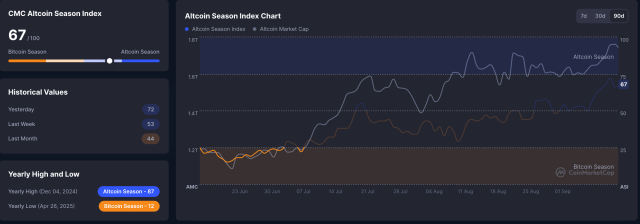
Altcoin season index
Source: Coinmarketcap

What To Expect

Previous market performances have shown altcoin seasons to be a period of explosive rallies for altcoins. The last alt season was categorized by notable rallies such as Dogecoin’s 36,000% rise and Shiba Inu’s legendary rally that saw it temporarily flip Dogecoin.

There was also the DeFi summer during this time that ushered the likes of Fantom, Polygon, and Uniswap into the limelight. Given this, it is expected that the next altcoin season will send existing altcoins flying while giving new narratives a chance to outperform as well.

Altcoin total market cap chart from TradingView.com
Altcoin market cap holds at $1.69 trillion | Source: Crypto Total Market Cap Excluding BTC on TradingView.com
Featured image from Dall.E, chart from TradingView.com
Editorial Process for bitcoinist is centered on delivering thoroughly researched, accurate, and unbiased content. We uphold strict sourcing standards, and each page undergoes diligent review by our team of top technology experts and seasoned editors. This process ensures the integrity, relevance, and value of our content for our readers.

Scott Matherson is a leading crypto writer at Bitcoinist, who possesses a sharp analytical mind and a deep understanding of the digital currency landscape. Scott has earned a reputation for delivering thought-provoking and well-researched articles that resonate with both newcomers and seasoned crypto enthusiasts. Outside of his writing, Scott is passionate about promoting crypto literacy and often works to educate the public on the potential of blockchain.

Leituras Relacionadas

Base Halts for Two Hours: A Single Invalid Block Reveals the Centralized Reality of L2s

Base, an Ethereum Layer-2 Rollup, experienced a two-hour network outage starting around 00:03 UTC on June 26. The halt was caused by a consensus issue that led to an invalid block being sequenced, which prevented the generation of new blocks after block 47806542. The team identified the problem, restored block sequencing by 01:51 UTC, and confirmed full recovery of ecosystem infrastructure synchronization shortly after. This incident highlights the operational reality for many L2s: while they leverage Ethereum for security and data availability, their day-to-day usability heavily depends on their sequencer and internal systems. Base employs a high-availability sequencer system with one active leader, but this setup did not prevent the outage when a consensus-level problem arose. This follows a previous 33-minute outage in August 2025 related to a faulty sequencer handover process. The downtime occurred near the scheduled activation window for the "Beryl" network upgrade, which has since been postponed. Beryl introduces the native B20 token standard, among other improvements. The incident has sparked renewed discussion about Base potentially launching its own network token in the future, shifting the conversation from mere speculation to questions about how a token might relate to sequencer decentralization, governance, and accountability in such failure scenarios.

Foresight NewsHá 7m

Base Halts for Two Hours: A Single Invalid Block Reveals the Centralized Reality of L2s

Foresight NewsHá 7m

STRC Must Re-Anchor for a BTC Bull Market to Happen

Title: STRC's Depegging Threatens MicroStrategy's Bitcoin-Buying Machine, and Thus the BTC Bull Run Summary: The sustained depegging of MicroStrategy's priority share STRC (trading ~25% below its $100 target) is severely disrupting the company's core business model and poses a major risk to Bitcoin (BTC) price support. STRC was MicroStrategy's most efficient and low-cost funding tool, designed to allow continuous capital raises near its $100 par value to fuel relentless BTC accumulation. Its depegging has effectively blocked this primary funding channel. The situation creates a severe cash flow crisis. STRC and other priority shares now obligate MicroStrategy to pay approximately $1.7 billion in annual cash dividends, while the company's cash reserves are only about $1.4 billion — insufficient to cover one year of payments. To raise cash, MicroStrategy is increasingly resorting to issuing common stock (MSTR) through ATM offerings. However, recent raises show most proceeds (around 90% in one week) are now used to bolster cash reserves rather than buy Bitcoin. This dilutes the key metric of Bitcoin per MSTR share, eroding the fundamental value proposition for equity investors. The company faces grim alternatives: issuing high-cost debt or selling its massive Bitcoin holdings. The latter, though hinted at, would likely trigger significant negative market reactions. Conclusion: As BTC's largest corporate holder and a major marginal buyer, MicroStrategy's funding woes mean reduced, and potentially reversing, institutional buy-side pressure. The company has shifted from being a guaranteed source of BTC demand to a significant overhang on the market. The article argues that without STRC re-anchoring to restore its funding engine, a sustained BTC bull market is in jeopardy.

marsbitHá 27m

STRC Must Re-Anchor for a BTC Bull Market to Happen

marsbitHá 27m

No Bull Market for BTC Without STRC Re-pegging

Summary: The sustained de-pegging of MicroStrategy's (MSTR) Strategy Preferred Shares (STRC) poses a severe threat to Bitcoin (BTC) and could prevent a bull market. STRC, designed to trade near a $100 target, has plunged to around $75, effectively shutting down MicroStrategy's cheapest and most efficient funding channel. This channel was critical for its "raise funds, buy BTC" business model. More critically, MicroStrategy now faces a massive cash outflow from these preferred shares. With approximately $10.49 billion of STRC outstanding at an 11.5% dividend yield, the annual cash obligation exceeds $1.2 billion. Combined with other preferred shares, the total annual payout nears $1.7 billion, depleting its current ~$1.4 billion cash reserve within a year. To address this, MicroStrategy is increasingly relying on common stock (MSTR) offerings via its ATM program. However, recent sales show most raised capital is now used to bolster cash reserves rather than buy more Bitcoin. This dilutes the key metric of BTC per share for common stockholders, eroding the foundation of its premium valuation. If STRC cannot re-peg, this costly dilution may continue. Worse, if cash pressure intensifies, selling Bitcoin becomes a real risk. As the largest corporate BTC holder (~847,363 BTC), any significant sales could crash the market. Thus, MicroStrategy is transforming from BTC's most reliable institutional buyer into a major potential seller, casting a significant shadow over Bitcoin's price prospects.

Odaily星球日报Há 28m

No Bull Market for BTC Without STRC Re-pegging

Odaily星球日报Há 28m

Tornado Cash Suffers Another Governance Attack: A Fake Proposal Targets $23 Million Community Treasury

On June 25, 2026, a deceptive governance proposal (#67) appeared in the Tornado Cash DAO, masquerading as an upgrade to implement fee adjustments and token burns. Security researchers, including Sergey Shemyakov and Pascal Caversaccio, quickly identified it as malicious. The proposal's unverified code contained a hidden function designed to stealthily replace the protocol's legitimate governance address (0x5efda50f22d34F262c29268506C5Fa42cB56A1Ce) with an attacker-controlled address (0x5efda50f22d34f272c7077689d6abc42f15e285f). If passed, this would have granted the attacker control over the DAO's treasury, containing approximately $23 million in TORN tokens, and the ability to drain all relayers. The attacker's wallet (0xd4eca8c9242b9f9faa3cf19a78defc21dc97a925) was funded via the privacy protocol Railgun four days prior, obscuring the source. The community response was swift, with the proposal receiving 27,163 TORN votes against (100%) and 0 for, far below the 100,000 TORN quorum required for validity. It is set to expire on June 30. This incident marks the second major governance attack on Tornado Cash, following a May 2023 exploit that stole $2.17 million. It highlights persistent vulnerabilities in DAO structures where power derives from token ownership. The article advises users to follow security researchers, vote against unverified proposals, and delegate voting power. For developers, implementing timelocks—a delay between proposal approval and execution—is presented as a critical security measure to allow for community review and intervention.

Foresight NewsHá 47m

Tornado Cash Suffers Another Governance Attack: A Fake Proposal Targets $23 Million Community Treasury

Foresight NewsHá 47m

Trading

Spot
Futuros
活动图片