详解 AAVE V4 升级:用模块化重塑借贷,老币能否迎来又一春?

marsbitPublicado em 2025-08-26Última atualização em 2025-08-27

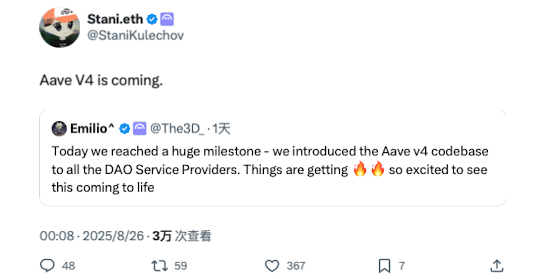
25日晚间,AAVE创始人Stani宣布即将上线AAVE V4的帖子迅速吸引了大量关注与讨论,而近期AAVE与WLFI关于7%代币分配提案的争议也在市场中闹的沸沸扬扬。
AAVE

一时间,市场的关注度都汇集在了AAVE这个老牌借贷协议上。

虽然AAVE和WLFI的争议暂时还没有一个最终定论,但在这场“闹剧”背后,似乎展现了一副别样的景象——“流水的新币,铁打的AAVE”。

随着越来越多新币的出现,在链上固定的代币借贷需求的刺激下,AAVE 无疑拥有着良好的基本面和催化剂。

此次V4更新,或许可以让我们看清其在DeFi领域未来的强大竞争力,以及其业务量不断上涨的根源所在。

从借贷协议到DeFi基础设施

当我们讨论AAVE V4时,首先需要理解一个关键问题,为什么市场对这次升级有期待?

从2017年的ETHLend,到今天386亿美元TVL的DeFi巨头,作为老牌协议,AAVE 过去的每个版本更新,实际上都在做优化,并且能够在不同程度上影响链上资产的流动性和玩法。

AAVE的版本史,其实就是DeFi借贷的进化史。

2020年初,V1上线时,整个DeFi锁仓量还不到10亿美元。AAVE采用流动池替代P2P模式,让借贷从"等待撮合"变成"即时成交"。这个改动帮助AAVE快速获得市场份额。

V2在2020年底推出,核心创新是闪电贷和债务代币化。闪电贷催生了套利和清算生态,成为协议重要收入来源。债务代币化则让头寸可以转让,为后续的收益聚合器铺平了道路。2022年的V3 主打跨链互通,让更多链上资产得以进入AAVE,成为多链流动性的连接器。

更重要的是,AAVE已经成为了定价基准。DeFi协议在设计利率时,都会参考AAVE的供需曲线。新项目在选择抵押率时,也会对标AAVE的参数。

不过尽管是基础设施,但V3的架构限制越来越明显。

最大的问题是流动性割裂。当前AAVE在以太坊有600亿美元TVL,Arbitrum只有44亿,Base更少。每条链都是独立王国,资金无法高效流动。这不仅降低了资金效率,也限制了小链的发展。

第二个问题是创新瓶颈。任何新功能都需要走完整的治理流程,从提案到实施往往需要数月。在DeFi快速迭代的环境下,这种速度显然跟不上市场需求。

第三个问题是定制化需求无法满足。RWA项目需要KYC,GameFi需要NFT抵押,机构需要隔离池。但V3的统一架构很难满足这些差异化需求。要么全部支持,要么全部不支持,没有中间地带。

这就是V4要解决的核心问题:如何让AAVE从一个强大但僵化的产品,变成一个灵活开放的平台。

V4 升级

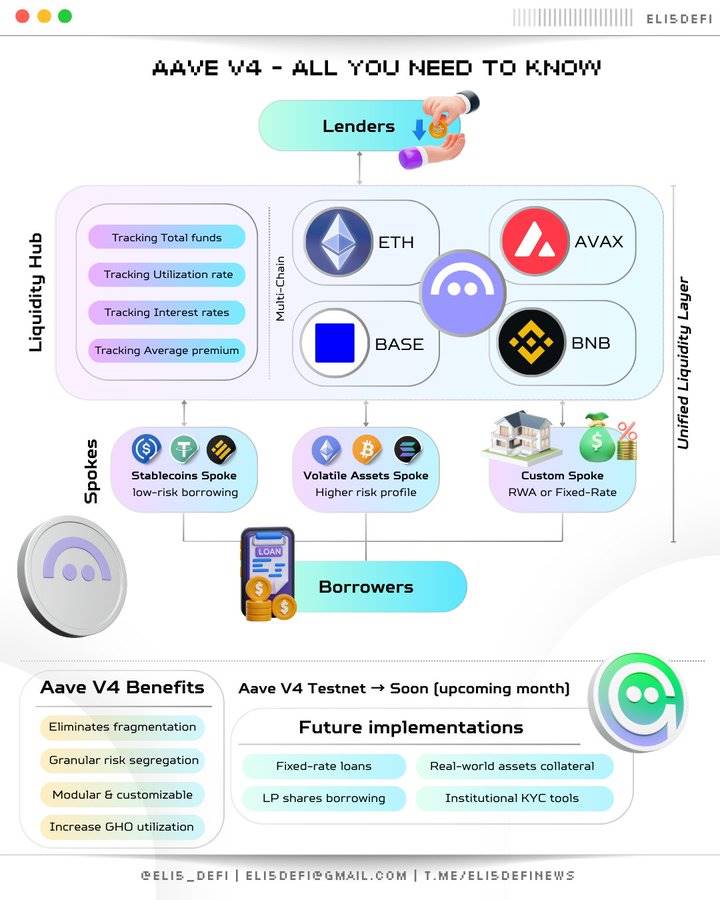
根据已公开的信息,V4的核心改进方向在于引入"统一流动性层"(Unified Liquidity Layer)采用Hub-Spoke模型来改变已有的技术设计甚至是商业模式。

AAVE

图源@Eli5DeFi

Hub-Spoke:解决既要又要的问题

简单来说,Hub汇集所有流动性,Spoke负责具体业务。用户永远通过Spoke交互,每个Spoke可以有自己的规则和风险参数。

这意味着什么?意味着AAVE不再需要用一套规则服务所有人,而是可以让不同的Spoke服务不同的需求。

比如,Frax Finance可以创建一个专门的Spoke,只接受frxETH和FRAX作为抵押品,设置更激进的参数;与此同时,一个"机构Spoke"可能只接受BTC和ETH,要求KYC,但提供更低的利率。

两个Spoke共享同一个Hub的流动性,但彼此风险隔离。

这种架构的精妙之处在于,它解决了"既要又要"的难题。既要深度流动性,又要风险隔离;既要统一管理,又要灵活定制。过去这些在 AAVE 里是矛盾的,但 Hub-Spoke 模型让它们可以共存。

动态风险溢价机制

除了 Hub-Spoke 架构,V4 还引入了动态风险溢价机制,革新了借贷利率的设定方式。

不同于 V3 的统一利率模型,V4 根据抵押品质量和市场流动性动态调整利率。例如,WETH 等高流动性资产享有基础利率,而 LINK 等波动性较高的资产需支付额外溢价。这种机制通过智能合约自动化执行,不仅提升了协议的安全性,还让借贷成本更公平。

智能账户

V4 的智能账户功能让用户操作更高效。过去,用户需要在不同链或市场间切换钱包,管理复杂头寸费时费力。现在,智能账户允许通过单一钱包管理多链资产和借贷策略,减少操作步骤。

一个用户可以在同一界面内调整以太坊上的 WETH 抵押品和 Aptos 上的借款,无需手动跨链转移。这种简化的体验让小额用户和专业交易者都能更轻松地参与 DeFi。

跨链与 RWA:扩展 DeFi 边界

V4 通过 Chainlink CCIP 实现秒级跨链交互,支持 Aptos 等非 EVM 链,让更多资产无缝接入 AAVE。比如,一个用户可以用 Polygon 上的资产抵押,在 Arbitrum 上借贷,全部在一笔交易中完成。此外,V4 整合现实世界资产(RWA),如 tokenized 国债,为机构资金进入 DeFi 开辟新路径。这不仅扩大了 AAVE 的资产覆盖,也让借贷市场更具包容性。

市场反应

虽然本周AAVE跟随加密市场大盘经历了暴跌,但其今日反弹力度明显强于其他头部DeFi标的。

AAVE代币在本周经历加密市场经历暴跌后24小时内全网交易量高达1872万美元,远远高于Uni的720万美元和Ldo的365万美元,反映出投资者对协议创新的积极响应,而交易活跃度提升也进一步增强了流动性。

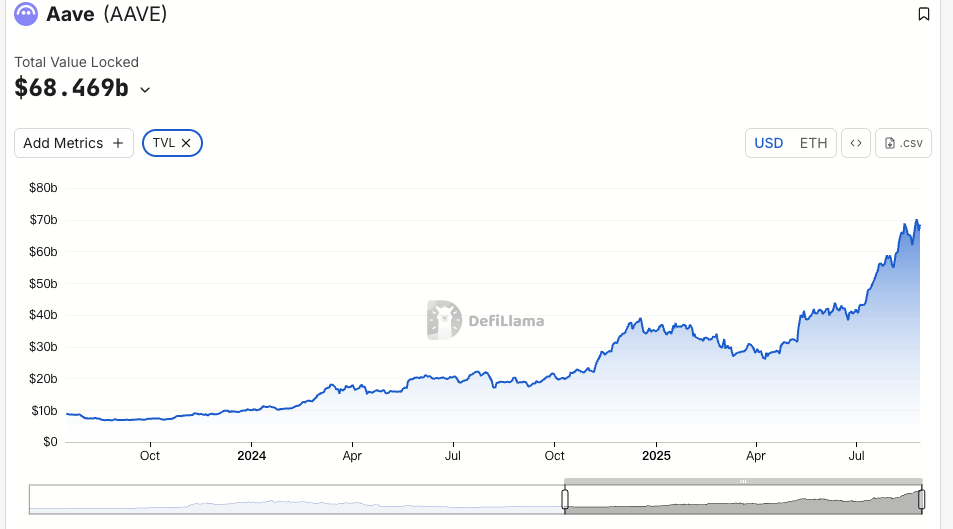
TVL则更直观体现了市场对其认可程度,相较于8月初,AAVE的TVL量级本月飙升19%至最高接近700亿美元关口创下历史新高,当前位于ETH链上TVL排名第一。这一增长远远超越DeFi市场平均水平,TVL的增加也从另一方面验证了AAVE V4多资产支持策略的有效性,或许暗示着机构资金已经悄然入场。
AAVE

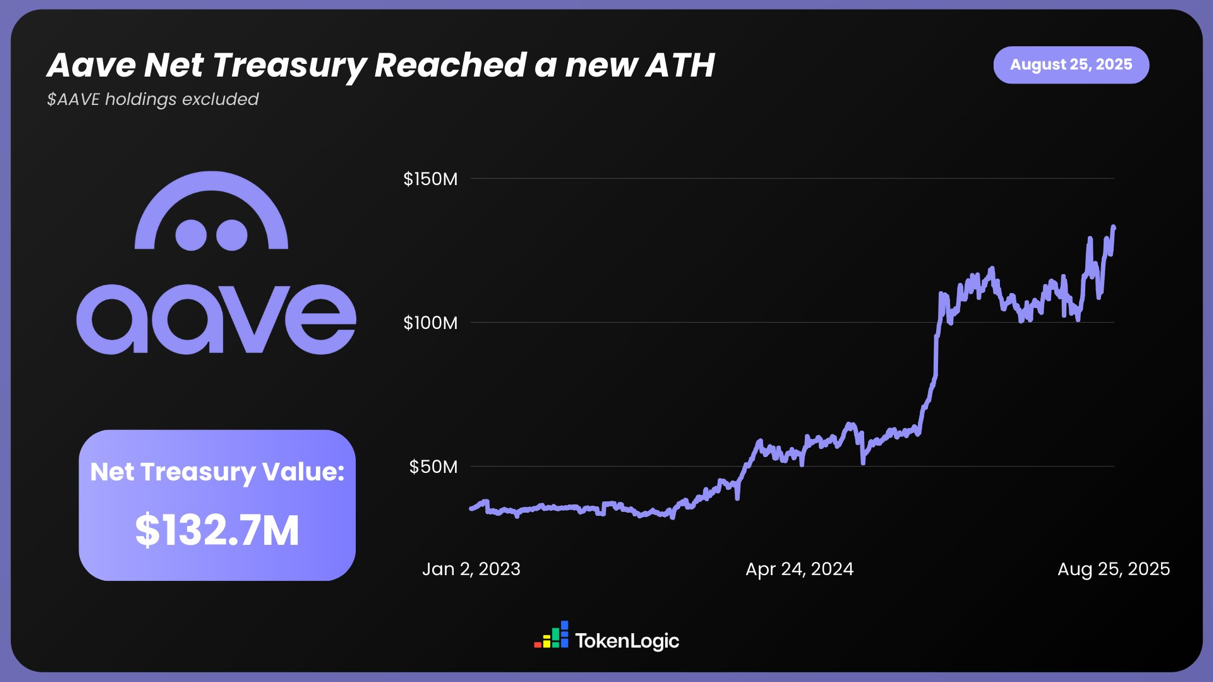
根据TokenLogic数据显示,AAVE净资产总额已经创下1.327亿美元(不包含AAVE代币持仓)的新高,在过去一年内增长约130%。
AAVE

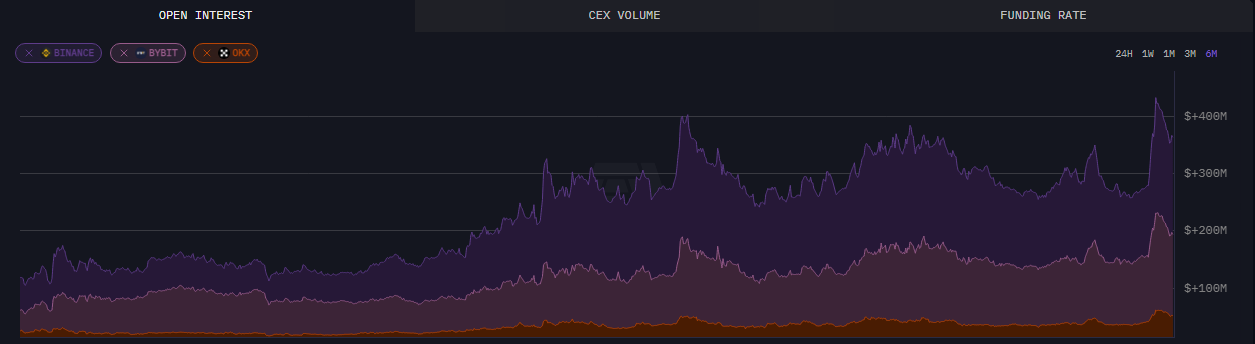
链上数据方面,截止至8月24日,AAVE上未平仓合约超4.3亿美元,创下六个月内新高。
AAVE

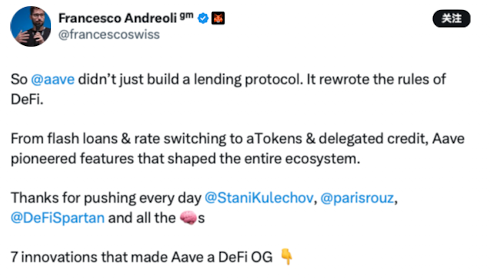
除了直观的数据,AAVE此次升级也引起了社区的广泛讨论,目前V4放出的前置信息也获得了大量的支持和认可,尤其是在资金利用率和可组合DeFi上,让市场看到了更多的可能性与潜力。
AAVE

Make DeFi great again

结合目前已经披露的更新内容来看,AAVE这次升级很有可能会带领DeFi市场再上一个台阶,模块化架构、跨链拓展和RWA整合这些升级亮点不仅点燃了市场热情,同样也推动了价格和TVL的上升。

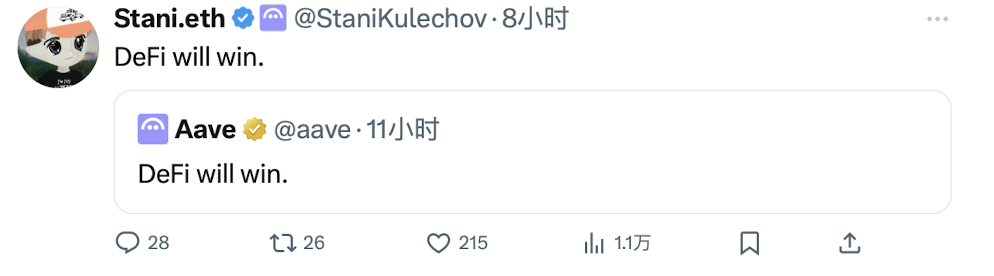
而其创始人Stani似乎也对V4升级后的对DeFi赛道的影响充满信心。
AAVE

或许在不远的未来,AAVE会借着加密牛市到来的流动性“东风”扶摇直上,开启无限可能。

Leituras Relacionadas

End of the 'Gray Era' for Hong Kong and US Stock Trading Accounts: Where Can Your Money Go Now?

Hong Kong and US stock “grey account opening era” ends, where can your money go? In a coordinated regulatory crackdown starting May 22nd, Hong Kong's SFC and China's securities regulator have targeted the previously common but legally ambiguous practice of mainland Chinese investors opening accounts with Hong Kong brokers to trade Hong Kong and US stocks. The SFC issued a stern circular after a review of 12 brokerages, citing major deficiencies including inadequate due diligence, acceptance of suspicious or forged documents, and weak management of cross-border relationships. New requirements mandate mainland clients to submit a written declaration confirming their investment funds originate from *outside* mainland China, the account has never been closed for using suspicious documents, and agreeing to information disclosure. Brokers must immediately close accounts opened with suspicious documents and dormant accounts. Simultaneously, Chinese authorities launched a two-year campaign to rectify illegal cross-border securities activities. Key internet brokers like Futu, Tiger Brokers, and Longbridge are facing penalties, with existing accounts allowed only to sell/withdraw funds, not add new ones. The impact is immediate. Reports from social media and financial news outlets confirm that individuals traveling to Hong Kong to open accounts are now required to sign the new declaration. However, even after signing, applications are frequently rejected. The declaration shifts compliance responsibility to the client and acts as a filter, as most mainland investors' funds do not legally meet the "from outside China" criterion. Major brokers like Futu and Tiger have stopped accepting new mainland clients. A few, such as uSmart Securities, Fosun Wealth, and Cheerful Investment, still offer limited channels, but approvals have tightened significantly. Crucially, funding must now come exclusively from the investor's own bank account in Hong Kong or a qualified jurisdiction, blocking previous workarounds like using money changers or stablecoins. For mainland investors, compliant pathways still exist but are narrower. Individuals with overseas status (students, work visa holders) and verifiable offshore funds may still qualify. Official channels like Stock Connect, QDII, and the Cross-boundary Wealth Management Connect remain fully compliant options, albeit with product and quota limitations. On-chain alternatives exist but carry their own regulatory uncertainties and often exclude mainland users. The crackdown signals the end of the lax expansion period for Hong Kong brokers targeting mainland clients. While investment opportunities persist, the era of easy, low-compliance access is over. Investors must now carefully assess their eligibility and understand that signing the new declaration carries personal legal liability.

Odaily星球日报Há 18m

End of the 'Gray Era' for Hong Kong and US Stock Trading Accounts: Where Can Your Money Go Now?

Odaily星球日报Há 18m

SpaceX's $1.75 Trillion IPO: A Quick Guide to 17 Related Stocks

**Title: SpaceX's $1.75 Trillion IPO: Analysis of 17 Related Stocks** SpaceX is set to IPO on Nasdaq with a $1.75 trillion valuation. The real value driver is Starlink, contributing 61% of Q1 revenue with high margins. Its valuation heavily depends on future execution, including user growth despite falling ARPU. Key stocks have already surged pre-IPO. Tesla (TSLA, +10%) is a primary beneficiary due to deep integration with SpaceX in chip design and AI. Rocket Lab (RKLB, +89%) is seen as a "mini-SpaceX," but faces risk from potential Neutron rocket delays. AST SpaceMobile (ASTS) competes in the same satellite-to-phone market as Starlink. Firefly (FLY, +70%) is a strong government contractor in lunar services. Partners like EchoStar (SATS), Planet Labs (PL), and T-Mobile (TMUS) will see revaluation. Suppliers like Qualcomm (QCOM, +57%) are critical ecosystem "picks and shovels." Investment vehicles like DXYZ (+80%) hold significant SpaceX stakes but trade at high premiums, which may collapse post-IPO. Redwire (RDW) is highlighted as an under-the-radar "pick and shovel" play in space components, with growth in defense contracts and microgravity pharmaceuticals. The article warns that much of the positive news is already priced in, and a post-IPO sell-off is possible. Large IPOs often underperform initially. Key risks include Starship delays, ARPU decline, and unforeseen black swan events affecting Elon Musk or space operations. Investors are advised to focus on companies with solid fundamentals and manage overall sector exposure carefully.

marsbitHá 21m

SpaceX's $1.75 Trillion IPO: A Quick Guide to 17 Related Stocks

marsbitHá 21m

Conversation with VanEck CEO: Memory Chip Stocks Are a Bubble, Bitcoin Will Stay but Token Ecosystems Will Disappear

In this podcast, VanEck CEO Jan van Eck discusses his investment outlook centered on three key long-term ("10-year macro") themes: AI-driven compute demand, India's economic rise, and excessive government debt in developed nations. Regarding AI and semiconductors, van Eck believes Nvidia has transformed into a foundational "host" for AI infrastructure, possessing deep moats in software, scale, and power efficiency, making it a core holding. However, he views the recent surge in memory chip stocks as a bubble driven by temporary supply-demand imbalances and pricing power, lacking Nvidia's competitive durability. On asset management, he emphasizes that while ETFs are scale-driven tools, the decisions on which ETFs to own and how to allocate remain highly active. He expresses greatest concern over fixed-income market illiquidity and the risk of a loss of confidence in government debt sustainability. Van Eck is bullish on gold's long-term role as a global monetary alternative and highlights the dramatic policy-driven growth in nuclear energy investment. He is strongly positive on India due to its demographic trends and pro-business reforms. Discussing crypto, he labels 2026 the "year of the corporate-controlled chain," where traditional finance adopts blockchain's best features (like 24/7 operation and programmability) but retains control. He predicts a permanent "crypto winter" for many projects, with only Bitcoin, stablecoins, and the core blockchain concept surviving long-term. He sees the U.S. stablecoin bill as marginally impactful, enabling tech firms to compete with, but not replace, banks. Finally, he views the upcoming SpaceX IPO as a significant, positive liquidity event for markets and advises investors to maintain a long-term, macro perspective when making asset allocation decisions.

marsbitHá 32m

Conversation with VanEck CEO: Memory Chip Stocks Are a Bubble, Bitcoin Will Stay but Token Ecosystems Will Disappear

marsbitHá 32m

In the Era of Agent Users, Where Does Crypto Value Flow?

Title: Who Makes Money from Agents? The rise of AI Agents as potential blockchain users raises a crucial question: if they become the next billion users, who will capture the value? Traditional crypto value capture theories—like "fat protocols" (where value accrues to the base layer) and "fat applications" (where value accrues to user-facing apps)—assume human users who value UX, brand, and convenience. Agents, however, operate differently: they interact via APIs, have no brand loyalty, and can switch services with near-zero cost. This shift could disrupt existing value flows. Applications might become "headless," offering their routing and infrastructure as APIs to Agents. Alternatively, Agents might bypass intermediaries entirely, allowing protocols to regain value capture ("fat protocols" reborn). A more extreme scenario is that Agents, being purely rational and cost-sensitive, could commoditize the entire stack, compressing margins toward marginal cost and turning crypto into a low-margin utility. However, Agents may not just amplify existing activities; they could enable entirely new ones—like continuous, sub-penny portfolio rebalancing, machine-to-machine commerce, and new market types only viable at automated speeds. This expands the economic pie rather than just redistributing it. Ultimately, the key question for builders is: what will make an Agent return to your service instead of a cheaper alternative? The answer may not be UX but factors like liquidity, latency, settlement guarantees, or a yet-unnamed business model. As humans and Agents will coexist as users, value capture may split: "fat apps" for human-facing services, and a new, evolving model for the Agent-dominated layer.

marsbitHá 1h

In the Era of Agent Users, Where Does Crypto Value Flow?

marsbitHá 1h

Trading

Spot
Futuros

Artigos em Destaque

Como comprar AAVE

Bem-vindo à HTX.com!Tornámos a compra de Aave Protocol (AAVE) simples e conveniente.Segue o nosso guia passo a passo para iniciar a tua jornada no mundo das criptos.Passo 1: cria a tua conta HTXUtiliza o teu e-mail ou número de telefone para te inscreveres numa conta gratuita na HTX.Desfruta de um processo de inscrição sem complicações e desbloqueia todas as funcionalidades.Obter a minha contaPasso 2: vai para Comprar Cripto e escolhe o teu método de pagamentoCartão de crédito/débito: usa o teu visa ou mastercard para comprar Aave Protocol (AAVE) instantaneamente.Saldo: usa os fundos da tua conta HTX para transacionar sem problemas.Terceiros: adicionamos métodos de pagamento populares, como Google Pay e Apple Pay, para aumentar a conveniência.P2P: transaciona diretamente com outros utilizadores na HTX.Mercado de balcão (OTC): oferecemos serviços personalizados e taxas de câmbio competitivas para os traders.Passo 3: armazena teu Aave Protocol (AAVE)Depois de comprar o teu Aave Protocol (AAVE), armazena-o na tua conta HTX.Alternativamente, podes enviá-lo para outro lugar através de transferência blockchain ou usá-lo para transacionar outras criptomoedas.Passo 4: transaciona Aave Protocol (AAVE)Transaciona facilmente Aave Protocol (AAVE) no mercado à vista da HTX.Acede simplesmente à tua conta, seleciona o teu par de trading, executa as tuas transações e monitoriza em tempo real.Oferecemos uma experiência de fácil utilização tanto para principiantes como para traders experientes.

407 Visualizações TotaisPublicado em {updateTime}Atualizado em 2025.03.21

Como comprar AAVE

Discussões

Bem-vindo à Comunidade HTX. Aqui, pode manter-se informado sobre os mais recentes desenvolvimentos da plataforma e obter acesso a análises profissionais de mercado. As opiniões dos utilizadores sobre o preço de AAVE (AAVE) são apresentadas abaixo.

活动图片