Bitcoin (BTC) starts a new week in the shadow of a new geopolitical conflict — what are the main hurdles that investors face?
In what has become an unrecognizable macro-environment compared to even days ago, Bitcoin, like many other assets, is feeling the pressure.
Russia’s invasion of and subsequent war against Ukraine is wreaking havoc on global markets, and developments can upend sentiment within hours or just minutes.
The timing has hit Bitcoin, too — its “safe haven” quality is seeing a serious test, as investors look for safety and fiat bagholders look for an exit.
As the overriding influence this week, Cointelegraph takes a look at what might lie in store for Bitcoin in the short term as it holds up against complex and almost surreal macro events.
Five topics for BTC investors this week can be found below.
Ukraine war dominates
It goes without saying that the Russia-Ukraine conflict is the main driver of market performance this week.
The situation, having only arisen in its current form five days ago, remains in a state of constant flux — sanctions keep coming, both sides and their allies continue to knuckle down, markets react to new threats and probabilities.
Chief among them is Russia’s economy, which is bracing for turmoil on Monday. Stock trading has been pushed back to at least 3 pm local time, and the prognosis is bleak for its currency, the ruble, which is already trading at record lows.
Talks are scheduled to begin Monday, and any glimmer of hope could cause an about-turn in the short-term outlook and thus change the face of markets.
While uncertainty rules, however, everyone will be looking for the ultimate safe haven, and Bitcoin’s use — whether by ordinary Russians and Ukrainians or their governments — is already a talking point.
As Cointelegraph reported, Ukraine’s army has already raised millions of dollars in crypto aid, and far-reaching sanctions against Moscow could yet facilitate a pivot to Bitcoin as an economic tool.
The idea has not passed the establishment by — Mykhailo Fedorov, Ukraine’s deputy president, called on exchanges to block Russian and Belarusian users’ funds.
“Bitcoin is like a knife to a surgeon or a knife to a criminal,” podcast host Preston Pysh wrote at the weekend, summing up the situation.
“Like any valuable technology throughout time, its value comes from the intention behind its use.”
Markets, meanwhile, will likely be driven depending on shifts in events on the ground and knock-on effects for governments.
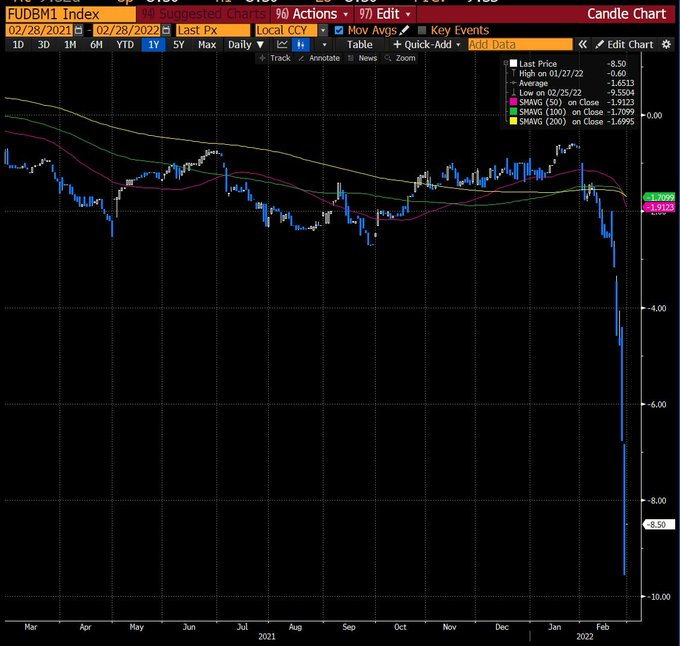
So far, oil — but not Russian oil — has been one of the few beneficiaries of the war, while Bitcoin has managed to remain fairly stable — unlike gold, which first gained rapidly and then lost all its newly-won ground.
Bitcoin and altcoins’ correlation to traditional stock markets remains, however, and low timeframes are thus apt to provide a real headache for traders regardless of what turns the war takes.
Spot price action faces macro force majeure
With traditional markets poised to be extremely volatile on their respective Monday opens, guessing how Bitcoin will fare on the shortest timeframes is a real problem.
Correlations aside, Bitcoin has so far managed to remain in a fairly tight range, and $40,000 is a clear resistance zone for bulls to beat.
The problem, however, is that any more dramatic move could ultimately come as a result of major macro changes and thus be an unreliable longer-term signal.
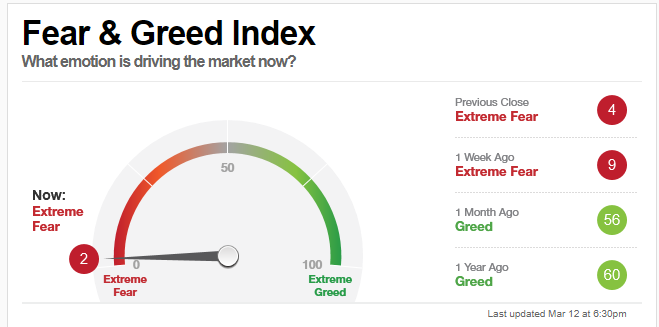
“Down about 4% on Sunday am 5:00EST (Feb. 27) from Friday, Bitcoin is indicating a rough week for risk assets,” Mike McGlone, chief commodity strategist at Bloomberg Intelligence warned.
A popular Twitter account meanwhile noted that current levels represent the so-called point of control (PoC) for the past 15 months, with $38,000 seeing large volumes relative to other price points in the current range.
“When it comes to Bitcoin, the playing field seems quite simple,” a more hopeful Michaël van de Poppe argued.
“Consolidation happening after a bullish move during the past week. If you truly want to see more momentum, then the corrections shouldn't be that deep so $38.1-38.2K must hold. Then, we could be going to $44K.”
With U.S. markets still to open at the time of writing, the picture may well change entirely before Monday is out.
A comparison to March 2020 may be useful — at that time, Bitcoin first fell in line with global markets, only to rebound as an asymmetric bet that took hodlers on a bull run never seen before for the next nine months.
Another month, another red candle
Sunday’s close did not really go according to plan for Bitcoin market observers.
A last-minute dive took away the chances of closing the week and the month above $38,500, and thus gave the history books their first four straight monthly red candles since the 2018 bear market.
Already an unexpected comedown, last week’s events appear so far to only be making things worse for Bitcoiners, who have yet to see the cryptocurrency branch out on its own, away from traditional assets.
Also causing a headache for analysts is the monthly chart relative to its 21-month exponential moving average (EMA), which could be apt to disappear as support should losses continue.
The 21 EMA being broken has been a common feature of macro bear trends for Bitcoin, with February mercifully avoiding a repeat performance.
“Tomorrow's Monthly Close is critical. If we close below $37,000 (purple 21m/EMA) that gives us the same bearish signal as all other previous Macro Downtrends,” analyst Kevin Svenson warned against a chart showing the level.

BTC/USD 1-month candle chart (Bitstamp) with 21EMA. Source: TradingViewBitcoin previously failed to reclaim two key moving averages as a pretext for retaking higher resistance levels nearer all-time highs from November. The result, analyst Rekt Capital warned at the time, could be a potential revisiting of the range low at $28,000.
On the plus side, Bitcoin’s 200-week moving average, a benchmark that few believe will be challenged as support, crossed $20,000 for the first time this weekend.
Difficulty steadies the ship
Turning away from geopolitics, investors have every reason to keep faith in the strength of the Bitcoin network.
Despite price pressures and uncertainty on practically every timeframe, miners keep mining, and hash rate and difficulty have kept climbing.
This week may see a challenge to the status quo — hash rate is steady, but difficulty is due to decrease for the first time in 12 weeks to take the latest changes into account.
This is nothing “bad” as a phenomenon — the 1.25% decrease is modest by Bitcoin’s standards and likely reflects circumstantial changes in miner participation, rather than the start of a new trend.
According to monitoring resource MiningPoolStats, hash rate, for its part, remains above 200 exahashes per second (EH/s), a sea change from even a matter of months ago when Bitcoin hit its all-time highs.

Bitcoin hash rate chart (screenshot). Source: MiningPoolStatsThe divergence of fundamentals from price has been extensively covered over the past year.
The question now is whether price will follow hash rate as in years gone by.
Sentiment predicts the worst
Bitcoin, true to its mantra, does not seem to have “liked” the emergence of a new armed conflict in Europe.
Related: Top 5 cryptocurrencies to watch this week: BTC, LUNA, AVAX, ATOM, FTM
Its potential roles aside, the largest cryptocurrency is not enjoying a sentiment boost as a result of recent events.
According to the Crypto Fear & Greed Index, a sentiment indicator which has seen increasing attention in 2022, the market is getting rapidly more nervous.
BTC/USD saw a relatively small dip overnight into Monday, but that was still enough to drag the Index back into its “extreme fear” territory — from 26/100 on Sunday to 20/100, its lowest since Feb. 22.
For context, January’s local lows of $32,800 produced a reading of 11/100 for Fear & Greed, this level often constituting macro lows in recent years.

Crypto Fear & Greed Index (screenshot). Source: Alternative.meReacting, commentators nonetheless argued that the price decrease into Monday could be a forewarning by the free market that doom and gloom will reign supreme come the start of TradFi market trading.
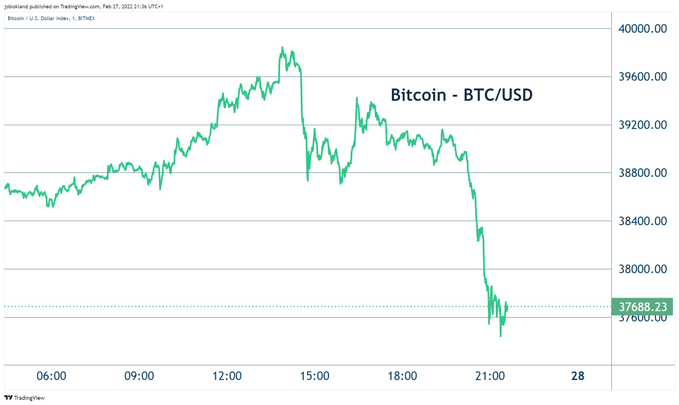
Crypto’s traditional counterpart, the Fear & Greed Index, was meanwhile also in “extreme fear” mode last week before a recovery.