3 Scenarios To Watch Out As Dogecoin Price Plays Out Its Thin Cloud Behavior

bitcoinistPublicado em 2026-04-15Última atualização em 2026-04-15

Resumo

Dogecoin's price is exhibiting a "Thin Cloud Behavior" on the 4-hour chart, indicating low volatility and a lack of directional commitment. A crypto analyst outlines three potential scenarios. The first is a bearish breakdown below the cloud's support at $0.092, which could trigger a sustained downtrend toward $0.09. The second is a bullish breakout above $0.094, turning the cloud green and signaling the start of a larger upward move. The third scenario is continued "chop," where the price moves sideways within the cloud, requiring investors to wait for clearer directional momentum. Until a definitive move occurs, the advice is to treat the market with caution.

The current Dogecoin performance trend has highlighted the appearance of a rather interesting behavioral pattern. This has to do with the zig-zag movement of the meme coin through the last few months, and depending on the direction of the next move, it could determine how the Dogecoin price could play out. Given this, a crypto analyst has given three different scenarios that could end up playing out for the digital asset soon.

Dogecoin Price Displays Kumo Cloud Behavior

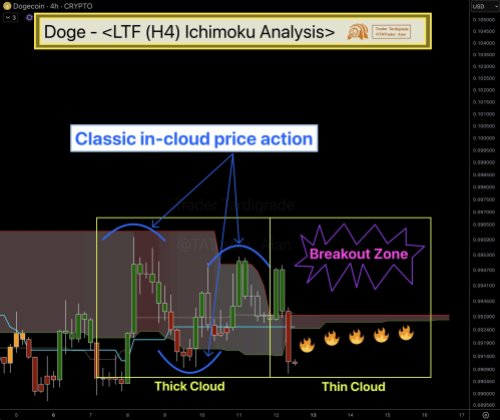
Crypto analyst Trader Tardigarde pointed out a rather ineresting formation on the Dogecoin price chart using the 4-Hour chart. According to the analysis, the current Dogecoin up and down movement suggests the appearance of a Thin Cloud Behavior.

As Trader Tardigrade explains, the Dogecoin price movements through this thin cloud suggests that the meme coin is not seeing a lot of movement. This means that there is nothing that is currently blocking the price from moving. But the interesting part of this is that the price is not blocked in either direction. Thus, Dogecoin could push in any direction from here.

As a result, there are three scenarios that could play out for the cryptocurrency at this point. The first of these is the bearish one that could lead to a sustained downtrend. The Thin Cloud current lies between $0.092 and just below $0.093. If the price breaks below the bottom, then it could trigger a breakdown.

This breakdown would lead to the cloud actually thickening, eliminating the thin cloud currently being seen. Additionally, it would push the price further down, possibly breaking below the $0.09 level once again. However, there is still the possibility of a bullish scenario.
Source: X

The second scenario highlighted by Trader Tardigrade is the the breakout, when the Dogecoin price successfully surges above the thin cloud. Such a move would put it in the breakout zone above $0.094, pushing the cloud from red to green. This would then be the first step before an even bigger move.

Last but not least is the third scenario, which the crypto analyst refers to as ‘Chop.’ In this case, the Dogecoin price would continue to revolve around the current thin cloud without any meaningful breakout in either direction. In this case, investors would have to wait for directional clarity to happen.

For now, the crypto analyst says that the Dogecoin price hasn’t committed to a single direction. And until it does, Trader Tardigrade says to “treat Kumo like air.” Thus, wait for the wind to change before taking a position.

DOGE bulls push for a recovery | Source: DOGEUSDT on Tradingview.com

Perguntas relacionadas

QWhat is the 'Thin Cloud Behavior' mentioned in the Dogecoin price analysis?

AThe 'Thin Cloud Behavior' refers to a pattern on the price chart where Dogecoin is moving in a zig-zag pattern within a narrow range, indicating a lack of significant price movement and no major resistance or support blocking its price in either direction.

QAccording to Trader Tardigrade, what are the three possible scenarios for Dogecoin's price movement?

AThe three scenarios are: 1) A bearish breakdown below the cloud leading to a sustained downtrend, 2) A bullish breakout above the cloud triggering a potential upward move, and 3) A 'Chop' scenario where the price continues to move sideways around the current range without a clear direction.

QWhat price levels define the current Thin Cloud for Dogecoin?

AThe Thin Cloud currently lies between the price levels of $0.092 and just below $0.093.

QWhat would a bullish breakout for Dogecoin price look like according to the analysis?

AA bullish breakout would occur if the Dogecoin price successfully surges above the thin cloud, breaking past the $0.094 level. This would change the cloud from red to green and could be the first step before a larger upward move.

QWhat is the analyst's advice for traders until Dogecoin commits to a direction?

AThe analyst advises traders to 'treat Kumo like air,' meaning they should wait for the wind to change (wait for a clear directional move) before taking a position, as the price hasn't committed to a single direction yet.

Leituras Relacionadas

Splashing Out 27 Billion Yuan, OpenAI Establishes New Company to Accelerate AI Deployment

On May 11th, OpenAI announced the formation of a new company, "OpenAI Deployment Company," with an initial investment of over $4 billion (approximately 27.2 billion RMB). This venture aims to help businesses build and deploy AI solutions. OpenAI is also acquiring the AI consulting firm Toromo to rapidly scale the deployment company's capabilities. This new entity, majority-owned by OpenAI, brings together 19 investment, consulting, and system integration partners, led by TPG with co-lead founding partners including Advent International, Bain Capital, and Brookfield. OpenAI's Chief Revenue Officer, Denise Dresser, stated that while AI is becoming increasingly capable, the current challenge lies in integrating these systems into core business infrastructure and workflows. The deployment company is designed to bridge this gap and translate AI capabilities into operational impact. This move comes as OpenAI emphasizes the next competitive phase will depend on the efficiency of deploying AI in real business scenarios. The company reports over 1 million businesses already use its products and APIs. OpenAI is significantly increasing its investments in computing power, with co-founder Greg Brockman stating the company expects to spend $50 billion on compute this year, a dramatic increase from $3 million in 2017. The announcement follows OpenAI's recent completion of a record $122 billion funding round in late March, led by Amazon, Nvidia, and SoftBank, valuing the company at $852 billion post-money. Major strategic investors committed $110 billion as a base for this round. Concurrently, OpenAI is advancing its core model development. It has shifted focus from its Sora video generator to developing advanced robotics and AI models that interact with the physical world. It has also begun allowing select users access to a new model specialized in identifying software vulnerabilities and is reportedly preparing to launch an enhanced image generation model in the coming weeks. According to reports citing founder Sam Altman, OpenAI is considering an IPO as early as 2027, with a potential valuation around $1 trillion.

marsbitHá 4m

Splashing Out 27 Billion Yuan, OpenAI Establishes New Company to Accelerate AI Deployment

marsbitHá 4m

The Essence of AI Layoffs: Why More AI Adoption Leads to More Corporate Anxiety?

The author, awaiting potential inclusion on an 8000-person layoff list, analyzes the true nature of recent "AI-driven" layoffs. They argue that while AI use, particularly tools like Claude for code generation, has skyrocketed and boosted developer output (e.g., 2-5x more code commits), this has not translated into proportional business growth or revenue. The core issue is a misalignment between increased "Input" (code) and tangible "Outcomes" (user value, revenue). AI acts as a costly B2B SaaS, inflating operational expenses without guaranteed returns. Two key problems emerge: 1) The friction that once filtered out bad ideas is gone, as AI allows cheap pursuit of even weak concepts. 2) Organizational "alignment tax"—the difficulty of coordinating across teams—becomes crippling when development velocity outpaces consensus-building. Thus, layoffs serve two immediate purposes: 1) To offset ballooning AI costs (Token consumption) and maintain cash flow, as rising input costs without outcome growth destroys unit economics. 2) To reduce organizational bloat and alignment friction by simply removing teams, thereby speeding up execution in the short term. Therefore, these layoffs are fundamentally caused by AI, even if AI doesn't directly replace roles. They represent a painful correction until companies learn to convert AI-driven productivity into real business outcomes and streamline organizational coordination to match the new pace of work. The cycle will continue until this learning curve is mastered.

marsbitHá 1h

The Essence of AI Layoffs: Why More AI Adoption Leads to More Corporate Anxiety?

marsbitHá 1h

Trading

Spot
Futuros
活动图片