京东招聘DeFi专家:稳定币只是冰山一角,PayFi才是深海蓝图

marsbitPublicado em 2025-08-10Última atualização em 2025-08-11

一份招聘广告,有时比一份年度财报更能揭示一家公司的战略意图。

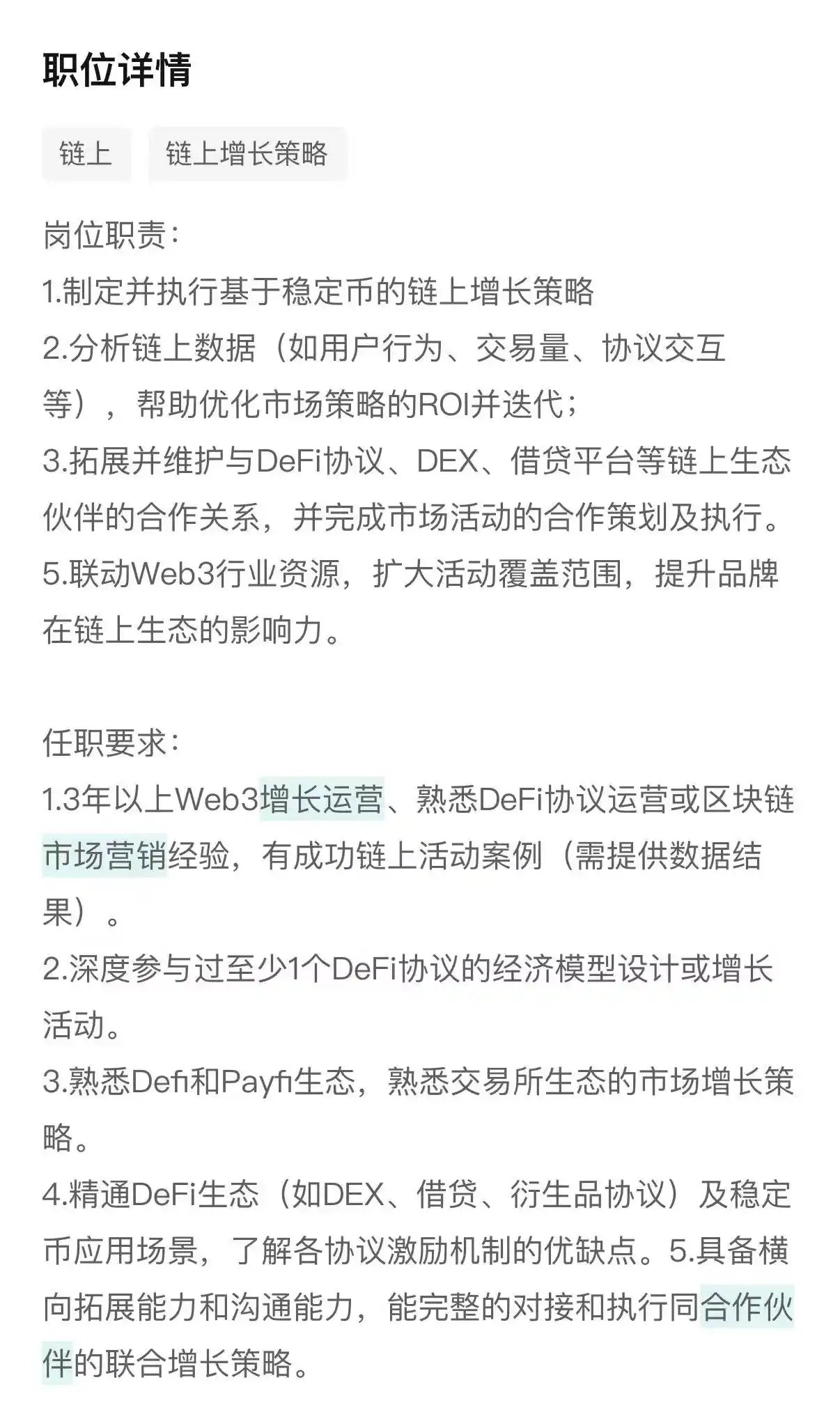
2025年8月,京东科技的一则招聘信息正是如此。它没有出现在主流招聘网站的首页,而是在Web3的小圈子里悄然流传。引人注目的并非“稳定币链上活动策划”这个职位名称本身,而是其堪称“加密原生”的任职要求:“深度参与至少一个DeFi协议的经济模型设计”、“精通DEX、借贷、衍生品协议”。
香港

这并非在寻找一位优化内部支付的金融科技专家,而是在“猎寻”一名真正的链上战略家。当一家年营收过万亿、以实体零售和供应链为根基的互联网巨头,开始公开物色能驰骋于去中心化世界的人才时,其释放的信号已再清晰不过:京东正准备将棋子,落在全球化、无需许可的Web3棋盘上。

香港“东风”已至,京东顺势入局

京东此举并非发生在真空里。招聘动作的时机,与香港一项关键的监管变革形成了精准的呼应。

就在招聘信息浮出水面的前几天——2025年8月1日,香港酝酿已久的《稳定币发行人发牌制度》正式生效。这意味着,香港金融管理局(HKMA)在经过多轮咨询和沙盒测试后,为全球的稳定币运营商铺开了一张合规的、规则明确的“迎宾毯”。因此,京东的这次“招兵买马”,与其说是一次向未知领域的探索,不如说是一次计算精准的落子,目标直指这块刚刚被官方认证的、极具战略价值的全球金融新大陆。

香港财经事务及库务局局长许正宇此前在公开场合多次强调:“在确保监管和风险可控的前提下,我们支持虚拟资产市场的稳慎发展,并视稳定币为连接传统金融与虚拟资产市场的关键桥梁。”

这股东风,对于像京东这样拥有庞大中国内地背景,又渴望链接全球市场的科技公司而言,来得恰逢其时。它提供了一个完美的“出海口”——一个在法律上明确、在地理上邻近、在文化上相通的战略支点。通过在香港设立合服规主体,京东便可以合法地发行锚定法币(如离岸人民币CNH或港币HKD)的稳定币,从而绕开中国内地对加密货币的严格管制,直接参与全球的链上经济活动。

京东的招聘紧随法规生效之后发布,这并非巧合,而是一场蓄谋已久的“顺势而为”。棋盘已经备好,京东显然不想只做看客。


PayFi:超越支付的“金融乐高”

如果说香港的合规环境是京东稳定币项目的“天时”,那么职位描述中一个不起眼的词——PayFi,则揭示了其真正的“地利”与核心野望。

PayFi,即Payment Finance(支付金融),是一个源于加密原生世界的概念。它远不止于“用加密货币支付”这么简单,其核心是通过智能合约,将支付行为本身与复杂的金融服务无缝结合,赋予每一笔资金流动的可编程性。

想象一下京东业务中的一个场景:一家为京东供货的中小企业,过去需要等待长达90天的账期才能收到回款,资金压力巨大。在PayFi模式下,会发生什么?

当京东确认收货后,系统可以生成一张代表这笔应收账款的链上凭证(NFT或同质化代币),并立即发送给供应商。供应商无需等待90天,而是可以立刻将这张“数字汇票”在DeFi借贷协议中作为抵押品,获得即时流动性;或者,它甚至可以被拆分、交易,作为支付给上游原材料供应商的款项。整个过程由代码自动执行,高效、透明且成本极低。

这正是Real World Assets(RWA,真实世界资产)代币化与PayFi结合的威力,也是2025年加密行业最激动人心的叙事之一。资产管理巨头富兰克林邓普顿的CEO Jenny Johnson就曾断言:“我们相信,将真实世界资产代币化,将重塑整个金融服务业。这是区块链技术最重大的应用之一。”

对于拥有海量商家、复杂供应链网络和亿万用户的京东而言,其内部蕴藏着价值万亿的“真实世界资产”——应收账款、仓单、物流订单、消费者信用。将这些资产通过稳定币和PayFi的模式在链上盘活,无异于打通了全身经络,其所能释放的能量将是指数级的。这不仅是对现有供应链金融业务的降本增效,更是创造了一个全新的、可编程的金融基础设施。


“两栖作战”:巨头们不同的Web3路径

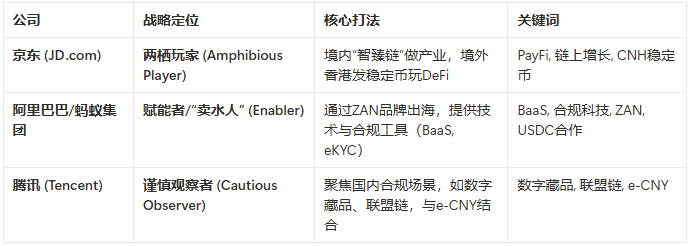
京东对稳定币和DeFi的明确指向,也使其在中国科技巨头的Web3探索中,走出了一条截然不同的道路。如果我们横向对比,会发现一幅有趣的画面:
香港

如上表所示,阿里巴巴旗下的蚂蚁集团,在Web3的布局更像是“卖水人”。其在香港推出的ZAN品牌,专注于为Web3开发者提供e-KYC(电子化身份验证)、AML(反洗钱)等合规技术组件和BaaS(区块链即服务)。其策略是“赋能”,帮助别人更好地“淘金”,而不是自己亲自下场。近期传出其专有链计划整合美元稳定币USDC的消息,也印证了其倾向于与成熟生态合作,而非另起炉灶的思路。

腾讯则更为谨慎,其动作大多围绕在联盟链和数字藏品等国内政策明确的领域,与公链世界保持着相当的距离。

在这样的背景下,京东的策略显得尤为独特和进取。它没有满足于只做技术服务商,而是选择了一条“两栖作战”的道路:

  • 对内(Inland): 其自研的“智臻链”继续在许可环境下深耕产业区块链,服务于防伪溯源、数字存证等,拥抱监管,对接数字人民币(e-CNY),做强合规的“产业数字化”基本盘。
  • 对外(Offshore): 则利用香港的窗口,亲自下场成为一名“玩家”,发行自己的稳定币,运营自己的链上生态,直接在DeFi的汪洋中捕鱼,探索“金融资产化”的星辰大海。

这种双线并行的策略,既保证了国内业务的稳定与合规,又为集团的未来打开了无限的想象空间。


从电商帝国到链上经济体

京东的这一步,标志着一个重要的转折点。它预示着顶级Web2巨头与Web3的融合,正在从理论探讨和边缘试水,走向核心业务的深度整合。

过去,人们总在讨论Web3将如何“颠覆”Web2。但京东的案例或许揭示了另一种可能:并非颠覆,而是“升维”。Web2巨头们并不会轻易被取代,它们会利用自身庞大的用户基础、丰富的应用场景和雄厚的资本,吸纳Web3的技术和理念,进化成一种新的、更强大的混合形态。

当然,前路并非坦途。从招聘一个职位到真正建立一个繁荣的链上生态,京东需要跨越技术集成、金融合规、市场教育和用户习惯等多重障碍。它将面对的不仅是传统金融机构的审视,还有来自加密原生世界的激烈竞争。

但无论如何,当京东这艘万亿级的商业航母开始调整航向,驶入DeFi的深水区时,整个行业都应该密切关注。因为这不仅仅关乎一家公司的未来,更可能是在为我们描绘一幅蓝图:一个电商帝国,如何通过稳定币这座桥梁,最终演化为一个高效、透明、全球化的链上经济体。那一天,交易的终点将不再是支付完成,而是另一段金融价值创造的开始。


Leituras Relacionadas

Wang Chuan: When the neighbor Lao Wang earned thirty times from investing in memory storage stocks, how can you still avoid anxiety (6) - The trap of homogeneous products

The article, "Wang Chuan: How to Remain Unanxious After Neighbor Lao Wang's Thirty-Fold Gain on Storage Stocks (Part 6) - The Trap of Commoditized Goods," analyzes the cyclical and perilous nature of the data storage industry through historical and current case studies. It begins with the example of Iomega, whose Zip drives led to a stock surge of over 160x in the mid-1990s before collapsing over 97% from its peak due to competition from cheaper CD-R technology. This pattern is characteristic of storage, where products like DRAM are highly commoditized, leading to extreme price volatility. The sector has seen prices crash over 80% multiple times, with companies often facing bankruptcy. The core dynamic is "elastic demand facing heavy-asset, long-cycle, rigid supply." High prices attract new capacity, but the long lead time means supply eventually overshoots, causing sharp price corrections. The current AI-driven boom, exemplified by surging demand for High-Bandwidth Memory (HBM), has led to skyrocketing prices and profit margins for companies like SanDisk and Micron, despite relatively flat production volumes. However, the author warns this high-margin environment is self-defeating. The high profits are already triggering massive new capacity investments (hundreds of billions starting 2026), with supply expected to ramp up by late 2027. When supply catches up, total revenue and profits may fall even as more units are sold. Long-term supply agreements offer little protection, as buyers can find ways to renegotiate if market prices drop, similar to fragile political treaties. Key risks include economic downturns, cuts in AI spending, faster-than-expected capacity expansion (especially from Chinese firms), and innovations in chip/algorithm design that reduce memory needs. A critical trap is that at the cycle's peak, storage stocks often appear cheap with low P/E ratios, luring value investors just before an impending downturn where profits evaporate. The conclusion cautions that for commoditized goods like storage, high margins inevitably destroy themselves, and the current asymmetry favors downside risk over further upside. The neighbor's dream of easy wealth from storage stocks is portrayed as a precarious illusion.

链捕手Há 9m

Wang Chuan: When the neighbor Lao Wang earned thirty times from investing in memory storage stocks, how can you still avoid anxiety (6) - The trap of homogeneous products

链捕手Há 9m

AI PCs Are Here, Going Toe-to-Toe with 120B Models Locally! NVIDIA Redefines the "Personal AI Computer" Foundation with RTX Spark

NVIDIA has redefined the "AI PC" standard with the launch of the RTX Spark super chip at GTC 2026. Boasting 1 petaflop (1000 TOPS) of AI performance, it dwarfs the 45-50 TOPS NPUs in current AI PCs. The SoC features a Blackwell GPU, a 20-core Arm CPU co-designed with MediaTek, and crucially, up to 128GB of unified memory shared between CPU and GPU. This architectural shift enables local execution of 120-billion-parameter large language models with million-token context windows, a massive leap from the 9B-40B models typical on current consumer hardware. Beyond AI, use cases include 12K video editing and high-fps ray-traced gaming. Key to enterprise adoption is a security collaboration with Microsoft. Windows security is upgraded, and NVIDIA's OpenShell sandbox runtime is integrated to safely contain AI agent actions. Major software support comes from Adobe, which announced a deep,底层-level rewrite of Photoshop and Premiere to leverage the unified memory for up to 2x performance gains. Six OEMs, including Dell, HP, Lenovo, and Microsoft Surface, will release RTX Spark-based轻薄本 and compact desktops this fall. However, questions remain about real-world performance,功耗, thermal management in laptops, pricing, and the actual impact of the OpenShell sandbox. The RTX Spark represents a fundamental power shift in the PC industry, moving from an x86 CPU-centric model to a GPU-centric SoC platform, but its ultimate success hinges on the upcoming product rollouts and ecosystem validation.

marsbitHá 22m

AI PCs Are Here, Going Toe-to-Toe with 120B Models Locally! NVIDIA Redefines the "Personal AI Computer" Foundation with RTX Spark

marsbitHá 22m

Jensen Huang: Vera Rubin Full Mass Production, AI Agent a Key Focus, Challenging Intel to Target the Next-Generation AI PC Gateway

NVIDIA CEO Jensen Huang delivered the keynote speech at GTC Taipei 2026, announcing several major product launches and strategic directions. The company's Vera Rubin architecture is now in full-scale production, with OpenAI, Anthropic, and SpaceX among the first customers. NVIDIA highlighted AI Agent as a key future focus, introducing the Vera CPU designed for AI agents and the Vera BlueField-4 STX for secure, chip-level AI storage processing. A significant move involves challenging Intel in the PC market. NVIDIA, in collaboration with MediaTek, is developing the RTX SPARK PC chip (manufactured by TSMC) for Windows systems, set to launch this fall for laptops and desktops. This signals NVIDIA's push into the next-generation AI PC arena, aiming to provide a vertically integrated core computing platform for the entire Windows ecosystem, similar to Apple's approach. Other announcements include the new Nemotron 3 Ultra AI model and the NVIDIA DSX platform, described as a complete "playbook" for building AI factories, allowing performance simulation and validation before physical deployment. In automotive, the DRIVE Hyperion platform was positioned as a global robotaxi platform, with major Chinese automakers like BYD, Geely, Zeekr, Xiaomi, and Pony.ai already adopting or developing autonomous driving solutions based on it. The Alpamayo 2 super open inference model for robotaxis was also introduced. For robotics, NVIDIA unveiled the Isaac GR00T humanoid robot reference platform for academic research and a large open-source agent tools and skills suite for Physical AI. The company plans to collaborate with global humanoid robot manufacturers, including China's Unitree, whose H2 Plus robot served as the reference hardware for the GR00T platform demonstration.

marsbitHá 50m

Jensen Huang: Vera Rubin Full Mass Production, AI Agent a Key Focus, Challenging Intel to Target the Next-Generation AI PC Gateway

marsbitHá 50m

Running MoE on Mobile Phones? Meta Proposes MobileMoE, Speeding Up iPhone 16 Pro by 3.8x

Meta's MobileMoE, a mobile-optimized Mixture-of-Experts (MoE) language model architecture, enables efficient on-device large language model (LLM) inference for the first time on commercial smartphones. Designed for decoder-only Transformers, it replaces dense feed-forward layers with MoE layers. Key design choices include 8 experts with granularity g=8, top-4 routing, and a shared expert. The model undergoes a four-stage training process: pre-training, intermediate training, supervised fine-tuning, and quantization-aware training. Results show MobileMoE models, with similar memory footprint, achieve equal or higher average accuracy across 14 foundational benchmarks while using only 1/2 to 1/4 of the FLOPs compared to dense baselines. After INT4 quantization, they remain competitive. Notably, on an iPhone 16 Pro, MobileMoE-S demonstrates significant speedups: up to 3.8x faster in the prompt phase and 2.2-3.4x faster in per-token generation compared to a dense counterpart, with lower peak memory usage. While MobileMoE establishes a new Pareto frontier for on-device LLMs in accuracy-compute trade-offs, particularly excelling in code and math tasks, it currently lags behind models like Qwen3.5 2B in advanced instruction following and knowledge reasoning. Future work includes improving post-training techniques, exploring NPU deployment, and managing the runtime memory sensitivity of MoE models to varying inputs.

marsbitHá 54m

Running MoE on Mobile Phones? Meta Proposes MobileMoE, Speeding Up iPhone 16 Pro by 3.8x

marsbitHá 54m

Trading

Spot
Futuros
活动图片