Running MoE on Mobile Phones? Meta Proposes MobileMoE, Speeding Up iPhone 16 Pro by 3.8x

marsbitPublicado em 2026-06-01Última atualização em 2026-06-01

Resumo

Meta's MobileMoE, a mobile-optimized Mixture-of-Experts (MoE) language model architecture, enables efficient on-device large language model (LLM) inference for the first time on commercial smartphones. Designed for decoder-only Transformers, it replaces dense feed-forward layers with MoE layers. Key design choices include 8 experts with granularity g=8, top-4 routing, and a shared expert. The model undergoes a four-stage training process: pre-training, intermediate training, supervised fine-tuning, and quantization-aware training. Results show MobileMoE models, with similar memory footprint, achieve equal or higher average accuracy across 14 foundational benchmarks while using only 1/2 to 1/4 of the FLOPs compared to dense baselines. After INT4 quantization, they remain competitive. Notably, on an iPhone 16 Pro, MobileMoE-S demonstrates significant speedups: up to 3.8x faster in the prompt phase and 2.2-3.4x faster in per-token generation compared to a dense counterpart, with lower peak memory usage. While MobileMoE establishes a new Pareto frontier for on-device LLMs in accuracy-compute trade-offs, particularly excelling in code and math tasks, it currently lags behind models like Qwen3.5 2B in advanced instruction following and knowledge reasoning. Future work includes improving post-training techniques, exploring NPU deployment, and managing the runtime memory sensitivity of MoE models to varying inputs.

In recent years, the Mixture of Experts (MoE) model has been widely used in large cloud-based models. However, on the mobile side, Large Language Models (LLMs) are still predominantly based on dense architectures. In the past, mobile devices imposed stricter constraints on memory, computing power, and latency, and there was a lack of systematic research on on-device MoE within the sub-billion active parameter range. Now, with the increase in DRAM capacity of mobile devices, MoE also has the opportunity to be deployed on smartphones.

The MobileMoE proposed by Meta's team achieves efficient MoE inference on commercial smartphones for the first time. The results show that across 14 foundational tests, MobileMoE-S/M, with similar memory usage, achieved comparable or even higher average accuracy using only 1/2 to 1/4 of the inference compute of dense baselines. In real-world tests, MobileMoE-S showed the most significant speedup on the iPhone 16 Pro's GPU/MLX backend, with a maximum speedup of 3.8x during the input phase.

Paper Link: https://arxiv.org/abs/2605.27358

The research team also proposed a set of on-device MoE scaling laws to determine model structures more suitable for mobile deployment. MobileMoE establishes a new Pareto frontier for on-device large language models, achieving better results in the trade-off between accuracy and inference computational overhead.
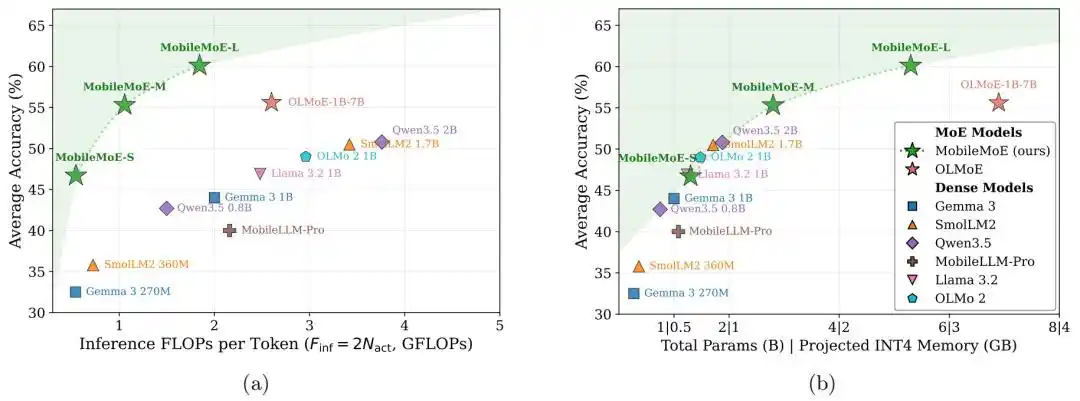
Figure | MobileMoE establishes a new Pareto frontier for on-device large language models.

How is MobileMoE Designed?

MobileMoE can be understood as follows: it is a class of MoE language models designed for on-device deployment. The overall architecture remains a decoder-only Transformer, but the original dense feed-forward layers are replaced with MoE layers. The router selects the top-scoring few experts for each token to participate in computation, while a shared expert always participates. The entire training process is divided into four steps: pretraining, intermediate training, supervised fine-tuning, and quantization-aware training.

Pretraining: The research team pretrained the model using approximately 6T tokens of open-licensed data with a context length of 2048. The data primarily consisted of web content, while also covering domains such as mathematics, code, knowledge, and science.

Intermediate Training: The research team extended the context length to 8192 and further increased the proportion of high-quality data in areas like knowledge, code, mathematics, and science, with a total scale of about 500B tokens.

Supervised Fine-Tuning (SFT): The research team fine-tuned MobileMoE-Base on open-licensed instruction-tuning data comprising over 80 million samples.

Quantization-Aware Training: The research team quantized linear layers and embeddings to INT4, activations to INT8 with dynamic quantization, while the router retained FP32 precision.

Figure | The four-stage training of MobileMoE.

Experimental Results

Ablation Study Results

The research team first compared three architectural variables: the number of experts E, expert granularity g, and the inclusion of a shared expert.
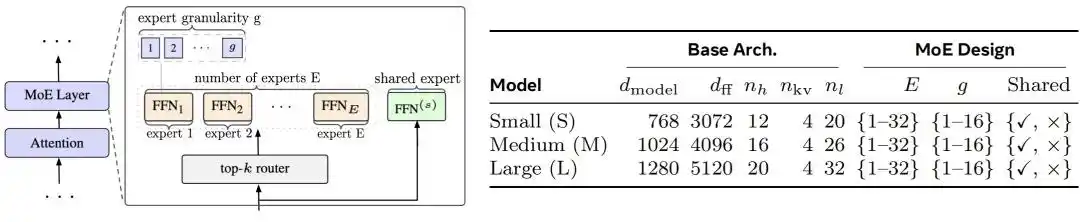
Figure | Scaling the number of experts E.

Under a fixed memory budget, when memory is above approximately 0.25GB, the loss of MoE begins to be lower than that of the corresponding dense model. Continuing to increase the number of experts E further reduces the loss, but the marginal gain significantly diminishes after E increases to 8. Experiments on expert granularity g indicate that finer-grained expert configurations are generally better, with g=8 achieving a good balance between effectiveness and training cost; when g increases from 8 to 16, the loss improvement is less than 0.01, but training time increases by about 50%. Under the same computational budget, the model loss further decreases after adding a shared expert.

Based on the ablation study results, the research team ultimately adopted the configuration with E=8, g=8, and a shared expert, i.e., 60 fine-grained routing experts, Top-4 routing, and 1 shared expert, and used this architecture for the three versions: MobileMoE-S, M, and L.
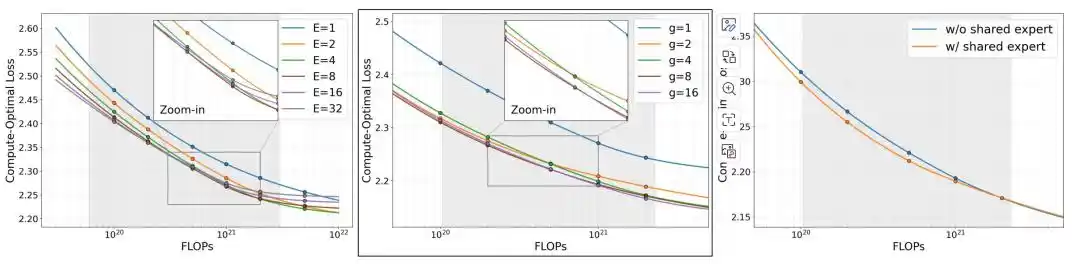
Figure | Scaling MoE models under compute-optimal conditions.
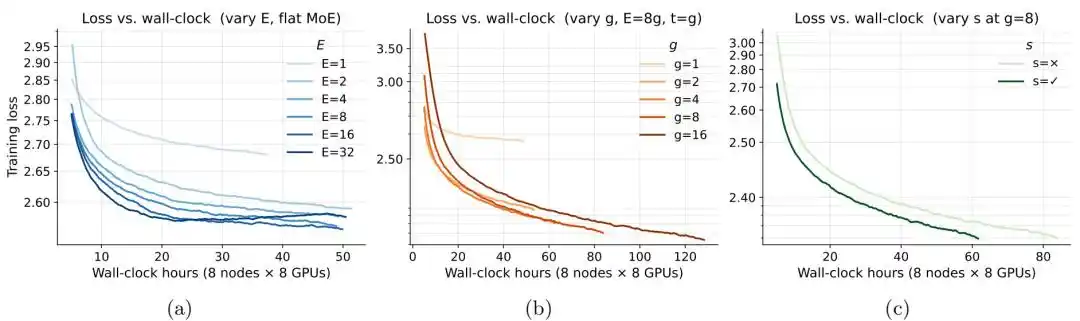
Figure | Training efficiency of the MoE architecture.

14 Foundational Evaluations: Establishing a New On-Device Pareto Frontier

The research team compared MobileMoE with models such as Gemma 3, SmolLM2, Qwen3.5, OLMo 2, and OLMoE-1B-7B under a unified setup across 14 foundational evaluations in five categories: commonsense reasoning, knowledge, science, reading, and reasoning.
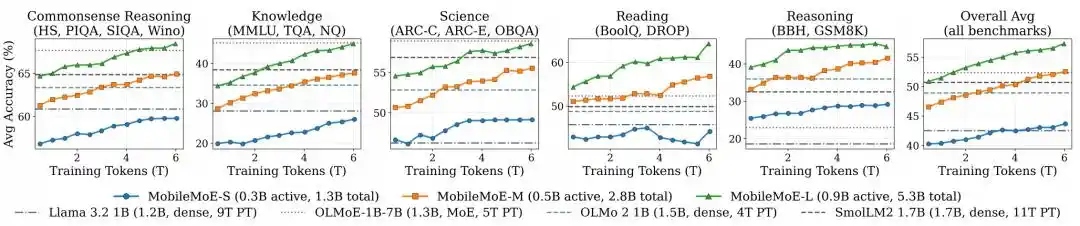
Figure | Pretraining trajectory of MobileMoE.

Comparison results for Base models show that the average score of MobileMoE-M is higher than that of Qwen3.5 2B, and the average score of MobileMoE-L is higher than that of OLMoE-1B-7B, while also requiring a smaller model size. The team also noted that the average score of the Base version of MobileMoE-L is already higher than that of the Instruct version of OLMoE-1B-7B. In terms of training scale, MobileMoE uses about 6T pretraining tokens, which is less than Llama 3.2 1B's 9T and SmolLM2 1.7B's 11T. In the overall comparison of instruction-tuned models, the average accuracy of MobileMoE-M is already close to that of OLMoE-1B-7B, but with both active and total parameters reduced by about 60%.

Figure | Comparison of MobileMoE-Base models.

Advanced Evaluations: More Prominent Advantages in Code and Math Tasks

In advanced evaluations after instruction tuning, MobileMoE performs more prominently on code and math tasks. Taking MobileMoE-L as an example, its average scores in both code and math categories are higher than those of Qwen3.5 2B and OLMoE-1B-7B. However, the research team also notes that in terms of instruction-following and knowledge reasoning capabilities, Qwen3.5 2B remains stronger.
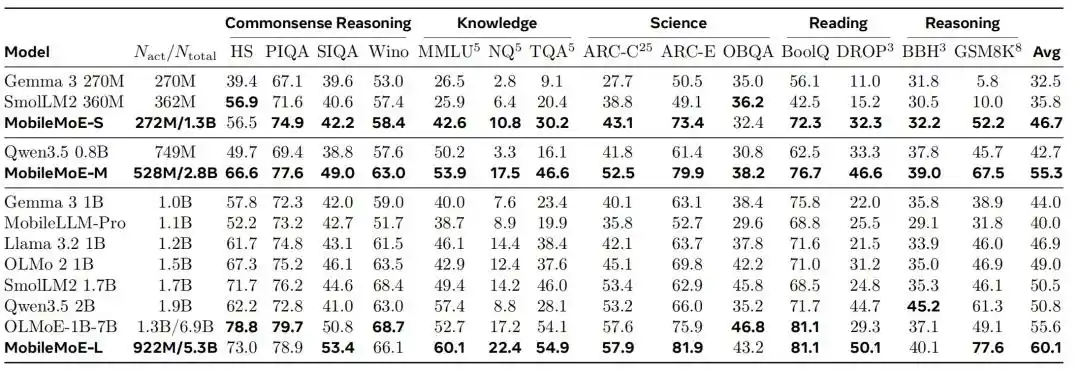
Figure | Comparison of Instruct models on advanced benchmarks.

Quantization and On-Device Deployment: Remains Competitive After INT4, Significant Speedup on Mobile

After quantization, the overall average scores of MobileMoE-S/M/L decreased compared to their respective BF16 versions, but the drops were roughly within 2 to 3 points. Even so, the performance of the INT4 version of MobileMoE-L remained higher than the BF16 version of OLMoE-1B-7B Instruct.

The research team also deployed MobileMoE on Samsung Galaxy S25 and iPhone 16 Pro for testing. The results show that under comparable INT4 weight memory conditions, MobileMoE-S, compared to MobileLLM-Pro, achieved speedups of 1.8-3.8x during the input phase and speedups of 2.2-3.4x during token-by-token generation.

In terms of memory usage, under conditions of Samsung Galaxy S25, 8K context length, and real prompts, the peak RSS of MobileMoE-S was 1.49GB, lower than MobileLLM-Pro's 1.91GB.

Figure | On-device runtime latency.

Limitations and Future Directions

Currently, in terms of higher-order instruction following, knowledge, and reasoning capabilities, the instruction-tuned MobileMoE still lags behind Qwen3.5 2B. The research team believes this gap may be related to more comprehensive post-training. In the future, to narrow this gap, training-side efforts should focus on strengthening distillation, inference-oriented post-training, and multimodal extension.

Furthermore, the research team points out that the memory footprint of MoE on mobile phones varies with input content. Compared to templated inputs, real inputs typically lead to higher memory usage. Testing solely based on templated inputs might underestimate the actual memory pressure in real deployment scenarios. In the future, to more accurately evaluate the real memory performance of on-device MoE, more real-world measurement data is needed.

At the same time, the research team has already completed systematic real-device testing on CPU and GPU backends, but the NPU path remains to be explored. Additionally, the runtime memory footprint of MoE is relatively sensitive to input content. In the future, dynamic routing, expert pruning, mixed-precision quantization, and mobile NPU deployment are all directions for further improving on-device efficiency.

For more technical details, please refer to the original paper.

This article is from the WeChat public account "Academic Headlines" (ID: SciTouTiao), Author: Xia Qiansi


Perguntas relacionadas

QWhat is MobileMoE and what problem does it address?

AMobileMoE is an efficient Mixture of Experts (MoE) language model designed by Meta for on-device deployment on smartphones. It addresses the challenge of deploying large language models (LLMs) with MoE architecture on mobile devices, which traditionally have stringent constraints on memory, compute power, and latency, making them predominantly use dense architectures. MobileMoE aims to provide competitive accuracy with significantly less computational cost than dense baselines.

QWhat key speed improvement did MobileMoE achieve on the iPhone 16 Pro?

AIn real-world testing, MobileMoE-S showed the most significant speed improvement on the iPhone 16 Pro's GPU/MLX backend, achieving up to a 3.8x speedup during the input processing phase.

QWhat are the main stages in the training process of MobileMoE?

AThe training process for MobileMoE consists of four main stages: 1) Pre-training on ~6T tokens with a 2048 context length, 2) Mid-training which extends the context to 8192 and uses ~500B higher-quality tokens, 3) Supervised Fine-Tuning (SFT) on over 80 million open-licensed instruction-following samples, and 4) Quantization-Aware Training (QAT), quantizing most layers to INT4/INT8 while keeping the router at FP32.

QWhat are the primary limitations or future directions mentioned for MobileMoE?

AThe main limitations are that MobileMoE still lags behind models like Qwen3.5 2B in higher-order instruction following and knowledge/reasoning capabilities. Future directions to address this include enhanced distillation, inference-oriented post-training, and multimodal extension. Additionally, MoE's runtime memory usage is sensitive to input content, and deploying on mobile NPUs remains an unexplored avenue for further efficiency gains.

QHow does MobileMoE's performance on code and mathematical tasks compare to other models in advanced evaluations?

AIn advanced evaluations after instruction fine-tuning, MobileMoE showed more pronounced advantages on code and mathematical tasks. For example, the MobileMoE-L model achieved higher average scores on code and math benchmarks compared to both Qwen3.5 2B and OLMoE-1B-7B.

Leituras Relacionadas

The Midlife Crisis of Crypto GPs: No PMF, No Next Check from LPs

The article "The Midlife Crisis of Crypto GPs: No PMF, No Next LP Check" analyzes the shifting crypto fundraising landscape. It argues the era of selling grand visions to LPs is over; GPs must now offer products with clear Product-Market Fit (PMF). The author categorizes crypto fundraising products into three types: Primary (VC funds), Liquid (trading strategies), and CeFi/DeFi Native Yield. This summary focuses on the Primary market. Key points include: * **Market Shift:** LPs are impatient, demand immediate returns, and are skeptical of future promises. The "easy money" narrative has faded. * **GP Value Erosion:** LP learning curves have shortened (aided by AI), reducing the value of a GP's basic "crypto knowledge." Superior judgment is now rare. * **Weakened LP Motivations:** Traditional reasons for LPs to invest in crypto VC funds (capturing industry beta, gaining access, leveraging GP judgment) have weakened due to new products like ETFs and increased LP sophistication. * **Surviving in Primary:** The primary market will likely persist for: 1) large funds in endowment mandates treating it as a lottery ticket, 2) family offices/HNWIs using proprietary capital, 3) a few funds with proven recent outperformance, and 4) funds with strong ecosystem "deal-making" capabilities. * **Conclusion:** For most GPs, rebuilding trust requires starting over in a niche, demonstrating alpha-generating ability, or providing concrete value/services to LPs.

marsbitHá 1h

The Midlife Crisis of Crypto GPs: No PMF, No Next Check from LPs

marsbitHá 1h

Crypto GPs' Midlife Crisis: No PMF, No LP's Next Check

The article "The Midlife Crisis of Crypto GPs: No PMF, No LP's Next Check" analyzes the shifting crypto fundraising landscape. It argues that the era of LPs funding vague "vision" is over; GPs must now offer products with clear Product-Market Fit (PMF) to secure capital. The market has matured. LPs, disillusioned by the last cycle's failures and wary of long lock-up periods, now demand tangible, near-term returns rather than speculative narratives. The proliferation of accessible crypto ETFs and other liquid products has reduced the need for VC blind pools as an entry point. The author categorizes crypto fundraising products into three types: Primary (VC funds, with blind pools or clear pipelines), Liquid (alpha/beta, directional/market-neutral strategies), and CeFi/DeFi Native Yield (crypto-specific mechanisms like staking, farming). Focusing on the Primary market, the piece details why traditional LP rationales for investing in crypto VCs have weakened: easier beta access via ETFs, diminished "access" and "judgement" premiums as LPs build internal teams, and a widespread lack of proven superior returns from GPs. Ultimately, only specific players are likely to remain at the primary VC table: large funds with access to patient endowment capital, family offices/HNWIs investing proprietary capital, the few funds with demonstrable excess returns from the last cycle, and those with clear "deal-making" or ecosystem resource advantages. For others, the path forward is to rebuild trust by proving alpha-generation capability in a niche or providing concrete, valuable services.

链捕手Há 1h

Crypto GPs' Midlife Crisis: No PMF, No LP's Next Check

链捕手Há 1h

The Age of Decoupling Has Arrived: Bitcoin is No Longer the Sole Compass of Crypto

The era of the cryptocurrency market moving in lockstep with Bitcoin is ending, as the industry splits into two distinct asset categories: endogenous and exogenous. Endogenous assets, like Bitcoin, derive value purely from the crypto market's cycles. Their narratives swing between being "interstellar money" in bull markets and "digital collectibles" in bear markets. Exogenous assets, however, are nominally crypto but operate with independent value drivers. Examples include: * **Venice:** An AI inference service using tokens for payments; its consumer-AI business model is decoupled from crypto price swings. * **Figure:** A fintech lender using blockchain to speed up loan approvals; its core value is in credit, not crypto. * **Stablecoin firms like BVNK:** Acquired by traditional finance giants (Mastercard, Stripe), their growth is tied to payment infrastructure, not market cycles. Hybrid projects like **Hyperliquid** (a decentralized exchange) show a shift, with a growing share of non-crypto trading (e.g., prediction markets). This divergence is fundamental. Endogenous assets remain highly correlated to Bitcoin, similar to gold miners to gold. Exogenous assets are evolving to have their own fundamentals, like the weak correlation between gold and the S&P 500. This changes investment analysis. Evaluating exogenous assets requires traditional fundamental research—assessing user bases, unit economics, and moats—more akin to fintech investing than charting Bitcoin. Promising exogenous sectors include: on-chain exchanges/brokers, AI-crypto fusion, privacy-focused digital banks, lending (institutional/private credit), stablecoins/real-world asset tokenization, payment rails, and non-financial crypto-consumer products. Currently, investing via equity is often safer than via tokens, as token value accrual mechanisms need further regulatory and industry development (e.g., the CLARITY Act). Nonetheless, the core trend is clear: crypto market drivers are diversifying from a single factor (Bitcoin) to multiple fundamentals, ending the era of uniform market moves.

marsbitHá 2h

The Age of Decoupling Has Arrived: Bitcoin is No Longer the Sole Compass of Crypto

marsbitHá 2h

Trading

Spot
Futuros
活动图片




