Trump Appoints Pro-Bitcoin Fed Economist, Boosts Crypto & Bitcoin Hyper Sentiment

bitcoinistPublicado em 2025-08-08Última atualização em 2025-08-08

Resumo

Bitcoin’s back on the up, bouncing near $117K after the US President Donald Trump gave crypto lovers something to cheer...

Trusted Editorial content, reviewed by leading industry experts and seasoned editors. Ad Disclosure

Bitcoin’s back on the up, bouncing near $117K after the US President Donald Trump gave crypto lovers something to cheer about: the appointment of Stephen Miran to the Federal Reserve Board.

Miran, a former Treasury official and vocal Bitcoin supporter, is expected to push for looser monetary policy, including fewer rate hikes and a more growth-friendly economic stance.

This could be great news for $BTC. As the #1 crypto with a hefty $2.32T market cap, it tends to perform well when inflation rises and the dollar loses strength.

But as $BTC gains more attention, the same old issues often resurface. The Bitcoin network still struggles with slow speeds and costly fees, especially during periods of peak demand.

Fortunately, Bitcoin Hyper – a Bitcoin Layer 2 solution – is getting set to launch this quarter to help address such woes.

Miran Joins Fed, Boosts Crypto Market Outlook

In a Truth Social post yesterday, Trump announced that Miran, the current Chairman of the Council of Economic Advisors, would fill the recently vacated Fed seat until January 31, 2026.

Trump announced hiring Stephen Miran to Fed on Truth Social.
Source: Truth Social (Donald J. Trump)

Interestingly, before his appointment, Miran questioned the accuracy of current inflation models and hinted at a more cautious approach to rate hikes – an outlook that could favor $BTC.

Stephen Miran discussed current inflation models on X.
Source: X (Stephen Miran)

With Miran now serving on the Fed Board, the crypto market has perked up. Since the news broke, $BTC has spiked by around 3%, from a $114K low to a $117.5K – though it has since stabilized to $117K.

Bitcoin ETFs are also on the rise, with all top 10 funds in the green. ProShares’ BITO, the only futures ETF in the top 10, posted the highest turnover rate at 9.31%.
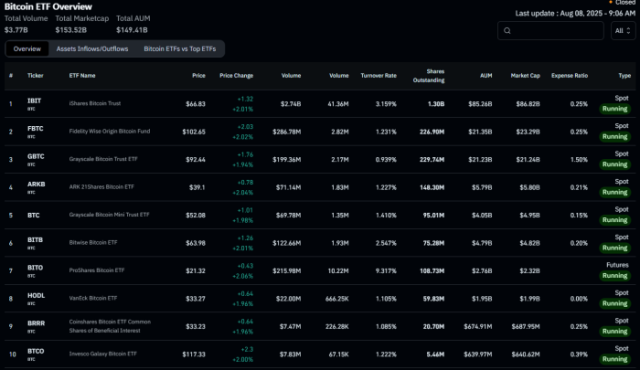
This signals that long-term investors and active traders are re-entering the market as $BTC shows renewed strength.
Bitcoin ETF overview on Coinglass.
Source: Coinglass

But while $BTC’s price hike is promising, the network on which it’s held still faces scalability issues. This makes Bitcoin Hyper’s upcoming launch all the more important.

Bitcoin Hyper to Solve Bitcoin’s Biggest Issues This Quarter

Once launched this quarter, Bitcoin Hyper promises to make Bitcoin more scalable, faster, and cost-friendly – all without compromising the Layer 1 version’s security or core principles.

As $BTC adoption grows, the network often becomes congested. Fees spike and transactions slow down, especially during bull runs. Bitcoin Hyper is under development to fix precisely this.

For instance, during the April 2024 halving event, fees on the Bitcoin network spiked above $128. This was also partly due to the launch of the Runes protocol, causing a sharp increase in transaction demand.

But with Bitcoin Hyper, instead of every transaction competing for space on the base layer, it batches transactions off-chain and settles them efficiently.

By doing so, it can facilitate lower fees, faster transactions, and more practical real-world use for DeFi protocols and dApps built on Bitcoin.

Bitcoin Hyper aims to achieve this by leveraging the Solana Virtual Machine (SVM), which brings smart contract capabilities to the Bitcoin ecosystem.

A Canonical Bridge is also at the core of the Layer 2’s infrastructure. Once a transaction is verified through an SVM smart contract, the system mints an equivalent wrapped $BTC on the Layer 2. This wrapped $BTC can then be used across DeFi platforms.
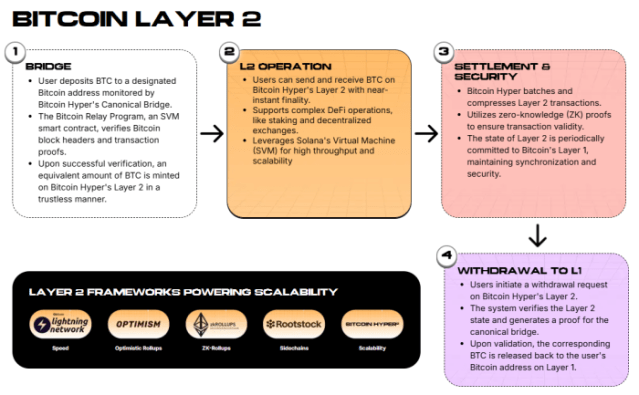
How the Bitcoin Hyper Layer 2 will operate.
Source: Bitcoin Hyper

If you want to retrieve your Bitcoins, fear not. The bridge will validate the Layer 2 activity and securely release the original $BTC back to the base layer.

Moreover, to ensure security while scaling, Bitcoin Hyper uses Zero-Knowledge Proofs (ZKPs). This allows for fast, trustless transaction verification with minimal impact on Bitcoin’s main chain.

To get the most out of the ecosystem, you’ll want to purchase $HYPER. As the project’s native currency, it grants access to lower gas fees, governance rights, and staking rewards up to a 139% APY.

It’s no wonder $HYPER has already attracted over $7.7M since its presale launch on May 16, 2025.

Verdict – Bitcoin Hyper to Gear Up at the Right Time

Miran joining the Federal Reserve Board signals a shift toward looser policy, a setup that often benefits $BTC.

While this is excellent news for the crypto leader and thus the entire market as a whole, the Bitcoin network will likely struggle to keep up with the surge in demand.

Good thing Bitcoin Hyper is getting set to launch shortly. To get the most out of the ecosystem, you can purchase $HYPER on presale for just $0.012575.

Once the Layer 2 launches its mainnet, it’s anticipated to reach $0.32, making now a prime time to join for possible gains surpassing 2,445%.

This isn’t investment advice. Always do your due diligence and never invest more than you’d be sad to lose.

Editorial Process for bitcoinist is centered on delivering thoroughly researched, accurate, and unbiased content. We uphold strict sourcing standards, and each page undergoes diligent review by our team of top technology experts and seasoned editors. This process ensures the integrity, relevance, and value of our content for our readers.

Leah is a British journalist with a BA in Journalism, Media, and Communications and nearly a decade of content writing experience. Over the last four years, her focus has primarily been on Web3 technologies, driven by her genuine enthusiasm for decentralization and the latest technological advancements. She has contributed to leading crypto and NFT publications – Cointelegraph, Coinbound, Crypto News, NFT Plazas, Bitcolumnist, Techreport, and NFT Lately – which has elevated her to a senior role in crypto journalism. Whether crafting breaking news or in-depth reviews, she strives to engage her readers with the latest insights and information. Her articles often span the hottest cryptos, exchanges, and evolving regulations. As part of her ploy to attract crypto newbies into Web3, she explains even the most complex topics in an easily understandable and engaging way. Further underscoring her dynamic journalism background, she has written for various sectors, including software testing (TEST Magazine), travel (Travel Off Path), and music (Mixmag). When she's not deep into a crypto rabbit hole, she's probably island-hopping (with the Galapagos and Hainan being her go-to's). Or perhaps sketching chalk pencil drawings while listening to the Pixies, her all-time favorite band.

Leituras Relacionadas

Predicting World Cup Knockout Matches: Why Are Different AI Models So Far Apart?

AI performance in predicting the 2026 FIFA World Cup knockout matches varied significantly, according to an analysis of models including ChatGPT, Grok, DeepSeek, Gemini, and Claude. The standout predictions came from DeepSeek and Gemini for the Netherlands vs. Morocco match. Gemini precisely forecasted a 1-1 draw and a penalty shootout win for Morocco, while DeepSeek correctly identified the high probability of a draw and Morocco's potential to advance via a defensive and counter-attacking strategy. Grok and Tongyi Qianwen (千问) demonstrated strength in predicting accurate scores for matches with clearer favorites. They correctly called the narrow 1-0 win for Canada over South Africa and Brazil's 2-1 victory over Japan, as well as Norway's 2-1 win over Ivory Coast. ChatGPT and Claude excelled more in match process analysis than in predicting exact scores or upsets. They frequently identified potential challenges for favorites, such as Japan's pressing against Brazil or DR Congo's defensive tactics against England, even when predicting the favorite's ultimate victory. A notable failure was the unanimous misjudgment of Germany vs. Paraguay. All models incorrectly favored Germany, underestimating Paraguay's ability to force a penalty shootout and cause an upset. In summary, Gemini and DeepSeek showed the most insight for high-stakes, unpredictable matches. Grok and Qianwen were reliable "score predictors" for less volatile games. ChatGPT and Claude were strong "analytical models," adept at outlining match dynamics but often hesitant to predict upsets.

Odaily星球日报Há 8m

Predicting World Cup Knockout Matches: Why Are Different AI Models So Far Apart?

Odaily星球日报Há 8m

Will There Be a Next Wave of Web3 Games? Veteran Player's Review: At the Peak of Hype, You Should at Least Sell Half

**Title: Is There Another Wave for Web3 Gaming? A Veteran Player's Review: When Hype Peaks, You Must Exit at Least Half** **Summary:** In an interview, veteran player "Earn Money Chicken" shares his journey and reflections on Web3 gaming. He transitioned from being a traditional in-game trader to a Web3 gamer, having profited from games like Mobox, StepN, and Seraph, but also experiencing significant losses. He defines himself primarily as a player, not an investor, attracted to Web3 games for the blend of earning potential, engaging gameplay, and the satisfaction of researching game mechanics. While he enjoys strategic "gambling" within games, he emphasizes it's not about zero-sum competition with other players. The interview explores the complex, often adversarial relationship between players, projects, and major investors (whales). The player's experience as a traditional game merchant helped develop his analytical mindset for spotting opportunities, but wasn't directly transferable. He identifies the core sources of profit in early Web3 gaming as **"era红利" (era-specific红利)** and strategic foresight, not just simple calculations. He warns that the biggest mistake ordinary players make is calculating their return-on-investment (ROI) period at peak hype, as asset and yield depreciation can trap them. Reflecting on his wins and losses, he now advocates for managing expectations. His most successful exit was from Seraph, where he sold at a relatively good time. The key problem with current Web3 games, he argues, is that most are not mature games first. A successful Web3 game must primarily be a **good, fun game** with a genuine player base willing to spend money for enjoyment, not just participants seeking profit. The blockchain element should solve problems within that context, not be the primary driver. While he believes the sector might see another speculative boom (possibly another strong "Ponzi" model attracting hype), a truly mature and sustainable Web3 game likely needs to come from a traditional major game studio. It would leverage a proven IP, mature content, a functional NFT trading system, and attract both traditional and crypto-native players, offering more normalized returns rather than extreme暴利. His final advice: Newcomers without prior experience should avoid the space now, as it's like searching for a diamond in the rough. For those remaining, the rule is: be brave when assets are low and overlooked, but **when everyone is talking about it (at peak hype), you must sell at least half your holdings.**

marsbitHá 53m

Will There Be a Next Wave of Web3 Games? Veteran Player's Review: At the Peak of Hype, You Should at Least Sell Half

marsbitHá 53m

The Most Hidden AI Winners

"The Most Under-the-Radar AI Winners" While core AI giants and their direct suppliers have dominated headlines, a group of seemingly unrelated, decades-old manufacturing companies have emerged as major beneficiaries. A key example is Japan's TOTO, famous for bathroom fixtures. Its stock soared 145% in a year, driven not by its mainstay toilet business but by its nearly 40-year-old semiconductor ceramic component unit. Specifically, TOTO manufactures electrostatic chucks—critical, hard-to-replace parts for advanced chip manufacturing processes like etching and EUV lithography. This segment, though only 9% of revenue, contributed over 54% of operating profit in FY2025 with a 43% margin. High barriers to entry, including deep know-how in high-purity ceramic sintering and long supplier certification cycles (5+ years), secure its position. This pattern repeats across industries. Nitto Boseki, a 128-year-old glass fiber maker, saw its stock rise 325% due to near-monopoly supply of T-glass, an essential low-expansion material for AI chip substrates. Similarly, Ajinomoto, the global MSG leader, commands 80-95% of the market for ABF film, a vital insulating layer in chip packaging. These "hidden" segments, often born from deep materials science expertise, are now bottleneck supplies in the AI hardware chain, enjoying pricing power and high margins. In China's A-share market, the theme combines this AI-driven demand with domestic substitution. Companies like Zhongci Electronic (advancing in electrostatic chucks) and Honghe Technology & Feilihua (in high-end electronic glass fabrics) are gaining traction. The investment thesis hinges on whether these domestic players can rapidly scale qualified capacity to capture the supply gap within the critical time window. Ultimately, these cases show that in the AI supply chain, high-profit concentrations exist not only at the cutting-edge tech frontier but also in indispensable, difficult-to-replicate materials and components. Market recognition often lags behind fundamental profit shifts, creating potential for significant re-ratings as traditional industrial firms are re-evaluated as key enablers of advanced semiconductor manufacturing.

marsbitHá 1h

The Most Hidden AI Winners

marsbitHá 1h

Trading

Spot
活动图片