VELVET stalls at $2—How deep could the current pullback go?

ambcryptoPublicado em 2026-07-02Última atualização em 2026-07-02

Resumo

Velvet (VELVET) experienced a bullish push above the key $2.00 resistance on June 29, reaching a high of $2.17, fueled by partnership news with Aerodrome Finance. However, momentum has since slowed, with an 11.5% price correction in 24 hours and a 27.1% drop in trading volume. Technical analysis shows mixed signals. While the On-Balance Volume (OBV) indicates sustained buying pressure, the Chaikin Money Flow (CMF) has turned negative, signaling significant capital outflows and short-term distribution. The overall structure remains bearish on the 1-day chart, though the recent correction found support at the 20-day moving average. Market data suggests the current pullback represents controlled selling pressure rather than a full trend reversal. Key supports to watch are the $2.00 level and the 20-day moving average near $0.75. The risk-to-reward ratio for new long positions is currently unfavorable, but the steady spot Cumulative Volume Delta (CVD) and funding rate indicate underlying bullish strength. Traders may consider using a deeper pullback as a potential buying opportunity.

Velvet [VELVET] has continued its bullish trend. Powered by the Aerodrome Finance partnership news, the token price briefly pushed past the $2.0 round-number resistance on Monday, June 29.

Since then, its momentum has slowed down. The altcoin saw an 11.5% correction in the past 24 hours, and its daily trading volume has fallen by 27.1%, according to CoinMarketCap statistics.

Assessing if Velvet can reach its projected extension targets

AMBCrypto had reported on the bullish catalysts, technical indicators, and price structure, but also warned of increased volatility. The rally to $2.17 has subsided within the past 72 hours.
Source: VELVET on TradingView

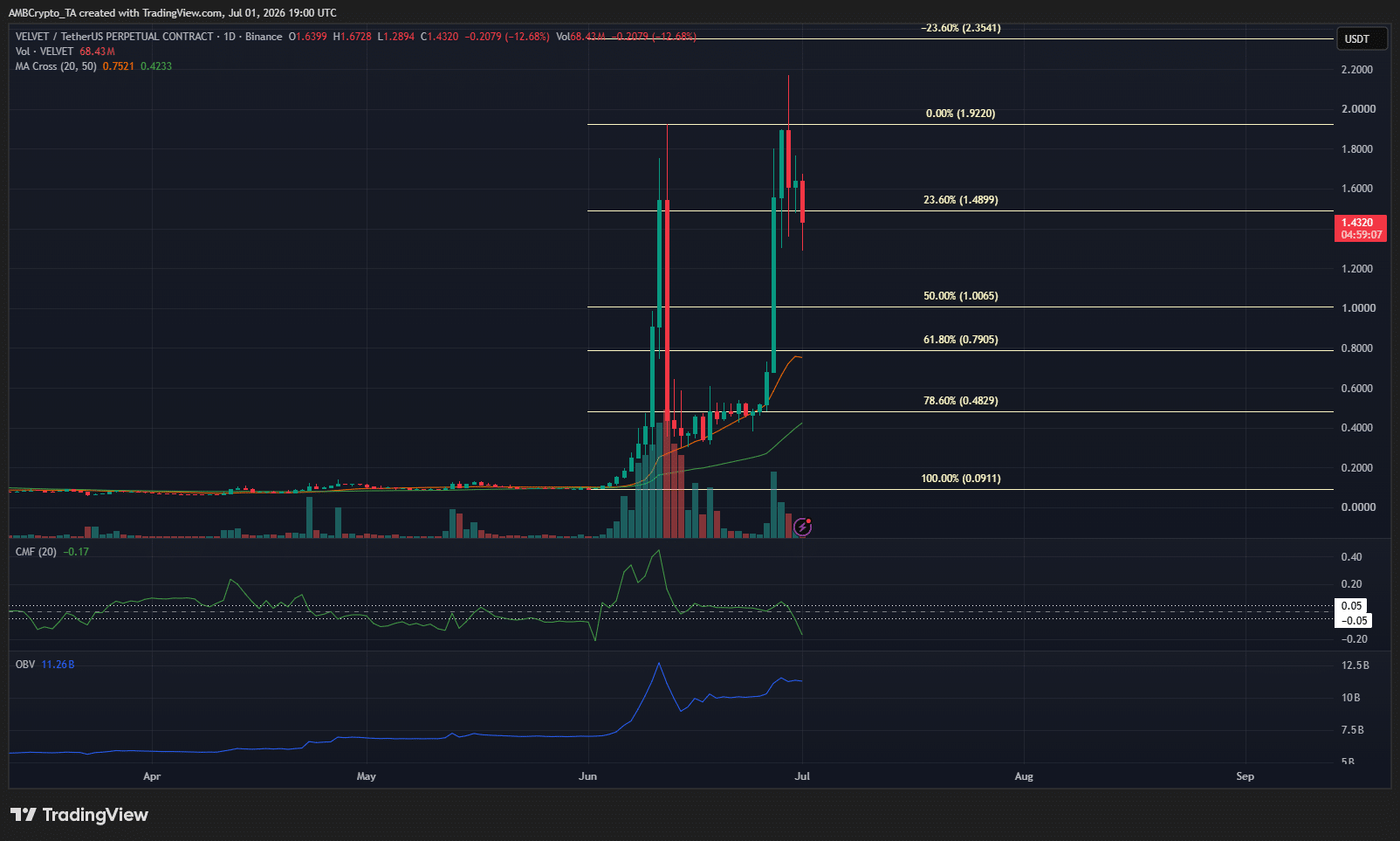
The 1-day structure was bearish despite the deep correction from $1.922 to $0.302 in the second week of June. Interestingly, this retracement halted at the 20-day moving average dynamic support.

Since this correction, VELVET has rallied to the local $1.922 highs once again, climbing to $2.17 before pulling back in the past three days as discussed earlier.

The volume indicators gave mixed signals. The OBV was rising higher to show steady buying pressure, but the CMF sank below -0.05 in the past couple of days. Its current reading of -0.17 highlighted severe capital outflows from the VELVET market.

This incongruence between the volume indicators meant that there was short-term distributory pressure on the altcoin. Overall, the buying volume in recent weeks has been high, and the current wave of selling has not dented it.

Traders’ call to action- Use a pullback to buy

The risk-to-reward ratio was too low for traders to go long now. At the same time, there was no guarantee that VELVET had run its uptrend to the fullest and would now descend toward $0.48 and lower once again.
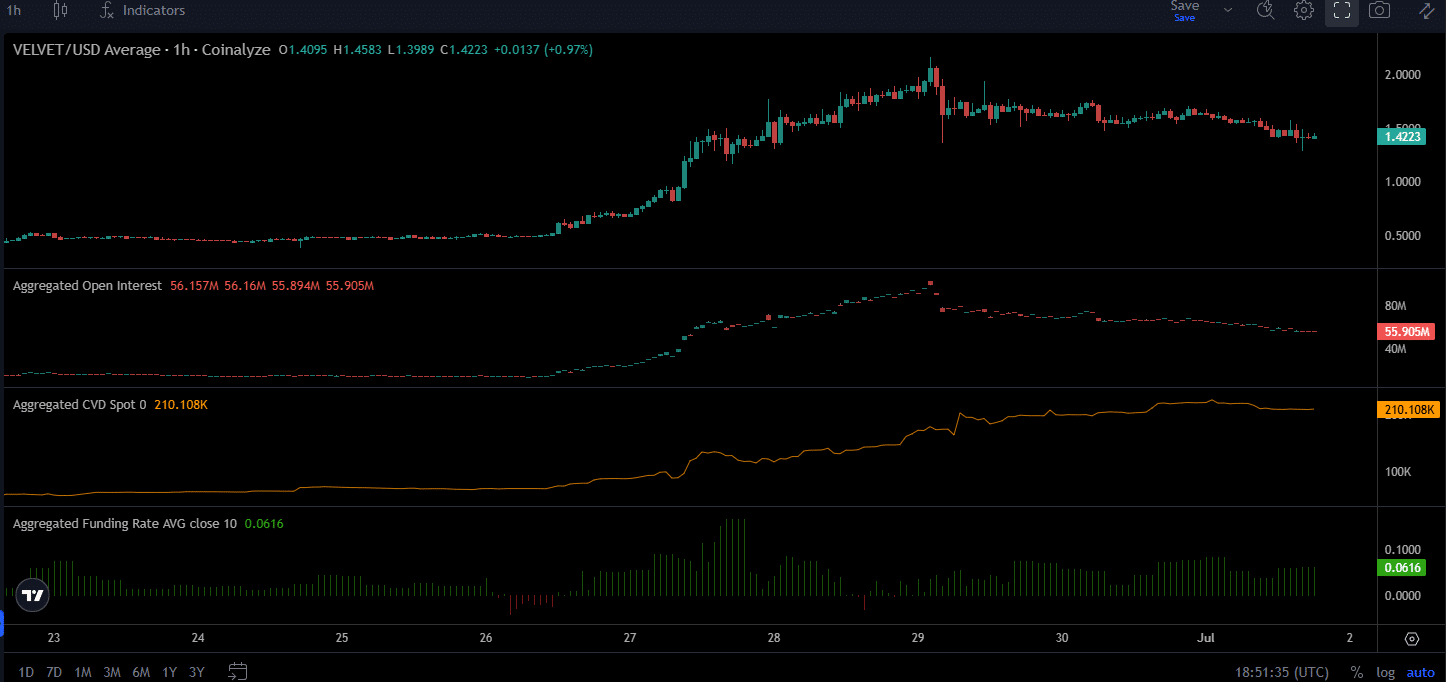
Source: Coinalyze

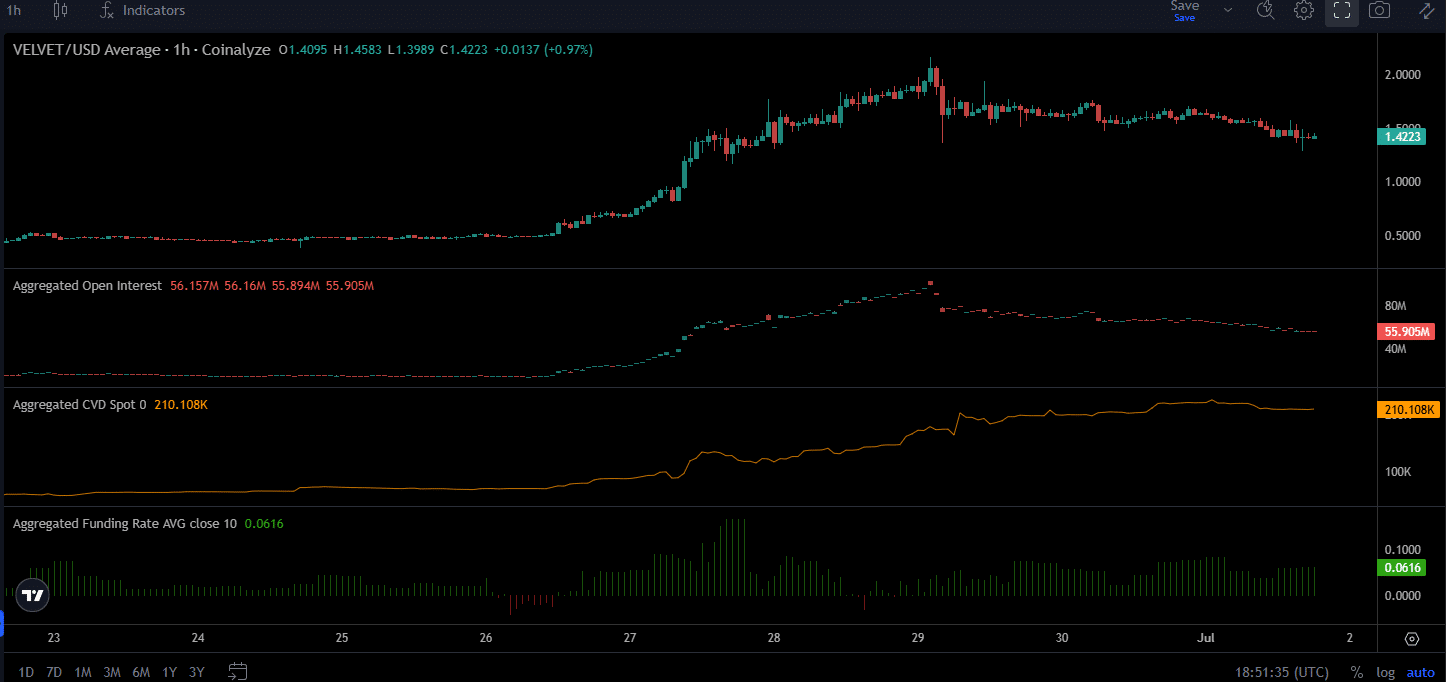
Though the OI was in decline, the spot CVD remained steady, as did the funding rate. This suggested short-term bearish momentum, but there was a good chance VELVET bulls would try to claim the $2 support once more.

The 20-day moving average at $0.75 was an interesting dynamic support to keep an eye on in case of a pullback.


Final Summary

  • Velvet had rallied to a high of $2.17 but was unable to flip the $2 psychological level from resistance to support.
  • It is unclear how deep the current pullback could go, but the evidence pointed toward controlled short-term distributory trends instead of full-blown profit-taking.


Perguntas relacionadas

QWhat was the key event that helped push Velvet's price briefly above $2.0?

AThe key event was the partnership news with Aerodrome Finance.

QAccording to the article, what are the conflicting signals shown by the volume indicators (OBV and CMF)?

AThe OBV was rising, showing steady buying pressure, while the CMF sank below -0.05, indicating severe capital outflows. This shows short-term distributory pressure despite high overall recent buying volume.

QWhat does the article suggest as a potential dynamic support level in case of a pullback for VELVET?

AThe article suggests the 20-day moving average at $0.75 as an interesting dynamic support level to watch in case of a pullback.

QBased on the data from Coinalyze, what do the steady spot CVD and funding rate suggest despite declining Open Interest?

AThe steady spot CVD and funding rate, despite declining Open Interest, suggest short-term bearish momentum but a good chance that VELVET bulls will try to reclaim the $2 support level again.

QWhat is the article's overall conclusion about the nature of the current pullback for VELVET?

AThe article concludes that while the depth of the pullback is unclear, the evidence points toward controlled short-term distributory trends rather than full-blown profit-taking by investors.

Leituras Relacionadas

IPO Imminent, OpenAI Faces Major Personnel Upheaval

OpenAI, preparing for a potential IPO, is experiencing significant leadership turmoil. In mid-August 2026, longtime "GPU geek" Scott Gray quietly left, and within three days, Chief Operating Officer Brad Lightcap (8-year veteran) and Chief Revenue Officer Denise Dresser (8-month tenure) departed. This follows a broader exodus of at least 10 senior executives in 2026, including heads of product, safety, and ethics. Analysts view this as a strategic "surgery" to transform from a research lab into a sales-driven enterprise company before going public. Revenue now tilts toward enterprise clients, surpassing consumer income sooner than expected, with annualized revenue reaching $40 billion. The new CRO, Dali Rajic, is a veteran enterprise sales leader. Concurrently, OpenAI has disbanded independent safety teams like "Preparedness," which assessed catastrophic risks, integrating their functions into core research. Critics warn this removes dedicated "brakes" on AI development. The leadership vacuum raises questions about who is the clear second-in-command after former apps CEO Fidji Simo moved to an advisory role. Co-founder Greg Brockman appears to be consolidating power. As OpenAI races against rival Anthropic ($47B annualized revenue), it faces the dual challenge of commercial execution while managing the departure of foundational technical talent and ensuring responsible AI development remains a priority.

marsbitHá 2h

IPO Imminent, OpenAI Faces Major Personnel Upheaval

marsbitHá 2h

AI Can 'Have Moods Too'! New Research from USTC: Confusion and Anxiety Make AI Work Better

The article discusses research from the University of Science and Technology of China and Oxford, revealing that allowing AI to recognize and act upon simulated "internal emotions" can significantly improve its performance. The study demonstrates a coherent pairing between specific emotional states in AI agents and their subsequent skill choices. For instance, an agent feeling curious and desirous will search for products, while one feeling confused and tense will rephrase queries. This mirrors human decision-making influenced by emotions. Statistical validation showed a 76.5% semantic consistency in these pairings. Crucially, the research challenges the traditional view of AI errors as flaws to be eliminated. It found that "bad" emotions like confusion, tension, or frustration serve as useful metacognitive signals, indicating a mismatch between the current strategy and the environment. By responding to these signals, AI can proactively adjust before a failure occurs. This is particularly effective in complex tasks prone to failure. For example, in tasks like "heating an item" and "picking up two items," success rates surged from 9.6% to 56.9% and 4.4% to 31.3%, respectively, when using the emotion-driven skill selection method (EMOTION2SKILL). The AI's "nervous" state about a closed microwave, for instance, prompted it to check and open it first, preventing failure. The article also mentions related work from Tianjin University, which embeds emotional prediction into world models (Large Emotional World Model, LEWM), significantly improving prediction accuracy in human-centric environments. Removing emotional data was found to degrade performance even in unrelated logical reasoning tasks. These studies build on earlier findings, like those from Anthropic, that identifiable emotional representations exist within large language models (LLMs). The focus is shifting from philosophical debate about AI emotion to practically harnessing these internal states as functional signals to enhance AI robustness and capability.

marsbitHá 2h

AI Can 'Have Moods Too'! New Research from USTC: Confusion and Anxiety Make AI Work Better

marsbitHá 2h

Trading

Spot
活动图片