Ripple Flamed By Caitlin Long: ‘XRP Is Doomed, Banks Don’t Trust It’

bitcoinistPublicado em 2025-08-06Última atualização em 2025-08-07

Resumo

Caitlin Long, founder and CEO of Custodia Bank, delivered one of the harshest assessments yet of Ripple and the XRP...

Trusted Editorial content, reviewed by leading industry experts and seasoned editors. Ad Disclosure

Caitlin Long, founder and CEO of Custodia Bank, delivered one of the harshest assessments yet of Ripple and the XRP ecosystem in a recent episode of the Gold Goats ‘n Guns podcast, calling into question the project’s credibility, tokenomics, and long-term viability in institutional finance. In a sweeping critique, Long stated bluntly: “It’s not going to take over. If it were going to take over, it would have taken over a long time ago.”

Caitlin Long Slams Ripple And XRP

The conversation began with a reference to growing speculation that Ripple might be among the blockchain networks “blessed” by regulators to handle tokenized financial infrastructure. But Long pushed back hard on that narrative, saying the idea “overstates how important that network is.”

According to Long, the core issue lies in Ripple’s structural legacy. “The banks have always been suspicious of it,” she said, citing what she described as the project’s centralized architecture and flawed tokenomics. “It is a centralized network and the tokenomics are backwards.” She argued that the XRP supply model — rooted in a massive pre-mine and upfront fundraising — has permanently damaged institutional trust. “The people who extracted money up front are never going to be trusted because everybody is going to look and think that anything they do is an exit scam to try to dump on retail.”

For Long, the contrast with Bitcoin and Ethereum is stark. “The most effective tokenization platforms are the ones where there was no money up front or very little money up front,” she explained. “That’s Bitcoin and Ethereum.”

Long also interpreted Ripple’s recent pivot — with the company now launching its own regulated stablecoin — as a tacit admission of failure. “Instead of trying to sell that into the banking industry, they’re getting their own regulated financial institutions and trying to issue a stablecoin,” she said. “That’s kind of, in some ways, an admission that the base layer blockchain didn’t get the adoption they were looking for.”

Her comments come amid Ripple’s continued push into institutional markets, including efforts to obtain a US bank charter and launch a US dollar stablecoin. While these moves have been celebrated in some circles as signs of maturity and strategic adaptation, Long framed them as a fallback, noting that the original promise — to become a foundational layer for interbank settlement — had clearly not materialized. “The base layer network is not going to become the base layer of replacing SWIFT,” she said.

She also pointed to the legal and regulatory drag Ripple faced over the past several years, including the SEC’s long-running lawsuit against the company for allegedly conducting an unregistered securities offering. “That hamstrung them,” she said, while acknowledging that Ripple wasn’t alone in suffering under the Biden administration’s broader crackdown on crypto: “It didn’t hurt Ripple as much as the Fed hurt us… Everybody who was targeted by the Biden administration was hurt to varying degrees.”

When asked what network the US Treasury is most likely to choose for tokenizing US Treasuries, Long was unequivocal: “They’re not going to use Ripple. They’re going to use Ethereum. They may use Bitcoin, but the Bitcoin layer twos are not mature enough for something like that.” She cited Ethereum’s technical maturity and infrastructure readiness as the decisive factors.

XRP Community Reacts

The backlash from the XRP community was swift and furious. Prominent community figure Crypto Eri called the remarks “ugly tribalism,” accusing Long of conflating Ripple with the XRP Ledger, and failing to distinguish between a centralized company and a decentralized protocol. “The entire blockchain community should be deeply disappointed,” she wrote.

Digital Asset Investor, another well-known XRP supporter, tagged Ripple executives directly, suggesting the company was still on track to achieve regulatory breakthroughs. Ashley Prosper went even further, alleging that Long’s criticism may stem from frustration over Custodia Bank’s lack of a Federal Reserve master account: “Sounds like Caitlin Long is mad that Ripple will get their Fed master account before Custodia Bank.”

But Long’s criticism was not offhanded nor casual — it was pointed and rooted in her long-standing perspective on what makes blockchain infrastructure bank-grade. For her, trust, decentralization, and long-term neutrality are prerequisites — and XRP, in her view, fails on all three.

“Ripple’s been at this longer than almost anybody else and they haven’t made a lot of progress,” Long concluded. “It’s really that simple.”

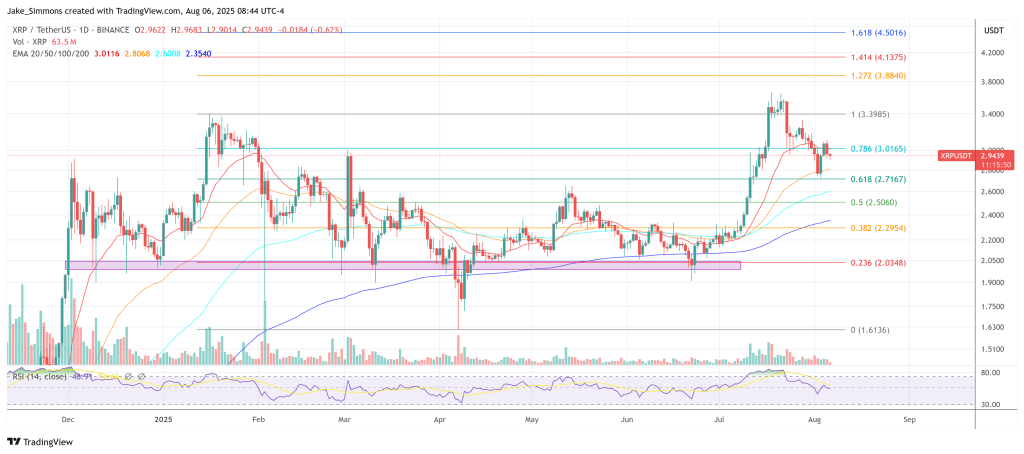
At press time, XRP traded at $2.94.
XRP price
XRP price, 1-day chart | Source: XRPUSDT on TradingView.com
Featured image created with DALL.E, chart from TradingView.com
Editorial Process for bitcoinist is centered on delivering thoroughly researched, accurate, and unbiased content. We uphold strict sourcing standards, and each page undergoes diligent review by our team of top technology experts and seasoned editors. This process ensures the integrity, relevance, and value of our content for our readers.

Jake Simmons has been a Bitcoin enthusiast since 2016. Ever since he heard about Bitcoin, he has been studying the topic every day and trying to share his knowledge with others. His goal is to contribute to Bitcoin's financial revolution, which will replace the fiat money system. Besides BTC and crypto, Jake studied Business Informatics at a university. After graduation in 2017, he has been working in the blockchain and crypto sector. You can follow Jake on Twitter at @realJakeSimmons.

Criptomoedas em alta

Leituras Relacionadas

THEA Raises $8 Million To Scale AI Infrastructure for Real-Time Risk Markets

Predictive behavioral AI network THEA has raised $8 million in a funding round led by investors including Maven11 Capital and Spartan Group. Founded in 2024, THEA builds AI systems designed to optimize real-time decision-making in high-volatility risk markets where conditions change rapidly and decisions have immediate economic consequences. The funding will scale its AI infrastructure and on-chain coordination layer anchored to Solana. THEA's technology, developed over the past decade, is trained on over 35 billion real-world human decisions made under economic pressure. Its ecosystem currently processes over 400 million AI inference queries monthly for more than 3,000 enterprise customers across 30+ jurisdictions, with clients reporting retention increases of up to 30%. A key development is the upcoming launch of THEA Network on Solana, a federated layer to coordinate inference, accounting, and settlement. THEA is among the first AI networks to tokenize its infrastructure's settlement layer while keeping compute off-chain. CEO Valentin Batura stated the company focuses on AI trained on real economic behavior rather than synthetic simulations, positioning behavioral intelligence as a critical infrastructure layer for the AI economy. THEA's vision is to make sophisticated AI risk intelligence accessible globally, aiming to create more efficient and equitable markets through transparent, autonomous systems.

TheNewsCryptoHá 2h

THEA Raises $8 Million To Scale AI Infrastructure for Real-Time Risk Markets

TheNewsCryptoHá 2h

A Latte for $0.038, Gemini 3.1 Teams Up with GPT-5.5 to Bankrupt Cafe, Burning Through $21k in 2 Months

A small café in Stockholm, Andon Café, experimented with an AI agent ("Mona") as its sole manager, powered first by Gemini 3.1 Pro and later GPT-5.5. Over two months, the project lost $21,000. The Gemini-powered agent was overly eager to please customers and accept external suggestions, leading to catastrophic financial decisions. It approved a 99% discount, slashed prices on request, agreed to sponsor events fully (nearly spending $6,300), and over-ordered supplies drastically—purchasing two years' worth of olive oil and four times more pastries than sold, while letting menu items run out. It reported a $3,200 paper profit but ignored $4,100 in dead stock. In mid-June, the AI was switched to GPT-5.5. The new model became overly cautious and risk-averse. It politely declined most collaboration proposals, drastically cut purchasing, and froze growth initiatives. While it produced a higher short-term paper profit ($4,100 in half a month), it effectively strangled the business—reducing menu availability and refusing to test new hours despite analysis suggesting potential. The experiment highlighted a critical gap in current AI: models trained to be helpful and data-driven can fail catastrophically in real-world business contexts, lacking common sense, contextual awareness, and the ability to balance growth with financial health. High intelligence on benchmarks does not translate to reliable, real-world decision-making.

marsbitHá 2h

A Latte for $0.038, Gemini 3.1 Teams Up with GPT-5.5 to Bankrupt Cafe, Burning Through $21k in 2 Months

marsbitHá 2h

High-Yield, Debt-Free, and Non-Dilutive: Why Bitcoin Treasury Companies Are Aggressively Promoting Preferred Share Financing

Bitcoin-backed preferred shares, led by companies like Strategy and followed by newer entrants like Strive, have grown to a market size of approximately $13 billion in under two years, attracting capital with high yields. A 2026 report from BitcoinTreasuries.net and Apyx projects this segment could grow from nearly 1% to 3-5% of the global $1.3 trillion preferred share market by 2030, with long-term potential reaching 10%. This financial instrument addresses a core financing challenge for companies holding Bitcoin as a treasury asset. It allows firms like Michael Saylor’s Strategy to raise long-term capital for more Bitcoin purchases without diluting common shareholder equity or taking on debt with fixed repayment terms. Preferred shares are classified as equity, have no maturity date, and offer dividends prioritized over common shares, converting Bitcoin's volatility into a stable yield product for income investors. Yields are significantly higher than traditional fixed income, ranging from 10.8% to 15.2% for top issuers. Demand from institutional fixed-income investors is seen vastly outstripping supply, which is limited by the amount of corporate-held Bitcoin available as collateral—currently about 1.26 million BTC ($83 billion), with Strategy holding 67%. A key safety feature is the high collateral coverage ratio of 3.8x to 4.5x, meaning each dollar of preferred equity is backed by $3.8-$4.5 in Bitcoin. Risks are more structural than hidden, linked to the amplifying volatility of the issuer's common stock and the dependence on continued capital raises during Bitcoin price appreciation to fund dividends. Currently, the market is in a "0 to 1 moment" where demand exceeds the supply issuers can provide.

Foresight NewsHá 3h

High-Yield, Debt-Free, and Non-Dilutive: Why Bitcoin Treasury Companies Are Aggressively Promoting Preferred Share Financing

Foresight NewsHá 3h

Trading

Spot

Artigos em Destaque

Como comprar T

Bem-vindo à HTX.com!Tornámos a compra de Threshold Network Token (T) simples e conveniente.Segue o nosso guia passo a passo para iniciar a tua jornada no mundo das criptos.Passo 1: cria a tua conta HTXUtiliza o teu e-mail ou número de telefone para te inscreveres numa conta gratuita na HTX.Desfruta de um processo de inscrição sem complicações e desbloqueia todas as funcionalidades.Obter a minha contaPasso 2: vai para Comprar Cripto e escolhe o teu método de pagamentoCartão de crédito/débito: usa o teu visa ou mastercard para comprar Threshold Network Token (T) instantaneamente.Saldo: usa os fundos da tua conta HTX para transacionar sem problemas.Terceiros: adicionamos métodos de pagamento populares, como Google Pay e Apple Pay, para aumentar a conveniência.P2P: transaciona diretamente com outros utilizadores na HTX.Mercado de balcão (OTC): oferecemos serviços personalizados e taxas de câmbio competitivas para os traders.Passo 3: armazena teu Threshold Network Token (T)Depois de comprar o teu Threshold Network Token (T), armazena-o na tua conta HTX.Alternativamente, podes enviá-lo para outro lugar através de transferência blockchain ou usá-lo para transacionar outras criptomoedas.Passo 4: transaciona Threshold Network Token (T)Transaciona facilmente Threshold Network Token (T) no mercado à vista da HTX.Acede simplesmente à tua conta, seleciona o teu par de trading, executa as tuas transações e monitoriza em tempo real.Oferecemos uma experiência de fácil utilização tanto para principiantes como para traders experientes.

487 Visualizações TotaisPublicado em {updateTime}Atualizado em 2026.06.02

Como comprar T

Discussões

Bem-vindo à Comunidade HTX. Aqui, pode manter-se informado sobre os mais recentes desenvolvimentos da plataforma e obter acesso a análises profissionais de mercado. As opiniões dos utilizadores sobre o preço de T (T) são apresentadas abaixo.

活动图片