Биткоин удерживает более высокий минимум, нацелился на прорыв $115 тыс.: последуют ли его примеру альткоины?

cryptonews.ruPublicado em 2025-11-05Última atualização em 2025-11-05

  • Биткоин демонстрирует первые признаки восстановления: минимум достиг более высокого уровня около $112 700.
  • Прорыв выше $116 тыс. может спровоцировать восходящий импульс как для биткоина, так и для рынка альткоинов.
  • Однако падение ниже $113 тыс. может свести на нет оптимистичную установку, при этом ключевая поддержка находится в диапазоне от $110 тыс. до $112 тыс.

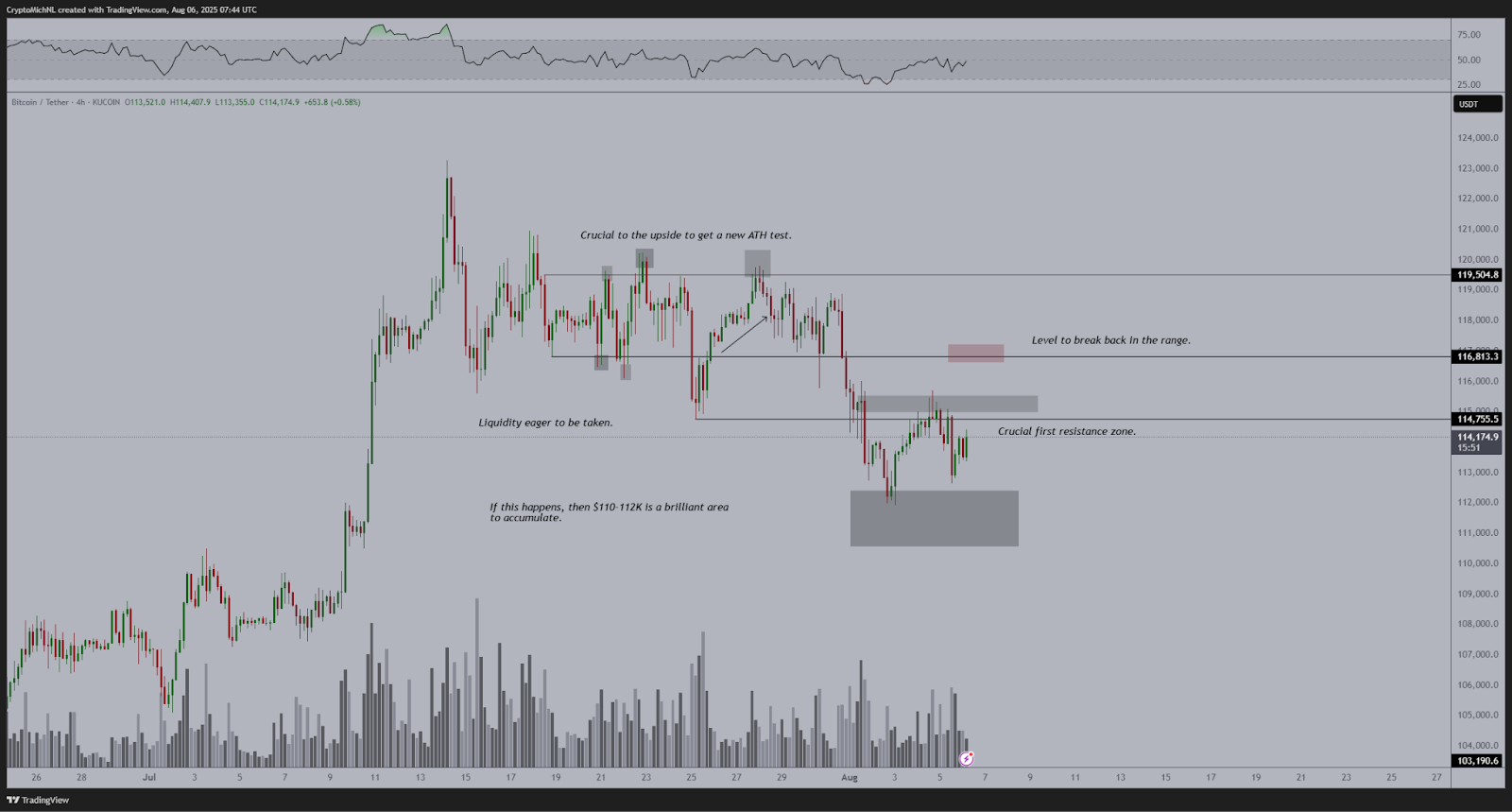
Аналитик Михаэль ван де Поппе отмечает, что биткоин демонстрирует первые признаки восстановления после того, как достиг более высокого минимума около отметки $112 700.

На момент публикации статьи BTC торгуется примерно на уровне $113 950, снизившись на 0,58% за последние 24 часа. Этому способствовала нестабильная неделя, в течение которой цена упала с максимумов середины июля в $123 200 до недавнего минимума около $112 000.

Ван де Поппе подчеркнул, что биткоин сейчас приближается к ключевой зоне сопротивления $114 755–$115 000. Он отметил, что этот ключевой уровень может определить, вернется ли BTC в свой предыдущий торговый диапазон. В частности, успешный прорыв этой области, вероятно, спровоцирует восходящий импульс не только для биткоина, но и для всего рынка альткоинов.

По теме: Цена биткоина (BTC) должна преодолеть отметку в $116 800, чтобы стать «взрывной», считает ведущий аналитик

Прорыв выше $116 800 может открыть дверь новому тесту ATH

На прилагаемом графике $116 813 обозначены как «уровень для выхода из диапазона». Другими словами, если биткоин вернёт себе эту зону, это может подготовить почву для нового рывка к историческим максимумам, особенно с учётом заметной ликвидности, скопившейся чуть выше этого уровня.

Дальнейшее движение к отметке $119 504 будет свидетельствовать о серьезном укреплении и, возможно, снова привлечет институциональный капитал на рынок.

С другой стороны, такой прорыв может также оживить рынки альткоинов, которые отставали во время недавнего восходящего тренда биткоина.
Внимание: ниже 113 тыс. долларов: возможны дополнительные недостатки

Хотя текущая структура выглядит конструктивной, Ван де Поппе предупредил, что падение ниже $113 000 сведёт на нет бычий тренд и, возможно, приведёт к новым локальным минимумам. Ключевая зона накопления остаётся между $110 000 и $112 000, которую он назвал «блестящей областью для накопления», если биткоин снова туда вернётся.

Этот регион ранее служил зоной спроса, оказывая поддержку во время откатов. Потеря этой зоны может ускорить снижение до более высоких уровней, включая $103 000.

На данный момент динамика цены биткоина остаётся в пределах определённого диапазона. Удержание уровня выше $113 000 и пробитие $115 000 могут вернуть импульс в пользу быков. Если прорыв произойдёт, это может стать зелёным светом для ралли альткоинов, отражая предыдущие рыночные циклы, где биткоин лидировал в выходе из консолидации.

По теме: Аналитики выделяют четыре альткоина с августовской силой

Опытный трейдер предупреждает: биткоин не исправит жизнь

В ожидании дальнейшего развития биткоина опытный трейдер Питер Брандт спровоцировал споры, назвав биткоин «всего лишь активом». Он предупредил, что те, кто рассчитывает на то, что он изменит их жизнь, будут разочарованы. В посте на X он раскритиковал идеологическую привязанность некоторых людей к биткоину, призвав их «найти себе жизнь».

Брандт, ранее отмечавший снижение доходности биткоина, предостерег молодых инвесторов от ожиданий экспоненциального роста, хотя он по-прежнему рассматривает его как инструмент хеджирования против фиатных валют.


Leituras Relacionadas

The Illusion of a Prodigy

The Illusion of the "Genius Youth" The article discusses the recent interview incident involving Li Bojie, a former "Huawei Genius Youth," and AI company DeepSeek. It highlights the core conflict not as a simple case of suspected cheating during a coding test, but as a profound mismatch in expectations. Li, with an impressive background including entrepreneurship, a role at Huawei, and a position as a chief scientist, was deeply affected by a standard remote interview where the interviewer questioned his actions. The key point is his stated view of DeepSeek as the "pinnacle of the Chinese tech world." For him, the interview was a quest for identity validation—proof he belonged at the center of the new AI era. For DeepSeek, it was a routine skills assessment. The article argues that Li, while publicly rejecting the "genius" label, subconsciously expected to be treated as a peer for discussion, a courtesy extended by other companies like MiniMax and Xiaomi. DeepSeek, however, adhered strictly to its standardized process, prioritizing consistent, merit-based evaluation over individual prestige. This clash symbolizes a larger shift in the tech industry. The core thesis is that the AI era is dismantling the old system where past titles, companies, and accumulated experience guaranteed status. Now, with rapid knowledge obsolescence, "excellence is calculated in real-time." Li's anxiety—waiting weeks for the DeepSeek interview despite other offers—stems from the fear that rejection means being left behind by technological progress. The article concludes that this incident is a harbinger; soon, everyone will face a constant, implicit "interview" with the AI age itself, asking: "You were excellent yesterday. What about today?"

marsbitHá 13m

The Illusion of a Prodigy

marsbitHá 13m

Vanguard Group Enters the Arena, Opening a New Crypto Portal for 50 Million Traditional Investors

Vanguard Group, the world's second-largest asset manager with $12 trillion in assets under management and over 50 million investors, has signaled a significant strategic shift by posting a job opening for a "Head of Digital Assets, Personal Wealth." The role entails developing a comprehensive digital asset strategy, establishing long-term plans, and overseeing the full integration of digital assets into Vanguard's wealth management platform, covering areas like custody, settlement, asset tokenization, and stablecoins. This move marks a notable reversal from the firm's previous stance. In 2024, Vanguard refused to list spot Bitcoin ETFs and removed Bitcoin futures products. By late 2025, it allowed some third-party crypto ETF trading but reiterated it would not create its own crypto funds. The new hire represents a third step: building an internal team to integrate digital assets into its core infrastructure, moving beyond merely listing products. The initiative focuses on foundational financial infrastructure—how tokenized assets and digital settlement systems can connect to Vanguard's existing platform, which primarily serves long-term, conservative investors. While Vanguard maintains it will not launch proprietary crypto ETFs, it is proactively preparing its systems for a future involving tokenized assets and stablecoins, which Citigroup projects could reach a $5.5 trillion market by 2030. Vanguard's scale means its chosen standards for custody, settlement, and compliance could set de facto rules for the broader wealth management industry. The firm is acting despite regulatory uncertainty and cautious market sentiment (e.g., Citi recently lowered crypto price targets). Analysts suggest even a minimal 0.01% allocation from Vanguard's asset base would bring ~$12 billion into digital assets, forcing the development of robust risk and operational frameworks. Ultimately, Vanguard's focus is on building the plumbing for digital assets to potentially serve its vast client base, an effort whose impact may extend far beyond any single market cycle.

Foresight NewsHá 27m

Vanguard Group Enters the Arena, Opening a New Crypto Portal for 50 Million Traditional Investors

Foresight NewsHá 27m

Paradigm's New Playbook: Crypto in One Hand, AI and Robotics in the Other

Title: Paradigm's New Strategy: Crypto in One Hand, AI and Robotics in the Other On July 8, 2026, top-tier venture capital firm Paradigm announced the successful $12 billion close of its fourth fund, marking a strategic evolution beyond its pure-play crypto roots. While remaining committed to cryptocurrency, the firm is now formally extending its investment focus to include artificial intelligence, robotics, and other frontier technologies. This shift was foreshadowed by a subtle but significant change to its official social media description earlier in March, from "A research-driven crypto investment firm" to a broader "We build and invest in the companies and ideas shaping the frontier." The move is driven by the firm's recognition of transformative technological waves beyond crypto, particularly in AI and robotics, and a response to the shifting capital allocation landscape. Despite significant AI sector fundraising, Paradigm emphasizes its commitment remains grounded in deep technical rigor. A key intersection for Paradigm lies in AI Agents, where decentralized blockchain networks and stablecoins are seen as a natural financial infrastructure for autonomous digital operations. The firm is active in promoting open-source, decentralized AI (e.g., investing in Nous Research) and building agent-friendly blockchains (e.g., incubating Tempo). It is also developing tools like EVMbench (with OpenAI) and the Centaur AI Agent platform. Within its crypto stronghold, Paradigm will continue focusing on core infrastructure areas. These include derivatives and new liquidity layers (e.g., Hyperliquid), prediction markets (with plans for a proprietary trading terminal), and developer tools (continuing development of Reth and Foundry). In summary, Paradigm's expansion reflects a broader realignment in venture capital, where the intense capital concentration in AI and the search for exponential growth compel even crypto-native funds to broaden their narratives. However, this does not signify an abandonment of crypto; instead, the focus is sharpening on real-world financial applications like stablecoins, RWA, on-chain derivatives, prediction markets, and the convergence of Crypto and AI Agents.

Foresight NewsHá 1h

Paradigm's New Playbook: Crypto in One Hand, AI and Robotics in the Other

Foresight NewsHá 1h

The Preferred Stock Domino Effect: Strive Incurs a 7.08 Million Dollar Loss, Strategic Risk Spreading in a Chain Reaction

"Priority Stock Domino Effect": Strive's $7.08 Million Loss Reveals Chain-Reaction Risk in Bitcoin Reserve Sector Bitcoin reserve company-issued preferred shares are no longer just yield assets but a credit test for balance sheet health. While focus remains on Strategy, Strive, the 7th largest public Bitcoin holder, disclosed a tangible spillover effect: its holding of Strategy's (STRC) preferred shares lost $7.08 million in fair value over eight days, despite no change in share count. This exposes a clear cross-company risk transmission channel within the sector. Strive's filing shows its 505,000 STRC shares fell from ~$88.59 to ~$74.57 per share. While Strive remains solvent with 19,864 BTC and $141.7M cash, the loss signals that preferred stock risks can spread via inter-company holdings, shifting their perception from stable income to credit-like, high-risk assets dependent on issuer liquidity and dividend sustainability. In response, Strategy unveiled a "Digital Credit Capital Framework," raising STRC's annual dividend to 12%, mandating a 12-month cash reserve for dividends, and authorizing up to $1B each for STRC/common stock buybacks and a $1.25B Bitcoin sale plan to bolster reserves. This marks a shift to active credit risk management, formally incorporating potential Bitcoin sales to stabilize its capital structure. Third-party valuation tools, like Farside's calculator estimating STRC's net present value at ~$49.89, highlight that pricing now hinges critically on perpetual dividend sustainability and the issuer's ability to pay amid market volatility. Bitcoin's price (~$62k) remains below Strategy's average cost basis ($75,651), intensifying focus on reserve policies. The market faces two scenarios: 1) Contained risk, where STRC's discount narrows and stress is limited to Strategy; or 2) Systemic risk, where deep STRC discounts persist, dividend hikes fail, Bitcoin sales commence, and pressure spreads to other issuers like Strive's SATA shares. Key indicators to watch are STRC/SATA discount levels, dividend coverage credibility, equity issuance rates, and any actual Bitcoin divestment. Strive's future reports will be crucial in determining if its loss is an isolated event or the first sign of sector-wide credit risk contagion via preferred shares.

marsbitHá 1h

The Preferred Stock Domino Effect: Strive Incurs a 7.08 Million Dollar Loss, Strategic Risk Spreading in a Chain Reaction

marsbitHá 1h

Trading

Spot
活动图片