Vanguard Group Enters the Arena, Opening a New Crypto Portal for 50 Million Traditional Investors

Foresight NewsPublicado em 2026-07-09Última atualização em 2026-07-09

Resumo

Vanguard Group, the world's second-largest asset manager with $12 trillion in assets under management and over 50 million investors, has signaled a significant strategic shift by posting a job opening for a "Head of Digital Assets, Personal Wealth." The role entails developing a comprehensive digital asset strategy, establishing long-term plans, and overseeing the full integration of digital assets into Vanguard's wealth management platform, covering areas like custody, settlement, asset tokenization, and stablecoins. This move marks a notable reversal from the firm's previous stance. In 2024, Vanguard refused to list spot Bitcoin ETFs and removed Bitcoin futures products. By late 2025, it allowed some third-party crypto ETF trading but reiterated it would not create its own crypto funds. The new hire represents a third step: building an internal team to integrate digital assets into its core infrastructure, moving beyond merely listing products. The initiative focuses on foundational financial infrastructure—how tokenized assets and digital settlement systems can connect to Vanguard's existing platform, which primarily serves long-term, conservative investors. While Vanguard maintains it will not launch proprietary crypto ETFs, it is proactively preparing its systems for a future involving tokenized assets and stablecoins, which Citigroup projects could reach a $5.5 trillion market by 2030. Vanguard's scale means its chosen standards for custody, settlement, and complianc...


Author: Gino Matos

Compiled by: Luffy, Foresight News


On July 6, Vanguard Group released a job posting for the role of Head of Digital Assets, Personal Wealth, with locations spanning four cities: Dallas, Scottsdale, Charlotte, and Malvern. The job announcement required the new head to lead the formulation of a comprehensive digital asset strategy, establish mid-to-long-term development plans, and oversee the full-process implementation within the company's wealth business division.


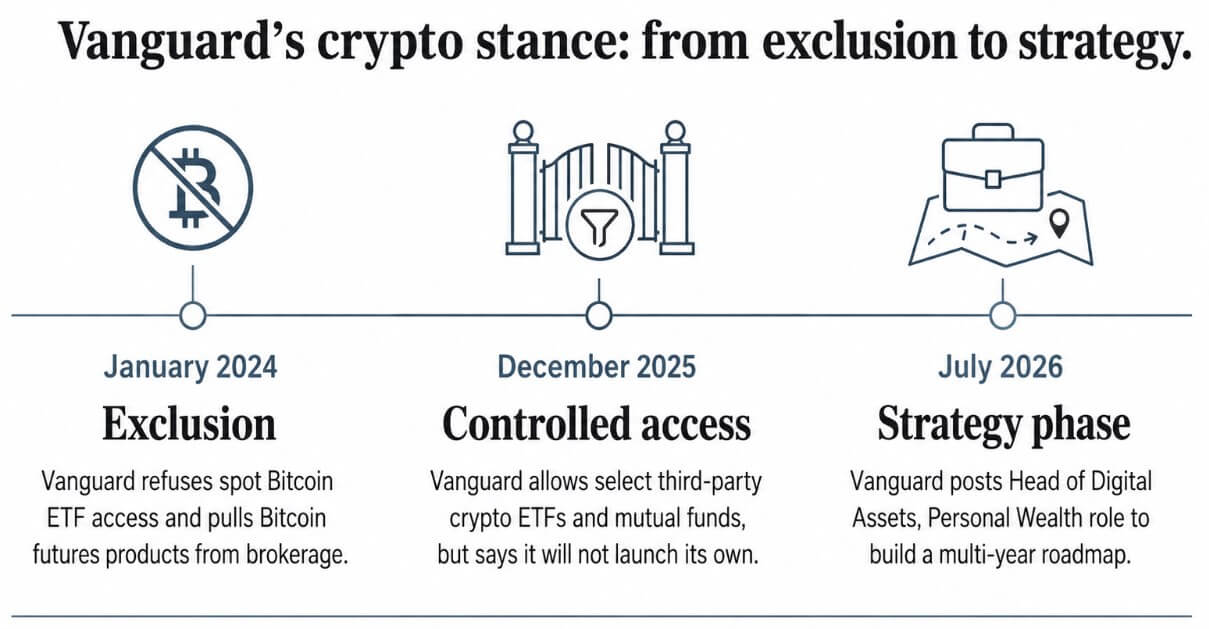
Two years ago, this asset management giant held a starkly different view towards crypto assets. In January 2024, after the U.S. SEC approved Bitcoin futures ETFs, Vanguard Group not only refused to list Bitcoin spot ETFs but also removed all Bitcoin futures products from its platform.


This shift is happening at the world's second-largest asset management company. As of December 2025, Vanguard Group managed approximately $12 trillion in assets, serving over 50 million investors. For an institution of such immense scale, a job posting that mentions custody, settlement, asset tokenization, and stablecoins carries far greater industry weight than similar announcements from native crypto brokerages.


Interestingly, while overall market expectations for crypto assets are trending towards caution, Vanguard Group is moving in the opposite direction by formally establishing an internal, dedicated digital assets team. This month, Citi lowered its price expectations for crypto assets, reducing its 12-month Bitcoin target price from $112,000 to $82,000 and its Ethereum target from $3,175 to $2,240, while also revising its full-year net inflow expectation for U.S. Bitcoin spot ETFs from $10 billion down to $0.

Vanguard's Changing Stance on Cryptocurrency


Core Job Responsibilities


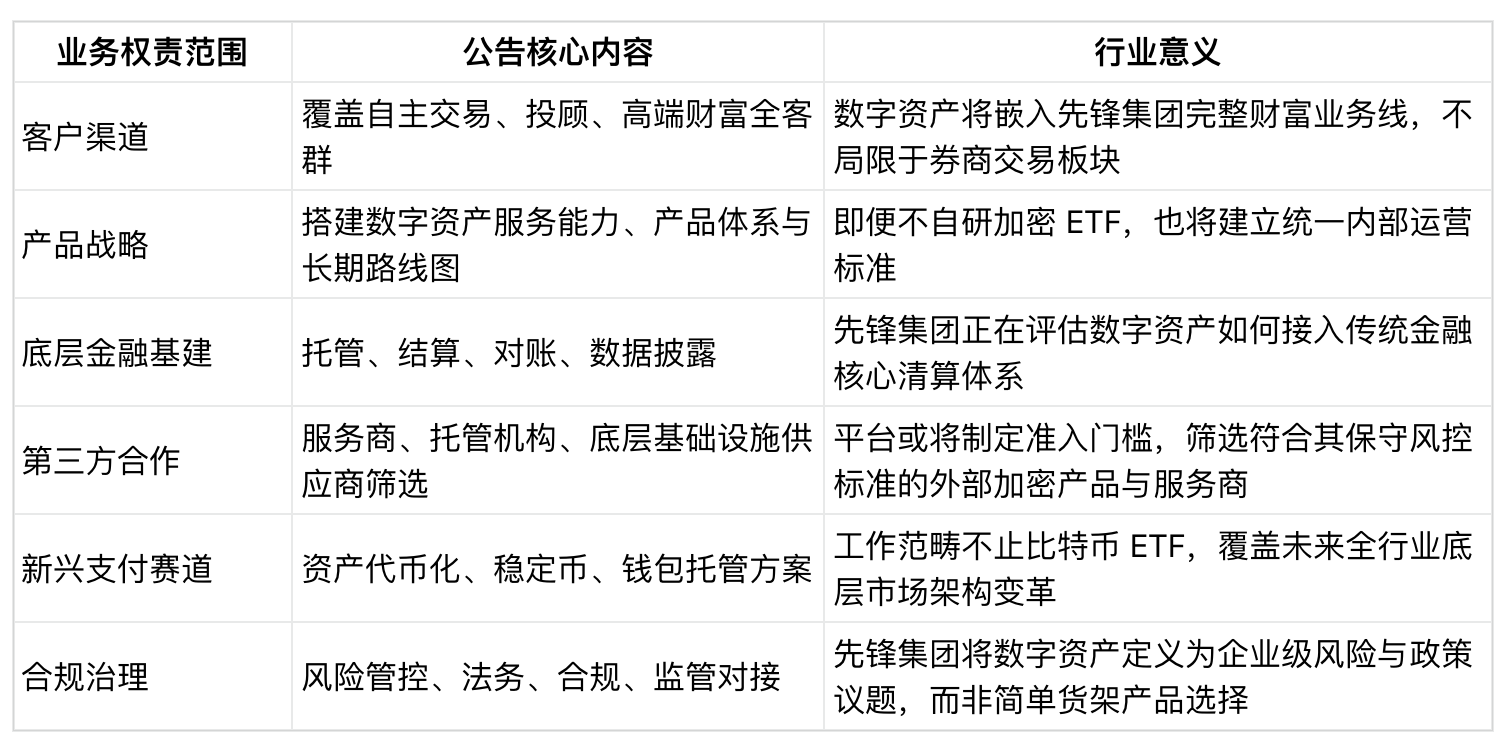
The Vanguard announcement requires the executive to comprehensively assess digital asset service capabilities for self-directed trading clients, advisory service clients, and high-net-worth clients; to design the entire operational system for asset access, custody, settlement, reconciliation, information disclosure, and third-party service provider integration.


The role must continuously monitor five core sectors: asset tokenization, stablecoins, wallet and custody architecture, and blockchain infrastructure, while simultaneously liaising with corresponding regulatory bodies, custody service providers, and technology vendors.


The scope of this role's responsibilities extends beyond the single question of "whether to list Bitcoin ETFs." Vanguard explicitly stated that its stance on self-developing crypto products remains unchanged, with the company having no plans to issue its own cryptocurrency ETFs or mutual funds. It also cautioned that crypto ETFs and crypto funds carry high trading risks and are not suitable for all investors.


The two positions are not contradictory: on one hand, it does not self-issue crypto products; on the other hand, it is establishing an executive role to coordinate how digital assets integrate into the existing financial systems for custody, settlement, and compliance, which currently only serve stocks and bonds.


Vanguard's core business model is providing low-cost, long-term investment products for retirement savers. Before a global regulatory framework is established, building standards for tokenized asset custody and settlement first is a high-stakes move. Once the blueprint is finalized, it would be extremely costly for this $12 trillion AUM giant to make adjustments.


Reviewing the stance changes: In 2024, Vanguard completely blocked Bitcoin spot ETFs; in December 2025, the platform opened access to some third-party crypto ETFs and funds but reiterated it would not self-develop similar products; the July 2026 hiring is the third step, establishing a dedicated internal department to consider how digital assets fit the platform's infrastructure, rather than just considering whether to list financial products.


Building Industry Infrastructure


BlackRock chose ETFs as its entry point. Its iShares Bitcoin Trust (IBIT) reached $46.5 billion in net assets as of July 6, with a product management fee of 0.25% and a 30-day median bid-ask spread of only 0.03%. IBIT's cumulative fund inflows surpassed $60.2 billion; according to Farside Investors data, while other funds like Grayscale's GBTC experienced continued outflows, the net cumulative inflow for all U.S.-listed Bitcoin spot ETFs was approximately $51.4 billion as of July 7.


BlackRock's market logic is very simple: package Bitcoin in the familiar ETF wrapper to enable standardized trading.


In June 2026, Citi's report "Tokenization of Assets 2030" provided a baseline forecast: the current $17 billion tokenized asset market will expand to $5.5 trillion by 2030, with a range of $2.7 trillion to $8.2 trillion. Among this, compliant stablecoins are projected to reach $1.9 trillion by 2030. The report defines tokenized cash as the core foundation for a delivery-versus-payment (DvP) settlement system, which is precisely the settlement sector highlighted in Vanguard's job posting.


The core of Vanguard's current move is to solve a key problem: how can this $12 trillion AUM giant connect its wealth platform to the already scaled ETF products from BlackRock and the trillion-dollar tokenized asset infrastructure predicted by Citi for 2030?


Roadmap Impact Scope


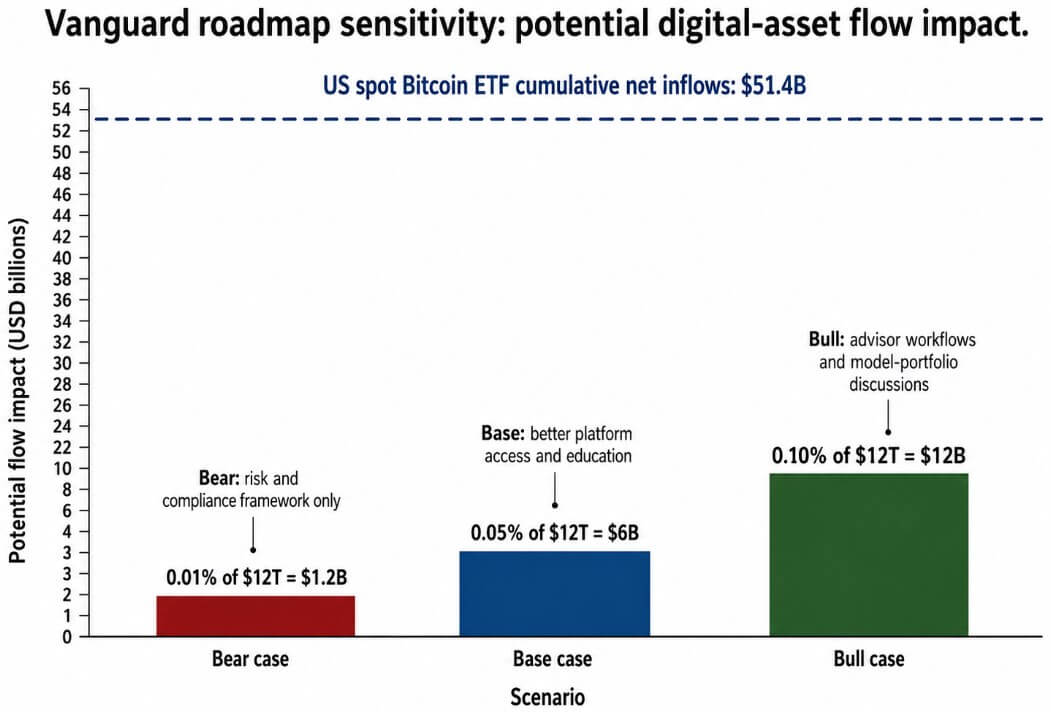
Vanguard's $12 trillion AUM dictates that its digital asset roadmap will have a massive market impact. Using this scale as a base and the $51.4 billion cumulative net inflow into U.S. Bitcoin spot ETFs as a reference, we can estimate the potential fund inflow range:


  • Pessimistic Scenario: The roadmap only establishes a risk and compliance framework, passively opens access to third-party products, and platform distribution channels remain cautious. Assuming only 0.01% of funds are allocated to digital assets, this corresponds to incremental capital of about $12 billion. Even this scale would force the platform to完善 (完善) complete supporting mechanisms like information disclosure, trading permission controls, and risk limits.
  • Baseline Scenario: Moderate capital inflow, corresponding to $6 billion in incremental funds.
  • Optimistic Scenario: Vanguard integrates digital asset trading into advisors' workflows and model portfolio discussions, still implemented through third-party products. Assuming such transactions account for 0.1% of its AUM, approximately $120 billion, this would equate to about 23% of the total cumulative net inflow into all U.S. Bitcoin spot ETFs.


Regulation Not Yet Finalized, Significant Industry Gaps Exist


In June 2026, the Bank for International Settlements (BIS) published a view that stablecoins have the potential to achieve high-speed programmable payments, but existing products exhibit significant flaws in monetary unity, full redemption guarantees, cross-chain interoperability, and resilience against financial crime.


The International Organization of Securities Commissions (IOSCO) also separately warned that asset tokenization suffers from ambiguity of ownership rights, making it difficult for investors to distinguish whether they hold the underlying real asset or merely a claim on the token. Additionally, the efficiency gains from tokenization are unevenly distributed, with vast disparities across different sectors.


Vanguard requires the new executive to continuously monitor the evolving global regulatory frameworks, the technological capabilities of third-party service providers, and the contradictions and shortcomings among various custody solutions. This giant, focused on stable long-term investment, is choosing to build its internal supporting systems in advance, during the current phase of uncertainty where global regulatory rules are not yet finalized.


Vanguard is deciding one thing: whether digital assets can be connected to the existing full-chain infrastructure of custody, settlement, and advisory services—a system currently serving the retirement accounts and index funds of 50 million investors. Once the custody and settlement standards Vanguard sets are adopted by other conservative wealth platforms, the institution that adamantly refused to list Bitcoin ETFs in 2024 could become the arbiter of tokenized asset operational rules for the Wall Street wealth management industry.


This job posting focuses on underlying financial infrastructure, and the influence of infrastructure standards will persist long-term, transcending individual crypto asset bull-bear cycles.


Criptomoedas em alta

Perguntas relacionadas

QWhat significant shift in strategy has Vanguard Group announced regarding digital assets, and what does this indicate about their long-term approach?

AVanguard Group has announced the hiring of a Head of Digital Assets for their personal wealth business, signaling a major strategic shift. This move, which involves creating a dedicated internal team and planning for digital asset integration into their core infrastructure (like custody and settlement systems), indicates a long-term, infrastructure-focused approach. They are building the foundational systems to support digital assets, moving beyond just the question of whether to list crypto ETFs.

QAccording to the article, what are the five core areas that Vanguard's new digital asset head is required to track?

AThe new Head of Digital Assets at Vanguard is required to continuously track five core areas: asset tokenization, stablecoins, wallet and custody architecture, blockchain underlying infrastructure, and the corresponding regulatory bodies and service providers.

QHow does Vanguard's new strategy for digital assets differ from BlackRock's approach as described in the article?

AVanguard's strategy focuses on building the underlying infrastructure (custody, settlement, compliance) to integrate digital assets into its existing wealth platform. In contrast, BlackRock's approach, as exemplified by its iShares Bitcoin Trust (IBIT), uses the familiar ETF wrapper as a breakthrough to provide standardized access to Bitcoin for investors. Vanguard is building the 'pipes,' while BlackRock created a popular 'product.'

QWhat potential market impact could Vanguard's digital asset roadmap have, based on the article's three scenarios?

ABased on the article's three scenarios, Vanguard's roadmap could attract significant new capital into digital assets: a pessimistic scenario with $1.2 billion (0.01% of AUM), a baseline scenario with $6 billion, and an optimistic scenario with $12 billion (0.1% of AUM). The optimistic inflow would equal roughly 23% of all net inflows into U.S. spot Bitcoin ETFs to date, demonstrating a substantial potential impact.

QWhy is Vanguard's move to establish digital asset standards considered strategically important, despite current regulatory uncertainty?

AVanguard's move is strategically important because, as a conservative giant managing $12 trillion for 50 million investors (often for retirement), the standards it sets for custody, settlement, and compliance for digital assets could become the de facto rules adopted by the broader traditional wealth management industry. By building its infrastructure now, it positions itself to shape the operational rules for tokenized assets on Wall Street, with an influence that will last beyond any single market cycle.

Leituras Relacionadas

Beyond Private Keys: From Wallets and L2 to Supply Chains, How to Guard the Security Perimeter of Web3?

Beyond Private Keys: Securing Web3's Expanding Attack Surface from Wallets to L2s and Supply Chains The crypto space faced a wave of security incidents in June, with over $75 million lost across 40 major attacks. These breaches highlighted risks beyond private key theft, exposing vulnerabilities across the entire user interaction chain. Wallet security was compromised not through stolen seed phrases, but via a critical flaw in the Cardano wallet SecondFi's signing implementation. This bug allowed attackers to potentially derive private keys from publicly visible signature data, emphasizing that wallet security depends on correct cryptographic implementation, ideally in open-source, auditable code. Layer-2 networks also revealed complex trust chain risks. Attacks on legacy Aztec deployments exploited inconsistencies in proof systems, showing that a valid zero-knowledge proof is only as secure as its underlying rules. Another attack on Taiko's SGX-based prover stemmed from a leaked signing key and inadequate verification checks. Furthermore, a technical glitch halted Base's block production, underscoring that L2 security encompasses network availability and reliable user exit paths as much as asset safety. Finally, the Polymarket incident demonstrated that even audited smart contracts are not immune. A compromised third-party supplier led to a malicious script being injected into the platform's frontend, resulting in user fund losses. This "supply chain attack" shows that the security of the entire interaction path—from the webpage to the wallet signature—is critical. The conclusion is clear: Web3 security now involves safeguarding the entire journey from transaction intent to on-chain settlement. Users must adopt layered security habits: isolating long-term holdings, using dedicated wallets for daily interactions, scrutinizing transaction details before signing, and managing authorizations cautiously. Defense must evolve from protecting a single point (the private key) to securing a complete chain of interactions.

marsbitHá 11m

Beyond Private Keys: From Wallets and L2 to Supply Chains, How to Guard the Security Perimeter of Web3?

marsbitHá 11m

Robinhood Chain Goes Viral in One Week: Memes Drive Traffic, Stablecoins Support TVL

Robinhood Chain, an Arbitrum-based Layer 2 network launched on July 1st, experienced explosive growth in its first week. While meme coin hype drove user activity, stablecoin deposits fueled its surge in Total Value Locked (TVL). The chain's rapid adoption was driven by multiple factors. CEO Vlad Tenev reversed his initial stance, endorsing the chain for meme coins despite its original focus on Real-World Assets (RWA). The integration of the popular Solana-based launchpad Pump.fun significantly lowered the barrier for meme trading. Furthermore, the prediction market application World announced a migration from Solana to Robinhood Chain. Meme coin mania, led by tokens like CASHCAT, generated massive trading volume, with daily active addresses skyrocketing from near zero to hundreds of thousands. However, the primary driver of the chain's TVL, which soared past $234 million, was a major institutional deposit. Ethena injected approximately $50 million in stablecoins into the Morpho lending protocol, which underpins Robinhood's Earn product, accounting for the bulk of locked value. This highlights two concurrent narratives: retail-driven meme speculation boosting transactions, and institutional stablecoin deposits building foundational liquidity. In contrast, the chain's flagship RWA offerings, like tokenized stocks, remain a minor part of the ecosystem at around $12.8 million. The first week demonstrates a path where speculative trading and yield-seeking capital provide initial momentum, while the core RWA vision is still in early development.

Foresight NewsHá 46m

Robinhood Chain Goes Viral in One Week: Memes Drive Traffic, Stablecoins Support TVL

Foresight NewsHá 46m

The Illusion of a Prodigy

The Illusion of the "Genius Youth" The article discusses the recent interview incident involving Li Bojie, a former "Huawei Genius Youth," and AI company DeepSeek. It highlights the core conflict not as a simple case of suspected cheating during a coding test, but as a profound mismatch in expectations. Li, with an impressive background including entrepreneurship, a role at Huawei, and a position as a chief scientist, was deeply affected by a standard remote interview where the interviewer questioned his actions. The key point is his stated view of DeepSeek as the "pinnacle of the Chinese tech world." For him, the interview was a quest for identity validation—proof he belonged at the center of the new AI era. For DeepSeek, it was a routine skills assessment. The article argues that Li, while publicly rejecting the "genius" label, subconsciously expected to be treated as a peer for discussion, a courtesy extended by other companies like MiniMax and Xiaomi. DeepSeek, however, adhered strictly to its standardized process, prioritizing consistent, merit-based evaluation over individual prestige. This clash symbolizes a larger shift in the tech industry. The core thesis is that the AI era is dismantling the old system where past titles, companies, and accumulated experience guaranteed status. Now, with rapid knowledge obsolescence, "excellence is calculated in real-time." Li's anxiety—waiting weeks for the DeepSeek interview despite other offers—stems from the fear that rejection means being left behind by technological progress. The article concludes that this incident is a harbinger; soon, everyone will face a constant, implicit "interview" with the AI age itself, asking: "You were excellent yesterday. What about today?"

marsbitHá 1h

The Illusion of a Prodigy

marsbitHá 1h

Paradigm's New Playbook: Crypto in One Hand, AI and Robotics in the Other

Title: Paradigm's New Strategy: Crypto in One Hand, AI and Robotics in the Other On July 8, 2026, top-tier venture capital firm Paradigm announced the successful $12 billion close of its fourth fund, marking a strategic evolution beyond its pure-play crypto roots. While remaining committed to cryptocurrency, the firm is now formally extending its investment focus to include artificial intelligence, robotics, and other frontier technologies. This shift was foreshadowed by a subtle but significant change to its official social media description earlier in March, from "A research-driven crypto investment firm" to a broader "We build and invest in the companies and ideas shaping the frontier." The move is driven by the firm's recognition of transformative technological waves beyond crypto, particularly in AI and robotics, and a response to the shifting capital allocation landscape. Despite significant AI sector fundraising, Paradigm emphasizes its commitment remains grounded in deep technical rigor. A key intersection for Paradigm lies in AI Agents, where decentralized blockchain networks and stablecoins are seen as a natural financial infrastructure for autonomous digital operations. The firm is active in promoting open-source, decentralized AI (e.g., investing in Nous Research) and building agent-friendly blockchains (e.g., incubating Tempo). It is also developing tools like EVMbench (with OpenAI) and the Centaur AI Agent platform. Within its crypto stronghold, Paradigm will continue focusing on core infrastructure areas. These include derivatives and new liquidity layers (e.g., Hyperliquid), prediction markets (with plans for a proprietary trading terminal), and developer tools (continuing development of Reth and Foundry). In summary, Paradigm's expansion reflects a broader realignment in venture capital, where the intense capital concentration in AI and the search for exponential growth compel even crypto-native funds to broaden their narratives. However, this does not signify an abandonment of crypto; instead, the focus is sharpening on real-world financial applications like stablecoins, RWA, on-chain derivatives, prediction markets, and the convergence of Crypto and AI Agents.

Foresight NewsHá 1h

Paradigm's New Playbook: Crypto in One Hand, AI and Robotics in the Other

Foresight NewsHá 1h

Trading

Spot

Artigos em Destaque

Como comprar PORTAL

Bem-vindo à HTX.com!Tornámos a compra de PORTAL (PORTAL) simples e conveniente.Segue o nosso guia passo a passo para iniciar a tua jornada no mundo das criptos.Passo 1: cria a tua conta HTXUtiliza o teu e-mail ou número de telefone para te inscreveres numa conta gratuita na HTX.Desfruta de um processo de inscrição sem complicações e desbloqueia todas as funcionalidades.Obter a minha contaPasso 2: vai para Comprar Cripto e escolhe o teu método de pagamentoCartão de crédito/débito: usa o teu visa ou mastercard para comprar PORTAL (PORTAL) instantaneamente.Saldo: usa os fundos da tua conta HTX para transacionar sem problemas.Terceiros: adicionamos métodos de pagamento populares, como Google Pay e Apple Pay, para aumentar a conveniência.P2P: transaciona diretamente com outros utilizadores na HTX.Mercado de balcão (OTC): oferecemos serviços personalizados e taxas de câmbio competitivas para os traders.Passo 3: armazena teu PORTAL (PORTAL)Depois de comprar o teu PORTAL (PORTAL), armazena-o na tua conta HTX.Alternativamente, podes enviá-lo para outro lugar através de transferência blockchain ou usá-lo para transacionar outras criptomoedas.Passo 4: transaciona PORTAL (PORTAL)Transaciona facilmente PORTAL (PORTAL) no mercado à vista da HTX.Acede simplesmente à tua conta, seleciona o teu par de trading, executa as tuas transações e monitoriza em tempo real.Oferecemos uma experiência de fácil utilização tanto para principiantes como para traders experientes.

159 Visualizações TotaisPublicado em {updateTime}Atualizado em 2026.06.02

Como comprar PORTAL

Discussões

Bem-vindo à Comunidade HTX. Aqui, pode manter-se informado sobre os mais recentes desenvolvimentos da plataforma e obter acesso a análises profissionais de mercado. As opiniões dos utilizadores sobre o preço de PORTAL (PORTAL) são apresentadas abaixo.

活动图片