Value Locked in Defi Jumped 7% in 5 Days — Harmony's Horizon Bridge Siphoned for $100M

Bitcoin.comPublicado em 2022-06-26Última atualização em 2022-06-26

Resumo

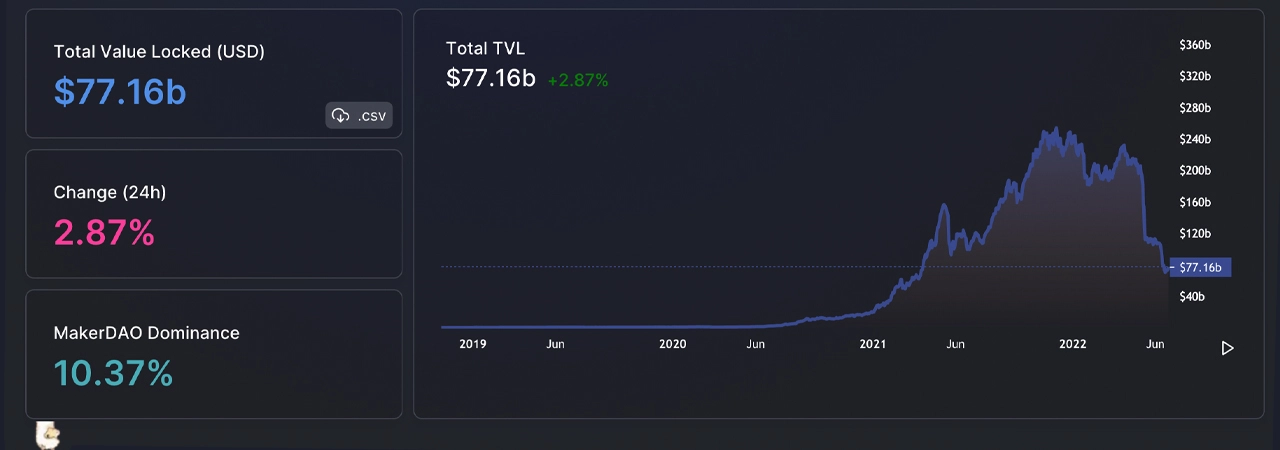
While crypto prices have seen some healing during the last few days, the total value locked (TVL) across the entire decentralized finance (defi) ecosystem has also improved. The TVL in defi has seen an increase of 7.19% since June 20, and the defi protocol Makerdao’s TVL dominates by 10.37% this weekend.

Defi TVL Improves, Cross-Chain Bridge TVL Slips, $100 Million Stolen From Harmony’s Horizon Bridge

Decentralized finance has taken a hit from the recent crypto bloodbath following the Terra blockchain fallout, the most recent Federal Reserve rate hike, and the alleged financial issues surrounding Celsius and Three Arrows Capital (3AC). On June 17, Bitcoin.com News reported on the bear market affecting defi negatively and three days later the TVL in defi dropped to a low of $71.98 billion.

Since then, there’s been a 7.19% increase as the TVL rose from $71.98 billion to today’s $77.16 billion. The Makerdao protocol has the largest TVL out of all the defi projects and dominates by 10.37% this weekend with $8 billion TVL.
Makerdao’s TVL has increased 6.89% during the past seven days. The second largest defi protocol in terms of TVL size is Aave, with $6.59 billion, and Aave recorded a 27.13% increase during the course of the week. As far as blockchain TVL distribution is concerned, Ethereum commands 63.98% with $49 billion TVL.

Binance Smart Chain (BSC) is the second largest chain by TVL with 7.85% or $6.01 billion locked. After the market capitalization of the top smart contract tokens hit $245 billion last week, the market cap has swelled to $280 billion, up 1.4% during the last 24 hours.

Ethereum (ETH) increased 12.7% against the USD, and BSC jumped 10.5% this past week. Solana (SOL) swelled by 37.1%, avalanche (AVAX) recorded a 32.2% increase, and polygon (MATIC) rose more than 50% during the seven-day period.

The biggest gainers in the top smart contract token list during the past week were ronin (RON), zilliqa (ZIL), and polygon (MATIC), respectively. Despite smart contract tokens seeing some gains this week and the TVL in defi improving, the TVL across the cross-chain bridge sector is down 60.4% during the past 30 days.

At the time of writing, the cross-chain bridge TVL across 16 different protocols is $11.77 billion in value. Polygon commands the largest cross-chain bridge TVL with $3.6 billion locked on June 25.

Meanwhile, the defi ecosystem has seen a few hiccups over the last seven days as Convex Finance is asking users to review approvals while it evaluates a “potential front end issue.” Additionally, Harmony’s cross-chain bridge lost $100 million in a theft that took place on June 23.

“Note this does not impact the trustless [bitcoin] bridge; its funds and assets stored on decentralized vaults are safe at this time,” the Harmony team wrote about the situation. “We have also notified exchanges and stopped the Horizon bridge to prevent further transactions. The team is all hands on deck as investigations continue.”


Leituras Relacionadas

The Storage Magnate Who Conquered a Trillion-Dollar Kingdom, Yet Ultimately Could Not Become the Richest

**Summary:** "The Memory Magnate Who Built a Trillion-Dollar Empire, Yet Never Became the Richest" explores the journey of Zhu Yiming, founder of GigaDevice (603986) and co-founder of the soon-to-IPO ChangXin Memory Technologies (CXMT). The article positions GigaDevice, a fabless chip designer now valued at ~¥340 billion, as a prequel to the massive IDM (Integrated Device Manufacturer) venture, CXMT. Starting in 2005 with minimal capital, Zhu strategically "picked up the pieces" by focusing on niche markets like NOR Flash and microcontrollers (MCUs), areas major players were exiting. This allowed GigaDevice to grow into a diversified semiconductor company, maintaining robust profitability even during industry downturns by controlling costs. However, the piece argues that in the highly cyclical and capital-intensive memory chip industry, the fabless model has limits. True resilience and scale require the ability for "counter-cyclical expansion" – investing heavily during downturns – a tactic only possible for IDMs like Samsung or SK Hynix. This insight led Zhu to partner with the Hefei city government in 2016 to establish CXMT, an IDM focused on DRAM. Zhu's symbolic moves, like forfeiting salary and diluting his equity, were crucial in securing the massive state and bank funding needed. CXMT's equipment base is now valued even higher than that of BYD's vast auto manufacturing empire. Despite the potential for CXMT to reach a market cap of ¥1-2 trillion upon its IPO, Zhu's indirect stake in both companies is estimated below 3%, placing his personal wealth far below that of China's top billionaires. The article concludes that his strategic vision built a trillion-yuan memory landscape, but the capital structure necessary to achieve it precluded a personal fortune of similar scale.

marsbitHá 4m

The Storage Magnate Who Conquered a Trillion-Dollar Kingdom, Yet Ultimately Could Not Become the Richest

marsbitHá 4m

XRP Ledger Daily Fees Drop Below $400 As Network Activity Question Returns

The XRP Ledger is drawing attention as daily network fees have fallen below $400. While low fees align with XRPL's design for affordable transactions and are often seen as a strength, the metric can also serve as an indicator of network demand and paid transaction volume. This data point of around $3,100 in weekly fee burn highlights the stark contrast with higher-fee chains like Ethereum and Bitcoin. The development fuels an ongoing debate. Proponents view low fees as a sign of efficiency and accessibility, while critics may question if the network is generating sufficient high-value activity relative to its market cap and payments-focused narrative. The article cautions against overstating the finding, noting a single low-fee day does not signify network failure. It instead adds context to discussions about XRPL's usage, especially alongside Ripple's broader initiatives in stablecoins (RLUSD), AI payments, and enterprise infrastructure. The report recommends monitoring for a fee rebound, checking transaction counts for a fuller picture, and confirming the trend via native explorers like Bithomp. It frames the story within a larger market shift where on-chain data, protocol updates, and infrastructure developments are becoming crucial alongside price action. The editorial stance is to present the verified data, explain its significance for assessing network activity, and avoid hype, positioning it as part of the daily crypto conversation.

bitcoinistHá 4h

XRP Ledger Daily Fees Drop Below $400 As Network Activity Question Returns

bitcoinistHá 4h

Trading

Spot
Futuros
活动图片