The Storage Magnate Who Conquered a Trillion-Dollar Kingdom, Yet Ultimately Could Not Become the Richest

marsbitPublicado em 2026-06-15Última atualização em 2026-06-15

Resumo

**Summary:** "The Memory Magnate Who Built a Trillion-Dollar Empire, Yet Never Became the Richest" explores the journey of Zhu Yiming, founder of GigaDevice (603986) and co-founder of the soon-to-IPO ChangXin Memory Technologies (CXMT). The article positions GigaDevice, a fabless chip designer now valued at ~¥340 billion, as a prequel to the massive IDM (Integrated Device Manufacturer) venture, CXMT. Starting in 2005 with minimal capital, Zhu strategically "picked up the pieces" by focusing on niche markets like NOR Flash and microcontrollers (MCUs), areas major players were exiting. This allowed GigaDevice to grow into a diversified semiconductor company, maintaining robust profitability even during industry downturns by controlling costs. However, the piece argues that in the highly cyclical and capital-intensive memory chip industry, the fabless model has limits. True resilience and scale require the ability for "counter-cyclical expansion" – investing heavily during downturns – a tactic only possible for IDMs like Samsung or SK Hynix. This insight led Zhu to partner with the Hefei city government in 2016 to establish CXMT, an IDM focused on DRAM. Zhu's symbolic moves, like forfeiting salary and diluting his equity, were crucial in securing the massive state and bank funding needed. CXMT's equipment base is now valued even higher than that of BYD's vast auto manufacturing empire. Despite the potential for CXMT to reach a market cap of ¥1-2 trillion upon its IPO, Zhu's i...

Author | Eastland

Header Image | Visual China


Changxin Technology is poised to list on the STAR Market, with its market capitalization highly likely to exceed 1 trillion yuan, and some optimistic voices even calling for 2 trillion yuan.

Changxin Technology has no actual controller. Its top five shareholders (including Hefei State-owned Assets, the National Integrated Circuit Industry Investment Fund) collectively hold approximately 58% of the shares. The "soul figure" Zhu Yiming holds less than 3% of the shares (indirectly), so even if Changxin's market cap rises further, it will be difficult for him to rank among the top tycoons.

Regarding Changxin Technology, the author already published an article on January 26, 2026 (published on Huxiu). This article introduces another excellent company founded by Zhu Yiming—GigaDevice (SH:603986), a storage chip giant with a market cap of 340 billion yuan.

The development history of GigaDevice is the "Prequel to Changxin Technology".

Diversification Born from "Finding Good Deals"

In April 2005, Zhu Yiming returned to China and founded "Beijing Xinjia Zhaowei Microelectronics Technology" (renamed GigaDevice Limited in 2010), with registered capital of 2 million yuan.


In December 2012, it completed its shareholding reform. After multiple rounds of capital increases, its registered capital reached 75 million yuan. Among them, Zhu Yiming held 16.292%.


In August 2016, it was listed on the Shanghai Stock Exchange, raising 517 million yuan.


In 2020, GigaDevice raised approximately 4.28 billion yuan through a private placement.


In January 2026, GigaDevice was listed on the Hong Kong Main Board (HK:03986), raising 4.68 billion Hong Kong dollars.


As financing channels opened up, GigaDevice's product structure diversified from a single storage chip through internal R&D and acquisitions, forming four product lines: storage chips, microcontrollers (MCU), sensors, and analog chips. However, the vast majority of revenue comes from storage chips and controllers.

  • NOR Flash


NOR Flash is GigaDevice's founding business, covering a variety of products with capacities ranging from 512Kb to 2Gb. Its global market share in 2025 was about 20% (ranking third globally and first in mainland China). In 2025, it achieved mass production of 45nm node SPI NOR Flash.

With the iteration of smartphone supply, the market for smaller-capacity NOR Flash has been declining—from $7 billion in 2006 to $1.58 billion in 2016. Samsung stopped developing new NOR Flash products as early as 2010. Although Micron did not completely exit, its market share fell from being the global leader in 2010 to fourth place in 2025.

AI computing power has no upper limit for storage chip capacity and transmission speed requirements. But in fields like automotive, consumer electronics, and industrial control, the requirement for storage chips is simply 'fit for purpose.' NOR Flash, with its fast read speed, high reliability, and low cost, has irreplaceability. A high-end electric vehicle equipped with an advanced intelligent driving system contains about 30 NOR Flash chips.

As international giants successively shut down mid-to-low-end DRAM and consumer-oriented NAND businesses, GigaDevice, in cooperation with Changxin Storage, gradually launched DDR3 and DDR4 products.

Low-end does not equal useless. GigaDevice seized the dividend from the giants' exit, gradually growing its storage chip business by "finding good deals." In 2024, its global market shares for NOR Flash, SLC NAND, and niche DRAM were 18.5%, 2.2%, and 1.7%, respectively.

  • Microcontrollers (MCU)

Before 2013, this market was dominated by European giants like STMicroelectronics. This was because the most critical component in an MCU is precisely the Flash memory chip.

After gaining a foothold in NOR Flash, GigaDevice did not rush into the high-end storage chip market. Instead, it entered the MCU market in 2013.

By 2024, it had mass-produced 63 series and over 700 products. In 2022, it entered the new energy vehicle market, providing specialized MCUs for application scenarios such as body domain control and chassis control.

  • Sensors and Analog Chips

In 2019, it entered the touch and fingerprint recognition sensor market through the acquisition of Silergy. In 2024, it acquired Suzhou Saixin, leading to explosive growth in its analog chip business.


From 2015 to 2018, the combined revenue from storage chips + microcontrollers accounted for 100% of total revenue.

In 2019, sensor revenue was 435 million yuan, accounting for 6.3% of revenue;

In 2021, storage chip revenue increased by 66% year-on-year to 5.45 billion yuan; but microcontroller revenue surged by 225%, causing the storage chip share to drop to 64%;

In 2022, storage chip revenue fell by 11.5% to 4.83 billion yuan; microcontroller revenue grew by 15.2% to 2.83 billion yuan; the storage chip share dropped to 59%;

......

In 2025, storage chip and microcontroller revenues were 6.56 billion yuan and 1.91 billion yuan, respectively, together accounting for 92% of total revenue; sensor and analog products combined revenue was 720 million yuan, accounting for 8% of total revenue.
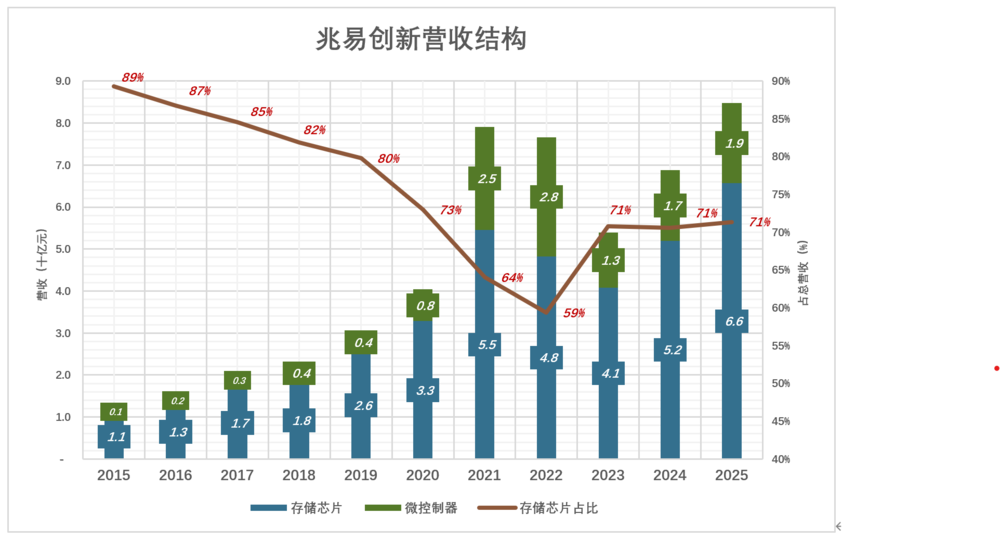
Only 800,000 yuan in cash was in the registered capital (the rest was contributed as non-patented technology), which is barely enough to even open a small restaurant. Based on his capital and technical strength, Zhu Yiming precisely "found good deals," developing and growing in the cracks between giants.

A Rare High-Performer in the Storage Industry

1) Shipment Volume, Unit Price, and Gross Profit

In 2025, the revenue index for storage chips was 200, and the sales volume index was 165 (with 2020 as the base year). The reason was an increase in the average selling price:

In 2020, storage chip shipments were 2.686 billion units, revenue was 3.28 billion yuan, with an average price of 1.22 yuan per unit;

In 2025, storage chip shipments were 4.436 billion units, and the average price rose to 1.48 yuan per unit, 21.1% higher than in 2020.
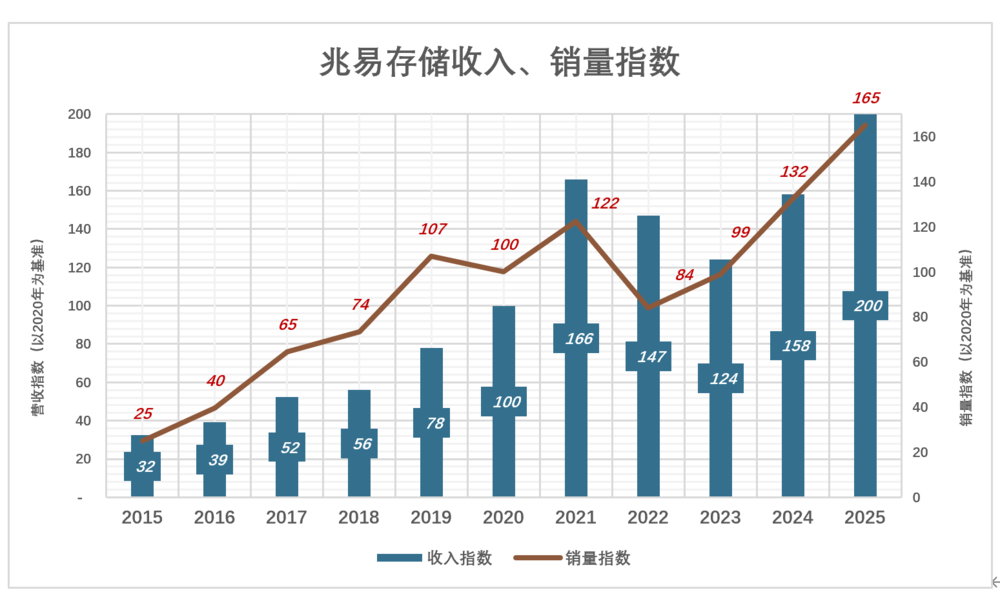

In 2022, demand for NOR Flash in the consumer, mobile phone, and PC sectors decreased. GigaDevice's storage chip shipments fell by 31.3% year-on-year. However, due to an increased proportion of mid-to-high-end products, gross profit per unit reached a record 0.86 yuan, with a gross profit margin of 40%.


In 2025, storage chip shipments reached 4.44 billion units, and gross profit per unit dropped to 0.63 yuan, 0.23 yuan lower than in 2022; but because costs decreased by 0.43 yuan, the gross profit margin actually increased to 43%.
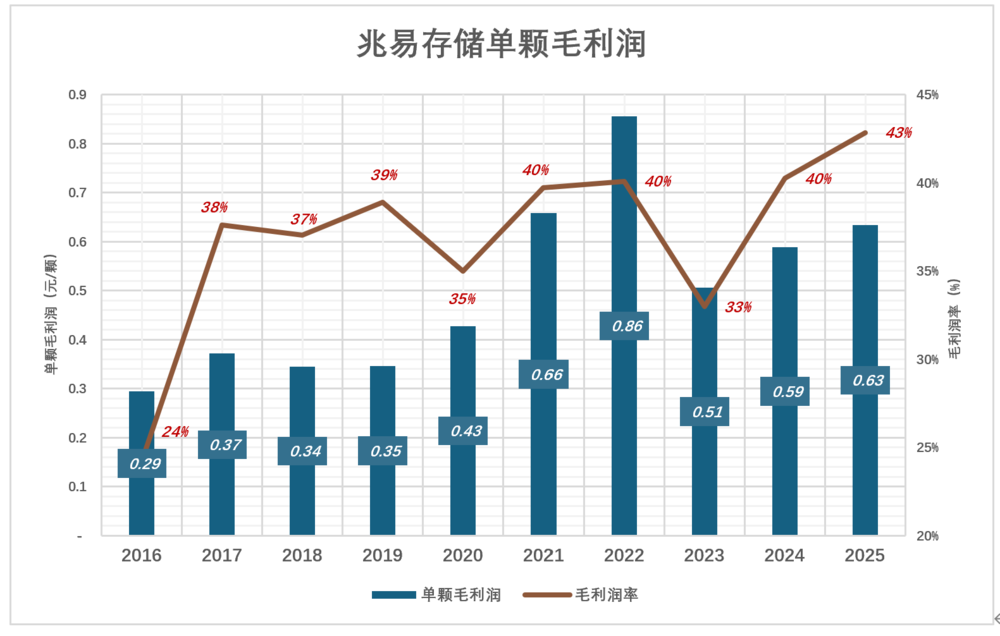

GigaDevice's storage chips are primarily small-to-medium capacity. In 2025, the average selling price was only 1.48 yuan, which is not comparable to DDR5 or HBM chips that cost tens or even hundreds of yuan each.

2) Gross Profit Margin, Expense Ratio

In the chart below, the blue line represents the gross profit margin, and the colored stacked bars represent the expense ratios. Operating profit is only possible when the blue "drowns out" the colors.

GigaDevice's blue line remains high above, demonstrating its strong high-performer credentials:


In the industry downturn of 2022, GigaDevice's gross profit was 3.88 billion yuan, with a gross profit margin as high as 47.7%; combined sales, management, and R&D expenses accounted for 20% of revenue; the gross profit margin was 28 percentage points higher than the total expense ratio!

In 2025, GigaDevice's revenue was 60% higher than in 2024; gross profit was 3.7 billion yuan, and the profit margin returned to above 40%;

In Q1 2026, performance exploded, with revenue increasing by 119% year-on-year; gross profit was 2.39 billion yuan, with a profit margin of 57.1%, 41 percentage points higher than the total expense ratio, far exceeding the profitability of 2022.
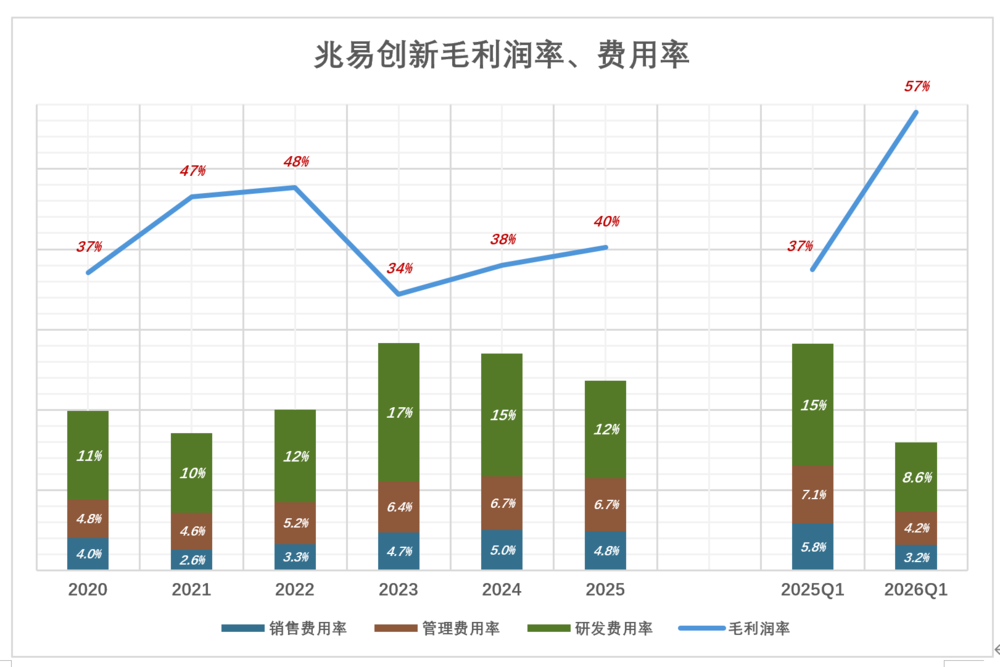


A 40% gross profit margin is not considered high for a light-asset company. It is quite remarkable for GigaDevice to control the total expense ratio below 30% while maintaining positive operating profit, especially at its revenue scale.

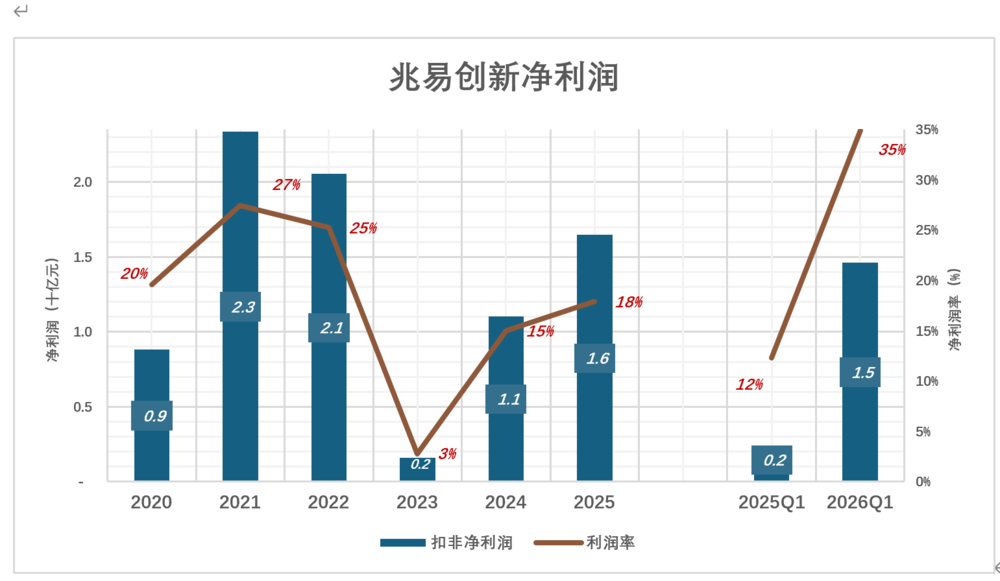
3) Cyclical Fluctuations in Net Profit

The storage chip industry exhibits strong cyclicality, and GigaDevice's performance clearly fluctuates with the industry cycle:


In 2021, net profit was 2.34 billion yuan, with a profit margin of 27.5%;

......

In 2023, net profit fell to 160 million yuan, with a profit margin of only 2.8%;

......

In 2025, net profit rebounded to 1.65 billion yuan, with a profit margin of 17.9%;

In Q1 2026, quarterly net profit reached 1.46 billion yuan, a year-on-year increase of 523%;


Binding with Changxin Forms the "Complete Entity"


Over the past 30 years, the storage chip industry has experienced four complete cycles:


1993~1996: Microsoft Windows drove DRAM demand to multiply, but overcapacity later emerged, causing prices to plummet;

2012~2015: Smartphones drove storage demand growth, but later this was completely offset by declining PC demand, leading to an industry downturn;

2016~2019: Android phone memory upgrades drove growth, but later this was completely offset by declining cloud computing demand, plunging the industry into deep losses;

2020~2023: The pandemic drove growth in mobile phone and PC shipments, and storage chip demand rose accordingly. Manufacturers, fearing shortages, overstocked. After the pandemic, the storage industry experienced a deep contraction;


In 2025, AI computing power created strong demand for high-bandwidth HBM chips. HBM uses a multi-layer chip stacking architecture, occupying about 3-4 times the wafer and packaging capacity of mid-to-low-end storage chips. The three giants—Samsung, SK Hynix, and Micron—allocated 90% of their capacity to high-end products like HBM and DDR5, leading to tight supply for mid-to-low-end products.

Semiconductor companies generally operate under four models: Vertical Integration (IDM), Fabless (Fablss), Foundry (Foundry),

and Outsourced Semiconductor Assembly and Test (OSAT).


IDM integrates chip design, manufacturing, packaging and testing, and product sales into one entity, representing a heavy-asset model.

The benefit is deep synergy between design and manufacturing, which helps optimize product yield, power consumption, and performance. The cost is high capital expenditure. Giants like Samsung, SK Hynix, and Micron adopt the IDM model.

The Fabless model allows companies to focus on chip design and R&D, outsourcing wafer manufacturing, packaging, and testing to specialized foundries, representing a light-asset model.

In a highly cyclical industry, does the light-asset model have a higher probability of success? In the storage chip field, the answer is no!


Taiwanese companies like ProMOS, Powerchip, and Inotera Memories adopted the Fabless model to avoid massive capital expenditure. When the storage chip industry was at a low point, these light-asset companies went bankrupt, were liquidated, or were acquired.


Heavy-asset giants engage in "counter-cyclical expansion"—investing huge sums to build factories and deploy advanced equipment; pouring fuel on the fire of overcapacity, accelerating price collapse, and speeding up the elimination of excess capacity.


Today's three storage chip giants (Samsung, Hynix, Micron) are all "survivors" of the industry's violent fluctuations.

Historical experience shows that counter-cyclical expansion is the "decisive move" in the storage chip field. The Fabless model is a light-asset model with no capacity to expand.


Due to the extremely high capital and technical barriers for R&D and manufacturing DRAM, GigaDevice found it difficult to achieve this on its own. In 2016, Zhu Yiming cooperated with the Hefei Municipal Government to establish Changxin Technology.

GigaDevice is not a complete entity and absolutely lacks the time and capital to evolve into an IDM model. Therefore, Zhu Yiming chose to cooperate with Hefei City.


In 2018, Zhu Yiming served as Chairman and CEO of Changxin Technology, explicitly stating he would not receive any salary before the company turned profitable. He also allocated half of the equity incentives he received (worth over 10 billion yuan) to reward employees.


In total, Zhu Yiming's shareholding proportion is slightly above 1% (post-listing). Zhu Yiming also voluntarily extended his lock-up period to 10 years.


Globally, it's not uncommon for founders of high-tech companies to make gestures like giving up salaries. Diluting equity often happens out of necessity (for financing), but control is the bottom line.


Zhu Yiming's series of actions made state-owned capital dare to invest heavily and banks dare to lend (long-term loans exceeding 100 billion yuan). As of the end of 2025, the original value of machinery and equipment at Changxin Technology reached 225.7 billion yuan, with accumulated depreciation of 55.2 billion yuan and a net book value of 169.3 billion yuan.

What does nearly 170 billion yuan worth of machinery and equipment mean? BYD has nine major production bases in China, with a double-shift capacity of about 8 million vehicles per year. Note, these are not simple assembly plants like a certain "super factory," but rather a vertically integrated industrial empire covering the entire new energy vehicle industry chain, from batteries to chips, producing over 75% of components in-house. As of the end of 2025, BYD's machinery and equipment had a net book value of 150.6 billion yuan, 18.7 billion yuan less than Changxin Technology's!


Assuming Changxin Technology's market capitalization reaches 2 trillion yuan, plus the value of his shares in GigaDevice, Zhu Yiming's net worth would not exceed 50 billion yuan, less than one-tenth of Zhong Shanshan's (According to the "2026 Hurun Rich List," the 20th-ranked Zhang Gang's family assets were 160 billion yuan).


*The above analysis is for reference only and does not constitute any investment advice!

Perguntas relacionadas

QWhy is Zhu Yiming unlikely to become a top-tier billionaire even if ChangXin Technology's market value soars?

ABecause he holds less than 3% of the shares (indirectly) in ChangXin Technology, which has no actual controller and its top five shareholders (including Hefei State-owned Assets and the Big Fund) collectively hold about 58%.

QWhat is the main development strategy that Zhuoyi Innovation adopted in its early stages?

AZhuoyi Innovation's main early strategy was 'cherry-picking' or seizing opportunities in market gaps left by giants. With limited initial capital (only 800,000 RMB in cash), it focused on niche areas like mid-to-low-end NOR Flash, SLC NAND, and later MCUs, where international giants were withdrawing or reducing presence.

QWhat are the two main product lines contributing to the majority of Zhuoyi Innovation's revenue?

AThe two main product lines are Storage Chips (primarily NOR Flash, SLC NAND, and niche DRAM) and Microcontroller Units (MCUs). In 2025, these together accounted for 92% of the total revenue.

QAccording to the article, why is the Fabless (asset-light) model not necessarily more successful in the memory chip industry?

ABecause the memory chip industry is highly cyclical. Fabless companies, being asset-light, cannot engage in 'counter-cyclical expansion'—investing heavily in new factories and advanced equipment during downturns. History shows that surviving giants like Samsung, SK Hynix, and Micron are IDM (Integrated Device Manufacturer) models that used heavy investments to outlast competitors and consolidate the market.

QWhat crucial strategic move did Zhu Yiming make to overcome the limitations of Zhuoyi Innovation's Fabless model in the high-end memory market?

AHe co-founded ChangXin Technology with the Hefei municipal government in 2016. This move created an IDM entity capable of the massive capital expenditure and advanced manufacturing required for DRAM (like DDR3, DDR4). To gain trust from state-owned assets and banks for heavy investment, Zhu made significant personal sacrifices, including forgoing salary until profitability and diluting his own equity and control.

Leituras Relacionadas

US Government Suddenly Halts Anthropic's Strongest Model, "Quasi-IPO Stock Price" Plunges 3.7% Overnight

U.S. Government Halts Anthropic's Top AI Models, 'Pre-IPO' Price Drops 3.7% On June 12, the U.S. government ordered Anthropic to shut down access to its two most powerful AI models, Claude Fable 5 and Claude Mythos 5, citing national security concerns. The directive, issued by the Department of Commerce, required Anthropic to block access for all foreign nationals, leading the company to disable the models globally for all users. Anthropic strongly opposed the move, arguing the government's basis was a "narrow jailbreak vulnerability" and warning that applying such a standard industry-wide would effectively halt all frontier model deployments. The news impacted Anthropic's implied valuation in speculative markets. The Anthropic perpetual contract on Hyperliquid fell approximately 3.7% to around $1,627, down from highs above $1,800 following the models' release. Unauthorized tokenized products linked to Anthropic on Solana also saw significant declines. The models, launched just days earlier on June 9, represented a major capability leap for Anthropic. Fable 5 was its first public release of a "Mythos"-tier model above its flagship Claude Opus. The shutdown creates an ironic situation for Anthropic, a company founded on "AI safety" principles, and adds uncertainty to its ongoing IPO preparations. The company is actively engaging with regulators to resolve what it calls a "misunderstanding" and restore service.

marsbitHá 6m

US Government Suddenly Halts Anthropic's Strongest Model, "Quasi-IPO Stock Price" Plunges 3.7% Overnight

marsbitHá 6m

SpaceX IPO Creates Trillion-Dollar Billionaire: Musk's Wealth Equals Half of Crypto Market

SpaceX's record-breaking IPO has propelled Elon Musk to become the first modern billionaire with a personal net worth exceeding $1 trillion, reaching $1.11 trillion according to Bloomberg. This staggering wealth surpasses the total market capitalization of all cryptocurrencies excluding Bitcoin and equals roughly half of the entire crypto market's value. The milestone highlights extreme wealth concentration and the significant devaluation of the altcoin market, whose total cap has nearly halved since late 2025 as capital flows into large tech stocks. SpaceX's Nasdaq debut saw its valuation hit $2.2 trillion, with shares soaring from a $135 offer price to close at $161. Its first-day trading volume of $85 billion set a new global IPO record. Musk owns 42% of the company. Despite his wealth dwarfing the altcoin sector, Musk maintains deep ties to digital assets. He personally holds Bitcoin, Ethereum, and Dogecoin, while his companies, SpaceX and Tesla, collectively hold over 30,000 Bitcoin, ranking among the top corporate BTC holders globally. His acquisition and integration of financial data tools into X (formerly Twitter) further connect his ecosystem to the markets. Ultimately, Musk's trillion-dollar status underscores the immense wealth controlled by tech founders, though this fortune remains largely tied to volatile stock prices rather than liquid assets.

Foresight NewsHá 14m

SpaceX IPO Creates Trillion-Dollar Billionaire: Musk's Wealth Equals Half of Crypto Market

Foresight NewsHá 14m

Hardcore First Look | Ocean Embodied Intelligence Company 'Shihang Intelligence' Secures Record-Breaking 1 Billion in Funding, Zhu Xiaohu, Temasek Place Bets

Breaking News | Ocean Embodied Intelligence company "Shihang Intelligent" secures a record-breaking 1 billion RMB (approximately 10 billion yuan) in Series A financing, with investment from Zhu Xiaohu and Temasek. Author: Qiu Xiaofen | Editor: Yuan Silai Ocean Embodied Intelligence company "Shihang Intelligent" has completed its Series A funding round, raising over 1 billion RMB. This marks the largest single funding round in the global marine robotics field to date. Investors include upstream momentum funds from chip companies "Moore Thread" and "Kunlunxin," Singapore's state-owned investment platform Vertex Growth, and listed company Dyneo, among others. Existing investors like GSR Ventures (whose founder Zhu Xiaohu has invested for the fifth time), Vertex Ventures China, Hua Ying Capital, and Long Capital also significantly increased their investments. Founder and CEO Chen Xiaobo, a 1989-born alumnus of Harbin Engineering University, is a long-time expert in underwater robotics. He received the National Defense Science and Technology Progress Award at age 28 (the youngest recipient) and led the development of China's first commercial underwater cleaning robot. The funds will be used for core technology R&D, global market expansion, and building the industry chain ecosystem to scale the application of marine robots in complex underwater scenarios. The ocean is considered one of the most challenging environments for robotics due to low light, high turbidity, complex currents, limited communication, high pressure, and corrosion. "Shihang Intelligent" focuses on developing core underlying technologies for marine robots, covering six key systems: power, control, sensing, navigation, sealing, and deployment. Its robots are capable of operating at depths from 0 to 10,000 meters with full degrees of freedom, performing complex maneuvers, autonomous navigation, and multi-robot collaboration. Applications include ship cleaning, underwater security, offshore wind power, marine ranching, and seabed inspection. The company's order value for the first half of 2026 alone has exceeded 1 billion RMB. Its "Orca Robot" is used by major shipping companies and has performed maintenance on over a thousand large vessels. In April of this year, the company launched its ocean embodied large model "Cangqiong CEORION." Unlike traditional remote-controlled or pre-programmed robots, this model integrates environmental perception, task understanding, and action generation into a single end-to-end architecture. Trained on millions of hours of commercial operation data and simulation data, it covers 12 major underwater operation scenarios. In simulations, it achieved over 90% task success rate and over 70% zero-shot adaptation capability to unseen environments. A built-in physics reasoning module reduces collision risk by 80%, enabling autonomous operation even with weak or no communication. Recently, "Shihang Intelligent" was selected as a core technology partner for Singapore's Maritime and Port Authority national hull inspection and cleaning program. These advancements indicate marine robotics is moving from pilot projects to scaled applications, with real-world operations generating valuable data to continuously improve robot capabilities. CEO Chen Xiaobo stated the company will continue investing in core marine robotics technology, the embodied intelligence model, and global application scenarios to expand into more high-risk, high-difficulty, and high-value underwater operations.

marsbitHá 39m

Hardcore First Look | Ocean Embodied Intelligence Company 'Shihang Intelligence' Secures Record-Breaking 1 Billion in Funding, Zhu Xiaohu, Temasek Place Bets

marsbitHá 39m

Three Months, 35 Billion Yuan: Investors Rush to Grab the OpenAI of the Physical World

Investors flock to a physical AI startup as the race for the "OpenAI of the physical world" heats up. Ji Jia Shi Jie (GigaWorld), a company dedicated to developing Artificial General Intelligence (AGI) for the physical world, has raised 3.5 billion RMB (approximately $490 million) in just three months, according to a report from investment media outlet Touzijie. The latest B2 funding round of 1 billion RMB attracted a wide range of top-tier investors, including sovereign wealth funds, industrial capital, and financial institutions. This brings the total funding for the young company, now valued over 10 billion RMB, to 3.5 billion RMB across three recent rounds. The company is led by Huang Guan, a post-90s Tsinghua University PhD with extensive experience in AI, autonomous driving, and entrepreneurship. Its core innovation is a "dual-pyramid" system comprising a five-layer data pyramid (from internet videos to real-world robot data) and a three-layer algorithm pyramid focused on world simulation, action alignment, and reinforcement learning. This system underpins its key models: the "World Action Model" (e.g., GigaBrain series for robot control) and the "World Generation Model" (e.g., GigaWorld series for simulating and understanding the physical world). Its models have reportedly achieved top rankings in global robotics benchmarks. Ji Jia Shi Jie argues that while current digital AGI excels in information processing, the next frontier is physical AGI—systems that can understand and interact with the real world. The company believes the field is approaching its "GPT-3 moment," a key inflection point in capability scaling. To achieve this, the company is pursuing a dual-market strategy. For the consumer (C) market, it launched the "SeeLight" brand and its S1 general-purpose humanoid robot, which has secured initial orders for deployment in real homes. For the business (B) market, it focuses on industrial automation with its Maker series robots, having signed agreements for large-scale deployment in factories, and its DriveDreamer world model for autonomous driving, which is already in use with over 30 automakers and tech companies. The report concludes that by bridging the gap between digital intelligence and physical action, Ji Jia Shi Jie aims to unlock a new wave of productivity, ultimately bringing physical AGI into everyday life.

marsbitHá 1h

Three Months, 35 Billion Yuan: Investors Rush to Grab the OpenAI of the Physical World

marsbitHá 1h

What's the Connection Between Pinduoduo's Huang Zheng and Blockchain?

This text explores the unexpected connection between Pinduoduo founder Colin Huang and blockchain, as suggested in his article *Turning Capitalism Upside Down*. Huang argues Pinduoduo's core business is about managing "uncertainty." He posits that wealth flows to the rich because they absorb life's uncertainties (e.g., illness, job loss) that devastate the poor, who pay a premium for certainty through insurance or stable prices. Pinduoduo's model attempts a "reverse insurance": by aggregating consumer demand via group-buying and flash sales, it creates a large, predictable order for manufacturers. This certainty allows factories to remove risk premiums, passing savings back as lower prices, thus partially reversing the wealth flow. The key obstacle, Huang notes, is that an individual's buying intent is an unreliable promise. He then asks if blockchain is the natural solution for this "reverse insurance." The text elaborates that blockchain, through smart contracts with binding deposits, could transform casual intent into a costly-to-break, enforceable commitment. This replaces interpersonal trust with coded rules, making promises credible, pricable, and resistant to fraud. Finally, the author draws a parallel to Bitcoin, framing two paths to creating certainty: the "Pinduoduo path" of aggregating decentralized will into scale, and the "Bitcoin path" of locking rules into immutable code. Both sacrifice something—personal freedom or system flexibility—to manufacture trust and predictability.

链捕手Há 2h

What's the Connection Between Pinduoduo's Huang Zheng and Blockchain?

链捕手Há 2h

Trading

Spot
Futuros
活动图片





