XRP News: SBI CEO Reveals The Key To Massive Wealth Shift

bitcoinistPublicado em 2025-07-15Última atualização em 2025-07-15

Resumo

The Chief Executive Officer (CEO) of SBI Global Asset Management, Tomoya Asakura, has described XRP as more than just a...

Trusted Editorial content, reviewed by leading industry experts and seasoned editors. Ad Disclosure

The Chief Executive Officer (CEO) of SBI Global Asset Management, Tomoya Asakura, has described XRP as more than just a speculative cryptocurrency, calling it a key player in a major global wealth transfer. As traditional markets feel the strain and pressure of rising tariffs and economic uncertainty, XRP is gaining momentum as a leading digital asset, seeing continued growth in both value and adoption. 

XRP Emerges As Global Wealth Transfer Trigger

In a bold and defining statement, Asakura declared on the X social media that XRP represents the most significant wealth transfer opportunity of this generation. The CEO’s assertion places XRP at the epicenter of a rapidly changing financial world, one where traditional markets are faltering and digital currencies are rising in response.

In his view, XRP stands apart from other digital assets due to its real-world use cases and growing role in global finance. He stated that the current economic climate, shaped by mounting tariffs and geopolitical tensions, is pushing investors away from traditional assets like stocks and bonds. In response, interest and capital are rapidly shifting toward alternatives such as cryptocurrencies and gold

XRP
Source: Shawn Mark on X

Among these cryptocurrencies, XRP has surged significantly, with its market capitalization recently exceeding 25 trillion yen ($172.6 billion)— a development Asakura believes signals a deeper financial shift. He further emphasized that XRP’s strength lies in its fast and low-cost international remittance infrastructure

Unlike speculative tokens, the SBI asset management CEO reveals that XRP is backed by a real-world solution aimed at improving cross-border payment inefficiencies. He noted that Ripple, a crypto company holding the largest share of XRP‘s supply, has built a global payment network increasingly embraced by major banks and financial institutions. This ever-growing institutional adoption is a key reason why XRP is gaining long-term value and attention. 

According to Asakura, XRP is no longer a niche digital currency but a foundational component of the digital financial revolution set to redefine the rules of global wealth. He believes its value and potential may continue to grow as more institutions recognize its capabilities in cross-border payments and digital liquidity.

XRP’s Value Continues Bullish Ascent

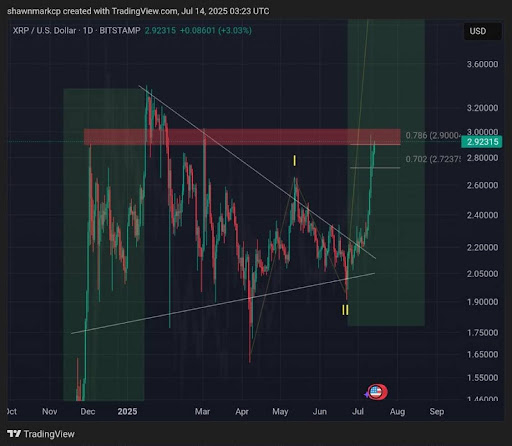
XRP is on a steady bullish trajectory, as its price once again approaches the $3 mark. A new analysis by market expert Shawn Mark on X suggests that XRP is rapidly building momentum around a key resistance zone near the $2.90 level. 

The cryptocurrency recently surged to $2.92, marking a sharp upward move from around $2.00 just weeks ago. Mark’s chart analysis shows a breakout from a long-term descending wedge, indicating the potential for a trend reversal and the start of a new bullish phase. The chart also shows that the price is presently testing the 0.786 Fibonacci resistance level. 

If XRP manages to break through this area cleanly, the analyst predicts that it could retest its all-time high of above $3.40 from previous cycles. Should bulls maintain control, the cryptocurrency may then enter price discovery mode.

XRP
XRP trading at $2.99 on the 1D chart | Source: XRPUSDT on Tradingview.com
Featured image from Getty Images, chart from Tradingview.com
Editorial Process for bitcoinist is centered on delivering thoroughly researched, accurate, and unbiased content. We uphold strict sourcing standards, and each page undergoes diligent review by our team of top technology experts and seasoned editors. This process ensures the integrity, relevance, and value of our content for our readers.

Scott Matherson is a leading crypto writer at Bitcoinist, who possesses a sharp analytical mind and a deep understanding of the digital currency landscape. Scott has earned a reputation for delivering thought-provoking and well-researched articles that resonate with both newcomers and seasoned crypto enthusiasts. Outside of his writing, Scott is passionate about promoting crypto literacy and often works to educate the public on the potential of blockchain.

Leituras Relacionadas

Is Anyone Still Buying in the Crypto Market? Unpacking 3 Common Watch-and-Wait Mentalities Today

Is Anyone Still Buying in the Crypto Market? Unpacking 3 Common Wait-and-See Mindsets This article analyzes the current cautious sentiment in the crypto market, distilled from conversations with sophisticated investors. The author identifies three dominant investor mindsets: 1. **Satisfied with Current Holdings:** Many retain a long-term belief in digital assets but see no immediate catalyst for significant price appreciation. They hold positions to avoid missing a future surge but allocate minimal new capital or attention. A shift requires a new, observable catalyst or a rotation from other portfolio areas. 2. **Waiting for Lower Prices:** This reflects not just short-term timing but a belief about crypto's total addressable market and upside potential. It could change if key perceived cycle bottoms pass without a crash, a major bullish event occurs (e.g., sovereign adoption), or price rebounds trigger FOMO-driven buying. 3. **High Opportunity Cost of Allocation:** The core question is comparative growth. With AI-related equities appearing to offer relentless, high-speed growth, justifying marginal investment into assets without similar perceived momentum is difficult. A slowdown in the AI trade could potentially mark a bottom and trigger capital reallocation into crypto. In conclusion, while long-term conviction persists for many, near-term marginal capital flows are constrained by these beliefs. The author suggests the market may be closer to a bottom than a top, but the current climate is defined by this wait-and-see approach, awaiting a catalyst to reignite broader investor commitment.

marsbitHá 40m

Is Anyone Still Buying in the Crypto Market? Unpacking 3 Common Watch-and-Wait Mentalities Today

marsbitHá 40m

China Added 67 New Unicorns in Half a Year, with AI and Robotics Accounting for Over Half

China added 67 new unicorn companies in the first half of 2026, reaching a total of 517 unicorns with a combined valuation of approximately $2.39 trillion. This surge marks a significant rebound after a post-2022 slowdown and sets a new semi-annual record. The growth is primarily driven by Artificial Intelligence (AI) and Robotics, which together account for over 53% of the new entrants. Specifically, 19 new unicorns are in robotics and 17 in AI. Notable companies include DeepSeek ($615.38B) and Kling AI ($18B). The trend indicates a decisive shift from internet consumer models to hard tech innovation. Geographically, new unicorns are highly concentrated in four cities: Beijing (19), Shanghai (18), Shenzhen (9), and Hangzhou (5), which together host 76.1% of the new companies. Hangzhou's overall valuation is boosted significantly by DeepSeek. Valuation distribution among new unicorns is pyramidal: 77.6% are valued between $1B and $2B, indicating early-stage status, while only two exceed $10B. There is a notable "speed divide": many AI/robotics startups achieved unicorn status in under three years, often via corporate spin-offs or led by star founders, while hard tech companies in semiconductors or biotech typically took over eight years. The report concludes that this wave reflects China's accelerating transition into an AI and robotics-powered innovation cycle, characterized by faster company formation, heightened geographic concentration, and a clear focus on foundational technologies.

marsbitHá 1h

China Added 67 New Unicorns in Half a Year, with AI and Robotics Accounting for Over Half

marsbitHá 1h

Trading

Spot
活动图片