解读全球流动性周期:我们处于哪个位置?

marsbitPublicado em 2025-07-11Última atualização em 2025-07-12

世代传承的财富往往诞生于从紧缩周期转向宽松的阶段。因此,明确自身在流动性周期中的位置,是精准布局资产的关键。我们如今处于哪个阶段?且听我细细道来……

为何你必须关注流动性周期(即使讨厌宏观经济)

央行流动性如同全球经济引擎的润滑油:

注入过多会让市场「超速运转」;抽离过度则会导致「活塞卡死」,就像你精心打扮的约会对象突然离你而去。重点是:若能跟上流动性的节奏,你就能提前预判泡沫与崩盘。

2020-2025 年流动性的四个阶段

1、激增阶段(2020-2021 年)

央行像开足马力的消防水枪疯狂注水:零利率落地、量化宽松(QE)规模创历史纪录,16 万亿美元财政救济砸向市场。

从背景看,全球货币供应量(M2)增速比二战以来任何时期都要快。

2、枯竭阶段(2021-2022 年)

利率飙升 500 个基点,量化紧缩(QT)启动,危机救助计划到期。

直观来说,2022 年债券市场创下史上最大跌幅(约 - 17%)。

3、平稳阶段(2022-2024 年)

政策保持紧缩,没有新动作。

决策者维持现有政策,让其充分发挥作用以压制通胀。

4、初步转向阶段(2024-2025 年)

全球开始降息并放松限制,尽管利率仍处于相对高位,但已开启下行趋势。

2025 年中期现状:我们一只脚还停留在平稳阶段,另一只脚试探着迈向初步转向阶段的第一步。当前利率高企,量化紧缩仍在持续,但除非新的冲击把我们拽回激增模式,否则下一步大概率会继续宽松。

更多细节可见下面的「交通信号灯速查手册」…

没错,我找 GPT 帮忙做了个超酷的表格!下面这张表能让你一眼看清 2017、2021、2025 这三个关键年份的情况:

十二大流动性杠杆交通信号灯速查手册

🔴 未激活 🟧 轻度激活 🟢 强烈激活
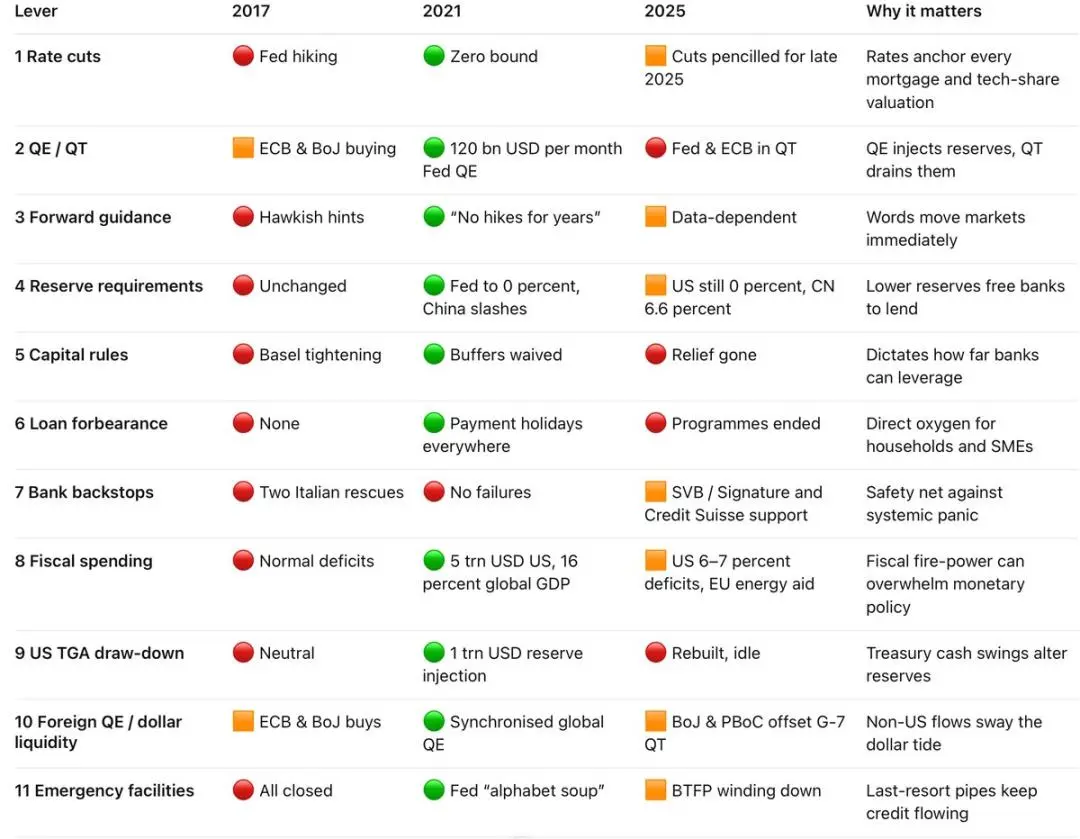
量化宽松

🔑 能激活其他 11 个杠杆的总开关是哪一个?

量化宽松

逐步拆解

降息方面——2017 年美联储加息,全球几乎没有宽松政策;2021 年全球紧急降息至接近零的水平;2025 年为维持抗通胀的公信力,利率保持高位,但美国和欧洲核心国家已计划在 2025 年底首次小幅降息。

量化宽松 / 紧缩(QE/QT)——2017 年美联储在缩减资产负债表,而其他大型央行还在买入债券;2020 到 2021 年全球各地都推出了创纪录的量化宽松政策;到 2025 年政策立场逆转,美联储继续实施量化紧缩,日本央行仍在无限制购买债券,中国则在有选择地注入流动性。

通俗来说:量化宽松就像给经济「输血」,量化紧缩则是「慢慢抽血」。

你得知道我们什么时候会进入量化紧缩或量化宽松阶段,以及当前处于流动性周期的哪个位置……

2025 年中期现状仪表盘

  • 降息方面:政策利率仍处于高位;若进展顺利,可能在 2025 年第四季度首次降息。
  • 量化宽松 / 紧缩(QE/QT):量化紧缩(QT)仍在进行,目前尚未推出新的量化宽松(QE)政策,但已出现早期刺激信号。


需重点关注的信号

信号 1:通胀率降至 2% 且政策制定者宣布风险平衡

  • 观察要点:美联储或欧央行声明明确转向中性措辞
  • 关键意义:为降息扫清最后一道舆论障碍

信号 2:量化紧缩(QT)暂停(上限设为 0 或 100% 再投资)

  • 观察要点:美联储公开市场委员会(FOMC)或欧央行宣布对到期债券全额再投资
  • 关键意义:将资产负债表缩减转为中性状态,增加市场流动性储备

信号 3:三个月期远期利率协议与隔夜指数掉期利差(FRA-OIS)超过 25 个基点或回购利率突然飙升

观察要点:三个月期 FRA-OIS 利差(注:远期利率协议(FRA)利率与隔夜指数掉期(OIS)利率的差值,是衡量金融市场信用风险和流动性风险的重要指标。)或一般抵押品(GC)回购利率跳升至 25 个基点左右

  • 关键意义:预示美元融资压力,通常会迫使央行提供流动性支持

信号 4:中国人民银行(PBoC)全面下调存款准备金率(RRR)25 个基点

  • 观察要点:全国性存款准备金率降至 6.35% 以下
  • 关键意义:注入 4000 亿元基础货币,常成为新兴市场宽松政策的第一块多米诺骨牌


总结来说…

我们还没到激增阶段。

因此,在大量杠杆变为绿色之前,市场会继续反复出现风险偏好波动,不会真正进入狂热阶段。

Leituras Relacionadas

Precious Metals Decline Alongside, What Signal is Gold Sending to the Market?

Gold and silver prices have declined recently, moving in tandem with a sell-off in risk assets like South Korean semiconductor stocks. This is unusual, as gold typically rises when equities fall due to its safe-haven status. The synchronized drop signals a shift in market focus: it's not about finding safety, but about the rising cost of holding assets that do not yield interest. This cost is the real interest rate. The key driver is a change in Federal Reserve policy expectations under new Chair Kevin Warsh. Despite holding rates steady, the Fed's rhetoric has turned more hawkish, emphasizing persistent inflation risks. This has led markets to price in a "higher for longer" rate environment, increasing the appeal of cash and bonds while pressuring zero-yield assets like gold and tech stocks with high future cash flow valuations. Technically, gold breached the $4,100/oz support level, approaching the critical $4,000 psychological and technical zone. A break below could trigger accelerated selling from momentum traders and ETFs. While long-term supportive factors like central bank buying and geopolitical risks remain, short-term price action is dominated by liquidity and opportunity cost dynamics. The South Korean market meltdown, driven by crowded AI-trade unwinding, is a symptom—not the cause—of this broader macro repricing. Both markets are reacting to the same pressures: higher real rates and a stronger US dollar. In summary, the concurrent decline in equities and precious metals highlights that diverse assets can share exposure to a common macro variable—the price of money. The near-term path for gold and silver depends primarily on the persistence of Fed hawkishness, dollar strength, and real yields, which currently override their traditional safe-haven narratives.

marsbitHá 5m

Precious Metals Decline Alongside, What Signal is Gold Sending to the Market?

marsbitHá 5m

Chip Stocks Lead U.S. Market Decline: Is AI Trading Being Hit by Both Interest Rates and Returns?

Chip stocks led a broad decline in US markets, with the Nasdaq dropping 2.2% and the S&P 500 falling 1.4%. This selloff reflects a dual challenge for the once-high-flying AI hardware trade: rising interest rate expectations and growing investor impatience for clear returns from massive AI capital expenditures. The pressure was most acute on hardware leaders. Nvidia fell about 4%, dipping below a $5 trillion market cap, while Micron plunged 13.2% ahead of its earnings report. Declines across memory, storage, AI, and mobile chips indicated a sector-wide retreat. The selloff spread globally, with South Korea's KOSPI index dropping nearly 10% as key suppliers SK Hynix and Samsung recorded double-digit losses. Investors appeared to be taking profits from the most crowded trades first. Macro headwinds intensified as market expectations shifted toward a more aggressive Federal Reserve. Forecasts for multiple rate hikes in 2026 pressured high-valuation tech stocks, which rely on long-term growth projections that become less attractive as discount rates rise. Concurrently, investors are scrutinizing the profit potential of the immense AI spending by cloud giants like Alphabet, Amazon, and Meta. While these expenditures drive demand for chips and hardware, the market is now questioning whether AI services will generate sufficient returns to justify the ongoing costs. This adjustment is not necessarily a bubble burst but a recalibration. AI demand fundamentals remain, but the narrative of endless growth can no longer fully offset concerns over higher interest rates and a longer path to profitability. Near-term direction may hinge on Micron's upcoming earnings guidance and incoming inflation data, which will influence both the AI demand outlook and the Fed's policy path. The market is transitioning from blindly buying growth to demanding clearer visibility on returns.

marsbitHá 1h

Chip Stocks Lead U.S. Market Decline: Is AI Trading Being Hit by Both Interest Rates and Returns?

marsbitHá 1h

OpenAI's New Paper: How to Train an AI that "Doesn't Deteriorate Under Pressure"?

OpenAI's new paper "Reinforcement Learning Towards Broadly and Persistently Beneficial Models" explores training AI to maintain safe, helpful, and honest behavior even under pressure, in unseen scenarios, or after being fine-tuned for harmful purposes. Moving beyond simple rule-based "don'ts," the research focuses on cultivating "beneficial traits" like honesty, risk-awareness, corrigibility, and transparency. It investigates if reinforcement learning (RL), often prone to "reward hacking" where models exploit loopholes, can instead be used to instill robust, generalized positive behaviors. Researchers created a multi-domain synthetic dialogue dataset covering areas like healthcare and law. They trained a model by replacing 5% of standard RL data with "beneficial trait" data. This model outperformed the baseline in 83% of 53 evaluations, showing average gains of 9.1% in alignment, safety, and helpfulness. Crucially, improvements generalized: a model trained only on healthcare "good behavior" data also performed better in 17 out of 19 non-healthcare alignment tests. The paper also tests "alignment persistence." When subjected to adversarial prompts or harmful fine-tuning, the beneficial trait model showed greater resilience, with smaller performance drops and less "spillover" of bad behavior to unrelated tasks. While not a complete solution, this work suggests a shift from post-hoc correction to proactively shaping robust, principled AI behavior, a critical step for deploying models in high-stakes, complex decision-making scenarios.

marsbitHá 1h

OpenAI's New Paper: How to Train an AI that "Doesn't Deteriorate Under Pressure"?

marsbitHá 1h

Trading

Spot
Futuros
活动图片