Цена Arbitrum упала после долгожданного партнёрства с Robinhood

cryptonews.ruPublicado em 2024-09-01Última atualização em 2025-07-01

Партнерство Robinhood с Arbitrum не смогло повысить интерес инвесторов, а вместо этого привело к резкому падению цены ARB, несмотря на первоначальный ажиотаж.

Согласно данным crypto.news, за последние 24 часа цена Arbitrum (ARB) упала более чем на 13 % и составила 0,32 доллара, а рыночная капитализация — 1,61 миллиарда долларов.

Цена ARB упала вскоре после того, как американская торговая платформа Robinhood подтвердила долгожданное партнёрство с Arbitrum во время мероприятия, которое она проводила в Каннах. В рамках сотрудничества проект сети второго уровня создаст Robinhood Chain — блокчейн-инфраструктуру, которая, как сообщается, позволит пользователям из ЕС торговать акциями США в сети.

Инвесторы уже учли большую часть новостей после того, как 29 июня компания Robinhood анонсировала, что один из её топ-менеджеров и Эй Джей Уорнер, директор по безопасности Offchain Labs, разработчиков Arbitrum, выступят вместе на вчерашнем мероприятии.

Вам также может понравиться: Вырастет ли цена Solana после запуска первого спотового ETF?

Сначала ARB вырос на 46 % до 0,38 доллара за восемь часов после публикации тизера, но с тех пор упал почти на 16 %, что указывает на типичную ситуацию «продажи на новостях», когда трейдеры опережают ожидаемые бычьи новости, а затем закрывают позиции после объявления, чтобы зафиксировать прибыль.

По мнению Нансена, резкий спад мог быть вызван активными продажами со стороны известных личностей и инфлюенсеров. Их совокупные активы в ARB за последний день сократились на 95,8 % и теперь составляют всего 784 токена. Такие действия часто воспринимаются розничными трейдерами как медвежьи сигналы, усиливающие общее давление со стороны продавцов.

Эти условия пока не смягчились, поскольку, согласно данным Nansen, за последнюю неделю биржевые балансы ARB выросли на 17 %, что указывает на продолжающийся приток средств на торговые платформы, вероятно, предназначенные для продажи.

Анализ цен на ARB

На 4-часовом графике/USDT у Arbitrum (ARB) наблюдается множество медвежьих технических сигналов, указывающих на вероятное продолжение нисходящей траектории.

50-дневная простая скользящая средняя, похоже, вот-вот пересечёт 200-дневную SMA, что обычно называют «крестом смерти». Трейдеры считают такую модель сильным медвежьим индикатором, который часто предшествует длительным периодам снижения цен.

График 50-дневной и 200-дневной SMA ARB — 1 июля | Источник: crypto.news

Индикаторы импульса также подтверждают медвежий прогноз. Линия MACD пересекла сигнальную линию снизу вверх, что обычно интерпретируется как сигнал к продаже, отражающий снижение бычьего импульса. Кроме того, индекс денежного потока Чайкина резко упал с 0,45 до 0,08, что свидетельствует о значительном снижении покупательского спроса и возможном оттоке капитала.
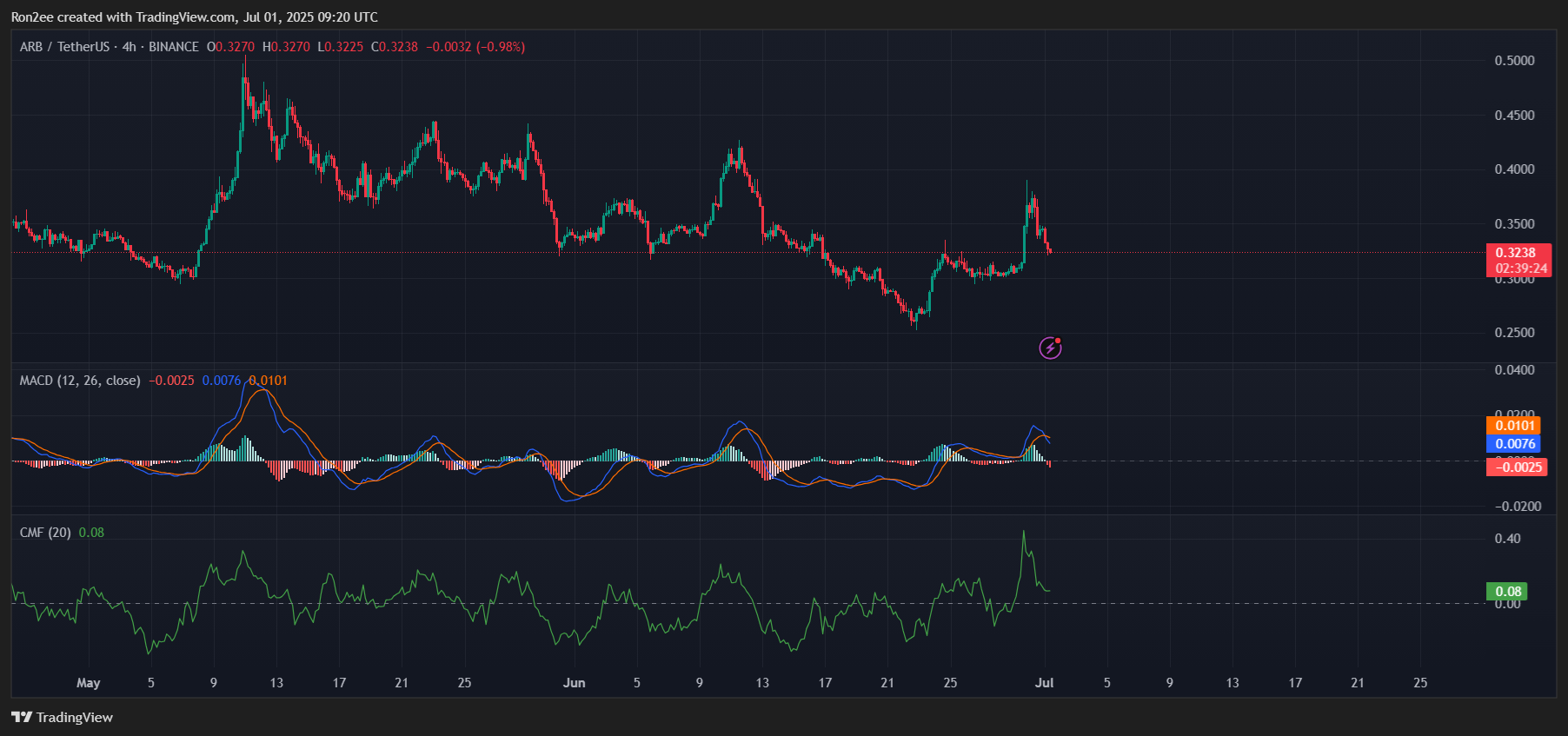
Графики ARB MACD и CMF — 1 июля | Источник: crypto.news

Учитывая эти факторы, ARB, скорее всего, продолжит снижаться и достигнет ближайшего уровня поддержки в 0,31 доллара.

Пробой этого уровня может привести к дальнейшему снижению стоимости токена, при этом следующая крупная психологическая и структурная поддержка находится на уровне 0,28 доллара.

Leituras Relacionadas

Top 8 DEXs of July 2026

This article presents the top 8 decentralized exchanges (DEXs) for July 2026, highlighting their key features and evolution within the DeFi space. DEXs, which enable peer-to-peer cryptocurrency trading via smart contracts without intermediaries, are praised for offering users greater control, privacy, transparency, and global access compared to centralized platforms. The listed DEXs are: 1. **Shadow Exchange**: A Sonic-native DEX specializing in concentrated liquidity for efficient trading and reduced slippage. 2. **Uniswap**: A leading protocol using an Automated Market Maker (AMM) model across multiple blockchains. 3. **SushiSwap**: An evolved platform offering token swaps, yield farming, and governance via its SUSHI token across 40+ networks. 4. **Orca**: A user-friendly AMM on Solana featuring capital-efficient "Whirlpools" for concentrated liquidity. 5. **Meteora**: A Solana-based DEX focusing on dynamic liquidity infrastructure and vaults for advanced strategies. 6. **Raydium**: A hybrid exchange on Solana combining AMM pools with a central limit order book for deep liquidity. 7. **Hyperliquid**: A Layer 1 blockchain hosting a non-custodial perpetual futures exchange using an on-chain order book. 8. **PancakeSwap**: A multi-chain AMM hub originating on BNB Chain, now supporting thousands of trading pairs across several networks. The article concludes by noting the significant role of DEXs in crypto, their expansion beyond simple swaps into areas like derivatives and cross-chain interoperability, and advises users to conduct their own research before engaging with any platform.

ambcryptoHá 1m

Top 8 DEXs of July 2026

ambcryptoHá 1m

USDT Market Cap Approaches Ethereum's: What Signal Does This Convey?

The market capitalization of USDT has nearly reached that of Ethereum, making it the second-largest cryptocurrency after Bitcoin. This prompts an examination of what this signifies and what it does not. Firstly, this does not relate to economic security. Unlike some Web3 systems where a governance token's value must underpin the security of its applications (e.g., oracles), USDT's stability is not backed by the value of the underlying blockchains it operates on. Tether, the issuer, controls the assets, and can freeze, reissue, or abandon tokens on a compromised chain. While stablecoins require functional blockchains, a chain's native token market cap does not provide direct security for the stablecoin. Secondly, USDT's growth does not inherently reflect poorly on Ethereum. USDT is a dollar-pegged store of value, while ETH represents a claim on future Ethereum network revenue. Their valuations are driven by different factors. USDT's rising market cap simply indicates strong demand for stablecoin utility, independent of Ethereum's technological merits or competitive position. The core insight is the overwhelming market demand for permissionless dollar transfers. This is the most established and essential use case in crypto. It requires minimal technological sophistication—essentially just a trusted issuer's promise of redemption on a functional chain. This explains why stablecoin supply has grown exponentially while the combined market cap of major non-stablecoin cryptocurrencies like Bitcoin, Ethereum, and others has stagnated for years. Users primarily seek accessible dollar-denominated assets. They largely disregard the issuer's credibility (as seen with Tether's dominance over more credible alternatives like USDC or BlackRock's BUIDL) and are indifferent to the governance or decentralization of the underlying blockchain. As long as a stablecoin is widely accepted and easy to transfer, users will adopt it across any chain. The trend suggests that the market for permissionless stablecoins could continue to expand far beyond the total value of the smart contract platforms that host them, driven by this singular, powerful use case.

Foresight NewsHá 19m

USDT Market Cap Approaches Ethereum's: What Signal Does This Convey?

Foresight NewsHá 19m

Crypto 美股观察:CRCL、HOOD、COIN 与 MSTR,最近在交易什么?

Recent weeks have seen significant developments for four key US-listed crypto-related stocks—Circle (CRCL), Robinhood (HOOD), Coinbase (COIN), and MicroStrategy (MSTR)—with their core investment theses diverging. For **Circle (CRCL)**, its stock price is increasingly realigning with the fundamental driver of **USDC circulation**. After IPO exuberance faded, CRCL's performance now correlates closely with changes in USDC supply, which is heavily influenced by DeFi activity and risk appetite. The recent contraction in USDC, linked to events like the KelpDAO incident, has pressured the stock. A sustainable recovery signal for CRCL would require a confluence of recovering DeFi TVL, stablecoin demand, and consecutive weeks of USDC net issuance. **Robinhood (HOOD)** gained market attention with the launch of its **Robinhood Chain**, an Ethereum L2. While not an immediate threat to Coinbase's dominant Base network in terms of scale or developer ecosystem, it represents a strategic encroachment. Robinhood's path—leveraging its traditional retail brokerage user base and assets to build a chain-based financial system—challenges Coinbase's narrative as the sole listed company integrating crypto-native infrastructure with traditional finance. This could dilute COIN's long-term scarcity premium. **MicroStrategy (MSTR)** made a notable shift by **selling Bitcoin** for the first time in a meaningful way (3,588 BTC), breaking its long-standing "buy-only" posture. The sales, used to fund dividends and replenish USD reserves, signal a move towards active capital management. While not indicative of a bearish turn on Bitcoin, it introduces new complexity for MSTR investors. The stock must now be evaluated not just as a leveraged Bitcoin proxy, but also considering fixed cash obligations from preferred dividends and debt, alongside its capital allocation strategy between holding BTC and maintaining liquidity. In summary, the investment narratives for these stocks are evolving beyond simple crypto market beta. Key variables now include stablecoin fundamentals, competition in chain-based financial ecosystems, and the balance between asset accumulation and corporate capital structure management.

marsbitHá 31m

Crypto 美股观察:CRCL、HOOD、COIN 与 MSTR,最近在交易什么?

marsbitHá 31m

Trading

Spot
活动图片