Crypto Profits Could Be Off-Limits To Presidents, Families Under New Proposal

bitcoinistPublicado em 2025-06-24Última atualização em 2025-06-24

Resumo

Senator Adam Schiff of California rolled out a bill on Monday aimed squarely at the highest office in the land....

Trusted Editorial content, reviewed by leading industry experts and seasoned editors. Ad Disclosure

Senator Adam Schiff of California rolled out a bill on Monday aimed squarely at the highest office in the land. It would bar the president, vice president and their immediate family from getting into any crypto business while wearing the badge of public office. The move comes as concern is growing over political power mixing with digital money moves.

Strict Ban On Crypto Endorsements

According to the Curbing Officials’ Income and Nondisclosure (COIN) Act, no sitting president or vice president could issue, sponsor or endorse any cryptocurrency, meme coin, NFT or stablecoin.

The same rule would cover their spouses and children. Based on reports, the plan even makes them report any sale of digital assets over $1,000. That simple step could force more transparency on deals that happen behind closed doors.
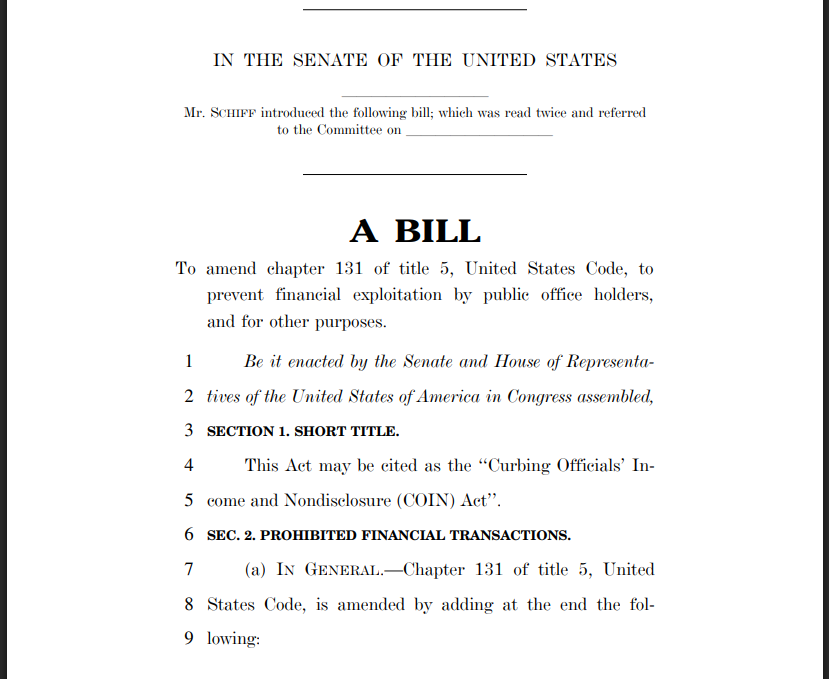
Source: US Senate.

Heavy Penalties For Violators

The COIN Act sets clear penalties for anyone who steps out of line. Civil fines would match the profit made on a bad deal. Anyone who breaks the rule could also face up to five years in prison.

It’s a steep price. That level of punishment sends a strong signal that these are not harmless side projects but serious conflicts of interest.

Links To Trump’s Crypto Deals

Schiff did not hide why he pushed this bill. Based on reports, US President Donald Trump pulled in $58 million from crypto ventures in 2024, mostly from WLFI token sales.

That haul was second only to his hotel and resort earnings. And he’s eyeing another $390 million token sale in 2025, plus gains from his meme coin that launched in January.

BTCUSD trading at $105,330 on the 24-hour chart: TradingView

His companies are also involved in Bitcoin mining and a proposed $2.3 billion Bitcoin treasury plan under Trump Media and Technology Group.

The SEC cleared that $2.3 billion filing on June 13, covering 85 million shares and 29 million tied to convertible notes.

Challenges In A Divided Congress

Getting this through won’t be easy. Nine Senate Democrats have signed on as co-sponsors. Of those, seven backed last week’s GENIUS Act, which set stablecoin rules for Congress but left the president untouched.

That split vote showed how tricky it is to balance broad crypto rules with a law aimed at one person. The House is under Republican control, and any bill that could put a president in a bind is likely to stall in committee.

Featured image from Pexels, chart from TradingView

Editorial Process for bitcoinist is centered on delivering thoroughly researched, accurate, and unbiased content. We uphold strict sourcing standards, and each page undergoes diligent review by our team of top technology experts and seasoned editors. This process ensures the integrity, relevance, and value of our content for our readers.

Christian, a journalist and editor with leadership roles in Philippine and Canadian media, is fueled by his love for writing and cryptocurrency. Off-screen, he's a cook and cinephile who's constantly intrigued by the size of the universe.

Leituras Relacionadas

Not Betting on Goals but on 'Tears': Polymarket Users Argue Over Ronaldo's Final World Cup Match

Title: Beyond Goals, Betting on Tears: Polymarket Users Clash Over Ronaldo's Emotional World Cup Exit On July 6, Portugal's 0-1 loss to Spain in the World Cup round of 16 marked the final tournament for Cristiano Ronaldo. The 41-year-old star's emotional reaction—red eyes, wiping his face, fighting back tears—was captured globally. Concurrently, a fierce debate erupted on the crypto prediction platform Polymarket over a specific market: "Will Ronaldo cry during the 2026 FIFA World Cup?" The market, with over $23 million in volume, saw its "YES" probability surge to 99% after the match, but the result was disputed and entered a final review phase. The core conflict centered on the market's precise rules: it required "clearly visible tears streaming down [Ronaldo's] face" in photos/videos taken on the field or bench area during Portugal's matches. While major media outlets described Ronaldo as "in tears" and footage showed him emotional, "NO" bettors argued visible tear tracks were not conclusively evident, only red eyes and dampness. Polymarket's official clarification on July 8 stated that eligible evidence existed showing Ronaldo crying with visible tears on his face post-match. The dispute now goes to a UMA oracle community vote for resolution. This incident highlights a recurring challenge for prediction markets: they excel with quantifiable events but can spark major controversies over subjective, visual, or emotional interpretations. It also serves as a reminder for participants to scrutinize rule wording meticulously, not rely on general perception. Ultimately, such high-profile disputes drive significant trading volume and attention for the platform.

Foresight NewsHá 34m

Not Betting on Goals but on 'Tears': Polymarket Users Argue Over Ronaldo's Final World Cup Match

Foresight NewsHá 34m

DeepSeek Secretly Builds AI Chip, Specializing in Inference, Project Started a Year Ago with No Public Recruitments

DeepSeek, the Chinese AI company known for its algorithmic models, is secretly developing its own AI chip to reduce dependence on Nvidia, according to a Reuters report. The chip is designed specifically for AI inference, not training, and the project began approximately a year ago. Currently in early stages, DeepSeek is reportedly in discussions with chip design firms, foundries, and memory suppliers. The company, historically focused on algorithmic efficiency, has been discreetly hiring chip design engineers without public job postings. This move aligns with a global trend where major AI model companies like OpenAI and Anthropic are also pursuing custom chip development. DeepSeek founder Liang Wenfeng previously highlighted chip shortages as a challenge. While the company initially trained models on Nvidia H800s and later adapted to Huawei's Ascend chips, it now seeks greater control over its hardware foundation. Designing a competitive AI chip is a significant challenge, requiring years and substantial investment with no guarantee of success. However, DeepSeek's efforts are backed by a recent major funding round of approximately 51 billion RMB (about $7.4 billion) raised in June 2026. The funds are designated for expanding data centers based on domestic chips, developing proprietary AI chips, and recruiting top global talent. Infrastructure plans are also advancing, with job postings for data center design engineers, including projects in locations like Ulanqab, Inner Mongolia. The company remains characteristically low-key, with sources speaking anonymously and no official comment from DeepSeek itself. Nevertheless, this initiative marks a strategic expansion from software algorithms into the hardware layer that powers its AI systems.

marsbitHá 41m

DeepSeek Secretly Builds AI Chip, Specializing in Inference, Project Started a Year Ago with No Public Recruitments

marsbitHá 41m

Trading

Spot
活动图片