Not Betting on Goals but on 'Tears': Polymarket Users Argue Over Ronaldo's Final World Cup Match

Foresight NewsPublicado em 2026-07-08Última atualização em 2026-07-08

Resumo

Title: Beyond Goals, Betting on Tears: Polymarket Users Clash Over Ronaldo's Emotional World Cup Exit On July 6, Portugal's 0-1 loss to Spain in the World Cup round of 16 marked the final tournament for Cristiano Ronaldo. The 41-year-old star's emotional reaction—red eyes, wiping his face, fighting back tears—was captured globally. Concurrently, a fierce debate erupted on the crypto prediction platform Polymarket over a specific market: "Will Ronaldo cry during the 2026 FIFA World Cup?" The market, with over $23 million in volume, saw its "YES" probability surge to 99% after the match, but the result was disputed and entered a final review phase. The core conflict centered on the market's precise rules: it required "clearly visible tears streaming down [Ronaldo's] face" in photos/videos taken on the field or bench area during Portugal's matches. While major media outlets described Ronaldo as "in tears" and footage showed him emotional, "NO" bettors argued visible tear tracks were not conclusively evident, only red eyes and dampness. Polymarket's official clarification on July 8 stated that eligible evidence existed showing Ronaldo crying with visible tears on his face post-match. The dispute now goes to a UMA oracle community vote for resolution. This incident highlights a recurring challenge for prediction markets: they excel with quantifiable events but can spark major controversies over subjective, visual, or emotional interpretations. It also serves as a reminder for p...


Byline: Ma He, Foresight News


On July 6th, the FIFA World Cup Round of 16 kicked off at AT&T Stadium in Arlington. Portugal narrowly lost 0-1 to Spain, with Mikel Merino heading in the winner during the first minute of stoppage time. This marked the end of the sixth and final World Cup for 41-year-old Cristiano Ronaldo (Ronaldo). Ronaldo was visibly emotional—images of his red eyes, wiping his face, and fighting back tears were captured by global media and widely circulated.


Simultaneously, in the crypto prediction market, people were fiercely debating whether he actually cried or not.
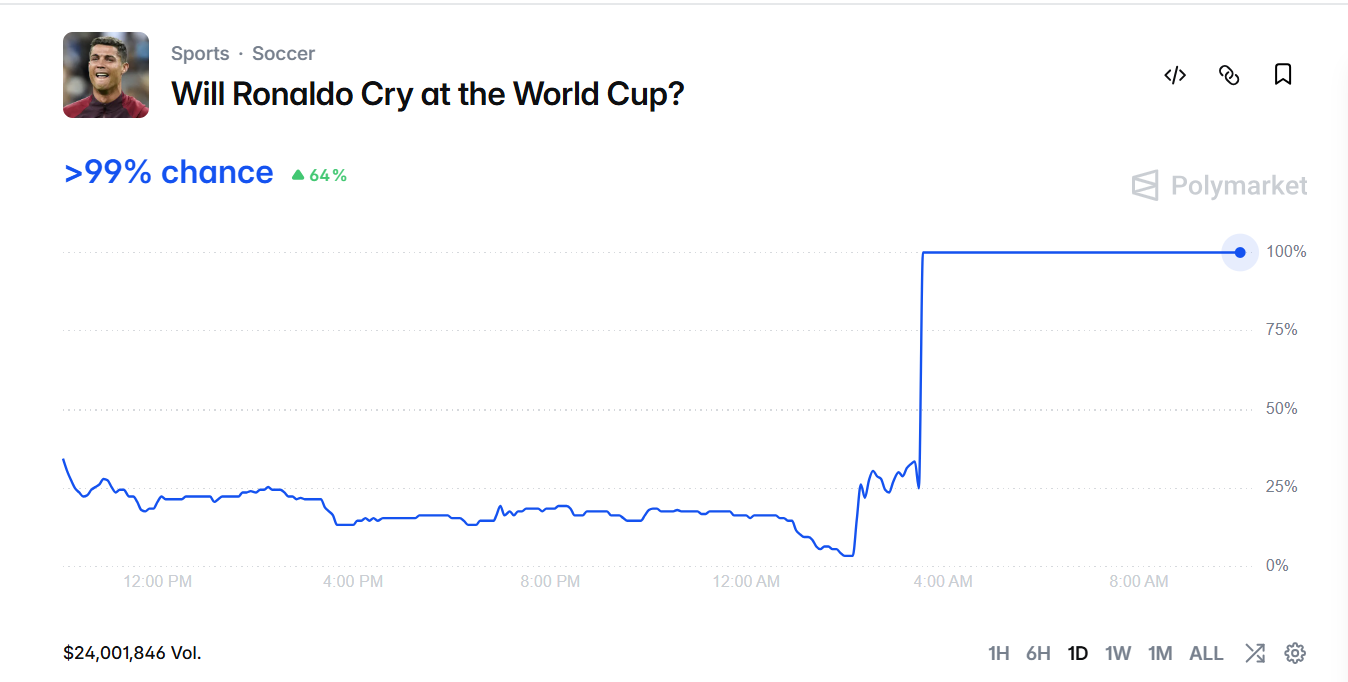


In June this year, Polymarket launched a prediction market on whether Ronaldo would cry during the World Cup, once again becoming a focal point. Its total trading volume has reached $23.94 million. On the evening of July 6th, the market price indicated a 15% probability for Yes, with No dominating. However, the result was twice proposed as "No," leading to a dispute. On July 8th, the probability for Yes suddenly surged to over 99%, with the final review period remaining about 1 day.


YES holders and NO holders argued fiercely: the core disagreement centered on whether it was "clearly crying" and if it met the rule requirement of clearly visible tears rolling down the face.


So, what exactly are the specific rules stated on Polymarket?


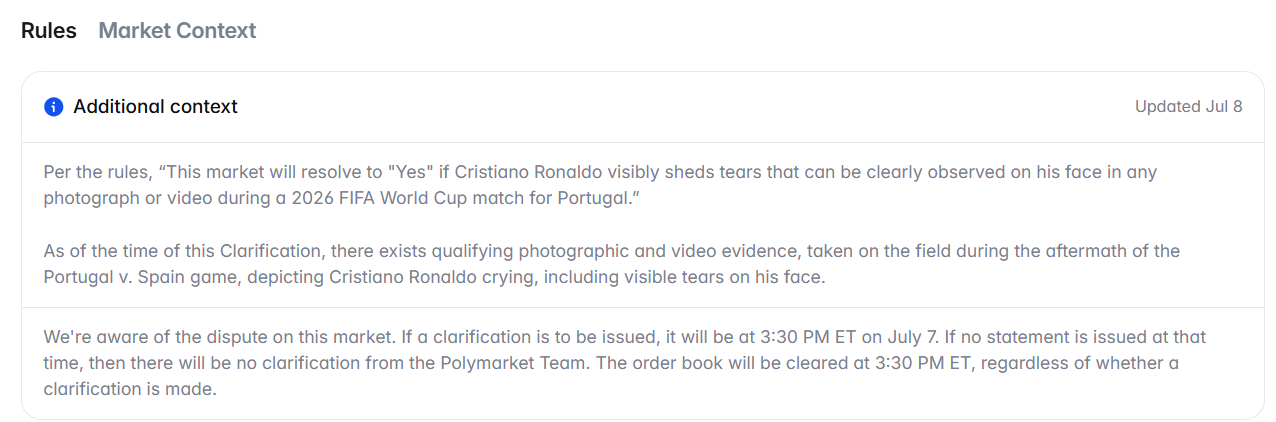
The rules are as follows: This market will resolve to Yes if, in any photograph or video from the 2026 FIFA World Cup while Ronaldo is representing Portugal, clearly visible tears are seen rolling down his face. Otherwise, it will resolve to No. "Crying" must occur while Ronaldo is on the field or in the technical/substitute bench area; crying in the locker room or other areas does not count. Crying may occur before, during, or after a match. Otherwise, this market will resolve to "No."


Therefore, the key issue returns to two core questions: whether Ronaldo's tears were clearly visible and where he was when crying.


Ronaldo's Final Match


There is no dispute about his red eyes on the pitch.


Multiple authoritative media outlets described Ronaldo's reaction immediately after the match. U.S. ESPN, the UK's The Independent, among others, consistently used phrases like "in tears," "tearful," "bursts into tears," and "emotional with tears in his eyes." Broadcasters like FOX Sports released post-match emotional reaction compilations, with fans and reporters capturing moments of Ronaldo's red eyes, wiping his face, and grim expressions in the stands and mixed zone.



These images were not from private areas but occurred in public spaces like the pitch, near the substitute bench, or the player tunnel, meeting the time and location requirements of "before, during, or after the match, on the field or in the technical/substitute bench area" per Polymarket rules. The images and videos are authentic on-site captures, with no suspicion of post-production, AI, or old footage.


On Xiaohongshu, topics related to Ronaldo's eyes welling up with tears once trended on the hot topics list.
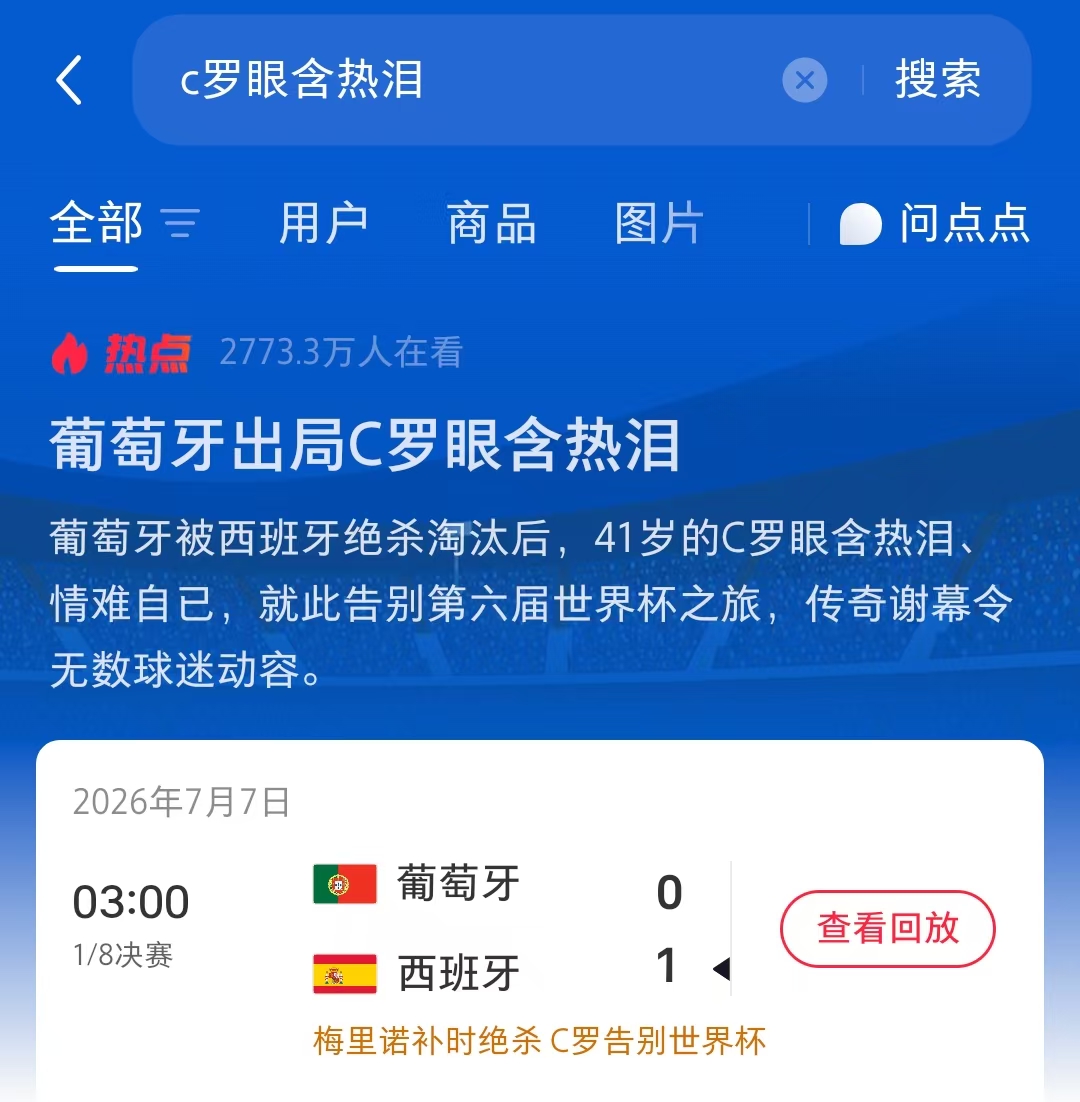


Upon examining video clips on Xiaohongshu, the author observed that his eyes indeed contained some tears, but it was impossible to clearly determine whether those tears noticeably rolled down his face.
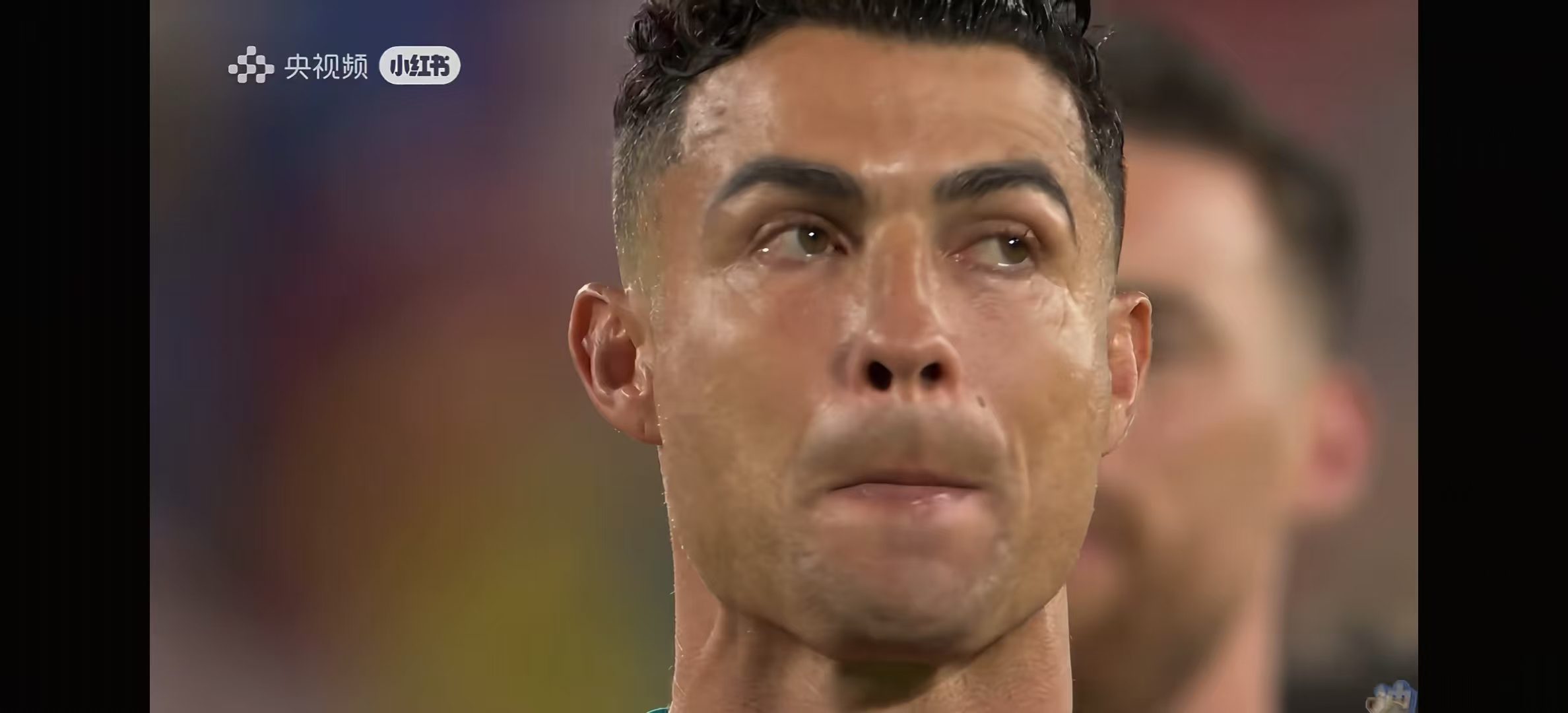


And this is precisely the focal point of the ongoing dispute on Polymarket.


The Controversy Erupts


The YES side argues that multiple high-definition photos and videos show Ronaldo's moist eyes, glistening tears, and wiping his face with his hand or sleeve. Global mainstream media reports and the photos/videos themselves are proof.


The NO side contends that the rules require a distinct teardrop rolling down the face, not just red eyes or suppressed tears. Some holders believe the available footage requires zooming in to barely discern, failing to meet the "clearly observable" detail.


Currently, the market has twice been proposed to resolve as No, both times met with protests, and has entered final review to be decided by a UMA oracle community vote—this is Polymarket's standard mechanism for handling disputes. However, oracle community votes often heavily favor large holders, making retail traders mere rule-takers.


This market once again proves: prediction markets are extremely efficient for quantifiable, verifiable events, but in scenarios involving subjective visual judgments and subtle emotional distinctions, they are prone to massive controversy.


On July 8th, the platform added a detailed clarification: As of the time of this clarification, photo and video evidence meeting the conditions exists. This evidence was captured on the pitch after the Portugal vs. Spain match, showing Cristiano Ronaldo crying with visible tears on his face.


Similar controversies have played out multiple times in Polymarket's history. Recently, a prediction market on MicroStrategy selling Bitcoin also sparked significant controversy. While MicroStrategy did sell 32 BTC before May 31st, because the 8-K filing was issued on June 1st, Polymarket forcibly introduced a supplemental interpretation to resolve as NO, leading to widespread online outcry of "PolyScam."


This also reminds participants: when betting on emotional or visual events, one must carefully study the literal meaning of the rules, not just rely on public perception or media headlines.


Perhaps for Polymarket, the greater the controversy and the more irreconcilable the conflict, the higher the platform's trading volume, fees, and exposure on social media. The platform likely has no desire for airtight rules; gray areas with loopholes serve as bait to attract massive long and short capital to gamble. The platform pockets hefty fees, UMA gains governance relevance, while only the retail traders on both sides are left fighting in the ruins over whether a single tear rolled down a cheek.


Perguntas relacionadas

QAccording to the article, what is the core issue that users on Polymarket are arguing about regarding Cristiano Ronaldo after Portugal's World Cup exit?

AThe core argument is whether Cristiano Ronaldo visibly shed tears on his face, as defined by the specific market rules, or merely had watery/red eyes and an emotional reaction.

QWhat are the specific location and visibility requirements set by the Polymarket rules for the 'C罗是否会在世界杯上哭' (Will Ronaldo cry at the World Cup) market?

AThe rules state that for the market to resolve to 'Yes,' clear and visible tears must be seen rolling down Ronaldo's face in any photo or video. This must occur while he is on the field or in the substitute bench area during, before, or after a Portugal match at the 2026 FIFA World Cup. Crying in locker rooms or other areas does not count.

QHow did the probability for 'Yes' in the Polymarket prediction change around the time of Portugal's match, and what mechanism is being used to resolve the final dispute?

AOn July 6th, the 'Yes' probability was around 15%. After the match, it was initially proposed as 'No' twice, causing disputes. By July 8th, the 'Yes' probability surged to over 99%. The final dispute resolution is being handled through a final review and a community vote by the UMA oracle.

QWhat point did the author make by referencing a past Polymarket event involving MicroStrategy's Bitcoin sales?

AThe author referenced the MicroStrategy event to illustrate that Polymarket has a history of controversial resolutions. In that case, although the action (selling Bitcoin) happened within the market's timeframe, a technicality regarding the official filing date led to a 'No' resolution, causing user backlash. This highlights the importance of scrutinizing the literal rules over general perception.

QWhat is the article's implied criticism regarding how Polymarket potentially benefits from markets with ambiguous rules?

AThe article implies that Polymarket may benefit from ambiguous or 'grey area' rules because they generate greater controversy, which in turn drives higher trading volumes, fees, and social media exposure for the platform, while leaving retail traders to fight over the subjective outcomes.

Leituras Relacionadas

Ilya Delivers, Huang Jen-Hsun Bets 50 Billion on SSI, First Model Suspected to Launch This Week

Ilya Sutskever's Safe Superintelligence (SSI) lab, backed by a rumored $5 billion investment from NVIDIA granting exclusive access to next-gen systems, may release its first groundbreaking model as early as this week. Industry insiders are hinting at a major breakthrough from a non-major player, with some claiming AI will be "utterly transformed." The model is speculated to fundamentally differ from current large language models like ChatGPT. Instead of relying on massive, static pre-training and ever-larger context windows, SSI's approach reportedly centers on **Test-Time Training (TTT)**. This would allow the model to **update its own internal weights in real-time** as it processes information, effectively "learning on the fly" and internalizing new knowledge like a human, rather than just referencing it from a large prompt. This aligns with Ilya Sutskever's long-stated vision of moving beyond the "pre-training" and "scaling" era. He envisions superintelligence not as a monolithic, pre-loaded database, but as an adaptive, "infinitely curious 15-year-old genius" capable of continual learning through interaction. SSI's strategy has been focused solely on this goal of "safe superintelligence" through efficient continual learning and alignment, explaining its prior silence. If successful, this model could disrupt the entire AI industry, challenging the current reliance on vast compute resources for training and the business models built around context windows. It suggests that core technological leaps, not just financial scale, remain decisive in the AI race.

marsbitHá 32m

Ilya Delivers, Huang Jen-Hsun Bets 50 Billion on SSI, First Model Suspected to Launch This Week

marsbitHá 32m

Demand Test: Bitcoin Whales Earn Record $1.2 Billion, Ethereum Holders Return to Profitability

In just three days after Bitcoin's price recovery, new Bitcoin whales have realized over $1.2 billion in profit, marking the largest profit-taking event for this cohort on record according to CryptoQuant. The peak occurred on August 20 with roughly $614 million, setting a daily record. Analysts note this selling pressure began after Bitcoin rose above the realized price of short-term whales, which was around $68,900. With Bitcoin trading near $77,700 on August 23, these whales were sitting on an average profit of about 12.8%. The market recovery allowed investors who were previously at breakeven or at a loss to lock in gains. CryptoQuant described the situation as a key test for Bitcoin demand; sustained prices above whale cost-basis with normalized profit-taking could signal strong new demand, while continued selling pressure could turn the rally into a mere break-even exit. Simultaneously, large Ethereum holders have also returned to an unrealized profit zone following its rally, as noted by CryptoQuant analyst Darkfost. Current profit levels, however, remain relatively low and are not seen as creating significant selling pressure. The Unrealized Profit/Loss Ratio for different whale cohorts stands at 0.075 (for 1k-10k ETH holders), 0.16 (10k-100k ETH), and 0.38 (over 100k ETH). This marks a significant improvement from June, when these whales were in substantial unrealized loss, with Ethereum having risen over 65% since then. The increased profitability is viewed as a positive sentiment signal for the Ethereum market.

cryptonews.ruHá 44m

Demand Test: Bitcoin Whales Earn Record $1.2 Billion, Ethereum Holders Return to Profitability

cryptonews.ruHá 44m

Kinetiq Team Announces Elysium L2 Network for Hyperliquid

On August 24, the liquid staking protocol Kinetiq announced Elysium, a new L2 network for the Hyperliquid ecosystem. It aims to increase HyperEVM's throughput and simplify the launch of spot markets, tokens, and DeFi applications. Elysium will use $HYPE for gas fees and plans direct integration with HyperCore's trading engine, giving apps access to its liquidity and orderbook data. Technical details and partners will be revealed later, with a launch date set for "soon." A primary reason for Elysium's development is to overcome HyperEVM's limitations, such as low throughput and rising fees during high load. Kinetiq claims the L2 will start with significantly higher block production and transaction speeds, later aiming to approach HyperCore's performance. This targets applications needing frequent state updates like high-frequency spot trading and AMMs, and will provide them deeper access to HyperCore orderbook data. The network also proposes to streamline the process of launching new assets within Hyperliquid, allowing a token to progress from AMM liquidity to HyperCore's spot orderbook and eventually to perp markets via HIP-3 in a unified flow. Regarding revenue, Kinetiq's model allocates 50% of sequencer fees to buy back and burn $KNTQ, 25% to developers using Elysium's block space, and 25% to the Kinetiq treasury. Elysium marks Kinetiq's expansion beyond its core liquid staking product, kHYPE.

cryptonews.ruHá 45m

Kinetiq Team Announces Elysium L2 Network for Hyperliquid

cryptonews.ruHá 45m

Trading

Spot
活动图片