More Crypto Clarity: US SEC Says Most Staking Activities Are Not Securities

bitcoinistPublicado em 2025-05-31Última atualização em 2025-05-31

Resumo

In a significant development for the industry, the US Securities and Exchange Commission’s (SEC) Division of Corporation Finance shared its...

Trusted Editorial content, reviewed by leading industry experts and seasoned editors. Ad Disclosure

In a significant development for the industry, the US Securities and Exchange Commission’s (SEC) Division of Corporation Finance shared its view on crypto staking after the recent call for clear guidance on the sector. The SEC branch seeks to “provide greater clarity on the application of the federal securities laws to crypto assets.”

SEC Offers Clarity On Crypto Staking

On Thursday, the SEC’s Division of Corporation Finance issued new guidance on Protocol Staking, affirming that most of these activities are not subject to US securities laws and “don’t need to register with the Commission transactions under the Securities Act.”

In its statement, the regulatory agency said that certain staking activities on Proof-of-Stake (PoS) networks are not considered securities transactions under federal regulations. The SEC explained that the new guidance addresses the staking of cryptocurrencies “intrinsically linked to the programmatic functioning of a public, permissionless network.”

Therefore, these activities, including self-staking, self-custodial staking with direct third-party validators, and custodial staking where platforms stake assets on behalf of customers, don’t meet the criteria for an investment contract under the Howey Test and don’t involve the offer and sale of securities.

Journalist Eleanor Terret highlighted that the SEC’s statement “is a big deal for ETF providers who want to offer staking,” as it clarifies that “staking in this format is generally not thought of as a securities transaction by the Division of Corporation Finance.”

However, the guidance noted that it doesn’t address all staking practices: “This statement addresses Protocol Staking generally rather than all of its variations. Further, this statement does not address all forms of ‘staking,’ such as so-called ‘liquid staking,’ ‘restaking’ or ‘liquid restaking.’”

‘Stake It Till You Make It’?

Following the news, SEC Commissioner Hester Peirce stated that the new guidance “provides welcome clarity for stakers” as uncertainty surrounding regulatory views discouraged Americans from engaging in staking activities for fear of violating securities laws.

“Providing Security is not a ‘Security,’” she affirmed, adding that the unclear rules “artificially constrained participation in network consensus and undermined the decentralization, censorship resistance, and credible neutrality of proof-of-stake blockchains.”

The new guidance follows the industry’s call for clear staking rules, where a coalition of nearly 30 industry players and advocacy groups urged the SEC to offer clarity. As reported by Bitcoinist, the Crypto Council for Innovation’s (CCI) Proof of Stake Alliance (POSA) sent a letter signed by 29 industry giants to the SEC’s Crypto Task Force on April 30.

Acknowledging the SEC’s regulatory shift under the Trump administration, the letter argued that the existing securities disclosure regime was ill-suited for staking services, which are fundamentally technical instead of financial.

The crypto coalition asked for clear, principles-based guidance for staking and staking services, citing the SEC’s March statement on Proof-of-Work (PoW) mining, to protect users while enabling the growth of the staking industry.

However, not all SEC Commissioners agreed with the new guidance. Commissioner Caroline Crenshaw expressed her discontent in a Thursday statement, claiming that “staff ignores how its conclusions conflict with that applicable law.”

Crenshaw considers that the Division of Corporation Finance’s analysis “may reflect what some wish the law to be, but it does not square with the court decisions on staking and the longstanding Howey precedent on which they are based,” affirming that “This is yet another example of the SEC’s ongoing ‘fake it ‘till we make it’ approach to crypto – taking action based on anticipation of future changes while ignoring existing law.”
crypto, TOTAL

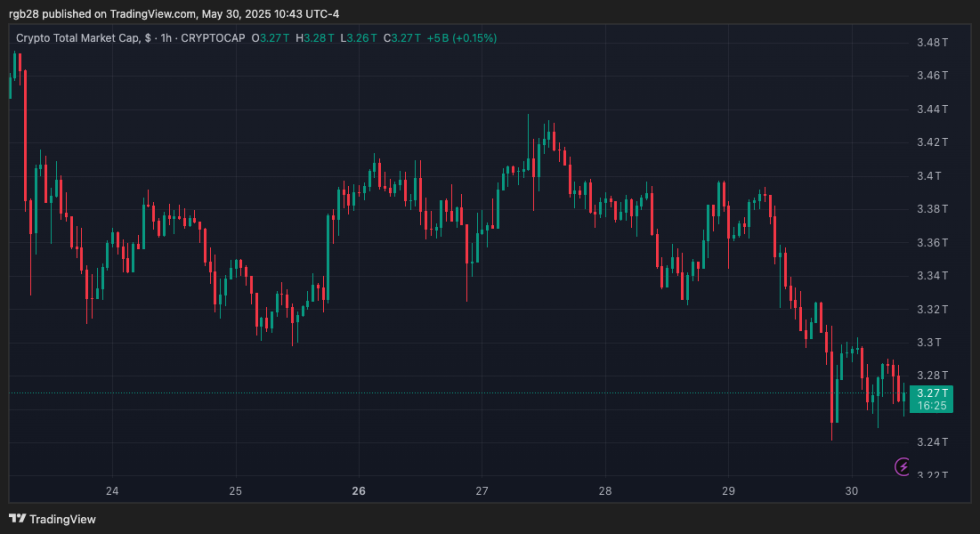
Total crypto market capitalization is at $3.27 trillion in the one-week chart. Source: TOTAL on TradingView
Featured Image from NBC News, Chart from TradingView.com
Editorial Process for bitcoinist is centered on delivering thoroughly researched, accurate, and unbiased content. We uphold strict sourcing standards, and each page undergoes diligent review by our team of top technology experts and seasoned editors. This process ensures the integrity, relevance, and value of our content for our readers.

Rubmar is a crypto enthusiast who likes learning and improving constantly. She enjoys reporting on the latest news and developments in the crypto industry. Rubmar also enjoys scrapbooking, crafting, simulation games, and watching football.

Leituras Relacionadas

After Aave's Exit and TVL's Sharp Fluctuation, Where Does MegaETH's Valuation Anchor Lie?

Following the withdrawal of Aave and a sharp drop in its Total Value Locked (TVL), the valuation of the high-performance DeFi blockchain MegaETH faces scrutiny. Once a highly anticipated project with a fully diluted valuation (FDV) reaching around $2 billion, MegaETH saw its TVL plummet from a May peak of $245 million to just over $30 million in July, a roughly 70% decline. Its native token, MEGA, currently trades around $0.048 with a market cap of approximately $54 million and an FDV of about $480 million. The report identifies a core vulnerability: MegaETH's TVL was heavily dependent on a single protocol, Aave V3, which at its peak contributed around 90% of the chain's TVL. A significant portion of this capital is attributed to leveraged yield-farming strategies involving stablecoins like USDe. When the profitability of these strategies diminished, capital rapidly exited, exposing the lack of diversified, sustainable activity. Three key mismatches between MegaETH's valuation and its fundamentals are highlighted: 1. **Valuation vs. Real Usage:** With an FDV of ~$4.8B but only ~$1M in annualized protocol revenue and ~2,600 daily active addresses, the valuation appears disconnected from current economic activity. 2. **Token Narrative vs. Ecosystem Reality:** Despite its DeFi narrative, nearly 80% of the chain's recent protocol revenue comes from a trading card game, Monster, not from core DeFi applications like Aave. The chain's native stablecoin, USDM, also shows low trading volume and a declining market cap. 3. **Short-Term Hype vs. Long-Term Delivery:** Initial hype from token generation, blue-chip integrations, and influencer support has faded. Major protocols like Uniswap now hold minimal TVL on the chain, indicating that early capital was largely transient and driven by incentives rather than organic demand. The situation reflects a broader market trend where investors are becoming less tolerant of valuations based on inflated TVL and narrative, demanding clearer evidence of sustainable transactions, revenue, and ecosystem development. While MEGA's price may experience short-term rebounds from market sentiment, a fundamental re-rating likely depends on the team's ability to convert its remaining resources into tangible, user-retaining applications and genuine ecosystem growth.

链捕手Há 4h

After Aave's Exit and TVL's Sharp Fluctuation, Where Does MegaETH's Valuation Anchor Lie?

链捕手Há 4h

Goldman Sachs In-Depth Report: Who Will Be the Long-Term Winners in China's AI Large Model Industry?

Goldman Sachs Report: China's AI Models at an Inflection Point China's open-source/open-weight large language models (LLMs) have reached performance parity with top global proprietary models, according to a Goldman Sachs report. This is driven by architectural innovations and higher parameter efficiency, allowing Chinese models to achieve comparable capabilities at 2%-10% the parameter size and significantly lower cost. The market is evolving into a two-tiered structure: a high-end segment (e.g., GLM5.2, Qwen3.7 Max) with premium pricing and a low-end, price-sensitive segment for global SMEs and individual users. Key points: * **Cost & Performance:** Innovations like Mixture of Experts (MoE) enable high performance with smaller models. Projects like Meituan's LongCat 2.0, trained on domestic hardware, highlight progress in tech self-sufficiency. * **Open-Source Strategy:** Most Chinese players use open-source/open-weight models for flexibility and ecosystem growth. However, Goldman notes this may underreport actual deployment and revenue. A shift toward "open-weight + community license" models with revenue sharing (e.g., MiniMax) could improve monetization. * **Market Shift & Global Expansion:** Enterprise AI adoption is shifting from "token maximization" to "ROI-first." International expansion, especially in non-US markets, is a major growth driver. Chinese models are increasingly available on global platforms like AWS Bedrock and Microsoft Copilot. * **Competitive Landscape:** Using a framework based on pricing power, cost advantage, and financial strength, Goldman identifies **Zhipu AI and DeepSeek** as the strongest in foundational text models, and **ByteDance** as the leader in multimodal/video generation. The report maintains Buy ratings on MiniMax and Kuaishou. * **Market Growth:** China's AI model API and subscription revenue is projected to grow from an estimated ¥35 billion in 2026 to ¥879 billion by 2030.

marsbitHá 4h

Goldman Sachs In-Depth Report: Who Will Be the Long-Term Winners in China's AI Large Model Industry?

marsbitHá 4h

Goldman Sachs Deep Dive Report: Who Will Become the Long-Term Winners in China's AI Large Model Industry?

Goldman Sachs Report: Who Will Be the Long-Term Winners in China's AI Large Model Industry? China's AI large model sector is at a historic inflection point. Goldman Sachs argues that the intelligence of Chinese open-source/open-weight models is approaching top global proprietary models. Rapid adoption by domestic enterprises and global SMEs is creating a data flywheel effect that will further drive model iteration. The evolution is summarized as moving from "DeepSeek's cost-efficiency moment last year to GLM's model-intelligence moment this year." Chinese models achieve near-state-of-the-art performance at significantly lower cost, primarily due to architectural innovations like Mixture of Experts (MoE) and higher parameter efficiency. Models like DeepSeek V4 Pro (1.6T params), GLM5.2 (0.7T), and MiniMax M3 (0.4T) are much smaller than global leaders. Recent advancements in coding capability are attributed to better data curation and RLHF. Landmarks like Meituan's LongCat 2.0, trained fully on domestic AI chips, demonstrate progress in hardware stack independence. The market is forming a "two-tiered structure." The high-end tier (e.g., GLM5.2, Alibaba's Qwen3.7 Max) prices around $1 per million tokens, about 10-25% of US top models, with estimated inference gross margins of 10-20%. The low-end tier (priced as low as $0.06-$0.2 per million tokens) targets price-sensitive global SMEs and individuals. MiniMax derives 60-70% of revenue overseas. Goldman forecasts China's AI model API/subscription revenue to grow from an estimated RMB 35bn in 2026 to RMB 879bn by 2030. Most Chinese players adopt open-source/open-weight strategies for deployment flexibility and community feedback, though this limits monetization as deployments on third-party platforms (e.g., Alibaba Cloud) may not generate direct revenue. A shift towards "open-weight + community license" models with revenue-sharing agreements (like MiniMax's approach) could improve unit economics. International expansion, particularly in non-US markets, is the key growth driver. The global enterprise AI paradigm is shifting from "token maximization" to "ROI prioritization." Chinese models are already hosted on major global platforms like AWS Bedrock and are under consideration for integration into Microsoft Copilot. Using a competitive framework based on pricing power, cost advantage, and financial strength, Goldman identifies the strongest players: In foundational text models, Zhipu AI (initiated coverage) and DeepSeek lead. In multimodal/video generation, ByteDance's Seed is the frontrunner, with Kuaishou's Kling and MiniMax's Hailuo also well-positioned. Goldman maintains a Buy rating on MiniMax, citing its attractive valuation.

链捕手Há 4h

Goldman Sachs Deep Dive Report: Who Will Become the Long-Term Winners in China's AI Large Model Industry?

链捕手Há 4h

Trading

Spot
活动图片