Why former Bank of America strategist sees an Ethereum ‘tactical bottom’

ambcryptoPublished on 2026-07-11Last updated on 2026-07-11

Abstract

Stephen Suttmeier, former Bank of America strategist, identifies a potential "tactical bottom" for Ethereum (ETH), contingent on the price holding above $1690-$1700 and reclaiming $1800. A decisive move above $1800, turning the 50-day moving average into support, could target the 200-day MA near $2200, implying a 25% upside. This technical view finds some support from other analysts and a double-bottom pattern on the daily chart. However, on-chain data shows significant headwinds. Exchange selling pressure has surged, with over 220K ETH moved to exchanges recently, and whale selling persists. Furthermore, U.S. spot ETH ETFs, after days of inflows, recorded a $52 million net outflow due to macro risks like U.S.-Iran tensions and bond market volatility. In summary, while technicals suggest a bullish reversal is possible if ETH sustains above $1800, sustained selling pressure and macroeconomic risks threaten to invalidate the optimistic "tactical bottom" thesis.

Stephen Suttmeier, former Head of Technical Strategy at Bank of America, believes Ethereum could be forming a “tactical bottom.”

In his recent analysis report, Suttmeier said that if the price stays above $1690-$1700, it would support his thesis of the altcoin forming a tactical low above its June lows. Another confirmation for this bottoming pattern would be a reclaim of $1800.

His projection was based on technical analysis, particularly using moving averages (MA) to gauge short- and long-term momentum shifts. As of press time, the Ethereum [ETH] price has briefly stalled below the 50-day MA (DMA).

Should the 50DMA be decisively reclaimed as support (ETH price above $1800), the next upside target would be the 200-day MA(blue line) at $2.2K, Suttmeier added. That would imply a 25% upside potential if the $2.1K obstacle is cleared.
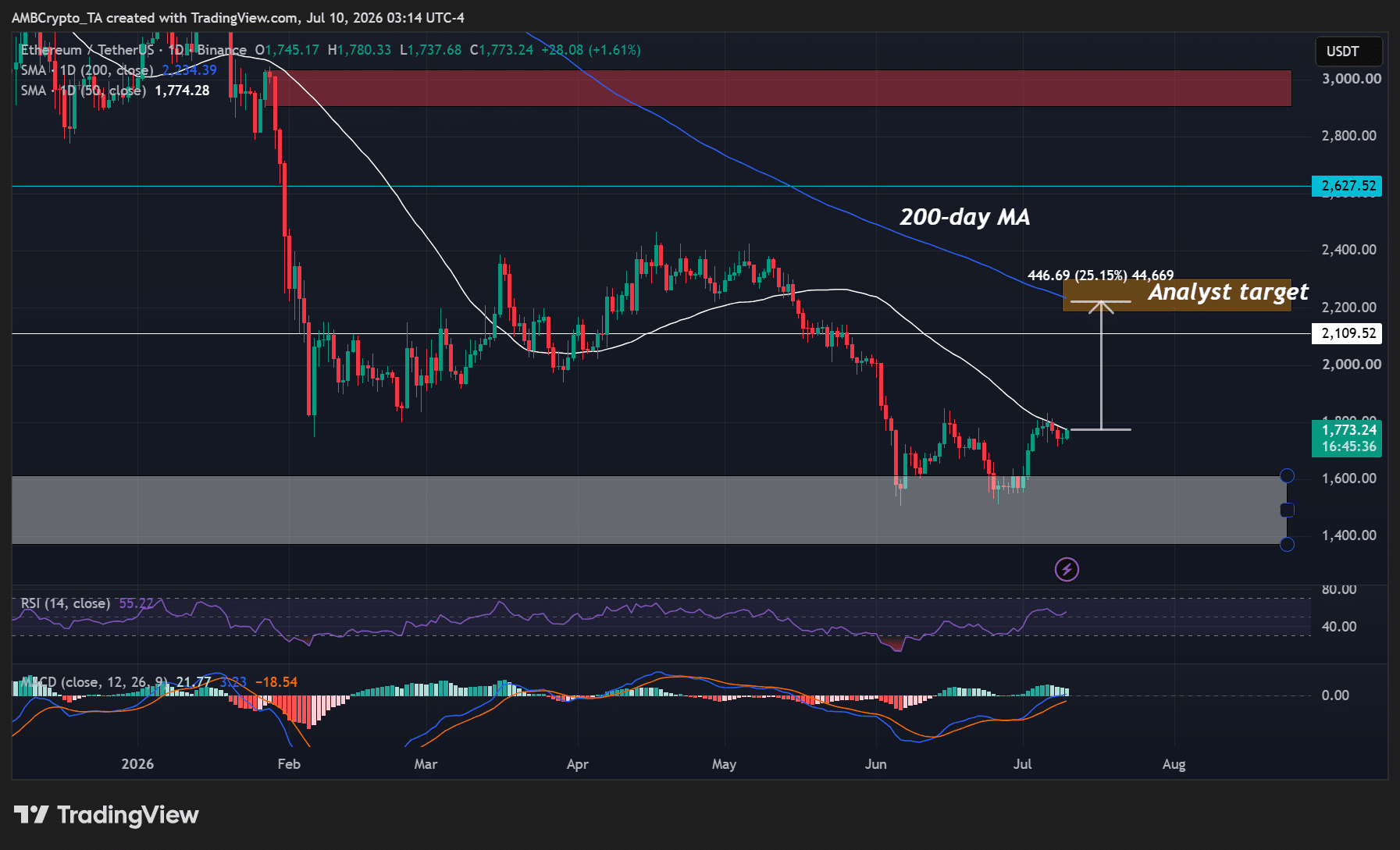
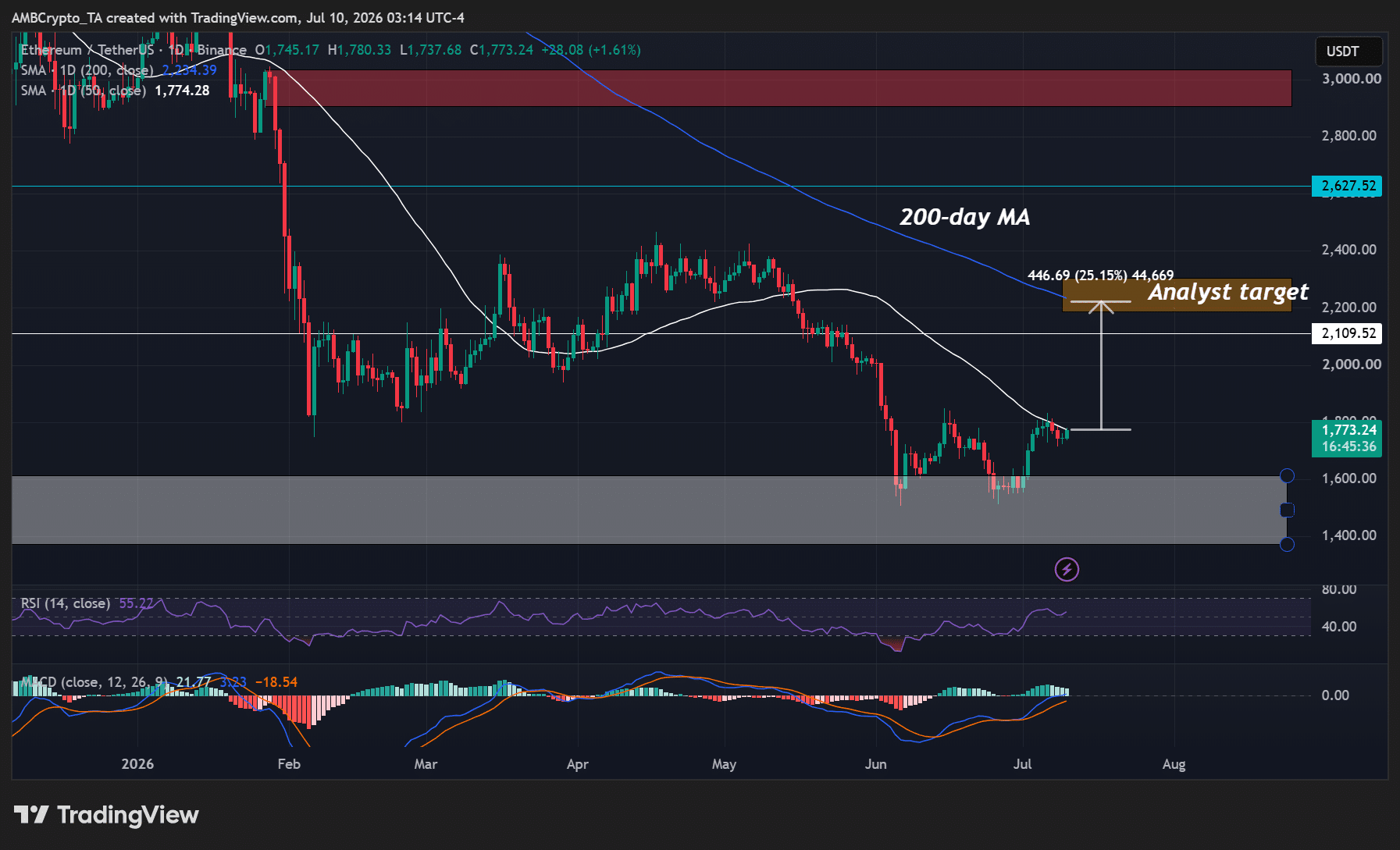
Source: ETH/USDT, TradingView

In fact, even Bitmine Immersion Technologies chairman and Fundstrat’s Tom Lee shared Suttmeier’s analysis, implying that he supported his projection.

Well, if there’s no bearish catalyst in the short term, the ETH daily chart leaned more toward a potential bullish reversal. It had formed a double bottom reversal pattern after the price slipped below $1600 twice in the past few weeks.

But some on-chain metrics were not as bullish on ETH as price charts suggested.

Ethereum’s exchange sell pressure is still high

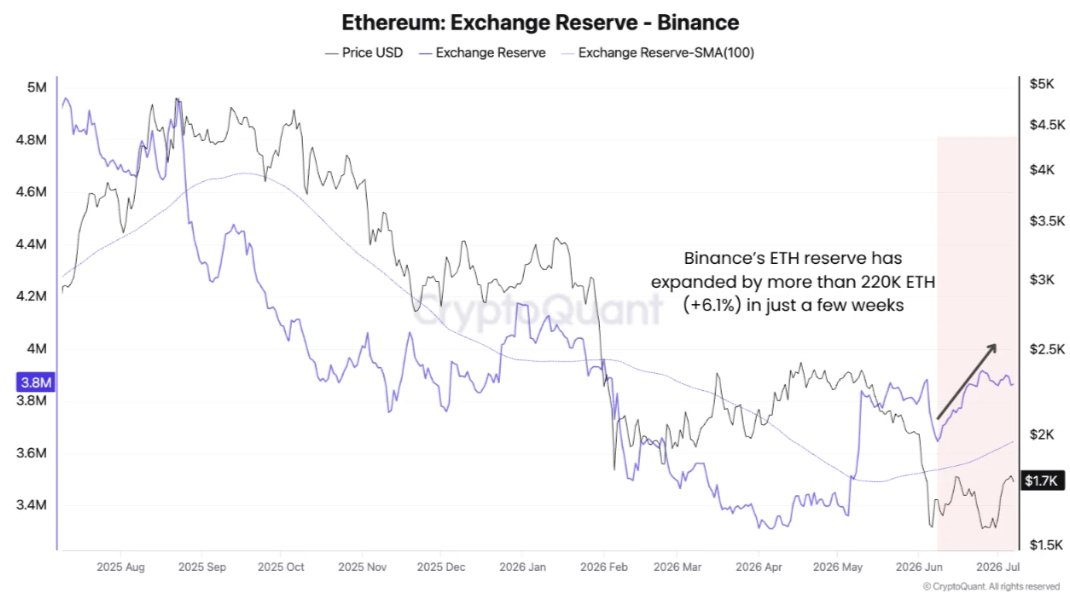
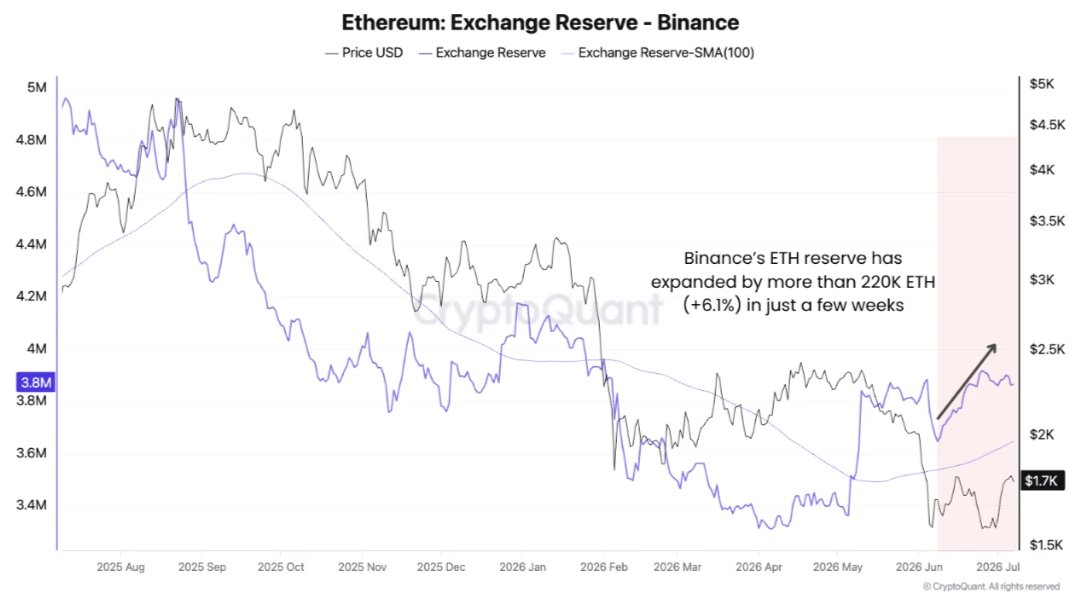
CryptoQuant reported a 6% surge in exchange selling pressure in the past few days as ETH attempted a rebound. Over 220K Ethereum [ETH] hit exchanges, slowing the relief rally near $1800.
Source: CryptoQuant

And the whales were notably reducing exposure during the relief rally. As such, the brief stalling below $1800 did not come as a surprise. As of writing, the whale sell-off had not tapered off.

In fact, the exchange selling pressure has been steadily rising since March. Hence, if the pressure persists, the ‘tactical bottom’ outlook could be invalidated.

Can ETF flows and macro risks derail ETH?

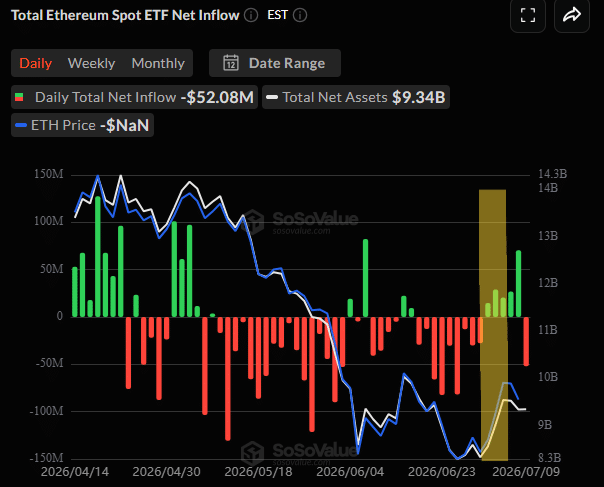
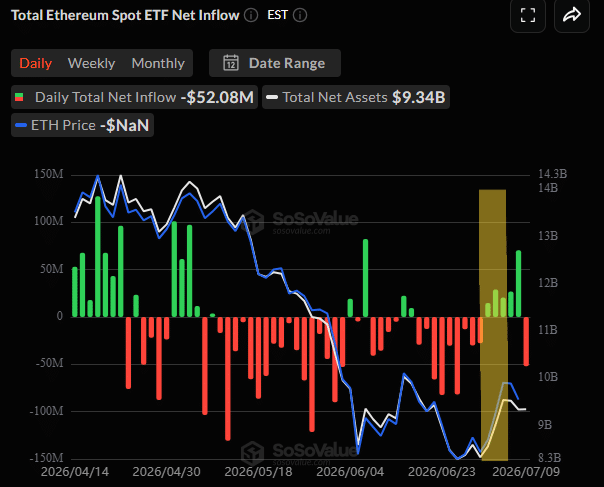
Apart from the whale pressure, the U.S. Spot ETF demand, which significantly boosted the early July relief recovery, has turned negative.

After seeing net inflows for five straight days, the trend broke on Thursday after the products posted a $52M net outflow. The risk-off move was triggered by renewed Iran-U.S escalations and bond market jitters.
Source: SoSo Value

Overall, ETH was on the verge of flipping its short-term momentum to bullish if it decisively stays above $1800. A 25% upside potential could be feasible if such a scenario plays out. But macro and geopolitical pressures remained at large and could affect bulls.


Final Summary

  • ETH could hit $2100 and offer a 25% potential gain if $1800 is decisively reclaimed.
  • Macro and geopolitical pressure could invalidate the bullish outlook, especially if the U.S-Iran escalations deepen

Trending Cryptos

Related Questions

QAccording to Stephen Suttmeier's analysis, what are the two key price levels that would confirm Ethereum is forming a 'tactical bottom'?

AAccording to Stephen Suttmeier's analysis, the two key levels are: 1) The price staying above the $1690-$1700 range, and 2) The price decisively reclaiming the $1800 level.

QBased on Suttmeier's technical analysis, what is the next upside price target for Ethereum if it reclaims the 50-day moving average?

AIf Ethereum decisively reclaims the 50-day moving average as support (price above $1800), the next upside target would be the 200-day moving average, which is at approximately $2,200.

QWhat on-chain metric suggests selling pressure on Ethereum is high, potentially challenging the 'tactical bottom' thesis?

AData from CryptoQuant indicates a 6% surge in exchange selling pressure, with over 220,000 ETH recently moving to exchanges, which is slowing the price rally near $1800.

QWhat recent shift in U.S. Spot ETF flows was mentioned as a potential headwind for Ethereum's price?

AAfter five consecutive days of net inflows, the U.S. Spot Ethereum ETFs posted a net outflow of $52 million on a recent Thursday. This shift was triggered by renewed U.S.-Iran tensions and bond market volatility.

QWhat is the implied potential upside percentage for Ethereum if it overcomes the $2,100 obstacle according to the article?

AIf Ethereum clears the $2,100 obstacle, the article states it would imply a 25% upside potential from that point.

Related Reads

OpenAI and Meta Join Forces, Bridging the "Last Mile" of Agent Commerce

On November 13, 2026, two major announcements landed the same day, together addressing the "last mile" of agent commerce: how AI assistants get through the door, and how they pay. Sierra and Meta released Poppy v1.0, a Personal Agent Protocol built on OAuth, HTTPS, OpenAPI, and the Model Context Protocol. Poppy lets businesses cryptographically verify three things: which assistant is making a request, which user it represents, and what permissions it holds. Companies publish a discovery file at /.well-known/poppy describing endpoints and allowed actions, while both user and business must consent to each interaction via two-way authorization. Shopify automatically enabled Poppy discovery files for merchants in 175+ countries, giving the protocol immediate scale, with over 100 design partners including Delta, 1Password, Okta, and Cloudflare. Separately, OpenAI launched ChatGPT Wallet for its personal assistant dots. The assistant can search, compare, and fill a cart, but must stop at checkout—users confirm via biometric authentication. Neither the assistant nor the merchant ever sees the real card number; card networks issue a one-time payment credential instead. Built with Amex, Mastercard, and Visa, the wallet runs entirely on traditional fiat rails—explicitly not crypto or stablecoins. It initially opens only to US Pro subscribers aged 18+. Notably, Visa and Mastercard span both initiatives, and OpenAI itself appears among Poppy's design partners—despite dots and Meta's Muse competing for the consumer entry point. The shared logic: consumer-facing competition, but shared infrastructure on the business side. The common bottom line is "human in the loop"—agent autonomy stops at the shopping cart. Open questions remain: liability when an assistant errs or is manipulated by malicious prompts, coverage beyond Shopify and US Pro users, and whether mandatory biometric confirmation for every small purchase will become friction that undermines the convenience promise.

marsbit9h ago

OpenAI and Meta Join Forces, Bridging the "Last Mile" of Agent Commerce

marsbit9h ago

Has the Time Come to Buy the Dip on Nvidia?

Nvidia announced on November 12 that Jensen Huang resigned as President, CEO, and Director, effective immediately. Shares fell as much as 14% intraday to $148.8, down nearly 40% from October highs, with over $600 billion in market value briefly erased. The founder's departure triggered the selloff, but the market is repricing the entire company rather than reacting to a single risk. Nvidia now trades at roughly 12x forward PE, its lowest in 15 years and below the S&P 500's ~18x, despite strong fundamentals: FY2026 revenue of $215.9 billion (+65%), data center revenue of $62.3 billion in a single quarter, ~75% gross margins, and Q2 FY2027 revenue of $96.2 billion with $21.3 billion free cash flow. Most investment banks cut targets but maintained Buy/Overweight ratings (Barclays $210, Goldman $220, Citi $225, RBC $230), implying ~20% upside, while Truist downgraded to Hold at $174. The consensus: the business is intact, but its valuation multiple needed resetting. Supporting demand, Huang forecast at GTC 2026 that Blackwell and Rubin AI chip demand would reach at least $1 trillion by 2027, double the prior 2026 estimate. However, risks remain beyond CEO succession. CUDA's lock-in effect is eroding on the inference side—Anthropic disclosed that its Claude Mythos Preview autonomously ported core GPU kernels to AMD flagship GPUs in three days with minimal human intervention, prompting investor Marcelo P. Lima's widely cited claim that "Nvidia's CUDA moat no longer exists." Supply bottlenecks lie in HBM and packaging, not wafers: TSMC can cut over 400 million GPU dies annually, but Nvidia ships only ~10 million GPUs yearly, constrained by HBM capacity (~3.75EB globally, ~70% allocated to Nvidia, ~260GB per GPU) and tight packaging, with HBM4 adjustments possibly delaying Rubin. Huang also leaves behind highly personalized assets—strategic technology judgment, supply chain negotiation with TSMC and SK Hynix, and direct channels to customers and governments—that interim CEO Colette Kress, the long-time CFO, may not fully replace. In short, the business remains, but the "faith premium" is being systematically stripped away. At 12x forward PE, much pessimism is priced in, offering a favorable risk-reward window if AI capex holds and demand materializes. Yet cheapness alone isn't sufficient: CUDA's erosion is slow but irreversible, HBM and packaging limit revenue upside, and succession uncertainty means the founder premium may not be fully removed. As Bernstein noted, "if you see two ants in the kitchen, there are more than two," warning that chains from scandal to governance vacuum to government probes could trigger further selloffs. Until the dust settles, what a Jensen-less Nvidia is worth remains an open question.

marsbit10h ago

Has the Time Come to Buy the Dip on Nvidia?

marsbit10h ago

AI Bull Market Trap? The Big Short Seller Strikes Again

Recent signals from Goldman Sachs, the Federal Reserve, and prominent short-seller Michael Burry are converging on concerns about the AI trade. Goldman warns that AI capital expenditure growth will likely peak in early 2027, with the boost to S&P 500 earnings falling from a 12-point peak in 2026 to a 5-point drag by 2028, shifting the market from a one-way rally to two-way volatility. The Fed has flagged AI as a potential threat to asset valuations and financial stability. Burry has doubled his Nasdaq 100 put options and rebuilt short positions in a semiconductor ETF, calling this a "bull market trap" analogous to the 2000 dot-com bubble, with Nvidia's influence a key worry. Four pressures weigh on the AI narrative: peaking capex growth, high interest rates that hit long-duration AI assets and leveraged GPU cloud providers like CoreWeave and Nebius, circular financing risks among interconnected tech firms, and tighter regulation under Democrats affecting data center energy, land, and permitting. Nvidia-related turmoil has shaken the pricing anchor for the entire supply chain. However, a valuation bubble bursting does not mean the AI industry is declining. Goldman notes US cloud giants trade at just 19.7x forward P/E, below their 20-year historical range and even below defensive staples, suggesting much pessimism is already priced in. Opportunities are shifting from upstream hardware "shovel sellers" toward fairly valued cloud giants with improving free cash flow, AI application companies delivering real ROI, and deeply discounted cyclical names like Korean memory. Conversely, GPU cloud providers dependent on Nvidia orders and cash-burning startups without products are most vulnerable. Investors should diversify, hedge, and focus on assets that convert spending into stable returns.

marsbit10h ago

AI Bull Market Trap? The Big Short Seller Strikes Again

marsbit10h ago

Just Offered 3.3 Million Yuan Salaries to Poach Talent, OpenAI Suddenly Dissolves Robotics Team—Is the Industry About to Change!

OpenAI has disbanded its standalone robotics research team, confirmed shortly after booking booth 208 at the CoRL robotics conference in Austin went empty on November 13. The move surprised many, given that just months earlier OpenAI was aggressively hiring robotics talent—some roles paying up to $500,000 base salary—and had expanded its San Francisco data-collection lab to about 100 workers across three shifts, with a second lab planned in Richmond, California. Researchers from the robotics team are now folded into Chief Research Officer Mark Chen's core research division, while robotics applications and hardware staff move to President Greg Brockman's Applied division. OpenAI says robotics remains part of its long-term vision and the reshuffle is meant to accelerate progress. This is not OpenAI's first robotics retreat: it ended its first independent robotics effort in 2020 to focus on large language models, which produced ChatGPT, and only rebuilt a team in 2024. OpenAI explains the latest pivot technically—researchers initially believed video-generation models like Sora could teach robots physics, but general models such as GPT-6 Astra proved capable of directly controlling robots, so robotics work is being merged into the general foundation-model team. The broader industry context supports this shift. Unitree's Wang Xingxing said his biggest mistake over the past decade was not trusting AI enough, noting GPT-6 integration exceeded expectations and that humanoid intelligence's tipping point may arrive within one to two years. Anthropic's Claude Fable 5.2 scored 64.9% on the RoboDojo Sim benchmark versus 29.8% for GPT-6 Astra, and Nvidia's Astranomy study showed GPT-6 Astra controlling simulated robots with 74.8% success using an agentic approach, beating the prior specialized-model best of 51.0%. Yet challenges remain: general models are costly and slow—GPT-6 Astra averaged 18.56 seconds per inference and about 30.9 million tokens (roughly $36.40 in API fees) per successful task—problematic for real factories where conveyor belts don't pause. Google DeepMind, Nvidia, Unitree and AgiBot continue training specialized robotics models; Google's Apollo 2 achieved 96% success sorting parts in Mercedes factories using paired reasoning and action models, while Nvidia's GR00T 2 reached 95% success after brief fine-tuning. Analysts suggest OpenAI now treats robotics as a downstream application of general intelligence, leveraging core model advances while using its data-collection and hardware capabilities to validate models on real robots.

marsbit10h ago

Just Offered 3.3 Million Yuan Salaries to Poach Talent, OpenAI Suddenly Dissolves Robotics Team—Is the Industry About to Change!

marsbit10h ago

Trading

Spot

Hot Articles

Discussions

Welcome to the HTX Community. Here, you can stay informed about the latest platform developments and gain access to professional market insights. Users' opinions on the price of ETH (ETH) are presented below.

活动图片