XRP Ledger Chosen By Dubai To Power Real Estate Tokenization

bitcoinistPublicado em 2025-05-26Última atualização em 2025-05-26

Resumo

Dubai’s Land Department (DLD) has switched on the Middle East’s first government-backed tokenization of property title deeds, selecting the open-source...

Trusted Editorial content, reviewed by leading industry experts and seasoned editors. Ad Disclosure

Dubai’s Land Department (DLD) has switched on the Middle East’s first government-backed tokenization of property title deeds, selecting the open-source XRP Ledger (XRPL) as the settlement layer for a pilot expected to reshape how domestic real-estate assets are bought, sold and financed. The live launch, developed under the DLD’s Real Estate Evolution Space Initiative (REES) and executed with tokenization specialist Ctrl Alt, synchronizes on-chain deed tokens with Dubai’s conventional land registry, creating a legally compliant bridge between the XRP Ledger and the emirate’s long-standing property system.

Dubai Turns To XRP Ledger

Ripple’s developer arm welcomed the choice. In a post on X, RippleX called the programme “a massive milestone for Dubai’s real estate market,” adding that the XRPL was picked “thanks to its decade-long reliability and stability in tokenizing and exchanging digital and real-world assets.”

Ctrl Alt’s infrastructure mints fractional title tokens, each representing a direct economic interest in a registered property. The company has integrated its stack directly with DLD databases so that any on-chain transfer instantly updates the government ledger, preserving legal finality while dispensing with paper conveyancing. Matt Ong, founder and chief executive of Ctrl Alt, said the team had “been working closely with the DLD … to bring real estate investment to a wider audience,” describing Dubai’s embrace of next-generation finance as “truly world-class.”

During the pilot phase, eligible UAE-ID holders can subscribe through PRYPCO Mint with a minimum ticket of AED 2,000 (about US$545). Transactions are settled in dirhams, not crypto, but ownership is recorded as bearer tokens on XRPL. The project targets cumulative fractional-deed issuance of roughly AED 60 billion ($16 billion) by 2033, equivalent to seven per cent of all property transactions forecast for that year, according to DLD projections.

For policymakers, the initiative advances two headline agendas: the Real Estate Sector Strategy 2033 and the broader Dubai Economic Agenda (D33), each of which mandates digital-first reforms to attract capital and sharpen regulatory competitiveness. Oversight is distributed: DLD governs the underlying physical asset, while the Virtual Assets Regulatory Authority (VARA) licenses Ctrl Alt as broker-dealer and issuer, ensuring that deed tokens meet the same provenance tests as the plots they represent.

XRPL’s selection gives the ledger its highest-profile government integration to date. Launched in 2012, the chain processes close to two million transactions per day, with finality in seconds and negligible network fees—features DLD cited as critical for scaling fractional real-estate markets without compromising retail-grade user experience.

Ctrl Alt arrives with a track record: as of 1 May 2025 the London- and Dubai-based firm had tokenized $295 million in alternative assets ranging from private credit to litigation finance. The real-estate deployment, however, places its infrastructure at the heart of an emirate whose property sector cleared more than $218 billion in deals last year, according to official statistics.

While authorities bill the sandbox as a gateway to broader participation, risk warnings accompany the launch. Ctrl Alt reminds prospective investors that “virtual assets may lose their value in full or in part, and are subject to extreme volatility,” and that fractional deed holders do not benefit from conventional investor-protection schemes.

If the pilot scales as planned, Dubai would become the world’s first jurisdiction to maintain mirror records of every property transfer on a public blockchain in real time—an architectural leap that could compress settlement cycles from weeks to minutes, widen access beyond high-net-worth buyers and generate transparent, machine-readable data streams for regulators and developers alike. For now, the ball is with early adopters: the PRYPCO Mint portal is live, the first apartments are tokenized, and every transaction settles irrevocably on XRPL’s consensus ledger—one more signal that the emirate intends to put real estate on-chain and on the map.

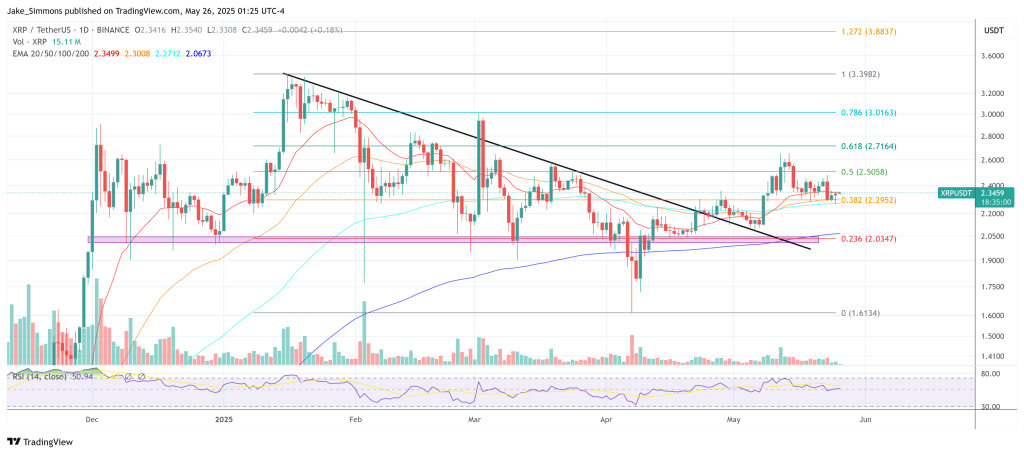
At press time, XRP traded at $2.34.
XRP price
XRP price, 1-day chart | Source: XRPUSDT on TradingView.com
Featured image created with DALL.E, chart from TradingView.com
Editorial Process for bitcoinist is centered on delivering thoroughly researched, accurate, and unbiased content. We uphold strict sourcing standards, and each page undergoes diligent review by our team of top technology experts and seasoned editors. This process ensures the integrity, relevance, and value of our content for our readers.

Jake Simmons has been a Bitcoin enthusiast since 2016. Ever since he heard about Bitcoin, he has been studying the topic every day and trying to share his knowledge with others. His goal is to contribute to Bitcoin's financial revolution, which will replace the fiat money system. Besides BTC and crypto, Jake studied Business Informatics at a university. After graduation in 2017, he has been working in the blockchain and crypto sector. You can follow Jake on Twitter at @realJakeSimmons.

Leituras Relacionadas

Top 8 DEXs of July 2026

This article presents the top 8 decentralized exchanges (DEXs) for July 2026, highlighting their key features and evolution within the DeFi space. DEXs, which enable peer-to-peer cryptocurrency trading via smart contracts without intermediaries, are praised for offering users greater control, privacy, transparency, and global access compared to centralized platforms. The listed DEXs are: 1. **Shadow Exchange**: A Sonic-native DEX specializing in concentrated liquidity for efficient trading and reduced slippage. 2. **Uniswap**: A leading protocol using an Automated Market Maker (AMM) model across multiple blockchains. 3. **SushiSwap**: An evolved platform offering token swaps, yield farming, and governance via its SUSHI token across 40+ networks. 4. **Orca**: A user-friendly AMM on Solana featuring capital-efficient "Whirlpools" for concentrated liquidity. 5. **Meteora**: A Solana-based DEX focusing on dynamic liquidity infrastructure and vaults for advanced strategies. 6. **Raydium**: A hybrid exchange on Solana combining AMM pools with a central limit order book for deep liquidity. 7. **Hyperliquid**: A Layer 1 blockchain hosting a non-custodial perpetual futures exchange using an on-chain order book. 8. **PancakeSwap**: A multi-chain AMM hub originating on BNB Chain, now supporting thousands of trading pairs across several networks. The article concludes by noting the significant role of DEXs in crypto, their expansion beyond simple swaps into areas like derivatives and cross-chain interoperability, and advises users to conduct their own research before engaging with any platform.

ambcryptoHá 46m

Top 8 DEXs of July 2026

ambcryptoHá 46m

USDT Market Cap Approaches Ethereum's: What Signal Does This Convey?

The market capitalization of USDT has nearly reached that of Ethereum, making it the second-largest cryptocurrency after Bitcoin. This prompts an examination of what this signifies and what it does not. Firstly, this does not relate to economic security. Unlike some Web3 systems where a governance token's value must underpin the security of its applications (e.g., oracles), USDT's stability is not backed by the value of the underlying blockchains it operates on. Tether, the issuer, controls the assets, and can freeze, reissue, or abandon tokens on a compromised chain. While stablecoins require functional blockchains, a chain's native token market cap does not provide direct security for the stablecoin. Secondly, USDT's growth does not inherently reflect poorly on Ethereum. USDT is a dollar-pegged store of value, while ETH represents a claim on future Ethereum network revenue. Their valuations are driven by different factors. USDT's rising market cap simply indicates strong demand for stablecoin utility, independent of Ethereum's technological merits or competitive position. The core insight is the overwhelming market demand for permissionless dollar transfers. This is the most established and essential use case in crypto. It requires minimal technological sophistication—essentially just a trusted issuer's promise of redemption on a functional chain. This explains why stablecoin supply has grown exponentially while the combined market cap of major non-stablecoin cryptocurrencies like Bitcoin, Ethereum, and others has stagnated for years. Users primarily seek accessible dollar-denominated assets. They largely disregard the issuer's credibility (as seen with Tether's dominance over more credible alternatives like USDC or BlackRock's BUIDL) and are indifferent to the governance or decentralization of the underlying blockchain. As long as a stablecoin is widely accepted and easy to transfer, users will adopt it across any chain. The trend suggests that the market for permissionless stablecoins could continue to expand far beyond the total value of the smart contract platforms that host them, driven by this singular, powerful use case.

Foresight NewsHá 1h

USDT Market Cap Approaches Ethereum's: What Signal Does This Convey?

Foresight NewsHá 1h

Trading

Spot
活动图片