Биткоин-ETF привлекли $2,75 млрд за одну неделю

cryptonews.ruPublicado em 2024-01-25Última atualização em 2025-05-25

Биткоин-ETF собрали рекордные $2,75 млрд за неделю, пока криптовалюта уверенно держится выше отметки $108 тыс. Цифра впечатляет особенно на фоне того, что еще неделю назад приток составлял скромные $608 млн — разница почти в 4,5 раза.
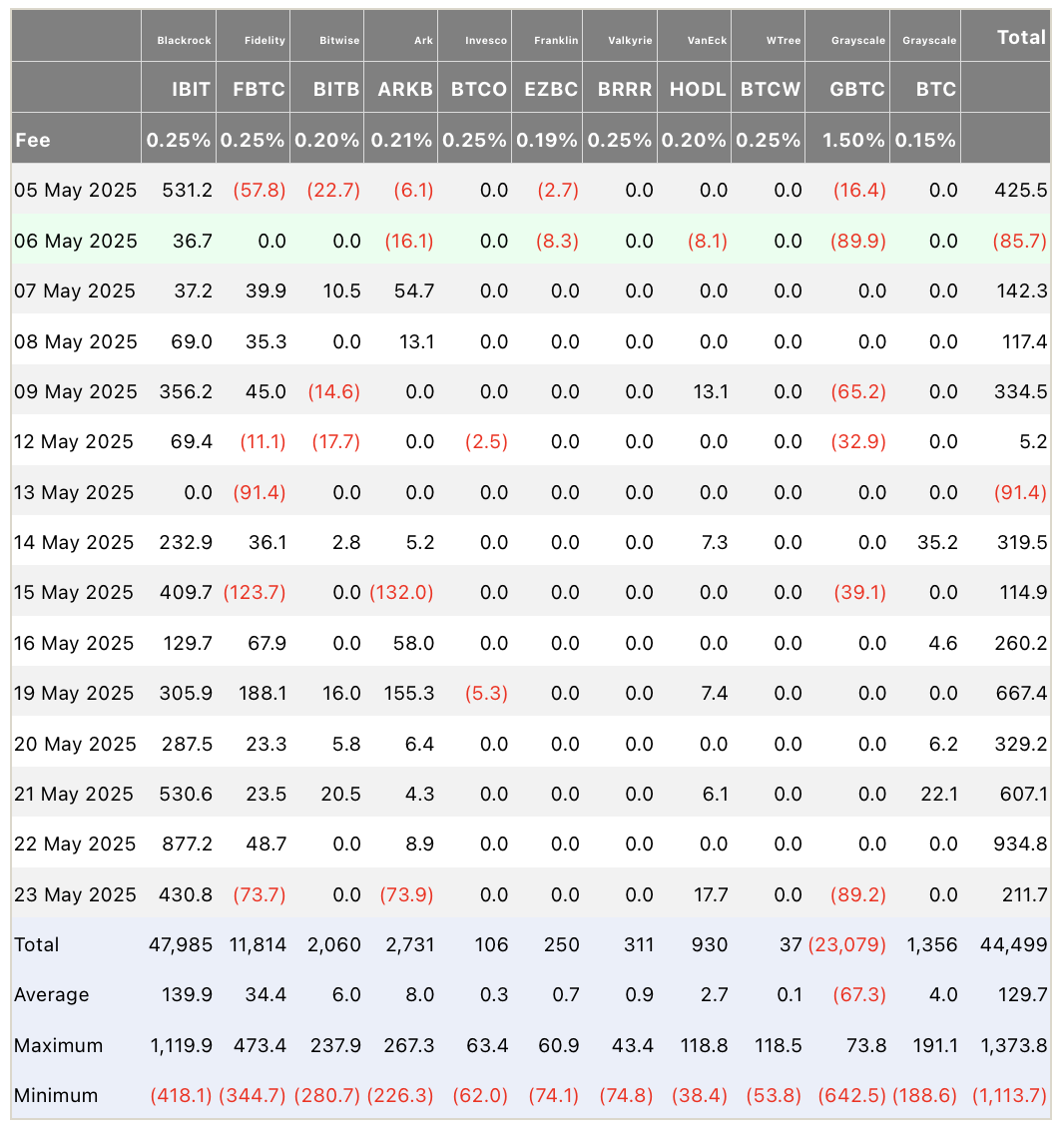
Движение средств в биткоин-ETF США. Источник: Farside Investors

BlackRock снова в лидерах

Американские спотовые биткоин-фонды продемонстрировали нечто особенное: впервые за четыре недели они зафиксировали целую неделю подряд с ежедневными притоком капитала. В пятницу, 23 мая, общий приток составил $211,7 млн, но настоящей звездой стал IBIT от BlackRock. Этот гигант притянул к себе $430,8 млн за один торговый день и продлил свою серию притоков до восьми дней подряд.

А вот Grayscale со своим GBTC показал противоположную картину — отток $89,2 млн. ARK 21Shares с фондом ARKB тоже не блистал, потеряв $73,9 млн. Получается интересная ситуация: пока одни фонды теряют инвесторов, BlackRock буквально собирает их пылесосом.

Новые рекорды биткоина

21 мая биткоин-ETF получили мощный импульс в виде $607,1 млн притока инвестиций — именно в тот день биткоин преодолел свой январский максимум в $109 тыс. На следующий день криптовалюта установила новый исторический максимум в $111 880.

Любопытная деталь: спотовые биткоин-ETF движутся к месячному рекорду притока капитала. В ноябре 2024 года они собрали $6,49 млрд, а сейчас, в мае, уже накопили около $5,39 млрд. И это при том, что до конца месяца остается еще пять торговых дней.

Аналитики пока не видят признаков перегрева биткоина, несмотря на новые максимумы. Алекс Крюгер (Alex Krüger) отмечает: «Это наименее эйфоричные новые исторические максимумы в истории биткоина».

Получается парадоксальная картина: биткоин бьет рекорды, фонды собирают миллиарды, но фундаментальные показатели говорят о том, что до настоящей эйфории еще далеко. Возможно, это именно то состояние рынка, которое инвесторы и ждали — органический рост, а не спекулятивный пузырь.

Leituras Relacionadas

Will There Be a Next Wave of Web3 Games? Veteran Player's Review: At the Peak of Hype, You Should at Least Sell Half

**Title: Is There Another Wave for Web3 Gaming? A Veteran Player's Review: When Hype Peaks, You Must Exit at Least Half** **Summary:** In an interview, veteran player "Earn Money Chicken" shares his journey and reflections on Web3 gaming. He transitioned from being a traditional in-game trader to a Web3 gamer, having profited from games like Mobox, StepN, and Seraph, but also experiencing significant losses. He defines himself primarily as a player, not an investor, attracted to Web3 games for the blend of earning potential, engaging gameplay, and the satisfaction of researching game mechanics. While he enjoys strategic "gambling" within games, he emphasizes it's not about zero-sum competition with other players. The interview explores the complex, often adversarial relationship between players, projects, and major investors (whales). The player's experience as a traditional game merchant helped develop his analytical mindset for spotting opportunities, but wasn't directly transferable. He identifies the core sources of profit in early Web3 gaming as **"era红利" (era-specific红利)** and strategic foresight, not just simple calculations. He warns that the biggest mistake ordinary players make is calculating their return-on-investment (ROI) period at peak hype, as asset and yield depreciation can trap them. Reflecting on his wins and losses, he now advocates for managing expectations. His most successful exit was from Seraph, where he sold at a relatively good time. The key problem with current Web3 games, he argues, is that most are not mature games first. A successful Web3 game must primarily be a **good, fun game** with a genuine player base willing to spend money for enjoyment, not just participants seeking profit. The blockchain element should solve problems within that context, not be the primary driver. While he believes the sector might see another speculative boom (possibly another strong "Ponzi" model attracting hype), a truly mature and sustainable Web3 game likely needs to come from a traditional major game studio. It would leverage a proven IP, mature content, a functional NFT trading system, and attract both traditional and crypto-native players, offering more normalized returns rather than extreme暴利. His final advice: Newcomers without prior experience should avoid the space now, as it's like searching for a diamond in the rough. For those remaining, the rule is: be brave when assets are low and overlooked, but **when everyone is talking about it (at peak hype), you must sell at least half your holdings.**

marsbitHá 38m

Will There Be a Next Wave of Web3 Games? Veteran Player's Review: At the Peak of Hype, You Should at Least Sell Half

marsbitHá 38m

The Most Hidden AI Winners

"The Most Under-the-Radar AI Winners" While core AI giants and their direct suppliers have dominated headlines, a group of seemingly unrelated, decades-old manufacturing companies have emerged as major beneficiaries. A key example is Japan's TOTO, famous for bathroom fixtures. Its stock soared 145% in a year, driven not by its mainstay toilet business but by its nearly 40-year-old semiconductor ceramic component unit. Specifically, TOTO manufactures electrostatic chucks—critical, hard-to-replace parts for advanced chip manufacturing processes like etching and EUV lithography. This segment, though only 9% of revenue, contributed over 54% of operating profit in FY2025 with a 43% margin. High barriers to entry, including deep know-how in high-purity ceramic sintering and long supplier certification cycles (5+ years), secure its position. This pattern repeats across industries. Nitto Boseki, a 128-year-old glass fiber maker, saw its stock rise 325% due to near-monopoly supply of T-glass, an essential low-expansion material for AI chip substrates. Similarly, Ajinomoto, the global MSG leader, commands 80-95% of the market for ABF film, a vital insulating layer in chip packaging. These "hidden" segments, often born from deep materials science expertise, are now bottleneck supplies in the AI hardware chain, enjoying pricing power and high margins. In China's A-share market, the theme combines this AI-driven demand with domestic substitution. Companies like Zhongci Electronic (advancing in electrostatic chucks) and Honghe Technology & Feilihua (in high-end electronic glass fabrics) are gaining traction. The investment thesis hinges on whether these domestic players can rapidly scale qualified capacity to capture the supply gap within the critical time window. Ultimately, these cases show that in the AI supply chain, high-profit concentrations exist not only at the cutting-edge tech frontier but also in indispensable, difficult-to-replicate materials and components. Market recognition often lags behind fundamental profit shifts, creating potential for significant re-ratings as traditional industrial firms are re-evaluated as key enablers of advanced semiconductor manufacturing.

marsbitHá 1h

The Most Hidden AI Winners

marsbitHá 1h

The Most Secretive Winners of the AI Boom

"The Most Hidden AI Winners" An unlikely group of companies are emerging as major beneficiaries of the AI boom, not from designing chips, but from supplying critical materials and components essential for advanced semiconductor manufacturing. These 'hidden winners' are traditional manufacturers whose deep expertise in materials science has become indispensable. Japanese companies are leading this trend. Toto, globally known for bathroom fixtures, has seen its stock surge 145% over the past year, driven by its 40-year-old semiconductor ceramics business, which now contributes over half of its operating profit. Its electrostatic chucks are vital for advanced chip production and require years of expertise to manufacture. Similarly, Nittobo, a 128-year-old textile firm, controls 90% of the market for T-glass, a low-expansion glass fiber essential for AI chip substrates. Ajinomoto, the world's largest MSG producer, dominates the market (80-95% share) for ABF insulating film used in chip packaging. The core insight is that chasing "advanced" chips paradoxically increases reliance on traditional, high-precision material science where supply cannot be quickly replicated. These materials are now critical bottlenecks in the AI supply chain. This trend is mirrored in China's A股 market, framed by the theme of 'import substitution'. Companies like Zhongci Dianzi (electrostatic chucks) and Honghe Technology (ultra-thin electronic cloth) are making progress, but face the test of scaling production and matching Japanese rivals' quality. The key tension lies in the slow change of market perception. While profit structures rapidly shift towards high-margin tech components, these firms retain their traditional industry classifications, creating a valuation gap that is gradually closing as their roles in the AI ecosystem become undeniable.

链捕手Há 1h

The Most Secretive Winners of the AI Boom

链捕手Há 1h

Trading

Spot
活动图片