US Banks Get Crypto Boost As OCC Confirms Service Approval

bitcoinistPublicado em 2025-05-09Última atualização em 2025-05-10

Resumo

American national banks are now legally allowed to buy and sell crypto on behalf of their customers. The ruling was...

Trusted Editorial content, reviewed by leading industry experts and seasoned editors. Ad Disclosure

American national banks are now legally allowed to buy and sell crypto on behalf of their customers. The ruling was made on Wednesday in the form of a revised interpretive letter from the Office of the Comptroller of the Currency (OCC), eliminating previous regulatory hurdles and allowing banks to go ahead with digital asset services.

Banks Permitted To Provide Full Crypto Services

Under the OCC guidance, federal savings associations and national banks may now offer the full array of crypto services. That would encompass buying and selling digital assets, converting them into US dollars, making settlements, maintaining customer records, and even supporting asset valuations and tax reporting.

These services may be managed either by the banks themselves or in collaboration with third-party providers. But in both instances, the OCC was unambiguous: banks need to have robust internal controls and risk management procedures.
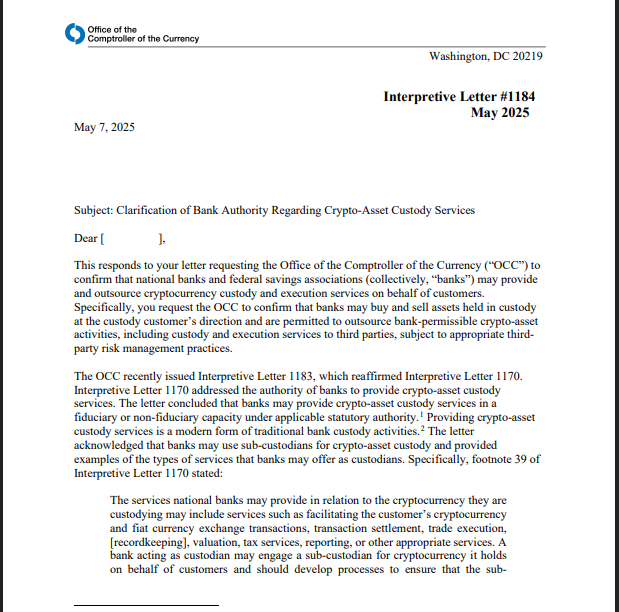
First page of the OCC Interpretive Letter. Source: OCC

The new guidance also indicates a broader change in the way US regulators are thinking about crypto. On March 7, the OCC eliminated a rule that had compelled banks to obtain supervisory non-objection before making a foray into digital currencies.

Then on April 24, the Federal Reserve backtracked on its 2022 policy mandating state member banks to provide prior notice before becoming involved in crypto activities. According to Faryar Shirzad, Coinbase’s Chief Policy Officer, this new direction brings more clarity. He also credited Acting Comptroller Rodney Hood with assisting to advance it.

Banks Must Act On Customer Direction

The OCC’s letter also makes it clear that banks can act on a customer’s instruction. So if one holds crypto with their bank and wishes to sell the crypto, then the bank can execute the transaction directly. This enhances customers’ control and paves the way for easier crypto transactions using well-known banking conduits.

This explanation is based on previous guidance from the OCC, but now eliminates any uncertainty. Banks are not required to wait for special approval to provide these services, which may accelerate adoption.

As of today, the market cap of cryptocurrencies stood at $3.23 trillion. Chart: TradingView

Risk Oversight Rules For Outside Providers

The OCC guidance also establishes requirements for how banks are to deal with third-party crypto service providers. In the event that banks outsource activities such as crypto custody or transaction facilitation, due diligence needs to be conducted and oversight instituted.

Image: FIU Business

Sub-custodians, especially, need to adhere to security protocols to safeguard customer assets. Banks are expected by the OCC to hold such partners to the same standards they apply in other banking segments. Risk frameworks need to be consistent with current regulations to safeguard customers from possible mishandling.

Crypto’s Path Into The Banking Mainstream

This announcement is a strong message that crypto is no longer taboo for mainstream banks. By providing banks with more latitude to engage without the need for prior approval, the OCC is signaling a more embracing attitude toward digital asset services within regulated finance.

Whether that leads to a flood of banks into the business is uncertain. But the guidelines are in place, the door is open, and customers can now choose to get crypto services from the same banks where they hold their checking accounts.

Featured image from The Information, chart from TradingView

Editorial Process for bitcoinist is centered on delivering thoroughly researched, accurate, and unbiased content. We uphold strict sourcing standards, and each page undergoes diligent review by our team of top technology experts and seasoned editors. This process ensures the integrity, relevance, and value of our content for our readers.

Christian, a journalist and editor with leadership roles in Philippine and Canadian media, is fueled by his love for writing and cryptocurrency. Off-screen, he's a cook and cinephile who's constantly intrigued by the size of the universe.

Leituras Relacionadas

Beyond Private Keys: From Wallets and L2 to Supply Chains, How to Guard the Security Perimeter of Web3?

Beyond Private Keys: Securing Web3's Expanding Attack Surface from Wallets to L2s and Supply Chains The crypto space faced a wave of security incidents in June, with over $75 million lost across 40 major attacks. These breaches highlighted risks beyond private key theft, exposing vulnerabilities across the entire user interaction chain. Wallet security was compromised not through stolen seed phrases, but via a critical flaw in the Cardano wallet SecondFi's signing implementation. This bug allowed attackers to potentially derive private keys from publicly visible signature data, emphasizing that wallet security depends on correct cryptographic implementation, ideally in open-source, auditable code. Layer-2 networks also revealed complex trust chain risks. Attacks on legacy Aztec deployments exploited inconsistencies in proof systems, showing that a valid zero-knowledge proof is only as secure as its underlying rules. Another attack on Taiko's SGX-based prover stemmed from a leaked signing key and inadequate verification checks. Furthermore, a technical glitch halted Base's block production, underscoring that L2 security encompasses network availability and reliable user exit paths as much as asset safety. Finally, the Polymarket incident demonstrated that even audited smart contracts are not immune. A compromised third-party supplier led to a malicious script being injected into the platform's frontend, resulting in user fund losses. This "supply chain attack" shows that the security of the entire interaction path—from the webpage to the wallet signature—is critical. The conclusion is clear: Web3 security now involves safeguarding the entire journey from transaction intent to on-chain settlement. Users must adopt layered security habits: isolating long-term holdings, using dedicated wallets for daily interactions, scrutinizing transaction details before signing, and managing authorizations cautiously. Defense must evolve from protecting a single point (the private key) to securing a complete chain of interactions.

marsbitHá 31m

Beyond Private Keys: From Wallets and L2 to Supply Chains, How to Guard the Security Perimeter of Web3?

marsbitHá 31m

Robinhood Chain Goes Viral in One Week: Memes Drive Traffic, Stablecoins Support TVL

Robinhood Chain, an Arbitrum-based Layer 2 network launched on July 1st, experienced explosive growth in its first week. While meme coin hype drove user activity, stablecoin deposits fueled its surge in Total Value Locked (TVL). The chain's rapid adoption was driven by multiple factors. CEO Vlad Tenev reversed his initial stance, endorsing the chain for meme coins despite its original focus on Real-World Assets (RWA). The integration of the popular Solana-based launchpad Pump.fun significantly lowered the barrier for meme trading. Furthermore, the prediction market application World announced a migration from Solana to Robinhood Chain. Meme coin mania, led by tokens like CASHCAT, generated massive trading volume, with daily active addresses skyrocketing from near zero to hundreds of thousands. However, the primary driver of the chain's TVL, which soared past $234 million, was a major institutional deposit. Ethena injected approximately $50 million in stablecoins into the Morpho lending protocol, which underpins Robinhood's Earn product, accounting for the bulk of locked value. This highlights two concurrent narratives: retail-driven meme speculation boosting transactions, and institutional stablecoin deposits building foundational liquidity. In contrast, the chain's flagship RWA offerings, like tokenized stocks, remain a minor part of the ecosystem at around $12.8 million. The first week demonstrates a path where speculative trading and yield-seeking capital provide initial momentum, while the core RWA vision is still in early development.

Foresight NewsHá 1h

Robinhood Chain Goes Viral in One Week: Memes Drive Traffic, Stablecoins Support TVL

Foresight NewsHá 1h

The Illusion of a Prodigy

The Illusion of the "Genius Youth" The article discusses the recent interview incident involving Li Bojie, a former "Huawei Genius Youth," and AI company DeepSeek. It highlights the core conflict not as a simple case of suspected cheating during a coding test, but as a profound mismatch in expectations. Li, with an impressive background including entrepreneurship, a role at Huawei, and a position as a chief scientist, was deeply affected by a standard remote interview where the interviewer questioned his actions. The key point is his stated view of DeepSeek as the "pinnacle of the Chinese tech world." For him, the interview was a quest for identity validation—proof he belonged at the center of the new AI era. For DeepSeek, it was a routine skills assessment. The article argues that Li, while publicly rejecting the "genius" label, subconsciously expected to be treated as a peer for discussion, a courtesy extended by other companies like MiniMax and Xiaomi. DeepSeek, however, adhered strictly to its standardized process, prioritizing consistent, merit-based evaluation over individual prestige. This clash symbolizes a larger shift in the tech industry. The core thesis is that the AI era is dismantling the old system where past titles, companies, and accumulated experience guaranteed status. Now, with rapid knowledge obsolescence, "excellence is calculated in real-time." Li's anxiety—waiting weeks for the DeepSeek interview despite other offers—stems from the fear that rejection means being left behind by technological progress. The article concludes that this incident is a harbinger; soon, everyone will face a constant, implicit "interview" with the AI age itself, asking: "You were excellent yesterday. What about today?"

marsbitHá 1h

The Illusion of a Prodigy

marsbitHá 1h

Vanguard Group Enters the Arena, Opening a New Crypto Portal for 50 Million Traditional Investors

Vanguard Group, the world's second-largest asset manager with $12 trillion in assets under management and over 50 million investors, has signaled a significant strategic shift by posting a job opening for a "Head of Digital Assets, Personal Wealth." The role entails developing a comprehensive digital asset strategy, establishing long-term plans, and overseeing the full integration of digital assets into Vanguard's wealth management platform, covering areas like custody, settlement, asset tokenization, and stablecoins. This move marks a notable reversal from the firm's previous stance. In 2024, Vanguard refused to list spot Bitcoin ETFs and removed Bitcoin futures products. By late 2025, it allowed some third-party crypto ETF trading but reiterated it would not create its own crypto funds. The new hire represents a third step: building an internal team to integrate digital assets into its core infrastructure, moving beyond merely listing products. The initiative focuses on foundational financial infrastructure—how tokenized assets and digital settlement systems can connect to Vanguard's existing platform, which primarily serves long-term, conservative investors. While Vanguard maintains it will not launch proprietary crypto ETFs, it is proactively preparing its systems for a future involving tokenized assets and stablecoins, which Citigroup projects could reach a $5.5 trillion market by 2030. Vanguard's scale means its chosen standards for custody, settlement, and compliance could set de facto rules for the broader wealth management industry. The firm is acting despite regulatory uncertainty and cautious market sentiment (e.g., Citi recently lowered crypto price targets). Analysts suggest even a minimal 0.01% allocation from Vanguard's asset base would bring ~$12 billion into digital assets, forcing the development of robust risk and operational frameworks. Ultimately, Vanguard's focus is on building the plumbing for digital assets to potentially serve its vast client base, an effort whose impact may extend far beyond any single market cycle.

Foresight NewsHá 1h

Vanguard Group Enters the Arena, Opening a New Crypto Portal for 50 Million Traditional Investors

Foresight NewsHá 1h

Trading

Spot
活动图片