Dogecoin App Layer Coming As DogeOS Raises $6.9 Million — Why It Matters

bitcoinistPublicado em 2025-05-08Última atualização em 2025-05-08

Resumo

DogeOS, the new application layer that aspires to give Dogecoin full-fledged utility beyond tipping and trading, has closed a $6.9...

Trusted Editorial content, reviewed by leading industry experts and seasoned editors. Ad Disclosure

DogeOS, the new application layer that aspires to give Dogecoin full-fledged utility beyond tipping and trading, has closed a $6.9 million seed round led by Polychain Capital. The funding marks the first time an independent development stack focused exclusively on Dogecoin has attracted institutional backing at this scale, signaling what Polychain calls “a critical layer for the future of decentralized innovation.”

According to the official press release, the capital will be deployed to launch the DogeOS platform, expand developer tools and forge partnerships aimed at consumer adoption. The roadmap cites “X-native applications and integrations to support next-generation AI and DeFi” as early priorities, all of them settled natively in DOGE. By presenting itself as an “App Layer,” DogeOS positions Dogecoin as programmable infrastructure—something the original meme coin has generally lacked since its 2013 launch.

Jordan Jefferson, chief executive of MyDoge and now the public face of DogeOS, framed the initiative as the logical extension of Dogecoin’s culture-first success. “Dogecoin has always been about community and culture — DogeOS is bridging the gap between Dogecoin’s massive consumer community and real on-chain innovation,” he said. “With over half a million users trusting MyDoge as their preferred wallet, we’ve seen firsthand the community’s demand for native DOGE experiences. DogeOS delivers on that demand — unlocking new use cases, more creativity, and a future where DOGE is built into everything.”

Polychain’s participation gives the project a stamp of credibility among crypto-native investors known for infrastructure bets. “DogeOS is a game-changer for the Dogecoin ecosystem,” remarked Luke Pearson, a partner at the firm. “Its ability to support a diverse range of applications, from gaming to AI, positions it as a critical layer for the future of decentralized innovation. We’re excited to support DogeOS in building a network that truly belongs to its community.”

Why This Matters For Dogecoin

RootData, a market-intelligence service that tracks private-round activity, contextualized the raise in a thread on X. The service described DogeOS as “the ‘operating system’ of Dogecoin — a dev platform enabling consumer apps across DeFi, gaming, AI, and more, all powered by DOGE,” and argued that the round represents “serious institutional interest in Dogecoin’s next evolution — from memecoin to utility layer.” RootData noted that Dogecoin’s lack of smart-contract programmability has so far limited on-chain experimentation; DogeOS promises to “bridge that gap” with a tool-set designed to be “simple, fun, and deeply community-driven.”

In practice, DogeOS will introduce native yield opportunities and decentralized-finance primitives—yield farming, stablecoin integration and other mechanisms—that have historically been unavailable to DOGE holders. By converting DOGE from a “static, cultural asset” into a token that can participate directly in decentralized applications, DogeOS aims to reframe Dogecoin’s role within the broader crypto economy.

While the $6.9 million infusion is modest compared with the billion-dollar treasuries behind Ethereum-compatible layer-twos, its symbolic weight is notable. Polychain was among the earliest backers of both Cosmos and Polkadot; its thesis-driven investments tend to precede wider developer attention. For Dogecoin—a network sustained primarily by retail enthusiasm and Elon Musk mentions—the arrival of an infrastructure-oriented venture round could mark the start of a more sustained buildout.

Whether DogeOS can galvanize developers remains an open question, but the project has at least one leverage point: MyDoge’s existing base of more than 500,000 users, who will be able to access new applications from within a familiar wallet. The DogeOS team argues that this “captive audience” lowers the usual cold-start friction faced by emerging blockchains.

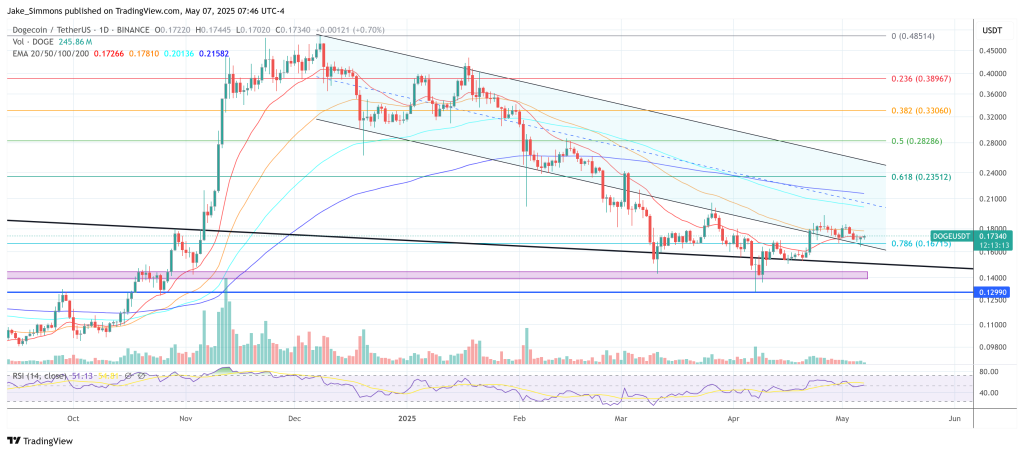
At press time, DOGE traded at $0.173.
Dogecoin price
DOGE remains inside the channel, 1-day chart | Source: DOGEUSDT on tradingView.com
Featured image created with DALL.E, chart from TradingView.com
Editorial Process for bitcoinist is centered on delivering thoroughly researched, accurate, and unbiased content. We uphold strict sourcing standards, and each page undergoes diligent review by our team of top technology experts and seasoned editors. This process ensures the integrity, relevance, and value of our content for our readers.

Jake Simmons has been a Bitcoin enthusiast since 2016. Ever since he heard about Bitcoin, he has been studying the topic every day and trying to share his knowledge with others. His goal is to contribute to Bitcoin's financial revolution, which will replace the fiat money system. Besides BTC and crypto, Jake studied Business Informatics at a university. After graduation in 2017, he has been working in the blockchain and crypto sector. You can follow Jake on Twitter at @realJakeSimmons.

Leituras Relacionadas

Are the Frantic Acquisitions of Crypto Companies by Giants Good or Bad?

In a bear market, giants are actively acquiring crypto companies. Recent months have seen at least five major deals: Samsung Securities bought a 2% stake in Upbit operator Dunamu; Robinhood acquired WonderFi for $180 million to enter the Canadian market; Figure purchased Kiavi for $717 million to expand into on-chain real estate credit; Franklin Templeton bought 250Digital to launch Franklin Crypto; and Blockworks acquired data platform Messari at a steep discount—over 90% less than its 2022 $300 million valuation. These moves highlight a strategic shift. Cash-rich giants are consolidating resources at low cost, targeting companies with established compliance frameworks to navigate tightening global regulations. Acquisitions like WonderFi and the Upbit stake provide immediate market access and licensed user bases. Figure's deal signals real-world asset (RWA) tokenization moving from concept to large-scale implementation, with Kiavi's $7+ billion annual transaction volume being integrated into on-chain capital markets. Franklin Crypto's launch targets institutional investors like pension funds, offering them tailored, compliant crypto strategies. For these strategic players, bear markets present an ideal entry point: valuations are depressed, speculative noise is minimized, and they can acquire robust technology and compliance infrastructure at a fraction of the cost. This acquisition wave marks a transitional phase for crypto—from a wild frontier toward an institutional, regulated financial system. Giants are positioning themselves to capture future growth when macroeconomic conditions and liquidity improve, leaving latecomers behind.

marsbitHá 40m

Are the Frantic Acquisitions of Crypto Companies by Giants Good or Bad?

marsbitHá 40m

In the MiCA Era, Europe's New Cryptography Landscape: Why is Germany Taking Center Stage?

With MiCA's transitional arrangements concluding, Europe's crypto industry has undergone a regulatory consolidation. Post-MiCA, platforms must secure CASP authorization to operate compliantly within the EU. As of July 1st, only about 12% of crypto firms have received authorization, with Germany emerging as a key player, holding 57 authorizations (roughly 23% of the EU total). This positions Germany as a primary compliance gateway to the EU's unified market. Germany's advantage stems from its established, function-based regulatory framework, which integrated crypto activities into existing banking, securities, and payment systems pre-MiCA. This allowed a smoother transition and attracted both domestic platforms (like Bitcoin.de, BISON) and international ones (like Coinbase Germany). A distinctive trend is German banks becoming direct retail entry points for crypto services. Examples include DZ Bank integrating "meinKrypto" into its VR Banking App and the Sparkassen savings bank network planning to offer crypto trading via DekaBank. This mainstreams crypto access for ordinary users. Beyond trading, Germany is evolving into a digital asset infrastructure hub. Deutsche Börse Group's Clearstream is developing a next-generation platform for issuing, settling, and servicing both traditional and tokenized securities. Furthermore, German banks like DekaBank and DZ Bank are key participants in the Qivalis project, a European initiative for a regulated euro stablecoin, positioning Germany at the intersection of critical future capabilities like custody, settlement, and cross-border services.

marsbitHá 1h

In the MiCA Era, Europe's New Cryptography Landscape: Why is Germany Taking Center Stage?

marsbitHá 1h

Trading

Spot
活动图片