Strive's Paper Loss Warning: Pressure from Strategy Preferred Shares Has Spread Across the Entire Bitcoin Treasury Track

Foresight NewsPublicado em 2026-07-09Última atualização em 2026-07-09

Resumo

Strive's disclosure that its holdings of Strategy's (STRC) preferred shares lost $7.08 million in value over eight days signals that credit risks are spreading across the Bitcoin reserve industry through cross-holdings. While not proof of insolvency, it shows how valuation pressure on one firm's securities can directly impact another's balance sheet. Strategy responded with a comprehensive credit management framework, including raising STRC dividends to 12%, authorizing share buybacks, and formalizing a plan to potentially sell Bitcoin to bolster its $2.55 billion cash reserve. However, third-party models value STRC at around $49.89 per share, far below its $100 face value, highlighting that its price depends critically on the sustainability of dividends and Strategy's financial health. The market now watches for two scenarios: either the risk is contained to Strategy, or it spreads industry-wide if STRC's discount deepens, dividends become unsustainable, and pressure spills over to securities like Strive's SATA. Key indicators to monitor are the discount rates of STRC and SATA, cash coverage for dividends, share issuance activity, and whether Bitcoin sales move from authorization to execution.


Author:Liam 'Akiba' Wright

Compile:Saoirse,Foresight News


The preferred shares issued by bitcoin reserve companies have long ceased to be purely income-generating assets; they have become a credit benchmark testing the balance sheet robustness of bitcoin enterprises. While market focus remains concentrated on Strategy, data disclosed by Strive, the seventh-largest bitcoin-holding listed company globally, directly demonstrates the real impact of risk spillover: another bitcoin reserve company holds Strategy preferred shares, and the value fluctuations of this holding have become a clear signal of market pressure.


In an update document released on June 29, Strive disclosed that between June 18 and June 26, the number of its held 505,000 STRC shares did not change, but the fair value of this holding fell from $44.738 million to $37.658 million.


In just 8 days, with no adjustment to the share count, the holding value evaporated by $7.08 million. Based on a simple calculation of the declared fair value, the market's valuation of Strive's STRC holdings dropped from approximately $88.59 per share to $74.57 per share.


This disclosure document does not prove the company is insolvent, forced to sell assets, or that its capital structure has completely failed. However, it reveals a more critical fact: even before a major crisis erupts, the risk associated with bitcoin reserve preferred shares can transmit to other companies' balance sheets through cross-shareholdings.


As of June 26, Strive still holds 19,864 bitcoins, possesses $141.7 million in cash and equivalents, and has 7,829,502 of its own SATA preferred shares outstanding. But the core signal released by this financial report is not its own asset scale, but rather that its exposure to Strategy preferred shares has fundamentally altered investors' judgment logic for the entire sector.


The market has long debated the STRC issued by Strategy: whether investors would treat this product as a stable income instrument or as a high-risk credit asset tied to bitcoin price action, market liquidity, and Strategy's dividend payment capability. Strive's disclosure makes this question even more pressing.


Different bitcoin reserve companies cross-holding each other's preferred shares establish a clear and visible cross-company risk transmission channel. Once STRC trades at a discount, Strive will reflect asset losses in its financial report's fair value. If Strive's subsequently issued SATA preferred shares also face market skepticism, the market can intuitively judge whether the current pressure is a single-company issue or has spread throughout the industry via the preferred share financing model.


The initial marketing points for these reserve preferred shares were stable yield, fixed par value, and regular dividends, which strongly appealed to investors preferring stable returns. However, when market focus shifts to discount-to-par ratios, cash reserve coverage, dividend adjustment mechanisms, share buybacks, and potential asset sales, the trading nature of these securities completely shifts towards credit-like risk assets.


The core question investors now care most about is: Does the issuer have sufficient cash, smooth financing channels, and adequate bitcoin liquidity to guarantee the credibility of dividend payments?
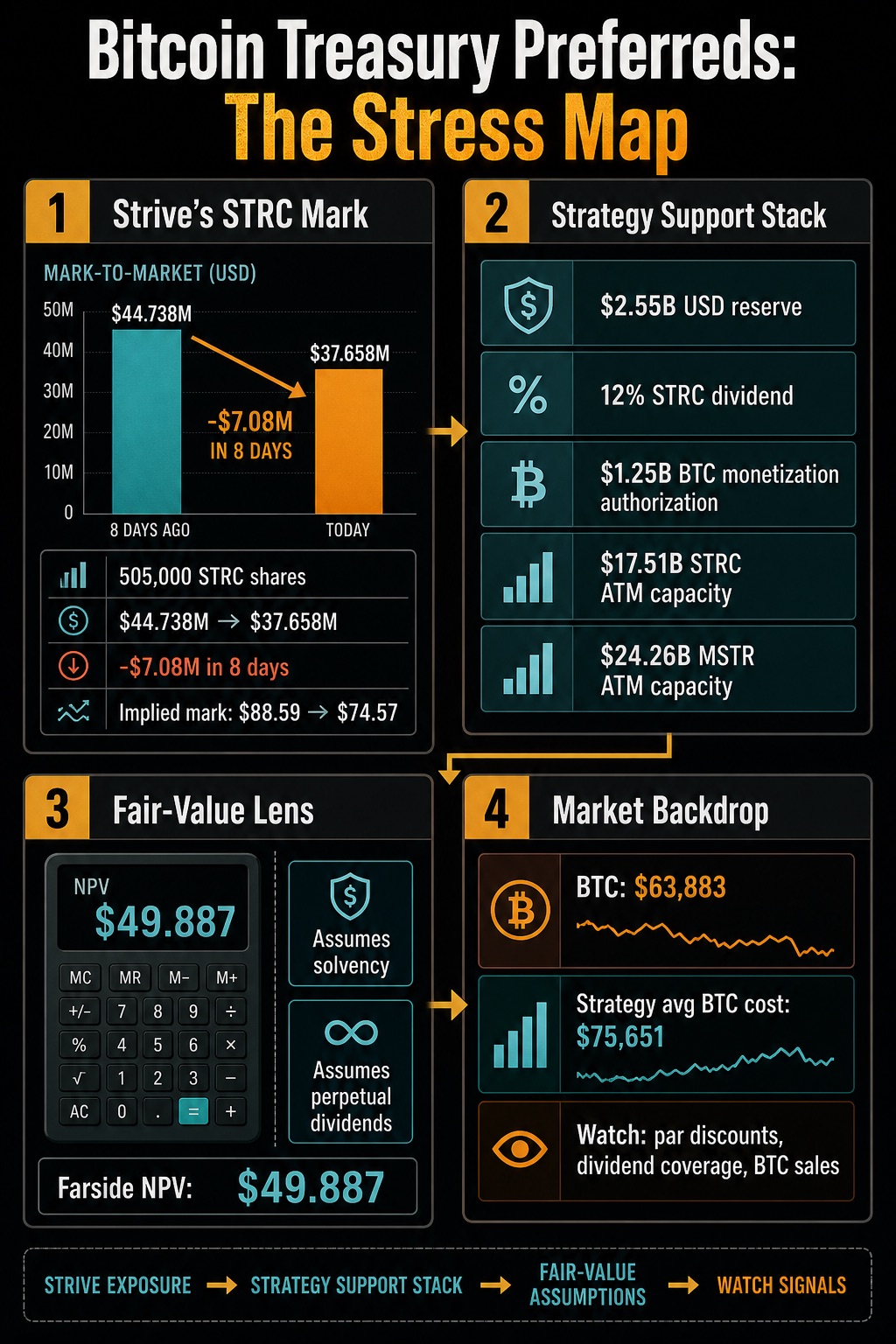

Strive's $7.08 million unrealized loss on its STRC preferred shares in 8 days exposes industry cross-holding risk. Simultaneously listing Strategy's full toolkit for stabilization—cash reserves, high dividends, coin sales, share issuance, etc.—alongside the third-party estimated STRC fair value of only $49.887 and the current bitcoin price far below the company's average cost basis, the article highlights the need to closely track preferred share discounts, dividend coverage capability, and bitcoin selling actions to judge industry risk trends.


Strategy's New Operational Framework: Essentially Credit Risk Management


The regulatory filing submitted by Strategy on June 29 further confirms the aforementioned shift in logic. The company introduced a Digital Credit Capital Framework, accompanied by policies including US Dollar Reserve Management Rules, a revised STRC dividend plan, a preferred share repurchase program, a common stock repurchase program, and a Bitcoin Monetization Plan. This combination of tools is specifically designed to address stressed capital structures.


Strategy disclosed that as of June 28, its US dollar reserve size reached $2.55 billion. The board mandated that management must retain cash reserves sufficient to cover at least the next 12 months of annual preferred share dividends and interest expenses, unless specifically authorized by the board to lower this threshold. The document also stated that reserve funds could be replenished through selling tokens under the Bitcoin Monetization Plan or via other capital market operations.


This reserve is crucial because Strategy increased the regular annualized dividend for STRC to 12%, payable monthly in two installments, applicable to record dates on or after July 1. The company has announced a $0.50 per share cash dividend for the settlement periods ending July 31 and August 15, with specific payment conditions subject to the STRC issuance agreement.


While raising dividends can support this income product in the short term, it also raises new questions: if the security continues to trade at a discount, can this high-dividend policy be sustained long-term?


Strategy clearly outlined the policy linkage logic: the STRC dividend plan will comprehensively consider the STRC secondary market price, overall market yields, credit spreads, bitcoin price and volatility, reserve coverage, capital market environment, and the company's overall capital structure. The document also emphasized that STRC dividends are not guaranteed obligations and will not be unilaterally increased simply because STRC's market price is below par value.


The entire policy system follows an active credit management approach. The company also authorized up to $1 billion for repurchasing its own digital credit securities. If management judges that repurchases can enhance enterprise value and optimize the capital structure, STRC will be the priority repurchase target. An additional $1 billion was authorized for repurchasing Class A common stock. These repurchase authorizations do not obligate the company to execute them but clearly demonstrate all the tools management can employ if discount risks continue to worsen.


Within the same capital framework, bitcoin sales were also formally incorporated as a response measure. The board approved the Bitcoin Monetization Plan, allowing the company to raise up to $1.25 billion by selling bitcoin to supplement US dollar reserves. If management determines this method is preferable to issuing additional common stock or other capital market operations, proceeds from coin sales can be used to cover preferred share dividends and interest expenses and also provide funds for share repurchases.


The company explicitly stated that this plan does not mandate forced bitcoin sales. However, this authorization fundamentally changes the market narrative: this company, originally built around hoarding bitcoin as its core business, now has a formal channel to utilize its bitcoin assets to stabilize its credit system.


Fair Value Calculations: The Core Test is Dividend Sustainability


The STRC fair value calculator publicly available from third-party firm Farside explains why the market discussion has long moved beyond surface-level yields. CryptoSlate queried the tool's data on July 7. Under preset calculation conditions, STRC's net present value per share was only $49.887. The calculation model defaults to an initial coupon rate of 11.50%, which steps down to 3.60% starting from month 33.


This calculation has a key prerequisite assumption: the enterprise continues normal operations and permanently pays dividends in full. This valuation is not the official pricing provided by Strategy, nor should it be conflated with Strategy's announced 12% annualized STRC dividend policy. However, it clearly reflects the core variable that preferred share investors truly focus on: valuation is highly dependent on dividend sustainability, the discount rate, and the issuer's ability to continue making interest payments amidst bitcoin price movements and capital market fluctuations.


The broader bitcoin market environment further amplifies this credit test. CryptoSlate bitcoin price data shows that on July 8, bitcoin was quoted around $62,000, with a 24-hour decline of 1.8%, a 7-day gain of 5.5%, a total market capitalization of $1.24 trillion, and bitcoin's market share of the total crypto market at 58%.


However, Strategy's June 28 bitcoin holdings data shows the company holds 847,363 bitcoins with an average cost basis of $75,651. While the current market price being far below the average cost won't force immediate sales, it also explains why the market is highly focused on reserve policies, at-the-market (ATM) issuance mechanisms, and terms related to bitcoin monetization.


Strategy's ATM issuance data intuitively shows this business model still possesses ample financing space. Between June 22 and 28, the company did not issue additional preferred shares via the ATM channel. It only sold 12,669,017 shares of MSTR common stock, raising net proceeds of $1.1524 billion. Remaining issuance capacity stands at: $17.5108 billion for STRC preferred shares and $24.2575 billion for MSTR common shares, alongside other preferred share issuance programs.


The entire business model still has multiple cushioning tools. But the key question is: What price must be paid to deploy these tools when investors demand higher yields, securities trade at significant discounts, or stronger collateral assets are required?


Two Scenarios: Judging Whether Risk Has Fully Spread


The market's current judgment on the subsequent trend is divided into two core logics:


Scenario One: Risk Contained, Affecting Only Strategy


STRC discount narrows. US dollar reserves and dividend policies stabilize market sentiment. The Bitcoin Monetization Plan remains only a backup option. Strive's asset impairment is merely a one-off, short-term shock from cross-holdings. The rest of the industry's reserve companies remain unaffected. Pressure remains concentrated solely on Strategy itself.


Scenario Two: Risk Fully Spreads


STRC remains deeply discounted long-term. Raising dividends fails to placate the market. The company increasingly relies on the common stock ATM issuance channel. The Bitcoin Monetization Plan transitions from authorization to actual selling. Simultaneously, Strive's own issued SATA preferred shares come under pressure. They are no longer viewed as independent products but are grouped with STRC by the market as high-risk assets. At that point, bitcoin reserve preferred shares evolve from a single-company issue into a systemic risk for the entire sector.


Existing disclosure documents do not prove the second scenario is occurring yet, but they sufficiently explain the root of market concern: Strive's holding of STRC directly translates Strategy's discount risk into a fair value loss on another company's financial report.


Strategy's introduced framework integrates dividends, cash reserves, share buybacks, ATM issuances, and potential bitcoin sales into a unified risk buffer system. Meanwhile, the Farside valuation tool highlights that corporate viability and the assumption of perpetual dividends are the core determinants of preferred share value.


The core indicators for subsequent market observation are clear: whether the discount-to-par for STRC and SATA widens, whether dividend cash coverage capability is credible, whether companies increase the intensity of common or preferred share issuance, and whether bitcoin sales remain only at the authorization stage.


Future financial reports disclosed by Strive will become a critical signal to judge whether the loss on its Strategy preferred shares is merely an isolated case or the first public sign of bitcoin reserve credit risk spreading industry-wide via the preferred share model.


Criptomoedas em alta

Perguntas relacionadas

QWhat key risk did Strive's disclosure regarding its STRC holdings highlight for the entire Bitcoin reserve enterprise sector?

AIt highlighted the risk of cross-holdings, where market pressure or devaluation of one company's preferred shares (like Strategy's STRC) can directly cause mark-to-market losses on the balance sheets of other companies in the sector (like Strive). This creates a clear channel for risk contagion beyond a single firm's problems.

QWhat are the two potential scenarios for risk evolution in the Bitcoin reserve preferred share market described in the article?

AThe two scenarios are: 1) Contained Risk, where STRC's discount narrows, confidence in cash reserves and dividend policies is restored, and the pressure remains limited to Strategy. 2) System-wide Diffusion, where STRC remains deeply discounted, cash reserves and increased dividends fail to stabilize the market, leading to actual Bitcoin sales, and pressure spreads to other preferred shares like SATA, transforming it into a sector-wide systemic risk.

QAccording to the article, how has Strategy's recently announced framework fundamentally changed the nature of its business and the preferred shares?

AIt has shifted the framework from a pure Bitcoin accumulation business to an active credit risk management model. By formally integrating tools like a mandatory cash reserve for dividends, revised dividend policies, share buyback plans, and a potential Bitcoin monetization plan, it treats its preferred shares (STRC) as credit instruments whose value depends on the company's financial strength and ability to service its obligations.

QWhat is the core factor determining the fair value of Strategy's STRC preferred share, as illustrated by the third-party valuation tool mentioned in the article?

AThe core factor is the sustainability of the dividend payments. The valuation model heavily depends on the critical assumption that the company will continue to operate normally and fully pay dividends in perpetuity. Therefore, the share's value is tied to the issuer's long-term solvency and cash flow generation capacity.

QWhat specific metrics does the article suggest are crucial for monitoring to assess the spread of risk in the sector going forward?

AKey monitoring metrics include: the discount-to-par value of STRC and other preferred shares like SATA; the credibility of the cash coverage for dividend payments; whether companies increase the pace of issuing common or preferred shares via ATM programs; and whether authorized Bitcoin sales plans transition from a contingency into actual asset sales.

Leituras Relacionadas

Are the Frantic Acquisitions of Crypto Companies by Giants Good or Bad?

In a bear market, giants are actively acquiring crypto companies. Recent months have seen at least five major deals: Samsung Securities bought a 2% stake in Upbit operator Dunamu; Robinhood acquired WonderFi for $180 million to enter the Canadian market; Figure purchased Kiavi for $717 million to expand into on-chain real estate credit; Franklin Templeton bought 250Digital to launch Franklin Crypto; and Blockworks acquired data platform Messari at a steep discount—over 90% less than its 2022 $300 million valuation. These moves highlight a strategic shift. Cash-rich giants are consolidating resources at low cost, targeting companies with established compliance frameworks to navigate tightening global regulations. Acquisitions like WonderFi and the Upbit stake provide immediate market access and licensed user bases. Figure's deal signals real-world asset (RWA) tokenization moving from concept to large-scale implementation, with Kiavi's $7+ billion annual transaction volume being integrated into on-chain capital markets. Franklin Crypto's launch targets institutional investors like pension funds, offering them tailored, compliant crypto strategies. For these strategic players, bear markets present an ideal entry point: valuations are depressed, speculative noise is minimized, and they can acquire robust technology and compliance infrastructure at a fraction of the cost. This acquisition wave marks a transitional phase for crypto—from a wild frontier toward an institutional, regulated financial system. Giants are positioning themselves to capture future growth when macroeconomic conditions and liquidity improve, leaving latecomers behind.

marsbitHá 31m

Are the Frantic Acquisitions of Crypto Companies by Giants Good or Bad?

marsbitHá 31m

In the MiCA Era, Europe's New Cryptography Landscape: Why is Germany Taking Center Stage?

With MiCA's transitional arrangements concluding, Europe's crypto industry has undergone a regulatory consolidation. Post-MiCA, platforms must secure CASP authorization to operate compliantly within the EU. As of July 1st, only about 12% of crypto firms have received authorization, with Germany emerging as a key player, holding 57 authorizations (roughly 23% of the EU total). This positions Germany as a primary compliance gateway to the EU's unified market. Germany's advantage stems from its established, function-based regulatory framework, which integrated crypto activities into existing banking, securities, and payment systems pre-MiCA. This allowed a smoother transition and attracted both domestic platforms (like Bitcoin.de, BISON) and international ones (like Coinbase Germany). A distinctive trend is German banks becoming direct retail entry points for crypto services. Examples include DZ Bank integrating "meinKrypto" into its VR Banking App and the Sparkassen savings bank network planning to offer crypto trading via DekaBank. This mainstreams crypto access for ordinary users. Beyond trading, Germany is evolving into a digital asset infrastructure hub. Deutsche Börse Group's Clearstream is developing a next-generation platform for issuing, settling, and servicing both traditional and tokenized securities. Furthermore, German banks like DekaBank and DZ Bank are key participants in the Qivalis project, a European initiative for a regulated euro stablecoin, positioning Germany at the intersection of critical future capabilities like custody, settlement, and cross-border services.

marsbitHá 1h

In the MiCA Era, Europe's New Cryptography Landscape: Why is Germany Taking Center Stage?

marsbitHá 1h

Trading

Spot

Artigos em Destaque

O que é BITCOIN

Compreender o HarryPotterObamaSonic10Inu (ERC-20) e a Sua Posição no Espaço Cripto Nos últimos anos, o mercado de criptomoedas assistiu a um aumento na popularidade das moedas meme, cativando não apenas os traders, mas também aqueles que procuram envolvimento comunitário e valor de entretenimento. Entre estes tokens únicos está o HarryPotterObamaSonic10Inu (ERC-20), um projeto intrigante que mistura referências culturais no tecido das criptomoedas. Este artigo explora os principais aspetos do HarryPotterObamaSonic10Inu, examinando os seus mecanismos, a sua ética orientada pela comunidade e o seu envolvimento com o vasto panorama cripto. O que é o HarryPotterObamaSonic10Inu (ERC-20)? Como o nome sugere, o HarryPotterObamaSonic10Inu é uma moeda meme construída na blockchain Ethereum, classificada sob o padrão ERC-20. Ao contrário das criptomoedas tradicionais, que podem enfatizar a utilidade prática ou o potencial de investimento, este token prospera no valor de entretenimento e na força da sua comunidade. O projeto visa promover um ambiente onde utilizadores envolvidos possam reunir-se, partilhar ideias e participar em atividades inspiradas por diversos fenómenos culturais. Uma característica notável do HarryPotterObamaSonic10Inu é a zero taxa sobre transações. Este elemento atraente visa encorajar a negociação e o envolvimento da comunidade, isento de encargos adicionais que podem desencorajar os traders de pequena escala. A oferta total da moeda está fixada em mil milhões de tokens, uma cifra que marca a sua intenção de manter uma circulação substancial dentro da comunidade. Criador do HarryPotterObamaSonic10Inu (ERC-20) As origens do HarryPotterObamaSonic10Inu estão um pouco envoltas em mistério; os detalhes sobre o criador permanecem desconhecidos. O desenvolvimento deste token carece de uma equipa identificável ou de um plano explícito, o que não é raro no setor das moedas meme. Em vez disso, o projeto surgiu de forma orgânica, com o seu progresso a depender fortemente do entusiasmo e da participação da sua comunidade. Investidores do HarryPotterObamaSonic10Inu (ERC-20) No que diz respeito a investimentos externos e apoios, o HarryPotterObamaSonic10Inu também permanece ambíguo. O token não lista quaisquer fundações de investimento conhecidas ou apoio organizacional significativo. Em vez disso, o “sangue vital” do projeto é a sua comunidade de base, que informa o seu crescimento e sustentabilidade através da ação coletiva e do envolvimento no espaço cripto. Como Funciona o HarryPotterObamaSonic10Inu (ERC-20)? Como uma moeda meme, o HarryPotterObamaSonic10Inu opera principalmente fora dos quadros tradicionais que muitas vezes governam o valor dos ativos. Existem vários aspetos distintivos que definem como o projeto funciona: Transações Sem Taxas: Sem taxas sobre transações, os utilizadores podem comprar e vender o token livremente, sem a preocupação de custos ocultos. Envolvimento da Comunidade: O projeto prospera na interação da comunidade, aproveitando plataformas de redes sociais para criar entusiasmo e facilitar a participação. Discussões, partilha de conteúdo e envolvimento são elementos cruciais que ajudam a expandir o seu alcance e a fomentar a lealdade entre os apoiantes. Sem Utilidade Prática: Deve ser notado que o HarryPotterObamaSonic10Inu não oferece utilidade concreta dentro do ecossistema financeiro. Em vez disso, é classificado como um token principalmente para entretenimento e atividades comunitárias. Referência Cultural: O token incorpora de forma inteligente elementos da cultura popular para atrair interesse, conectando-se tanto com entusiastas de memes como com seguidores de criptomoedas. HarryPotterObamaSonic10Inu exemplifica como as moedas meme operam de forma diferente de projetos de criptomoedas mais tradicionais, entrando no mercado como construções sociais inovadoras em vez de ativos utilitários. Linha do Tempo do HarryPotterObamaSonic10Inu (ERC-20) A história do HarryPotterObamaSonic10Inu é marcada por vários marcos notáveis: Criação: O token surgiu de um meme viral, capturando a imaginação de muitos entusiastas de criptomoedas. Datas específicas de criação não estão disponíveis, sublinhando a sua ascensão orgânica. Listagem em Exchanges: O HarryPotterObamaSonic10Inu conseguiu entrar em várias exchanges, permitindo um acesso e negociação mais fáceis pela comunidade. Iniciativas de Envolvimento da Comunidade: Atividades contínuas direcionadas a melhorar a interação comunitária, incluindo concursos, campanhas em redes sociais e geração de conteúdo por fãs e defensores. Planos de Expansão Futura: O roteiro do projeto inclui o lançamento de uma coleção de NFTs, mercadorias e um site de eCommerce relacionado aos seus temas culturais, envolvendo ainda mais a comunidade e tentando adicionar mais dimensões ao seu ecossistema. Pontos-Chave sobre o HarryPotterObamaSonic10Inu (ERC-20) Natureza Orientada pela Comunidade: O projeto prioriza a contribuição coletiva e a criatividade, assegurando que o envolvimento dos utilizadores está na vanguarda do seu desenvolvimento. Classificação como Moeda Meme: Representa o epítome da criptomoeda baseada em entretenimento, destacando-se dos veículos de investimento tradicionais. Sem Afiliação Direta com o Bitcoin: Apesar da semelhança no nome do ticker, o HarryPotterObamaSonic10Inu é distinto e não tem qualquer relação com o Bitcoin ou outras criptomoedas estabelecidas. Foco na Colaboração: O HarryPotterObamaSonic10Inu é projetado para criar um espaço de colaboração e partilha de histórias entre os seus detentores, proporcionando uma via para a criatividade e o fortalecimento da comunidade. Perspectivas Futuras: A ambição de expandir além da sua premissa inicial para NFTs e mercadorias delineia um caminho para o projeto potencialmente entrar em avenidas mais mainstream dentro da cultura digital. À medida que as moedas meme continuam a capturar a imaginação da comunidade cripto, HarryPotterObamaSonic10Inu (ERC-20) destaca-se devido aos seus laços culturais e abordagem centrada na comunidade. Embora possa não se encaixar no molde típico de um token orientado para utilidade, a sua essência reside na alegria e camaradagem fomentadas entre os seus apoiantes, destacando a natureza em evolução das criptomoedas em uma era cada vez mais digital. À medida que o projeto continua a desenvolver-se, será importante observar como as dinâmicas comunitárias influenciam a sua trajetória no panorama em constante mudança da tecnologia blockchain.

1.7k Visualizações TotaisPublicado em {updateTime}Atualizado em 2024.12.03

O que é BITCOIN

Como comprar BTC

Bem-vindo à HTX.com!Tornámos a compra de Bitcoin (BTC) simples e conveniente.Segue o nosso guia passo a passo para iniciar a tua jornada no mundo das criptos.Passo 1: cria a tua conta HTXUtiliza o teu e-mail ou número de telefone para te inscreveres numa conta gratuita na HTX.Desfruta de um processo de inscrição sem complicações e desbloqueia todas as funcionalidades.Obter a minha contaPasso 2: vai para Comprar Cripto e escolhe o teu método de pagamentoCartão de crédito/débito: usa o teu visa ou mastercard para comprar Bitcoin (BTC) instantaneamente.Saldo: usa os fundos da tua conta HTX para transacionar sem problemas.Terceiros: adicionamos métodos de pagamento populares, como Google Pay e Apple Pay, para aumentar a conveniência.P2P: transaciona diretamente com outros utilizadores na HTX.Mercado de balcão (OTC): oferecemos serviços personalizados e taxas de câmbio competitivas para os traders.Passo 3: armazena teu Bitcoin (BTC)Depois de comprar o teu Bitcoin (BTC), armazena-o na tua conta HTX.Alternativamente, podes enviá-lo para outro lugar através de transferência blockchain ou usá-lo para transacionar outras criptomoedas.Passo 4: transaciona Bitcoin (BTC)Transaciona facilmente Bitcoin (BTC) no mercado à vista da HTX.Acede simplesmente à tua conta, seleciona o teu par de trading, executa as tuas transações e monitoriza em tempo real.Oferecemos uma experiência de fácil utilização tanto para principiantes como para traders experientes.

4.2k Visualizações TotaisPublicado em {updateTime}Atualizado em 2026.06.02

Como comprar BTC

O que é $BITCOIN

OURO DIGITAL ($BITCOIN): Uma Análise Abrangente Introdução ao OURO DIGITAL ($BITCOIN) OURO DIGITAL ($BITCOIN) é um projeto baseado em blockchain que opera na rede Solana, com o objetivo de combinar as características dos metais preciosos tradicionais com a inovação das tecnologias descentralizadas. Embora partilhe um nome com o Bitcoin, frequentemente referido como “ouro digital” devido à sua percepção como uma reserva de valor, o OURO DIGITAL é um token separado projetado para criar um ecossistema único dentro da paisagem Web3. O seu objetivo é posicionar-se como um ativo digital alternativo viável, embora os detalhes sobre as suas aplicações e funcionalidades ainda estejam em desenvolvimento. O que é o OURO DIGITAL ($BITCOIN)? OURO DIGITAL ($BITCOIN) é um token de criptomoeda explicitamente projetado para uso na blockchain Solana. Em contraste com o Bitcoin, que fornece um papel amplamente reconhecido como armazenamento de valor, este token parece focar em aplicações e características mais amplas. Aspectos notáveis incluem: Infraestrutura Blockchain: O token é construído na blockchain Solana, conhecida pela sua capacidade de lidar com transações de alta velocidade e baixo custo. Dinâmicas de Oferta: O OURO DIGITAL tem um fornecimento máximo limitado a 100 quatrilhões de tokens (100P $BITCOIN), embora os detalhes sobre o seu fornecimento circulante ainda não tenham sido divulgados. Utilidade: Embora as funcionalidades precisas não estejam explicitamente delineadas, existem indicações de que o token poderia ser utilizado para várias aplicações, potencialmente envolvendo aplicações descentralizadas (dApps) ou estratégias de tokenização de ativos. Quem é o Criador do OURO DIGITAL ($BITCOIN)? Neste momento, a identidade dos criadores e da equipa de desenvolvimento por trás do OURO DIGITAL ($BITCOIN) permanece desconhecida. Esta situação é típica entre muitos projetos inovadores no espaço da blockchain, particularmente aqueles alinhados com finanças descentralizadas e fenómenos de moedas meme. Embora tal anonimato possa fomentar uma cultura orientada pela comunidade, intensifica as preocupações sobre governança e responsabilidade. Quem são os Investidores do OURO DIGITAL ($BITCOIN)? As informações disponíveis indicam que o OURO DIGITAL ($BITCOIN) não tem apoiantes institucionais conhecidos ou investimentos proeminentes de capital de risco. O projeto parece operar num modelo peer-to-peer focado no apoio e adoção da comunidade, em vez de rotas de financiamento tradicionais. A sua atividade e liquidez estão principalmente situadas em exchanges descentralizadas (DEXs), como a PumpSwap, em vez de plataformas de negociação centralizadas estabelecidas, destacando ainda mais a sua abordagem de base. Como Funciona o OURO DIGITAL ($BITCOIN) A mecânica operacional do OURO DIGITAL ($BITCOIN) pode ser elaborada com base no seu design de blockchain e nas características da rede: Mecanismo de Consenso: Ao aproveitar o exclusivo proof-of-history (PoH) da Solana combinado com um modelo de proof-of-stake (PoS), o projeto assegura uma validação eficiente das transações, contribuindo para o alto desempenho da rede. Tokenomics: Embora mecanismos deflacionários específicos não tenham sido extensivamente detalhados, o vasto fornecimento máximo de tokens implica que pode atender a microtransações ou casos de uso de nicho que ainda estão por definir. Interoperabilidade: Existe o potencial para integração com o ecossistema mais amplo da Solana, incluindo várias plataformas de finanças descentralizadas (DeFi). No entanto, os detalhes sobre integrações específicas permanecem não especificados. Cronologia de Eventos Chave Aqui está uma cronologia que destaca marcos significativos relacionados ao OURO DIGITAL ($BITCOIN): 2023: O lançamento inicial do token ocorre na blockchain Solana, marcado pelo seu endereço de contrato. 2024: O OURO DIGITAL ganha visibilidade ao tornar-se disponível para negociação em exchanges descentralizadas como a PumpSwap, permitindo que os utilizadores o negociem contra SOL. 2025: O projeto testemunha atividade de negociação esporádica e potencial interesse em envolvimentos liderados pela comunidade, embora não tenham sido documentadas parcerias ou avanços técnicos notáveis até ao momento. Análise Crítica Forças Escalabilidade: A infraestrutura subjacente da Solana suporta altos volumes de transações, o que pode aumentar a utilidade do $BITCOIN em vários cenários de transação. Acessibilidade: O potencial preço de negociação baixo por token pode atrair investidores de retalho, facilitando uma participação mais ampla devido a oportunidades de propriedade fracionada. Riscos Falta de Transparência: A ausência de apoiantes, desenvolvedores ou um processo de auditoria publicamente conhecidos pode gerar ceticismo em relação à sustentabilidade e confiabilidade do projeto. Volatilidade do Mercado: A atividade de negociação depende fortemente do comportamento especulativo, o que pode resultar em volatilidade significativa dos preços e incerteza para os investidores. Conclusão O OURO DIGITAL ($BITCOIN) surge como um projeto intrigante, mas ambíguo, dentro do ecossistema em rápida evolução da Solana. Embora tente aproveitar a narrativa do “ouro digital”, a sua divergência do papel estabelecido do Bitcoin como reserva de valor sublinha a necessidade de uma diferenciação mais clara da sua utilidade pretendida e estrutura de governança. A aceitação e adoção futuras dependerão provavelmente da abordagem da atual opacidade e da definição mais explícita das suas estratégias operacionais e económicas. Nota: Este relatório abrange informações sintetizadas disponíveis até outubro de 2023, e desenvolvimentos podem ter ocorrido além do período de pesquisa.

123 Visualizações TotaisPublicado em {updateTime}Atualizado em 2025.05.13

O que é $BITCOIN

Discussões

Bem-vindo à Comunidade HTX. Aqui, pode manter-se informado sobre os mais recentes desenvolvimentos da plataforma e obter acesso a análises profissionais de mercado. As opiniões dos utilizadores sobre o preço de BTC (BTC) são apresentadas abaixo.

活动图片