Bitwise Forecasts XRP To Hit $29.32 By 2030 In ‘Max Case’ Scenario

bitcoinistPublicado em 2025-05-07Última atualização em 2025-05-08

Resumo

Bitwise Asset Management’s latest 32-page study, The Investment Case for XRP, applies a capital-asset-pricing-style framework to the embattled payments token...

Trusted Editorial content, reviewed by leading industry experts and seasoned editors. Ad Disclosure

Bitwise Asset Management’s latest 32-page study, The Investment Case for XRP, applies a capital-asset-pricing-style framework to the embattled payments token and concludes that, under its most optimistic assumptions, it could trade at $29.32 by 2030. The figure is the output of what the authors label the “Max Case”, in which the token “secures a modest but meaningful slice of the multi-trillion payments and tokenization use cases” and enjoys lower volatility than in previous cycles.

XRP’s 10x+ Potential

At the core of the forecast is a customised CAPM equation, RXRP = e^(–κ·σ) (α + β·Rm), which discounts expected returns for volatility before layering the specific alpha and its historical beta of roughly 1.92 to the broader crypto market. Three regimes are modelled. In the Bear Scenario, an alpha of –50 percent and a 147 percent volatility assumption drive the price to $0.13.

The baseline Bull Scenario, with zero alpha and 89 percent volatility, yields $12.68. By contrast, the Max Case assigns a one-percent alpha and trims volatility to 75 percent, producing an annualised return of 46 percent and the headline 2030 price target of $29.32. As the report puts it, “RXRP = 0.47 ∙ (1% + 1.92 ∙ 60%), … placing [it] at roughly $29.30 by 2030.”

Bitwise argues that token mechanics could amplify any demand shock. The fixed 100 billion supply is already 57 billion in circulation, while about 37.7 billion sits in Ripple-controlled escrow that drips onto the market but is often re-escrowed, pushing full float-out to roughly 2033 on current trends. Moreover, each on-ledger transaction destroys 0.00001 XRP; some 13.46 million coins have been burned to date. “A 100× increase in transaction volume … would mean 0.75 percent is removed from circulation each year,” the authors note, suggesting a structural tail-wind should usage accelerate.

Whether that acceleration materialises hinges on the ledger’s technical and regulatory position. The XRP Ledger settles transactions in three to five seconds at roughly 1,500 tps and includes compliance-oriented features such as native decentralised identity, a central-limit-orderbook DEX and forthcoming side-chains aimed at asset tokenisation. Bitwise also reminds readers that Ripple’s treasury—worth an estimated $80 billion—gives the ecosystem a uniquely large development war-chest.

Macro-regulatory tone is likewise pivotal. The study links a 400 percent post-election rally in late 2024 to expectations that a crypto-friendly Washington will end the SEC lawsuit over the token’s security status and level the playing field for institutional adoption. In the Max Case, that clarity, plus growth in real-world-asset tokenisation projected by Statista at $10.9 trillion by 2030, allows XRP to claim a 1–2 percent foothold—enough, Bitwise argues, to justify a capitalisation of roughly $2.9 trillion, or 13.8 percent of their projected $21 trillion Bitcoin market cap.

Sceptics will note that the same report catalogues risks: institutional inertia, rival blockchains, and the possibility that ledger activity scales while direct token demand lags. Yet Bitwise’s analysts insist the upside scenario is plausible, concluding that “a bet on XRP is a bet that it can compete successfully to be a major piece of a new, tokenized payment and broader financial ecosystem.” Whether that ecosystem materialises remains an open question, but Bitwise has now placed a clear numerical marker on the table—and at $29.32, it is far above today’s spot price.

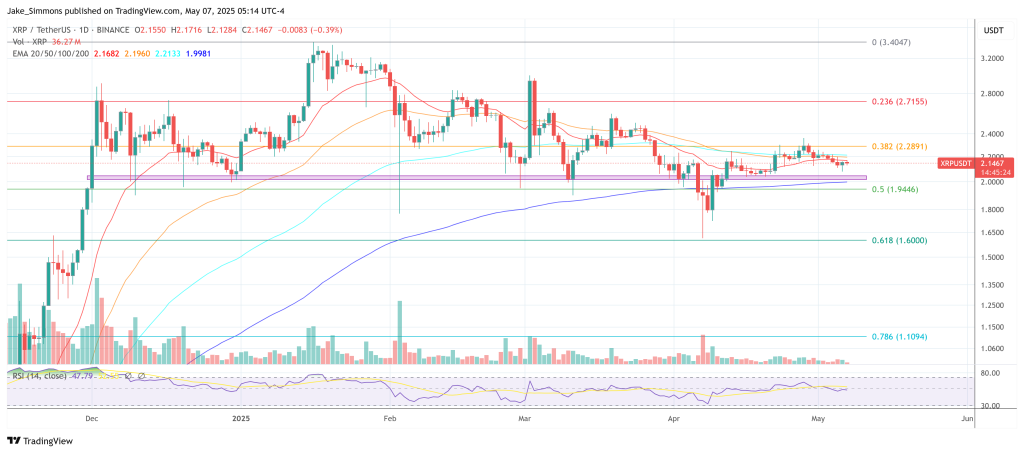
At press time, XRP traded at $2.14.
XRP price
XRP price, 1-day chart | Source: XRPUSDT on TradingView.com
Featured image created with DALL.E, chart from TradingView.com
Editorial Process for bitcoinist is centered on delivering thoroughly researched, accurate, and unbiased content. We uphold strict sourcing standards, and each page undergoes diligent review by our team of top technology experts and seasoned editors. This process ensures the integrity, relevance, and value of our content for our readers.

Jake Simmons has been a Bitcoin enthusiast since 2016. Ever since he heard about Bitcoin, he has been studying the topic every day and trying to share his knowledge with others. His goal is to contribute to Bitcoin's financial revolution, which will replace the fiat money system. Besides BTC and crypto, Jake studied Business Informatics at a university. After graduation in 2017, he has been working in the blockchain and crypto sector. You can follow Jake on Twitter at @realJakeSimmons.

Leituras Relacionadas

Are the Frantic Acquisitions of Crypto Companies by Giants Good or Bad?

In a bear market, giants are actively acquiring crypto companies. Recent months have seen at least five major deals: Samsung Securities bought a 2% stake in Upbit operator Dunamu; Robinhood acquired WonderFi for $180 million to enter the Canadian market; Figure purchased Kiavi for $717 million to expand into on-chain real estate credit; Franklin Templeton bought 250Digital to launch Franklin Crypto; and Blockworks acquired data platform Messari at a steep discount—over 90% less than its 2022 $300 million valuation. These moves highlight a strategic shift. Cash-rich giants are consolidating resources at low cost, targeting companies with established compliance frameworks to navigate tightening global regulations. Acquisitions like WonderFi and the Upbit stake provide immediate market access and licensed user bases. Figure's deal signals real-world asset (RWA) tokenization moving from concept to large-scale implementation, with Kiavi's $7+ billion annual transaction volume being integrated into on-chain capital markets. Franklin Crypto's launch targets institutional investors like pension funds, offering them tailored, compliant crypto strategies. For these strategic players, bear markets present an ideal entry point: valuations are depressed, speculative noise is minimized, and they can acquire robust technology and compliance infrastructure at a fraction of the cost. This acquisition wave marks a transitional phase for crypto—from a wild frontier toward an institutional, regulated financial system. Giants are positioning themselves to capture future growth when macroeconomic conditions and liquidity improve, leaving latecomers behind.

marsbitHá 11m

Are the Frantic Acquisitions of Crypto Companies by Giants Good or Bad?

marsbitHá 11m

In the MiCA Era, Europe's New Cryptography Landscape: Why is Germany Taking Center Stage?

With MiCA's transitional arrangements concluding, Europe's crypto industry has undergone a regulatory consolidation. Post-MiCA, platforms must secure CASP authorization to operate compliantly within the EU. As of July 1st, only about 12% of crypto firms have received authorization, with Germany emerging as a key player, holding 57 authorizations (roughly 23% of the EU total). This positions Germany as a primary compliance gateway to the EU's unified market. Germany's advantage stems from its established, function-based regulatory framework, which integrated crypto activities into existing banking, securities, and payment systems pre-MiCA. This allowed a smoother transition and attracted both domestic platforms (like Bitcoin.de, BISON) and international ones (like Coinbase Germany). A distinctive trend is German banks becoming direct retail entry points for crypto services. Examples include DZ Bank integrating "meinKrypto" into its VR Banking App and the Sparkassen savings bank network planning to offer crypto trading via DekaBank. This mainstreams crypto access for ordinary users. Beyond trading, Germany is evolving into a digital asset infrastructure hub. Deutsche Börse Group's Clearstream is developing a next-generation platform for issuing, settling, and servicing both traditional and tokenized securities. Furthermore, German banks like DekaBank and DZ Bank are key participants in the Qivalis project, a European initiative for a regulated euro stablecoin, positioning Germany at the intersection of critical future capabilities like custody, settlement, and cross-border services.

marsbitHá 1h

In the MiCA Era, Europe's New Cryptography Landscape: Why is Germany Taking Center Stage?

marsbitHá 1h

Trading

Spot
活动图片