Корреляция биткоина с золотом резко возросла после февральского «рассинхрона»

cryptonews.ruPublicado em 2024-03-29Última atualização em 2025-04-29

30-дневный коэффициент корреляции Пирсона между биткоином и золотом достиг 0,54, приблизившись к годовому максимуму в 0,73. Это может свидетельствовать об укреплении нарратива о защитном активе среди инвесторов, отметили исследователи The Block.

Усиление взаимозависимости произошло после примечательной «отвязки» первой криптовалюты от благородного металла в феврале. Тогда в течение трех недель 30-дневная корреляция обвалилась с 0,73 до -0,67.

В начале февраля биткоин торговался в районе $102 000, тогда как унция золота стоила $2800. К концу месяца первая криптовалюта подешевела до $84 000, а благородный металл подорожал до $2850.

«Это расхождение вызвало резкое снижение корреляции, когда биткоин упал более чем на 17%, в то время как золото выросло почти на 2%», — отметили аналитики.
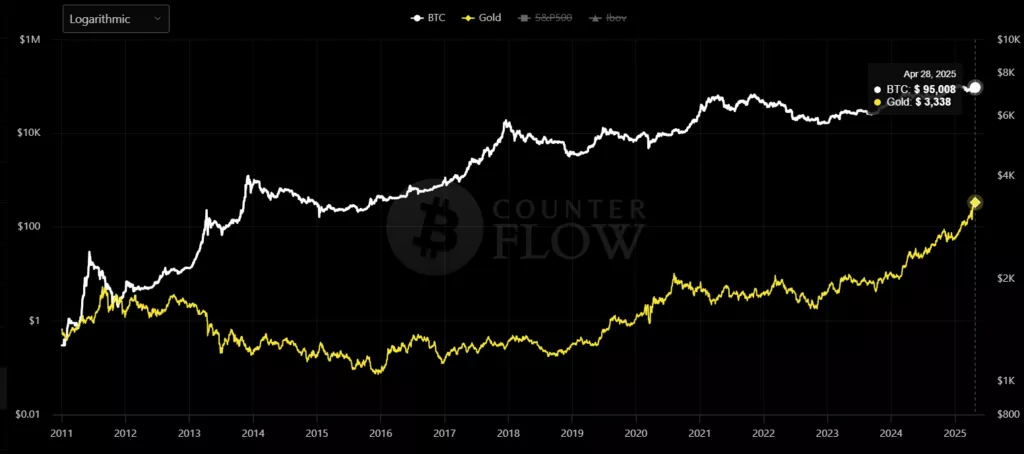
Графики цен биткоина и золота. Данные: Bitcoin CounterFlow.

С тех пор коэффициент корреляции между упомянутыми активами в значительной мере восстановился, поднявшись с -0,67 до 0,52. Вероятная причина «возобновления привязки»: «освободительные пошлины», способствующие росту макроэкономической неопределенности и снижению индекса доллара.

История повторяется?

Если изучить исторические паттерны, «воссоединение» биткоина с золотом можно рассматривать как цикличное явление. Эксперты The Block насчитали 18 случаев с 2020 года, когда коэффициент корреляции между биткоином и золотом опускался ниже -0,50 или приближался к этой отметке.

В 17 эпизодах показатель восстанавливался уже через семь дней. Единственное исключение — декабрь 2022 года, когда для возвращения к исходным значениям понадобилось чуть больше двух недель.

Исторически, каждый раз, когда коэффициент корреляции между биткоином и золотом опускается ниже -0,50, криптовалюта снова начинает «сильно привязываться» к металлу. Этот процесс часто сопровождается ростом корреляции до 0,8 и выше, после чего цикл «развязывания» возобновляется.

Напомним, исследователи NYDIG заявили об укреплении биткоина как защитного актива после «Дня освобождения» президента США Дональда Трампа.


Leituras Relacionadas

Stablecoins Are the 'Royalists' of the Crypto World: Open USD Brings the Old Monetary System into the Fray

Title: Stablecoins Are the "Royalists" of the Crypto World: Open USD Brings the Old Monetary System into the Fray The article analyzes the launch of Open USD, a new dollar-pegged stablecoin backed by a coalition of over 140 traditional financial, payment, and tech giants like Visa, BlackRock, and Google. Author Hu Yilin argues that stablecoins like Open USD represent not a "moderate" wing of the crypto revolution, but a "royalist reform" within the old monetary system. He posits that while stablecoins adopt blockchain's efficiency, programmability, and borderless nature, they fundamentally reinforce the US dollar's centrality and the Federal Reserve's authority. They aim to replace inefficient "bureaucrats" (like traditional payment networks) rather than challenge the "monarch" (the dollar-based system). Thus, Open USD symbolizes the old system co-opting blockchain technology to upgrade dollar hegemony, potentially marginalizing native crypto projects like Circle's USDC. Hu contrasts this with more revolutionary paths, like a "Bitcoin standard," which seeks to change the monetary base itself. He warns that if the crypto ecosystem's unit of account, collateral, and value anchor remain dollar-denominated stablecoins,链上繁荣 may enrich the traditional financial system ("off-chain") rather than granting monetary premium to native crypto assets like ETH. Projects with civilizational ambitions, he argues, cannot reduce their narrative to mere "fuel" or transaction fees but must grapple with the core revolutionary idea: that a decentralized market does not require a central bank as the anchor of monetary order.

marsbitHá 1h

Stablecoins Are the 'Royalists' of the Crypto World: Open USD Brings the Old Monetary System into the Fray

marsbitHá 1h

Standard Chartered Takes Over USDC Onboarding; Circle Cedes Control for Scale

Standard Chartered and Circle have announced a partnership where institutional clients can now mint and redeem USDC directly through Standard Chartered's existing banking infrastructure, eliminating the need for separate accounts with Circle. Initially launching in the Dubai International Financial Centre (DIFC), this service represents the first time a Global Systemically Important Bank (G-SIB) is offering such direct, integrated access. This move effectively "translates" USDC into a standard banking option, opening the door for major institutional capital like pension funds and sovereign wealth funds that require the trust, compliance, and risk frameworks of a major bank. For Circle, this is a strategic trade: ceding some direct client relationships to leverage Standard Chartered's vast distribution network, thereby potentially massively scaling USDC's circulation and its core interest revenue model. For Standard Chartered, it's a chance to offer a new digital asset service without building the underlying stablecoin infrastructure. The partnership signals a significant shift in the stablecoin narrative. Rather than bypassing traditional finance, stablecoins are becoming integrated into it, with major banks like Standard Chartered positioning themselves at the crucial entry point. The focus is moving from legitimizing stablecoins to determining how value and pricing power will be distributed among issuers, banking channels, and regulatory frameworks in this new, converging landscape.

marsbitHá 4h

Standard Chartered Takes Over USDC Onboarding; Circle Cedes Control for Scale

marsbitHá 4h

Trading

Spot
活动图片