Berachain — блокчейн с новым подходом к безопасности и экономике

cryptonews.ruPublicado em 2024-01-04Última atualização em 2025-04-04

Berachain — это Layer 1 блокчейн, работающий на собственном консенсусе proof-of-liquidity. Он основан на Cosmos SDK, но поддерживает полную совместимость с Ethereum Virtual Machine (EVM). Мейннет запустился 6 февраля 2025 года, и с тех пор экосистема проекта стремительно растет.

Как работает proof-of-liquidity

В отличие от привычных proof-of-stake и proof-of-work, модель Berachain требует не просто стейкинга нативного токена, а блокировки ликвидности. Это создает более сложную, но устойчивую систему безопасности.

Чтобы стать валидатором, нужно внести минимум 250 000 токенов BERA, при этом лимит составляет 10 миллионов BERA на одного участника. В активный набор входят только 69 валидаторов с наибольшим стейком.

Механика вдохновлена PoS, но в Berachain цепочка разделяет функции:

  • BERA используется для оплаты комиссий, безопасности сети и взаимодействия с dApps.
  • BGT — это токен управления и распределения вознаграждений. Его можно получать только через стейкинг в специальных смарт-контрактах (reward vaults).
  • HONEY — стабильная монета экосистемы.

Три токена, три роли

1. BERA — утилитарный токен.

Служит для комиссий, безопасности сети и основной деятельности в экосистеме.

2. BGT — governance-токен.

Позволяет голосовать за обновления протокола и бустить валидаторов, увеличивая их вознаграждение при соблюдении условий.

3. HONEY — стейблкоин.

Выпускается через dApp HoneySwap под залог ликвидных активов. Используется для расчетов в DeFi-сегменте Berachain.

Совместимость с Ethereum и Cosmos SDK

Berachain построен на Cosmos SDK, но сохраняет EVM-совместимость. Это значит, что разработчики могут использовать привычный стек (Solidity, Remix, MetaMask), а обновления EVM мгновенно применимы и в Berachain.

Такой подход позволяет комбинировать масштабируемость и модульность Cosmos с гибкостью и экосистемой Ethereum.

Что уже построено на Berachain

Несмотря на молодость, экосистема быстро наполняется:

  • BeraHub — хаб для управления BGT, просмотра валидаторов и взаимодействия с сетью.
  • BEX — нативная децентрализованная биржа.
  • HoneySwap — платформа для выпуска и обмена HONEY.
  • Berascan — собственный обозреватель блоков.
  • Infrared Finance — протокол ликвидного стейкинга.
  • Honey Chat — платформа SocialFi на базе Berachain.

Кто стоит за проектом

Основатели Berachain под псевдонимами: Homme Bera, Dev Bear, Papa Bear и Smokey the Bera. Но в команде уже есть люди с опытом в Sui, Polygon, Coinbase, Chainlink, Aave. Например, бывший руководитель DeFi-направления Polygon Джек Мелник присоединился к Berachain в 2024 году.

Развитием сети занимается Berachain Foundation, включая контроль за аллокацией токенов и ростом экосистемы.

Финансирование и перспективы

В апреле 2023 года Berachain привлек $42 млн, а в 2024 — еще $100 млн в рамках раунда серии B.

Модель proof-of-liquidity, модульная архитектура Cosmos и полная EVM-совместимость делают Berachain одним из самых перспективных Layer 1 блокчейнов нового поколения.

Что дальше?

Berachain делает ставку на гибридную архитектуру и сильную токеномику. Если экосистема продолжит развиваться такими темпами, проект может занять серьезную нишу в секторе DeFi, особенно на фоне переосмысления роли ликвидности и стейкинга в Web3.

Читать далее: Wormhole взлетел на 12%, но индикаторы указывают на слабость

Criptomoedas em alta

Leituras Relacionadas

Xing Bo Strikes Again: Last Time 'Critiquing' World Models, This Time It's Agents' Turn

Xing Bo, President of MBZUAI and professor at Carnegie Mellon University, along with co-authors Mingkai Deng and Jinyu Hou, has released a new paper, "Critique of Agent Model," critiquing the current state of artificial intelligence agents. The paper draws a crucial distinction between "agentic" systems, which rely on external toolchains, prompts, and workflows, and truly "agentive" systems capable of genuine autonomy driven by internal decision-making structures. To illustrate this, it references a real-world incident where an AI programming assistant, following an external prompt but lacking internalized judgment, caused a catastrophic data deletion. The authors propose a detailed analysis and a new framework, "Goal-Identity-Configurator" (GIC), for building truly autonomous agents. This framework systematically addresses five key dimensions where current "Agent" designs fall short: 1. **Goal:** Moving from step-by-step human instruction to a system capable of autonomously decomposing a single long-term goal and adapting sub-goals based on new information. 2. **Identity:** Evolving self-assessment updated by experience, rather than a static description in a system prompt. 3. **Decision Making:** Replacing textual Chain-of-Thought reasoning with "simulative reasoning" that uses a dedicated world model to predict real-world consequences before selecting actions. 4. **Cognitive Control:** Introducing a separate "System III" metacognitive module that dynamically decides when to deliberate, stick to a plan, or act quickly. 5. **Learning:** Enabling "continual autonomous learning," where the agent itself decides when to act, practice in simulation, or update its world model and self-perception. The GIC architecture integrates six components—a belief encoder, goal decomposer, identity evolver, configurator (System III), simulation-based planner (System II), and executor (System I)—to embody these principles. The paper argues that a growth path akin to pilot training (ground theory, simulator practice, real deployment) should be underpinned by a unified cognitive architecture, not separate workflows. On safety, the authors contend that the GIC framework's modular, explicit design enhances inspectability, allowing problematic behavior to be traced to specific components (e.g., flawed goal or poorly trained module) rather than emerging opaquely. However, they acknowledge that ultimate safety depends on correctly training these modules in the first place. In conclusion, the paper challenges the loose application of the term "Agent," asserting that task completion alone does not equal true autonomy. True autonomy requires goals, identity, and judgment to be genuinely internalized within the agent's architecture, not merely enforced by external scripts.

marsbitHá 2m

Xing Bo Strikes Again: Last Time 'Critiquing' World Models, This Time It's Agents' Turn

marsbitHá 2m

How Collector Crypt Uses 'Recirculating Buybacks' to Create an Illusion of Growth

Title: How Collector Crypt Creates a Growth Illusion with "Buyback Loops" Key Findings: Collector Crypt's (CC) net take rate has halved from 11.2% in Q3 2025 to 5.6% in Q2 2026, while GMV grew 4.7x. This growth is driven by higher-tier card packs ($250, $1,000, $2,500) which have lower platform dollar retention rates. The newly launched $2,500 Mythic tier captured 36.7% of June GMV within 13 days. Growth is fueled by a small cohort of high-spending, high-frequency wallets rather than broad user base expansion. The economic model faces pressure from three key areas: 1) **Shifting GMV Mix**: Pushing users towards larger, lower-retention card packs increases GMV but reduces overall profitability. 2) **Physical Redemptions**: Card redemptions for physical items remove reusable inventory from the system, creating costly replenishment needs. In May, redemptions consumed 41.6% of pre-redemption net income. Only 75 wallets drove redemptions in June. 3) **B2B/API Strategy**: Partner revenue remains negligible (cumulatively $1.83M) and dependent on CC for inventory, vaulting, and buyback services, failing to create a scalable, asset-light recurring revenue stream. The core product is a repetitive pack-buyback loop with limited secondary market activity and token value accrual. Sensitive modeling shows CC's economics turn negative when any two of the following pressures coincide: replenishment costs near market price, redemption rates exceeding 9%, or high-tier buyback rates around 93%. While CC operates in a large and growing collectibles market, its current growth levers—bigger packs, high buyback rates, and capital recycling by a few wallets—create a volume illusion without demonstrating sustainable collector engagement, deep secondary markets, or a viable path to improved margins. Future proof points include broadening collector participation, deepening secondary trading, and developing true asset-light B2B revenue channels.

Foresight NewsHá 24m

How Collector Crypt Uses 'Recirculating Buybacks' to Create an Illusion of Growth

Foresight NewsHá 24m

Grayscale's Latest Research: What is Solana's Next Growth Engine?

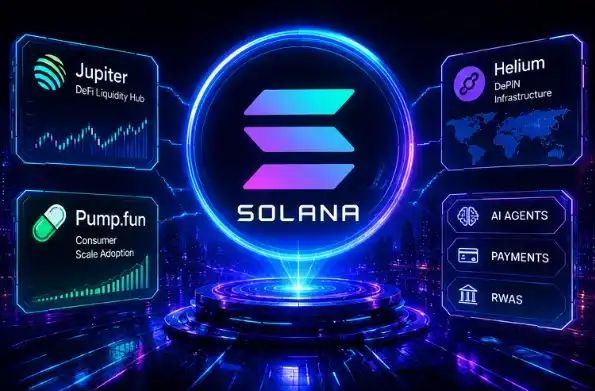
Grayscale's latest report, "Solana: Crypto's Financial Bazaar," signals a shift in how the market views Solana, moving beyond its high-performance and meme-centric reputation. The report frames Solana as an evolving application platform for large-scale economic activity, akin to a bustling digital marketplace. The analysis highlights that public chain competition has moved past raw throughput (TPS) to focus on genuine economic activity—daily users, transaction volume, and real revenue. Solana's metrics, such as over 1,000 dApps, 100M+ daily transactions, and ~4.3M daily active users, showcase this shift toward application-layer prosperity. The report identifies three key growth drivers: 1. **Jupiter**: Evolving from a DEX aggregator to a core liquidity hub and comprehensive financial platform for Solana's DeFi. 2. **Pump.fun**: Demonstrates Solana's capacity for consumer-scale applications, attracting millions of users and generating significant, sustainable revenue, validating network stability under high load. 3. **Helium & DePIN**: Represents expansion into real-world infrastructure, connecting blockchain to physical resources like wireless networks and positioning services, opening new long-term use cases. Solana Foundation's recent focus aligns with this broader vision, emphasizing AI Agents (for machine-to-machine transactions), payments, stablecoins, and Real-World Assets (RWA) to build a sustainable growth model beyond cyclical trends. While challenges remain—such as value capture for SOL and maintaining ecosystem sustainability beyond hot trends—institutional interest is growing due to Solana's maturing application business models, expanding payment/stablecoin ecosystem, and persistent developer activity. The competition is no longer about speed alone, but about which network can foster the most vibrant and valuable digital economy.

marsbitHá 46m

Grayscale's Latest Research: What is Solana's Next Growth Engine?

marsbitHá 46m

Trading

Spot

Artigos em Destaque

Como comprar LAYER

Bem-vindo à HTX.com!Tornámos a compra de Solayer (LAYER) simples e conveniente.Segue o nosso guia passo a passo para iniciar a tua jornada no mundo das criptos.Passo 1: cria a tua conta HTXUtiliza o teu e-mail ou número de telefone para te inscreveres numa conta gratuita na HTX.Desfruta de um processo de inscrição sem complicações e desbloqueia todas as funcionalidades.Obter a minha contaPasso 2: vai para Comprar Cripto e escolhe o teu método de pagamentoCartão de crédito/débito: usa o teu visa ou mastercard para comprar Solayer (LAYER) instantaneamente.Saldo: usa os fundos da tua conta HTX para transacionar sem problemas.Terceiros: adicionamos métodos de pagamento populares, como Google Pay e Apple Pay, para aumentar a conveniência.P2P: transaciona diretamente com outros utilizadores na HTX.Mercado de balcão (OTC): oferecemos serviços personalizados e taxas de câmbio competitivas para os traders.Passo 3: armazena teu Solayer (LAYER)Depois de comprar o teu Solayer (LAYER), armazena-o na tua conta HTX.Alternativamente, podes enviá-lo para outro lugar através de transferência blockchain ou usá-lo para transacionar outras criptomoedas.Passo 4: transaciona Solayer (LAYER)Transaciona facilmente Solayer (LAYER) no mercado à vista da HTX.Acede simplesmente à tua conta, seleciona o teu par de trading, executa as tuas transações e monitoriza em tempo real.Oferecemos uma experiência de fácil utilização tanto para principiantes como para traders experientes.

321 Visualizações TotaisPublicado em {updateTime}Atualizado em 2026.06.02

Como comprar LAYER

Discussões

Bem-vindo à Comunidade HTX. Aqui, pode manter-se informado sobre os mais recentes desenvolvimentos da plataforma e obter acesso a análises profissionais de mercado. As opiniões dos utilizadores sobre o preço de LAYER (LAYER) são apresentadas abaixo.

活动图片