Market Pulse: Week 14

insights.glassnodePublicado em 2025-04-03Última atualização em 2025-04-04

Beta release. Please submit feedback here. Free for a limited period.

Overview

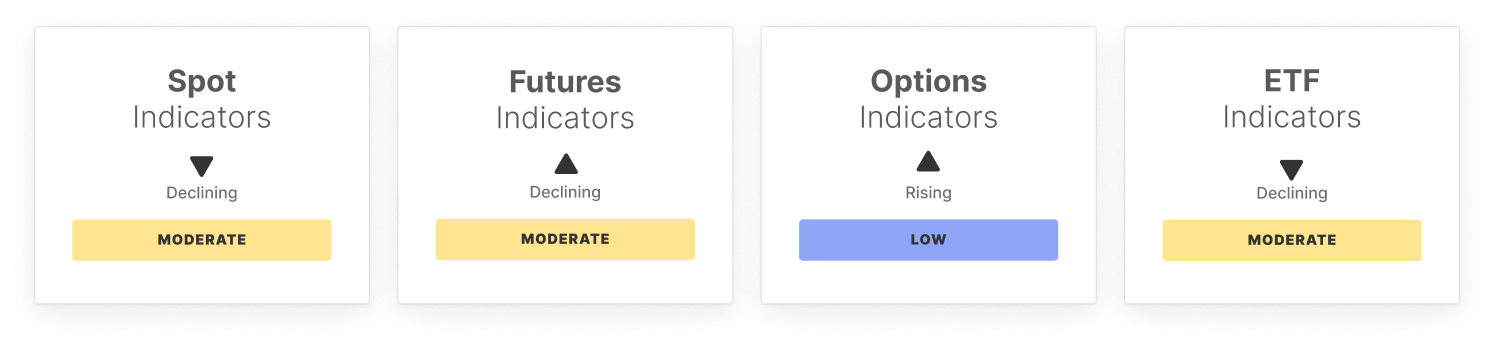
The Bitcoin market remains in a defensive posture as signs of weakness persist across spot, derivatives, and on-chain metrics. Price momentum cooled notably after last week's failed rally attempt, while Spot CVD continued to deteriorate, reflecting persistent net sell pressure. Spot volumes rebounded slightly from multi-month lows, yet remain far below bull market levels, indicating muted speculative participation. In the derivatives market, open interest continues to unwind, funding rates remain below neutral, and perpetual CVD signals dominance by short sellers — a combination suggesting cautious positioning and limited risk appetite.

Options market activity contracted sharply due to the March expiry, with open interest falling well below statistical norms. However, both volatility spread and 25 Delta Skew point to elevated hedging behavior, as traders brace for uncertainty and potential downside. Meanwhile, ETF flows turned negative again after a short-lived rebound, and trade volumes remain suppressed, reinforcing the narrative of institutional risk-off sentiment.

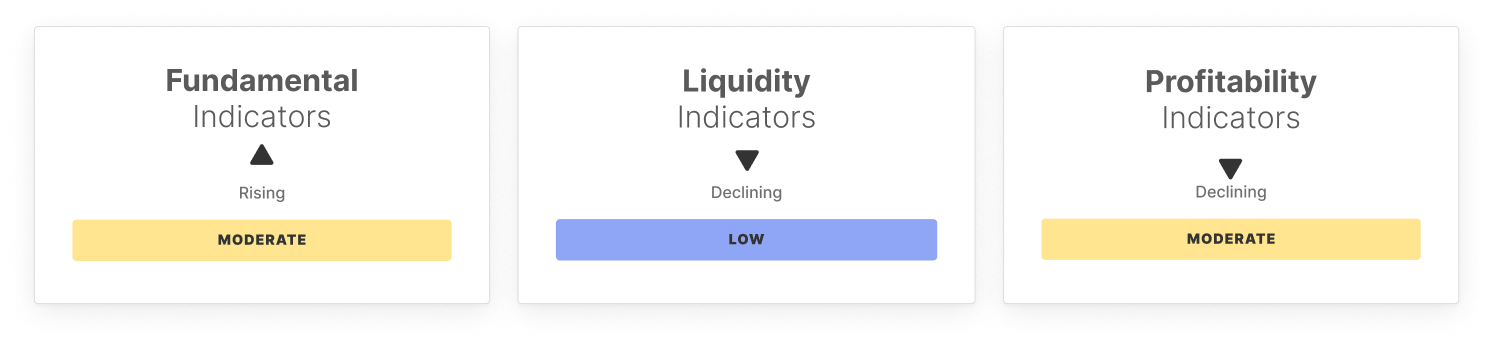
On-chain activity remains weak, with only modest upticks in active addresses and transfer volume during recent volatility. Fee revenue has retraced its short-term gains, confirming a lack of meaningful new demand. Liquidity metrics echo these conditions, with realized cap growth still sluggish and hot capital share continuing to decline. Short-term holder supply ratio remains low, emphasizing a broader shift toward holding over trading.

Profitability metrics also weakened, with Percent Supply in Profit and NUPL both trending lower. Realized Profit/Loss ratio plunged to its statistical low, underscoring a shift toward loss realization as conviction wanes. Overall, the market structure remains fragile. Amid looming macro risks such as a potential tariff war, low liquidity and rising hedging demand suggest that downside pressure remains a credible threat unless significant inflows return to the market.

Off-Chain Indicators
On-Chain Indicators
Don't miss it!

Smart market intelligence, straight to your inbox.

Subscribe now

Disclaimer: This report does not provide any investment advice. All data is provided for information and educational purposes only. No investment decision shall be based on the information provided here and you are solely responsible for your own investment decisions.

Exchange balances presented are derived from Glassnode’s comprehensive database of address labels, which are amassed through both officially published exchange information and proprietary clustering algorithms. While we strive to ensure the utmost accuracy in representing exchange balances, it is important to note that these figures might not always encapsulate the entirety of an exchange’s reserves, particularly when exchanges refrain from disclosing their official addresses. We urge users to exercise caution and discretion when utilizing these metrics. Glassnode shall not be held responsible for any discrepancies or potential inaccuracies. 

Please read our Transparency Notice when using exchange data.

Leituras Relacionadas

Retail Investors' 'Lead Brother' Serenity vs. Newly Minted Stock God Leopold: How Are the Two Top Hunters Mining AI's 'Physical Limits'?

The article profiles two prominent figures, Serenity and Leopold Aschenbrenner, who are gaining attention for their unconventional investment strategies focused on the physical constraints of the AI boom, moving beyond mainstream software narratives. Serenity, an anonymous online trader, advocates a "shiso leaf" theory. He targets small-cap companies with monopolies on critical, overlooked components in the AI hardware supply chain, such as specific semiconductor materials. His deep, technical analysis of bottlenecks in areas like co-packaged optics (CPO) has reportedly yielded massive returns, though his anonymity and focus on illiquid micro-cap stocks pose significant risks for followers. Leopold Aschenbrenner, a former OpenAI researcher, founded a multi-billion dollar hedge fund. His macro thesis argues that physical infrastructure—power grids, land, data centers—is the true bottleneck for AI growth, lagging far behind chip production. Consequently, his fund employs an infrastructure arbitrage strategy: heavily investing in storage and compute infrastructure companies while placing massive bearish bets (put options) against major semiconductor stocks, betting their valuations will correct as physical constraints become apparent. While their methods differ—Serenity drills into microscopic supply chain details, while Leopold takes a macroscopic, infrastructure-focused view—both share a core belief: the real power and investment alpha in the AI era lie in controlling scarce physical resources, not just software. The article concludes by noting the inherent risks in both approaches, such as liquidity issues for micro-caps and timing risks for macro bets, but suggests they signal a broader market re-evaluation of AI's foundational assets.

marsbitHá 5h

Retail Investors' 'Lead Brother' Serenity vs. Newly Minted Stock God Leopold: How Are the Two Top Hunters Mining AI's 'Physical Limits'?

marsbitHá 5h

Who Will Make Money in the Age of Agents?

In the Agents era of blockchain, traditional value capture theories face challenges. The "Fat Protocol" theory, dominant since 2016, suggested protocols capture most value as their tokens are essential for network use. However, the proliferation of interchangeable L1s, L2s, and modular layers has eroded protocol scarcity and pricing power. Conversely, the "Fat App" theory posits that applications capturing user relationships (like wallets and exchanges) become the primary value layer by controlling distribution and transaction flows. This aligns with the current "Great Repricing" cycle. Agents disrupt this logic. As software users, they lack brand loyalty, prioritize cost and efficiency, and switch between platforms seamlessly. This undermines the front-end UX moats that "Fat Apps" rely on. The article explores several potential futures: 1. **Headless Applications:** Current leading apps could strip their front-ends and become backend API infrastructure for Agents, preserving their role. 2. **Protocol Resurgence:** If integration becomes trivial, Agents might bypass aggregators and interact directly with protocols, reviving "Fat Protocol" dynamics. 3. **Pricing Power Collapse:** Agents' rational, frictionless routing could commoditize the entire stack, compressing margins toward cost and leaving little profit for intermediaries. 4. **Unprecedented Activity:** Agents may enable new, high-frequency, machine-to-machine economic activities, expanding the total value pie even if margins are thin. 5. **A New, Unnamed Model:** Historically, major tech shifts (like the internet's attention economy) create unforeseen business models. The Agents era may spawn entirely new ways to capture value. The most likely outcome is a coexistence where "Fat Apps" continue to serve human users valuing UX, while a separate, Agent-driven economy emerges governed by different rules—where loyalty is based on factors like liquidity, latency, and settlement guarantees rather than brand.

marsbitHá 6h

Who Will Make Money in the Age of Agents?

marsbitHá 6h

Trading

Spot
Futuros
活动图片