TRON vs. Cardano: Will TRX overtake ADA's $23B market cap?

AmbcryptoPublicado em 2025-04-01Última atualização em 2025-04-01

Resumo

If TRX’s five-month consolidation leads to a breakout, it could soon overtake Cardano.

TRX has shown notable growth, with its market cap surpassing $20 billion in December 2024, setting a new all-time high.

If the market trends downward, ADA is at a higher risk of losing this support compared to TRX.

TRON [TRX] continues to gain traction, nearing Cardano [ADA] in market capitalization, with a current valuation of approximately $22 billion.

A 4% weekly gain and a 33% surge in trading volume signal growing investor interest and heightened network activity. If this trend holds, can TRX close the gap and secure its spot among the top blockchain networks?

Support levels at risk: TRX holds stronger than ADA

Bitcoin had its worst Q1 in seven years, ending 11% down from its New Year opening price. The altcoin market wasn’t spared, with both TRX and ADA trading far below their highs and losing key support levels.

AMBCrypto’s analysis shows a striking trend: TRX shed $14 billion in market value since Q4 last year, while ADA lost over $20 billion in the same time.

In short, ADA’s struggles have brought it closer to TRX. In fact, if Tron’s five-month consolidation leads to a breakout when the market recovers, overtaking Cardano could become a real possibility.

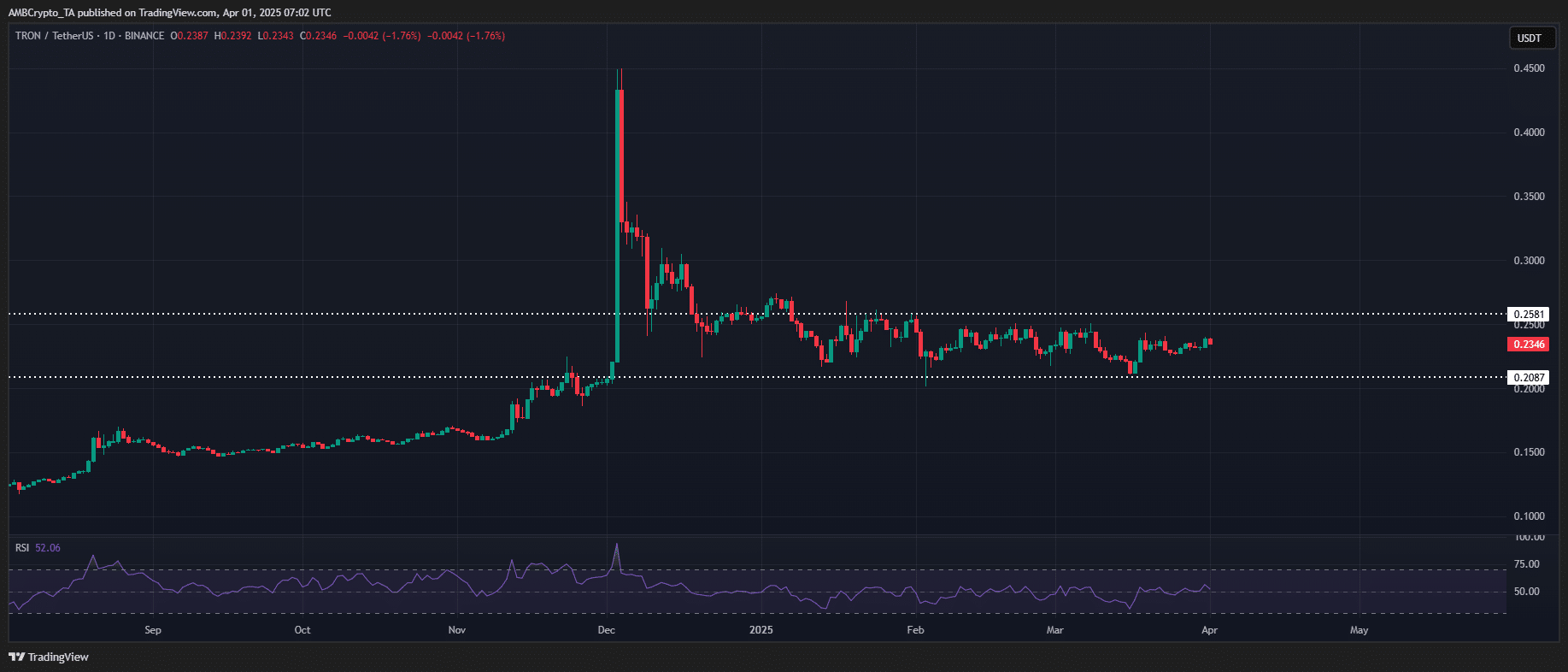
Since its December peak of $0.44, TRX has been stuck around $0.20, which it has tested four times.

ADA, on the other hand, is holding strong at $0.60, but it’s only tested this level twice. If the market dips further, ADA is more likely to lose its support than TRX.
The derivatives market highlights notable differences between Cardano and Tron. According to Coinglass data , Cardano leads in high-risk futures trading with an Open Interest (OI) of $766 million, a decline from $1.12 billion earlier this year.

In contrast, TRX has significantly lower speculative activity, with an OI of $195 million, making it less susceptible to major liquidations. Over the past 24 hours, more than $2 million in ADA longs were liquidated, compared to only $57.7k in TRX.

In bullish markets, Cardano’s strong presence in derivatives could drive its price higher than Tron’s. However, in bearish conditions, ADA is more vulnerable to steep liquidations, while TRX is likely to remain more stable.

This supports AMBCrypto’s earlier observation that Cardano is more likely than Tron to lose key support levels.

Beyond speculation: What the data tells us?

The on-chain metrics over the past year show some key differences. Cardano’s struggle to reclaim the $1 mark is backed by a significant -42.6% year-on-year drop in daily active addresses, now at just 23,477.

Meanwhile, TRX has seen a 53.1% surge in active addresses, reaching 2.6 million. This growth extends across other key metrics.

For instance, TRX has crossed the 1 million mark in fee generation, a stark difference from ADA’s 8.9k. Despite a dip in DEX volume, TRX still dominates with 76.1 million, leaving Cardano’s 1.9 million far behind.
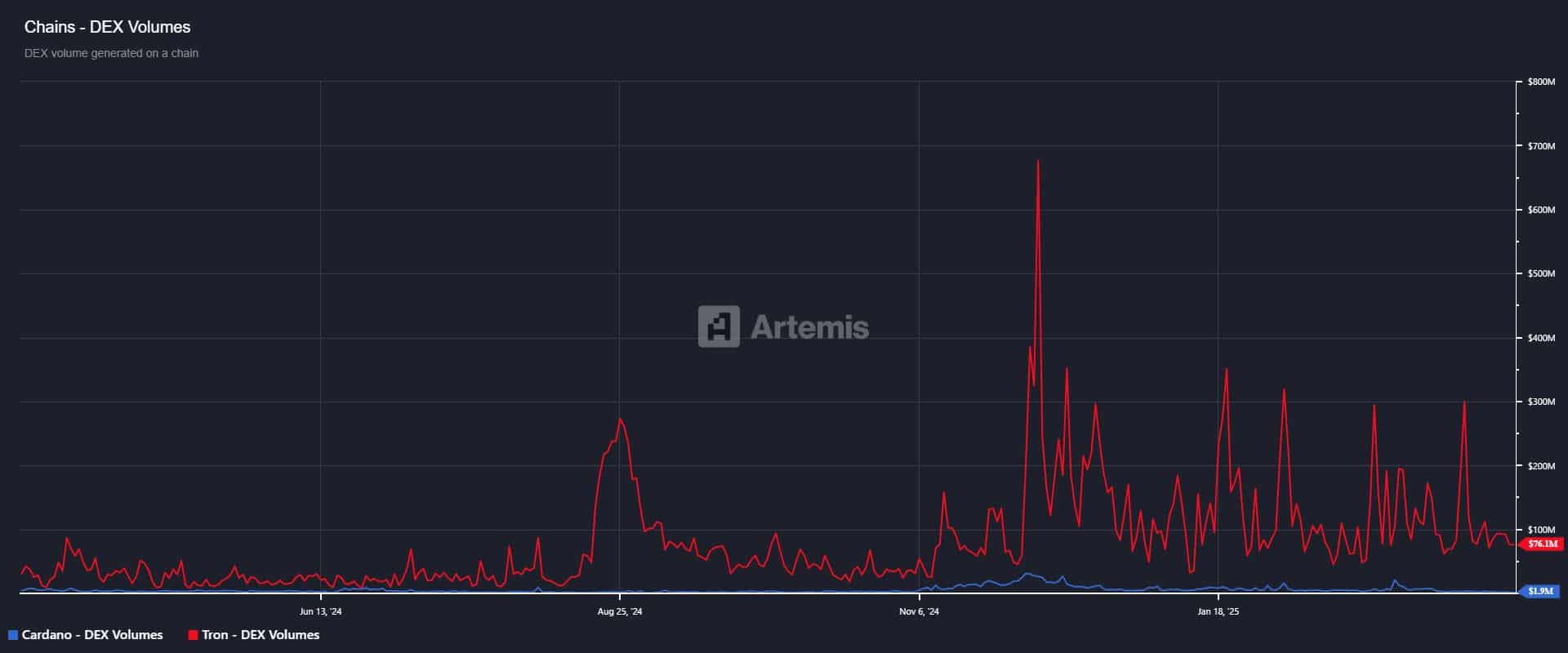
Overall, these metrics suggest TRON is far outperforming Cardano in terms of network activity and adoption. With this momentum, TRON has a solid chance of surpassing Cardano’s $23 billion market cap.


Leituras Relacionadas

Retail Investors' 'Lead Brother' Serenity vs. Newly Minted Stock God Leopold: How Are the Two Top Hunters Mining AI's 'Physical Limits'?

The article profiles two prominent figures, Serenity and Leopold Aschenbrenner, who are gaining attention for their unconventional investment strategies focused on the physical constraints of the AI boom, moving beyond mainstream software narratives. Serenity, an anonymous online trader, advocates a "shiso leaf" theory. He targets small-cap companies with monopolies on critical, overlooked components in the AI hardware supply chain, such as specific semiconductor materials. His deep, technical analysis of bottlenecks in areas like co-packaged optics (CPO) has reportedly yielded massive returns, though his anonymity and focus on illiquid micro-cap stocks pose significant risks for followers. Leopold Aschenbrenner, a former OpenAI researcher, founded a multi-billion dollar hedge fund. His macro thesis argues that physical infrastructure—power grids, land, data centers—is the true bottleneck for AI growth, lagging far behind chip production. Consequently, his fund employs an infrastructure arbitrage strategy: heavily investing in storage and compute infrastructure companies while placing massive bearish bets (put options) against major semiconductor stocks, betting their valuations will correct as physical constraints become apparent. While their methods differ—Serenity drills into microscopic supply chain details, while Leopold takes a macroscopic, infrastructure-focused view—both share a core belief: the real power and investment alpha in the AI era lie in controlling scarce physical resources, not just software. The article concludes by noting the inherent risks in both approaches, such as liquidity issues for micro-caps and timing risks for macro bets, but suggests they signal a broader market re-evaluation of AI's foundational assets.

marsbitHá 18m

Retail Investors' 'Lead Brother' Serenity vs. Newly Minted Stock God Leopold: How Are the Two Top Hunters Mining AI's 'Physical Limits'?

marsbitHá 18m

Who Will Make Money in the Age of Agents?

In the Agents era of blockchain, traditional value capture theories face challenges. The "Fat Protocol" theory, dominant since 2016, suggested protocols capture most value as their tokens are essential for network use. However, the proliferation of interchangeable L1s, L2s, and modular layers has eroded protocol scarcity and pricing power. Conversely, the "Fat App" theory posits that applications capturing user relationships (like wallets and exchanges) become the primary value layer by controlling distribution and transaction flows. This aligns with the current "Great Repricing" cycle. Agents disrupt this logic. As software users, they lack brand loyalty, prioritize cost and efficiency, and switch between platforms seamlessly. This undermines the front-end UX moats that "Fat Apps" rely on. The article explores several potential futures: 1. **Headless Applications:** Current leading apps could strip their front-ends and become backend API infrastructure for Agents, preserving their role. 2. **Protocol Resurgence:** If integration becomes trivial, Agents might bypass aggregators and interact directly with protocols, reviving "Fat Protocol" dynamics. 3. **Pricing Power Collapse:** Agents' rational, frictionless routing could commoditize the entire stack, compressing margins toward cost and leaving little profit for intermediaries. 4. **Unprecedented Activity:** Agents may enable new, high-frequency, machine-to-machine economic activities, expanding the total value pie even if margins are thin. 5. **A New, Unnamed Model:** Historically, major tech shifts (like the internet's attention economy) create unforeseen business models. The Agents era may spawn entirely new ways to capture value. The most likely outcome is a coexistence where "Fat Apps" continue to serve human users valuing UX, while a separate, Agent-driven economy emerges governed by different rules—where loyalty is based on factors like liquidity, latency, and settlement guarantees rather than brand.

marsbitHá 1h

Who Will Make Money in the Age of Agents?

marsbitHá 1h

Trading

Spot
Futuros

Artigos em Destaque

Como comprar TRX

Bem-vindo à HTX.com!Tornámos a compra de TRON (TRX) simples e conveniente.Segue o nosso guia passo a passo para iniciar a tua jornada no mundo das criptos.Passo 1: cria a tua conta HTXUtiliza o teu e-mail ou número de telefone para te inscreveres numa conta gratuita na HTX.Desfruta de um processo de inscrição sem complicações e desbloqueia todas as funcionalidades.Obter a minha contaPasso 2: vai para Comprar Cripto e escolhe o teu método de pagamentoCartão de crédito/débito: usa o teu visa ou mastercard para comprar TRON (TRX) instantaneamente.Saldo: usa os fundos da tua conta HTX para transacionar sem problemas.Terceiros: adicionamos métodos de pagamento populares, como Google Pay e Apple Pay, para aumentar a conveniência.P2P: transaciona diretamente com outros utilizadores na HTX.Mercado de balcão (OTC): oferecemos serviços personalizados e taxas de câmbio competitivas para os traders.Passo 3: armazena teu TRON (TRX)Depois de comprar o teu TRON (TRX), armazena-o na tua conta HTX.Alternativamente, podes enviá-lo para outro lugar através de transferência blockchain ou usá-lo para transacionar outras criptomoedas.Passo 4: transaciona TRON (TRX)Transaciona facilmente TRON (TRX) no mercado à vista da HTX.Acede simplesmente à tua conta, seleciona o teu par de trading, executa as tuas transações e monitoriza em tempo real.Oferecemos uma experiência de fácil utilização tanto para principiantes como para traders experientes.

1.7k Visualizações TotaisPublicado em {updateTime}Atualizado em 2025.03.21

Como comprar TRX

Discussões

Bem-vindo à Comunidade HTX. Aqui, pode manter-se informado sobre os mais recentes desenvolvimentos da plataforma e obter acesso a análises profissionais de mercado. As opiniões dos utilizadores sobre o preço de TRX (TRX) são apresentadas abaixo.

活动图片