План Aave по выкупу токенов на 1 миллион долларов может быть реализован в этом месяце

cryptonews.ruPublicado em 2025-01-19Última atualização em 2025-03-19

Основатель Aave Chan Initiative (ACI) Марк Зеллер заявил, что предложение по обновлению токеномики протокола Aave прошло кворум. В своём посте на X он отметил, что внедрение Aavenomics может начаться в этом месяце.

Aavenomics — это предложение по управлению, направленное на изменение токеномики Aave таким образом, чтобы протокол внедрил переключение комиссий. Это позволит протоколу делиться частью своего дохода с участниками экосистемы. Согласно этому предложению, те, кто поставил токены AAVE, получат вознаграждение в AAVE в рамках программы обратного выкупа.
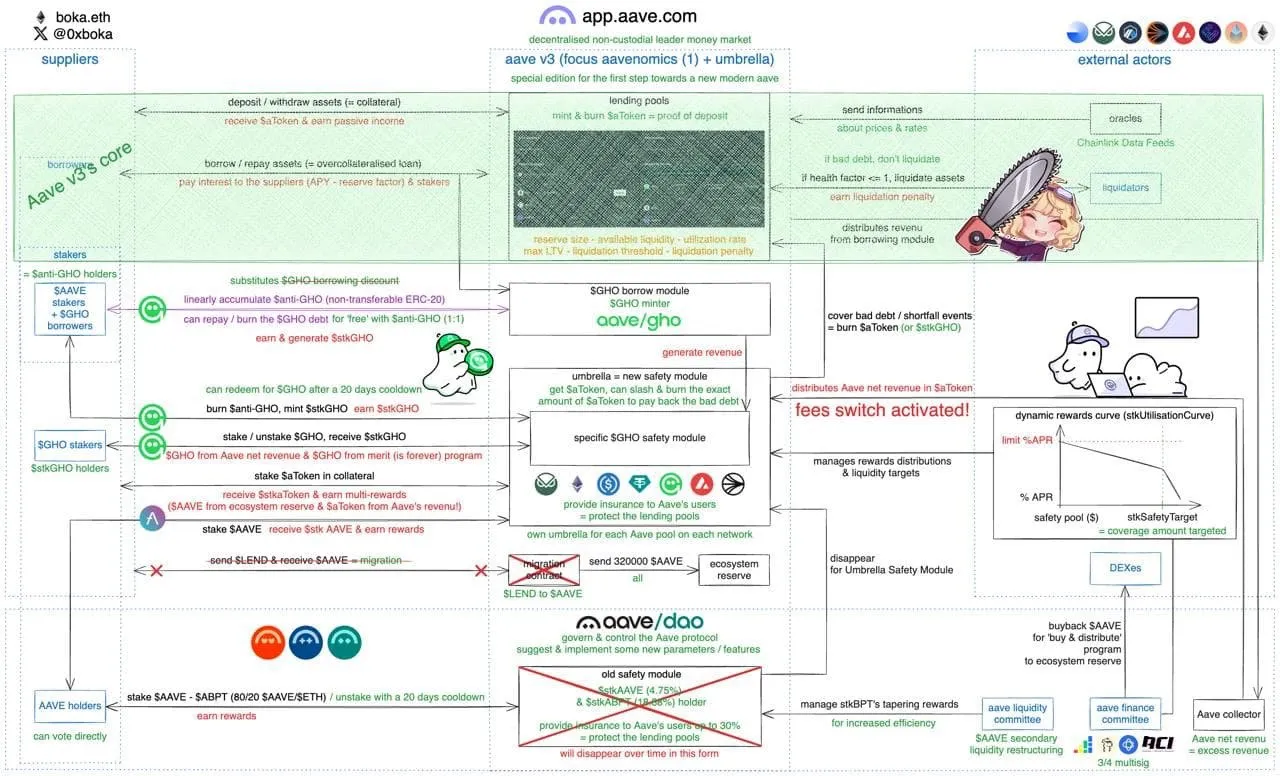
Aavenomics, предложенная ACI (Источник: Aave DAO)

С помощью функции «Купить и распределить» финансовый комитет будет еженедельно выкупать токены AAVE на сумму 1 миллион долларов в течение шести месяцев, используя избыточный доход протокола, и распределять их между пользователями Aave, которые поставили или заблокировали свои токены.

Сообщество поддержало Aavenomics с момента его первоначального предложения. Соучредитель Aave Стэни Кулехов назвал его «платой за переключение на стероидах». Зеллер также назвал его самым важным предложением в истории ACI, отметив, что на его реализацию ушло полдесятилетия.

Поддержка сообщества по-прежнему очевидна: около 100% голосов было отдано за это предложение. Согласно скриншоту, которым поделился Зеллер, за предложение было отдано более 813 000 голосов, а против — менее трёх. Теперь, когда оно принято, следующим шагом станет предложение по улучшению Aave (AIP), за которое DAO также должен будет проголосовать, чтобы функция заработала в полную силу.
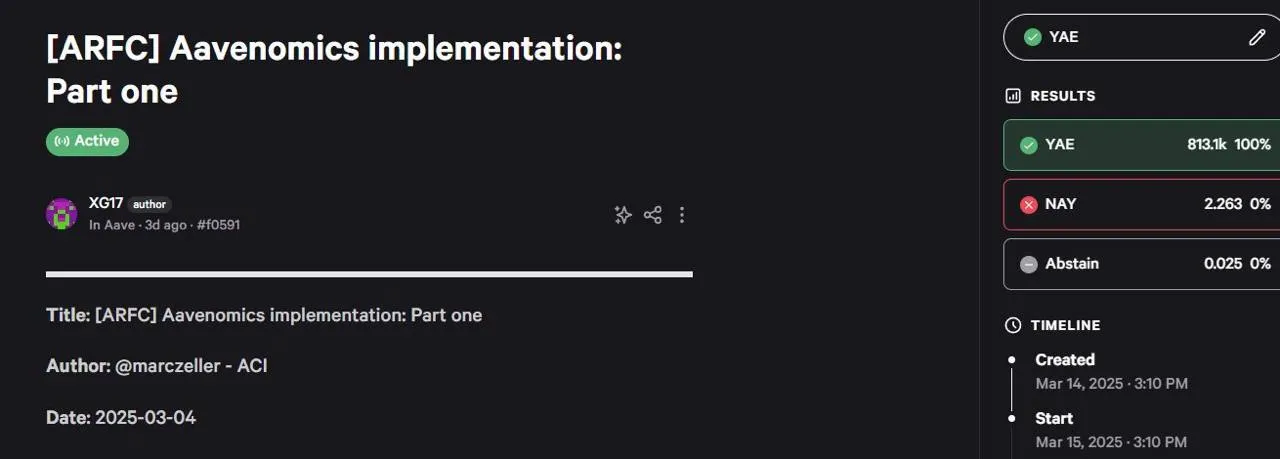
Реализация Aavenomics получила подавляющую поддержку со стороны Aave DAO (Источник: Марк Зеллер)

Сказал Зеллер:

«Если внедрение, проверка и голосование AIP будут проведены вовремя, обратный выкуп SAAVE, скорее всего, начнётся в этом месяце».

В то же время подавляющее большинство голосов за моментальный снимок подтверждает ожидания, что предложение может стать активным в ближайшее время. Многие ожидают, что это окажет значительное влияние на стоимость AAVE, отмечая, что еженедельный выкуп токенов на 1 миллион долларов создаёт постоянное давление спроса на токен, что может повысить его цену.

Токен AAVE упал почти на 50%, несмотря на позитивные изменения

Эта новость пополняет растущий список положительных изменений в протоколе Aave, начиная с 2024 года. За последние несколько лет Aave превратился в крупнейший протокол DeFi с общим объёмом заблокированных средств (TVL) в 17,386 миллиарда долларов. Протокол кредитования продолжает развиваться, и его последним шагом стала интеграция Aave V3 в блокчейн Celo, ориентированный на мобильные устройства.

Его запуск на Celo означает, что Aave V3, выпущенный в марте 2022 года, уже работает в семи блокчейн-сетях, включая Ethereum, Aptos, Polygon, Avalanche и Arbitrum.

Несмотря на новости о потенциальном обратном выкупе токенов и предстоящем одобрении масштабных изменений в токеномике, сегодня токен AAVE упал почти на 1%, что свидетельствует о том, что год для токена был непростым. По данным CoinMarketCap, с начала года токен упал на 47%, а за последние 90 дней — более чем на 50%.

Его низкая эффективность, по-видимому, связана с общим спадом на рынке криптовалют, который сильнее повлиял на альткоины. По сравнению с биткоином AAVE упал на 42% за последние 90 дней и на 22% за 30 дней.

Тем не менее, AAVE по-прежнему находится в гораздо более выгодном положении по сравнению с прошлым годом. Стоимость токена выросла на 37% по сравнению с прошлым годом, и многие считают, что он готов к бычьему росту, когда на рынок вернутся позитивные настроения.


Criptomoedas em alta

Leituras Relacionadas

How Collector Crypt Uses 'Recirculating Buybacks' to Create an Illusion of Growth

Title: How Collector Crypt Creates a Growth Illusion with "Buyback Loops" Key Findings: Collector Crypt's (CC) net take rate has halved from 11.2% in Q3 2025 to 5.6% in Q2 2026, while GMV grew 4.7x. This growth is driven by higher-tier card packs ($250, $1,000, $2,500) which have lower platform dollar retention rates. The newly launched $2,500 Mythic tier captured 36.7% of June GMV within 13 days. Growth is fueled by a small cohort of high-spending, high-frequency wallets rather than broad user base expansion. The economic model faces pressure from three key areas: 1) **Shifting GMV Mix**: Pushing users towards larger, lower-retention card packs increases GMV but reduces overall profitability. 2) **Physical Redemptions**: Card redemptions for physical items remove reusable inventory from the system, creating costly replenishment needs. In May, redemptions consumed 41.6% of pre-redemption net income. Only 75 wallets drove redemptions in June. 3) **B2B/API Strategy**: Partner revenue remains negligible (cumulatively $1.83M) and dependent on CC for inventory, vaulting, and buyback services, failing to create a scalable, asset-light recurring revenue stream. The core product is a repetitive pack-buyback loop with limited secondary market activity and token value accrual. Sensitive modeling shows CC's economics turn negative when any two of the following pressures coincide: replenishment costs near market price, redemption rates exceeding 9%, or high-tier buyback rates around 93%. While CC operates in a large and growing collectibles market, its current growth levers—bigger packs, high buyback rates, and capital recycling by a few wallets—create a volume illusion without demonstrating sustainable collector engagement, deep secondary markets, or a viable path to improved margins. Future proof points include broadening collector participation, deepening secondary trading, and developing true asset-light B2B revenue channels.

Foresight NewsHá 3m

How Collector Crypt Uses 'Recirculating Buybacks' to Create an Illusion of Growth

Foresight NewsHá 3m

Grayscale's Latest Research: What is Solana's Next Growth Engine?

Grayscale's latest report, "Solana: Crypto's Financial Bazaar," signals a shift in how the market views Solana, moving beyond its high-performance and meme-centric reputation. The report frames Solana as an evolving application platform for large-scale economic activity, akin to a bustling digital marketplace. The analysis highlights that public chain competition has moved past raw throughput (TPS) to focus on genuine economic activity—daily users, transaction volume, and real revenue. Solana's metrics, such as over 1,000 dApps, 100M+ daily transactions, and ~4.3M daily active users, showcase this shift toward application-layer prosperity. The report identifies three key growth drivers: 1. **Jupiter**: Evolving from a DEX aggregator to a core liquidity hub and comprehensive financial platform for Solana's DeFi. 2. **Pump.fun**: Demonstrates Solana's capacity for consumer-scale applications, attracting millions of users and generating significant, sustainable revenue, validating network stability under high load. 3. **Helium & DePIN**: Represents expansion into real-world infrastructure, connecting blockchain to physical resources like wireless networks and positioning services, opening new long-term use cases. Solana Foundation's recent focus aligns with this broader vision, emphasizing AI Agents (for machine-to-machine transactions), payments, stablecoins, and Real-World Assets (RWA) to build a sustainable growth model beyond cyclical trends. While challenges remain—such as value capture for SOL and maintaining ecosystem sustainability beyond hot trends—institutional interest is growing due to Solana's maturing application business models, expanding payment/stablecoin ecosystem, and persistent developer activity. The competition is no longer about speed alone, but about which network can foster the most vibrant and valuable digital economy.

marsbitHá 24m

Grayscale's Latest Research: What is Solana's Next Growth Engine?

marsbitHá 24m

They Waited 7 Years for This Money

The article discusses the significant drop in share price of Circle, known as the "first stablecoin stock," triggered by the announcement of a new alliance including Visa, Stripe, Mastercard, Coinbase, BlackRock, Google, IBM, and Ripple. This alliance plans to launch Open USD, a USD stablecoin, later this year. Key to the market reaction is Open USD's plan to distribute reserve-generated profits to its adopters, directly challenging Circle's core revenue model from USDC's reserve interest. The piece draws a parallel to Facebook's 2019 Libra (later Diem) project, which involved many of the same companies. Libra failed due to regulatory pressure, its association with Facebook's controversial reputation, and overly ambitious global currency narratives. However, the underlying desire of these major financial and tech firms to create a new digital payment infrastructure persisted. Over seven years, the landscape changed: clearer US stablecoin regulations (GENIUS Act), mature blockchain infrastructure, and companies gaining practical experience with crypto payments. Open USD presents a more modest, compliance-focused narrative—a settlement tool and enterprise payment rail rather than a revolutionary global currency. While the new alliance poses a serious threat to Circle's profitability and exclusivity, it faces challenges typical of large consortia: slow decision-making and complex profit-sharing. USDC's established liquidity, trust, and integrations provide Circle with significant defenses. The market's reaction is seen partly as an emotional overreaction but also a necessary reevaluation of Circle's business model from a unique "stablecoin era ticket" to a "strong issuer" in a competitive commodity market. Ultimately, the core ambition from the Libra era remains: to digitize the movement of dollar value on the internet and capture the adjacent commercial opportunities. The lesson learned is to pursue this goal not as a high-profile, platform-led revolution, but as a quiet, utility-focused infrastructure play.

marsbitHá 24m

They Waited 7 Years for This Money

marsbitHá 24m

Trading

Spot

Artigos em Destaque

Como comprar AAVE

Bem-vindo à HTX.com!Tornámos a compra de Aave Protocol (AAVE) simples e conveniente.Segue o nosso guia passo a passo para iniciar a tua jornada no mundo das criptos.Passo 1: cria a tua conta HTXUtiliza o teu e-mail ou número de telefone para te inscreveres numa conta gratuita na HTX.Desfruta de um processo de inscrição sem complicações e desbloqueia todas as funcionalidades.Obter a minha contaPasso 2: vai para Comprar Cripto e escolhe o teu método de pagamentoCartão de crédito/débito: usa o teu visa ou mastercard para comprar Aave Protocol (AAVE) instantaneamente.Saldo: usa os fundos da tua conta HTX para transacionar sem problemas.Terceiros: adicionamos métodos de pagamento populares, como Google Pay e Apple Pay, para aumentar a conveniência.P2P: transaciona diretamente com outros utilizadores na HTX.Mercado de balcão (OTC): oferecemos serviços personalizados e taxas de câmbio competitivas para os traders.Passo 3: armazena teu Aave Protocol (AAVE)Depois de comprar o teu Aave Protocol (AAVE), armazena-o na tua conta HTX.Alternativamente, podes enviá-lo para outro lugar através de transferência blockchain ou usá-lo para transacionar outras criptomoedas.Passo 4: transaciona Aave Protocol (AAVE)Transaciona facilmente Aave Protocol (AAVE) no mercado à vista da HTX.Acede simplesmente à tua conta, seleciona o teu par de trading, executa as tuas transações e monitoriza em tempo real.Oferecemos uma experiência de fácil utilização tanto para principiantes como para traders experientes.

424 Visualizações TotaisPublicado em {updateTime}Atualizado em 2026.06.02

Como comprar AAVE

Discussões

Bem-vindo à Comunidade HTX. Aqui, pode manter-se informado sobre os mais recentes desenvolvimentos da plataforma e obter acesso a análises profissionais de mercado. As opiniões dos utilizadores sobre o preço de AAVE (AAVE) são apresentadas abaixo.

活动图片