В Lido анонсировали обновление v3

cryptonews.ruPublicado em 2021-09-12Última atualização em 2025-02-12

Разработчики платформы ликвидного стейкинга Lido планируют выпустить обновление протокола v3 летом 2025 года.

Introducing Lido V3: Ethereum Staking Infrastructurehttps://t.co/SYNSBW6S6R

Advancing Ethereum staking with stVaults.

👇 pic.twitter.com/nMFhGlLDL3

— Lido (@LidoFinance) February 11, 2025

Основной элемент v3 — модульные смарт-контракты stVaults, с которыми пользователи могут настраивать механизм стейкинга, в том числе определять комиссии и формировать списки доверенных операторов.

Выход обновления пройдет в три этапа:

  1. Создание рестейкинговых хранилищ на базе существующих технологий и формирование предварительных депозитов, которые перейдут в stVaults при запуске в мейннете.
  2. Развертывание в тестнете и разработка интеграций с партнерами.
  3. Запуск stVaults в мейннете.

ДАО Lido определит сроки для выпуска обновления в тестовой и основной сети.

Разработчики отметили, что старались сделать новый функционал «как можно более универсальным», однако в первую очередь ориентировались на институциональных стейкеров, операторов нод и менеджеров активов.
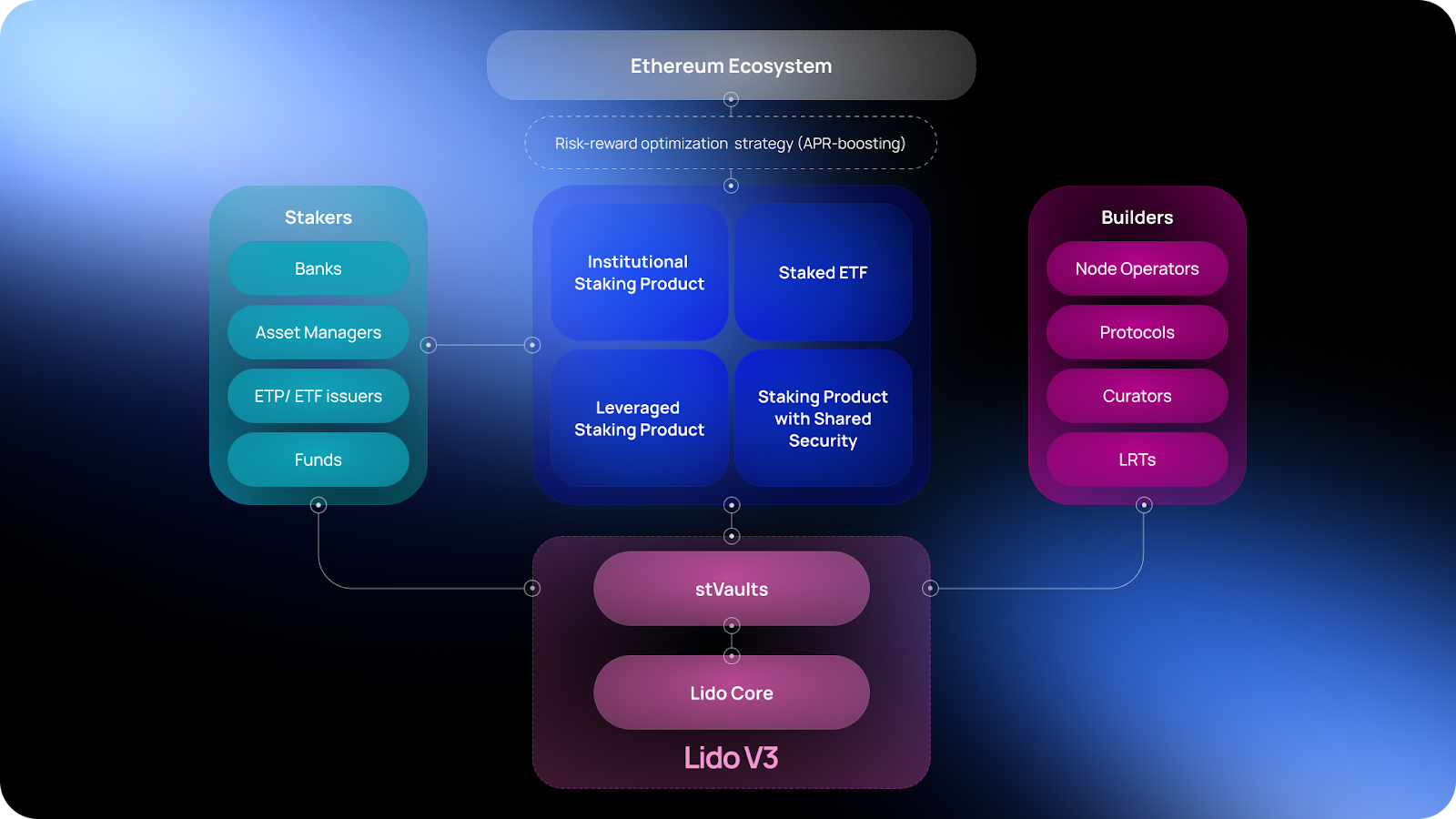
Данные: Lido.fi.

Согласно описанию в блоге проекта, stVaults существует как отдельная некастодиальная платформа наряду с протоколом Lido Core.

Использование новой механики оставят добровольным. По словам создателей, так участники смогут «изучать индивидуальные стратегии и учитывать новые тенденции в перераспределении активов», не подвергая дополнительному риску остальную экосистему.

Напомним, за 2024 год TVL в Ethereum-протоколах ликвидного рестейкинга увеличился почти на 6000%.

Leituras Relacionadas

The "Impossible Triad" Is Fundamentally a Pseudo-Problem

The article argues that blockchain's fundamental limitation is not the scalability trilemma (decentralization, scalability, security), which has been largely solved, but the lack of **privacy** and, until recently, clear **legitimacy**. Blockchain is described as a slow, expensive, globally shared computer whose core value is censorship resistance and verifiability. While ideal for native digital assets like money (e.g., stablecoins), its default transparency acts as a **tax**, exposing all transactions and enabling MEV extraction, which deters serious institutional capital. Simultaneously, its permissionless nature created regulatory ambiguity. The piece contends that **privacy** is the missing critical feature. It rejects the false choice between total transparency and complete anonymity. Modern cryptography (like zero-knowledge proofs) enables **compliant privacy**: users can prove facts (solvency, KYC status, compliance) without revealing the underlying sensitive data (specific holdings, identities). This preserves auditability for regulators and eliminates the leak of financial information. With recent regulatory progress (e.g., the GENIUS Act) addressing legitimacy, adding default, provably compliant privacy becomes a pure upgrade. It transforms blockchain from a costly, public ledger into a confidential settlement layer, finally bridging the gap to mainstream institutional and individual adoption of on-chain finance.

链捕手Há 13h

The "Impossible Triad" Is Fundamentally a Pseudo-Problem

链捕手Há 13h

Trading

Spot
Futuros
活动图片