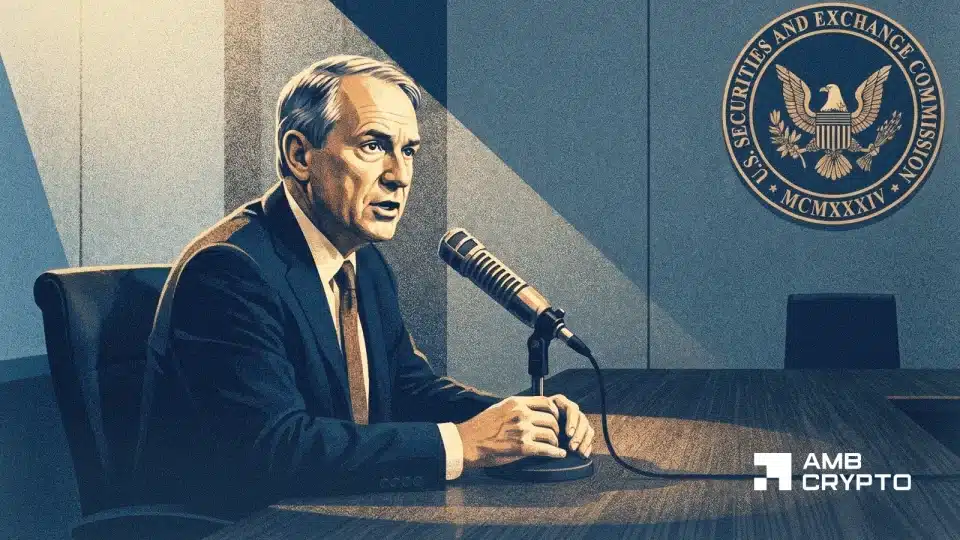
South Korea To Reconsider Crypto ETFs In 2025 Amid Global Demand

bitcoinistPublicado em 2025-01-04Última atualização em 2025-01-04

Resumo

On Thursday, the South Korea Stock Exchange chairman, Jeong Eun-bo, revealed their plan to “explore” the approval of crypto-based exchange-traded...

On Thursday, the South Korea Stock Exchange chairman, Jeong Eun-bo, revealed their plan to “explore” the approval of crypto-based exchange-traded funds (ETFs) to continue with its “value-up program” and face the ongoing market challenges.

Korea Exchange To Explore Crypto ETFs

On January 2, Jeong Eun-bo announced the Korea Exchange’s plan to explore crypto-based ETFs this year at the 2025 Securities and Derivatives Market open ceremony. The Chairman stated that the South Korean capital markets faced significant challenges in 2024, which has weakened the growth potential of local companies.

Jeong also noted that global conflicts and domestic political developments made the market “significantly sluggish compared to major countries.” The South Korean market will continue facing risks this new year as “the domestic and global economic conditions are unfavorable.”

Nonetheless, the Chairman explained that the exchange will continue promoting its value-up program to “engage more leading companies and establish a management culture centered on shareholder value.”

Moreover, Jeong revealed that the Korea Exchange will “benchmark overseas cases for new business avenues such as crypto ETFs and explore new territory in the capital market.”

It’s worth noting that crypto ETFs have been banned in South Korea since 2017. The country’s regulator, the Financial Services Commission (FSC), reaffirmed its stance after the US Securities and Exchange Commission (SEC) approved the crypto-based investment products last year.

However, the financial watchdog announced in October that the newly formed advisory group for discussing digital asset policies would review the ban, signaling an apparent shift from the strict regulation. This shift seems to be influenced by the success of spot Bitcoin and Ethereum ETFs, which surpassed most experts’ expectations in their first year.

South Korea’s Political Crisis Stopping New Regulations

The Korea Exchange’s chief previously called for crypto’s institutionalization in the country to “create added value.” Jeong stated that lawmakers and financial institutions should look at digital assets differently, arguing that the industry has grown and become considerably influential in recent years.

The Chairman added that South Korea should consider incorporating digital assets into institutional finance, as the market needs revitalization to compete with other countries.

The regulator’s current stance on digital assets has made the market fail to cross various regulatory thresholds for years, challenging the market’s development and competitiveness. However, crypto-related regulations will be halted until the political crisis resolution, which could take a few months.

In December, South Korean President Yoon Suk Yeol declared the first emergency martial law in four decades. Yoon accused the country’s opposition Democratic party, which has a majority in the National Assembly, of sympathizing with North Korea and anti-state activities.

The National Assembly voted to nullify the President’s declaration and successfully ended the emergency martial law in six hours. Since then, the Assembly has impeached Yoon and Prime Minister Han Duck-soo, who became acting president after Yoon’s powers were suspended.

According to Associated Press reports, South Korea’s presidential security service prevented authorities from detaining Yoon today in a six-hour stand-off at the impeached President’s residency.

As a result, the anti-corruption agency plans to “strongly demand” that the current acting leader, Deputy Prime Minister Choi Sang-mok, instruct the service to comply with the detention warrant’s execution.

The Constitutional Court is set to determine whether to remove Yoon from office or reinstate him. To remove him, at least six justices on the nine-member court must vote in favor.
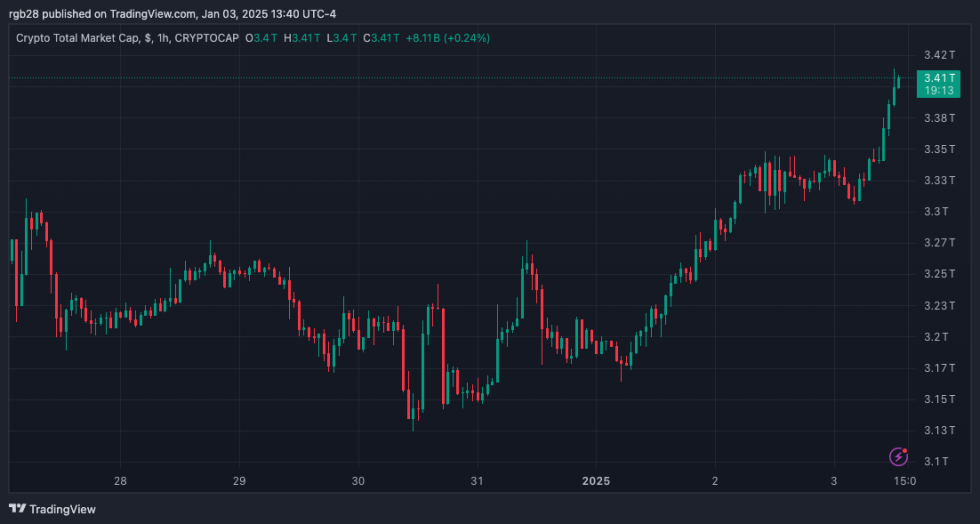
crypto, TOTAL

Total crypto market capitalization is at $3.41 trillion in the one-week chart. Source: TOTAL on TradingView
Featured Image from Unsplash.com, Chart from TradingView.com
Rubmar Garcia

Rubmar Garcia

Rubmar is a crypto enthusiast who likes learning and improving constantly. She enjoys reporting on the latest news and developments in the crypto industry. Rubmar also enjoys scrapbooking, crafting, simulation games, and watching football.

Leituras Relacionadas

77 Bloody Codes: When the '$5 Wrench' Shatters the Privacy Myth of France's Crypto Elite

**Summary** In the first half of 2026, France recorded 77 violent crimes—including kidnappings, illegal confinement, and extortion—targeting cryptocurrency holders, a 71% increase over the 45 cases in all of 2025. This equates to an attack every 2.3 days, making France a global hotspot for so-called "wrench attacks," where criminals use physical violence to coerce victims into surrendering crypto assets. High-profile cases include the 2025 kidnapping of Ledger co-founder David Balland, who was shown with a severed finger in a ransom video, and an attempted kidnapping of the family of Paymium's CEO in Paris. Prosecutors note these are not isolated incidents but part of structured criminal networks, sometimes involving minors. Several factors contribute to France's vulnerability: a large holder base (approx. 7.3 million people), the presence of major crypto firms and executives, a culture of public disclosure among enthusiasts, and potential data leaks. The trend is spreading across Europe, which now accounts for over 40% of such global attacks. Research indicates a correlation between Bitcoin price surges and increased wrench attacks. In response, French Interior Minister Laurent Nuñez announced a three-pillar action plan focusing on enhanced intelligence sharing, deeper cooperation with the industry association Adan, and improved operational and cross-border coordination. Authorities have made over 200 arrests in the past year. Security experts warn that digital asset safety now extends to the physical world. They advise holders to use hardware wallets, avoid disclosing holdings on social media, enable multi-factor authentication, and report suspicious activity. The situation underscores the urgent need for the crypto community to shift from a "show-off" culture to one of discretion as physical security becomes paramount.

marsbitHá 1h

77 Bloody Codes: When the '$5 Wrench' Shatters the Privacy Myth of France's Crypto Elite

marsbitHá 1h

Both OpenAI and Anthropic are 'Developing Their Own Chips' — Beyond Cost, the Control Over Computing Power is Paramount

OpenAI and Anthropic are both advancing plans to develop custom AI chips, driven by the need to control computing power and reduce costs. According to reports, Anthropic is in early-stage development of its own chips and in talks with Samsung for manufacturing, while OpenAI is collaborating with Broadcom and TSMC, aiming to deploy its first inference chip by late 2026. The primary motivation extends beyond just lowering expenses. For these large model companies, chips are core production assets. By designing specialized hardware (ASICs) tailored to their specific model architectures—OpenAI's being more sparse and Anthropic's more dense—they aim to achieve deeper software-hardware co-design. This synergy can significantly improve inference speed, energy efficiency, and overall unit economics, offering advantages that off-the-shelf GPUs cannot. This move does not signify an immediate replacement for suppliers like Nvidia. The process from design to deployment takes 18-24 months, and Nvidia's GPU ecosystem remains deeply entrenched. Instead, custom chips provide a strategic alternative and negotiating leverage, allowing companies to use them for specific, high-volume workloads like inference while still relying on external GPUs and TPUs for other tasks. The trend reflects a broader industry shift where AI competition is evolving from pure algorithmic prowess to integrated control over the entire software-hardware stack. Companies like Google, Amazon, Meta, and Microsoft are already on this path. For foundries like Samsung, securing orders from AI leaders like Anthropic represents a significant opportunity to expand its footprint in the advanced semiconductor market for AI. Ultimately, the race for "computing sovereignty" is now a central battleground for major AI players.

marsbitHá 1h

Both OpenAI and Anthropic are 'Developing Their Own Chips' — Beyond Cost, the Control Over Computing Power is Paramount

marsbitHá 1h

Trading

Spot
活动图片