Machine Learning Algorithm Predicts Double-Digit Crash For Dogecoin Price In January 2025

bitcoinistPublicado em 2024-12-28Última atualização em 2024-12-28

Resumo

Coincodex’s machine learning (ML) algorithm has provided a bearish outlook for the Dogecoin price. The ML algorithm predicted that the...

Coincodex’s machine learning (ML) algorithm has provided a bearish outlook for the Dogecoin price. The ML algorithm predicted that the meme coin would suffer a double-digit crash in January 2025. 

Dogecoin Price To Suffer A Double-Digit Crash? 

Coincodex predicted that the Dogecoin price would suffer a 10.62% crash by January 27, 2025. This projected price crash will cause Dogecoin to drop to $0.28 from its current price level. This price prediction is based on technical indicators showing that the current sentiment towards the foremost meme coin is bearish. 

The Fear and Greed Index for the Dogecoin price is showing 74, which indicates greed. Coincodex noted that Dogecoin has recorded 14/30 (47%) green days with 11.78% price volatility over the last 30 days. Based on this DOGE price forecast, the ML algorithm stated that now is a bad time to buy the meme coin. 

Coincodex’s Dogecoin price prediction for February 2025 is also bearish, as the ML algorithm predicts that the foremost meme coin will continue to range around $0.28 that month. However, things could change in March as the algorithm predicts that Dogecoin could finally rally above the much-anticipated psychological $1 level.

Specifically, Coincodex predicted that the Dogecoin price could rally to as high as $1.3 in March 2025. While this is bullish for Dogecoin, further predictions suggested that the $1.3 price level would mark the top for the foremost meme coin in this market cycle. 

DOGE is currently trading at $0.31. Chart: TradingView

This is contrary to predictions made by several analysts, such as Trader Tardigrade, who predicted that the meme coin could rally to double digits in this market cycle. Trader Tardigrade predicted that the Dogecoin price could reach as high as $30 by March 2025 if it replicates the 2021 bull run. 

Rally To $11 On The Cards 

In an X post, crypto analyst Dima James predicted that the Dogecoin price would rally to $11 in 2025. This came as he analyzed Dogecoin’s monthly chart with a focus on the meme coin’s fourth year in each cycle. The analyst noted that in the first cycle, DOGE’s year four started at $0.00023 and ended at $0.000851, representing a 37 times price increase. 
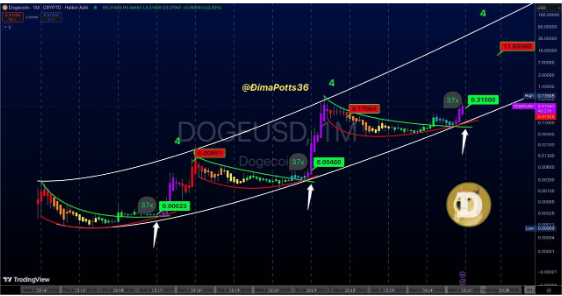
Something similar happened in year four of the second cycle as the Dogecoin price started at $0.00460 and ended at $0.17064, representing a 37 times price increase. In line with this, Dima James predicted that Dogecoin will end 2025, this cycle’s year four, at around $11.65 if 2024 closes at around $0.315 and history repeats itself with the 37x price rally. 

At the time of writing, the Dogecoin price is trading at around $0.31, down in the last 24 hours, according to data from CoinMarketCap. 

Featured image from Pixabay, chart from TradingView

Scott Matherson

Scott Matherson

Scott Matherson is a leading crypto writer at Bitcoinist, who possesses a sharp analytical mind and a deep understanding of the digital currency landscape. Scott has earned a reputation for delivering thought-provoking and well-researched articles that resonate with both newcomers and seasoned crypto enthusiasts. Outside of his writing, Scott is passionate about promoting crypto literacy and often works to educate the public on the potential of blockchain.

Leituras Relacionadas

Warsh's First Day in Office, Markets Deliver a 'Wake-up Call': Rate Hike Expected This Year

On his first day in office, newly inaugurated Federal Reserve Chairman Warsh received a stark market warning, with expectations now fully pricing in a 25-basis-point interest rate hike this year. The shift was triggered by hawkish remarks from Fed Governor Waller, who stated that inflation is now the key policy "driver" and that the odds of a hike or cut are evenly split. This sent short-term Treasury yields higher. Waller signaled a significant pivot in his stance, citing disappointing inflation and labor data. He suggested removing "easing bias" language from Fed statements and did not rule out future rate increases if inflation fails to recede, though he noted immediate action isn't warranted without signs of unanchored inflation expectations. Chairman Warsh faces immediate pressure at his first FOMC meeting in June. With the preferred inflation gauge at a three-year high, analysts warn that failing to hike could be interpreted as an implicit easing of policy. The geopolitical situation in the Middle East is adding to existing price pressures. The market's expectation for a hike contrasts sharply with earlier forecasts for multiple cuts. While long-term Treasury yields have been contained by lower energy prices recently, analysts note they remain under structural upward pressure. Warsh's swearing-in at the White House highlights political scrutiny over Fed independence. However, the market has made it clear that inflation is the most urgent challenge, leaving the new chairman little time to settle in.

marsbitHá 1h

Warsh's First Day in Office, Markets Deliver a 'Wake-up Call': Rate Hike Expected This Year

marsbitHá 1h

Has Microsoft Lost Its Way in the AI Race, and Can Copilot Bring It Back on Track?

Microsoft, once seen as an early AI frontrunner due to its investment in OpenAI, is navigating a strategic shift amid increased competition. Its initial reliance on OpenAI’s GPT models has been complicated by OpenAI’s growing ambitions as a direct competitor, rapid advancements from rivals like Claude and Gemini, and the disruptive rise of AI agents, which challenge its traditional SaaS business model. These factors contributed to stock declines and slower-than-expected adoption of its flagship Copilot products. In response, CEO Satya Nadella has taken a hands-on role in product development, signaling the urgency of change. Microsoft is pivoting from a model-centric strategy to a "model-agnostic" enterprise platform approach. It aims to become the foundational layer connecting various AI models—from OpenAI, Anthropic, or its own new "Superintelligence" team—with enterprise workflows, data, security, and cloud services. Recent organizational changes merged consumer and enterprise Copilot teams to accelerate innovation, exemplified by new products like Copilot Tasks and Copilot Cowork. However, this transformation comes at a high cost. Microsoft faces massive capital expenditures, potentially reaching ~$190 billion by 2026, to support AI infrastructure. While its platform strategy shows early signs of traction with growing Azure AI revenue, it must balance startup-like agility with the reliability expected by enterprise clients. The core challenge is no longer being the sole AI winner but defending its position as the essential enterprise software entry point amidst rapid technological commoditization and the shift towards always-on AI agents.

marsbitHá 2h

Has Microsoft Lost Its Way in the AI Race, and Can Copilot Bring It Back on Track?

marsbitHá 2h

Why Haven't Forex Stablecoins Taken Off?

Why FX Stablecoins Never Took Off: A Path Forward via Synthetic FX Despite the explosive growth of stablecoin-powered digital banking, which has seen ~$6B in VC investment and a 24x surge in crypto card spending in under a year, a major limitation persists: these banks are essentially dollar-only accounts. This leaves 95-99% of global accounts, which are denominated in non-USD currencies, underserved. Attempts to create native foreign currency (FX) stablecoins (like EURC) have largely failed, with total FX stablecoin TVL at ~$600M compared to $400B for USD stablecoins—a 700x gap. These FX tokens face critical challenges: fragile pegs due to low liquidity, limited exchange/FinTech acceptance, poor on/off-ramps, complex regional compliance, and a chicken-and-egg adoption problem. The article argues that the solution lies not in competing with entrenched USD stablecoin networks (USDT/USDC), but in adopting a synthetic FX model inspired by traditional finance. Specifically, it advocates for Mark-to-Market Non-Deliverable Forwards (NDFs)—cash-settled FX derivatives that allow users to maintain underlying USD stablecoin holdings while having their account balance and P&L denominated in a foreign currency. This approach offers key advantages: strong oracle-based pegs, retention of deep USD stablecoin liquidity and yield, superior on/off-ramps, scalability to any currency with a reliable feed, and capital efficiency. It mirrors how modern institutional FX markets operate. Primary use cases for on-chain NDFs include: 1. **Digital Banks/Wallets:** Enabling multi-currency accounts for international users without leaving the USD stablecoin ecosystem, boosting deposits and retention. 2. **FX Carry Trade Vaults:** Offering access to sovereign interest rate differentials (e.g., earning yield on BRL) in a more stable and scalable format than crypto-native products like Ethena. 3. **Global Enterprise Payments:** Allowing merchants to receive payments in local currency equivalents while settling in USD stablecoins, similar to services offered by Stripe for fiat. The conclusion is that synthetic FX, not native FX stablecoins, is the viable path to integrating foreign exchange into the growing stablecoin digital banking landscape, potentially unlocking the next phase of institutional DeFi and multi-trillion-dollar global adoption.

链捕手Há 2h

Why Haven't Forex Stablecoins Taken Off?

链捕手Há 2h

Trading

Spot
Futuros
活动图片