27-Year Reign Ends: SK Hynix Market Cap Surpasses Samsung for First Time, an AI-Driven Reshuffle of Korean Chip Power

marsbitPublicado em 2026-06-22Última atualização em 2026-06-22

Resumo

On June 22, 2026, SK Hynix made history by surpassing Samsung Electronics in market capitalization, ending Samsung's 27-year reign as South Korea's most valuable company. This dramatic reversal is powered by the AI boom and SK Hynix's dominant position in High Bandwidth Memory (HBM), a critical component for AI model training. Once a heavily indebted firm on the brink of bankruptcy, SK Hynix bet early on HBM, which has evolved from a niche product to essential AI infrastructure. It now commands a 59% share of the global HBM market. Its financial performance is staggering, with Q1 2026 net profit soaring nearly fourfold year-over-year to KRW 40.35 trillion, translating to over 2 billion RMB in daily net profit. HBM now drives roughly 40% of its revenue with exceptionally high margins. In contrast, Samsung, with its broad portfolio spanning memory chips, smartphones, and foundry services, has lagged in the HBM race while facing headwinds in other divisions. This shift signifies a deeper restructuring of South Korea's economy, moving from consumer electronics to AI-driven growth. However, the future remains competitive. With major capacity expansions planned industry-wide by 2028 and Samsung aiming to catch up in HBM technology, the new market leader cannot afford complacency. This event marks a pivotal moment in the global semiconductor industry's ongoing power realignment.

On June 22, 2026, SK Hynix, once burdened with $14 billion in debt and teetering on the brink of bankruptcy, saw its market capitalization surpass that of Samsung Electronics, which had dominated the Korean capital market for 27 years, to become South Korea's most valuable listed company. Behind this lies a precise, historic gamble—as the AI wave propelled High Bandwidth Memory (HBM) from a niche product to the core of computing power, SK Hynix, with a 59% market share and staggering daily net profits exceeding 2 billion yuan, completed the most dramatic comeback in business history.

The moment that rewrote the history of South Korea's capital market occurred during the trading session on June 22, 2026.

SK Hynix's total market capitalization exceeded that of Samsung Electronics for the first time, making it South Korea's highest-valued listed company. This marked the first time since 1999 that Samsung Electronics relinquished its title as South Korea's "market cap leader." At the intraday peak, SK Hynix's market cap reached 2,080 trillion won (approximately $1.35 trillion), while Samsung Electronics reported a market cap of 2,066 trillion won.
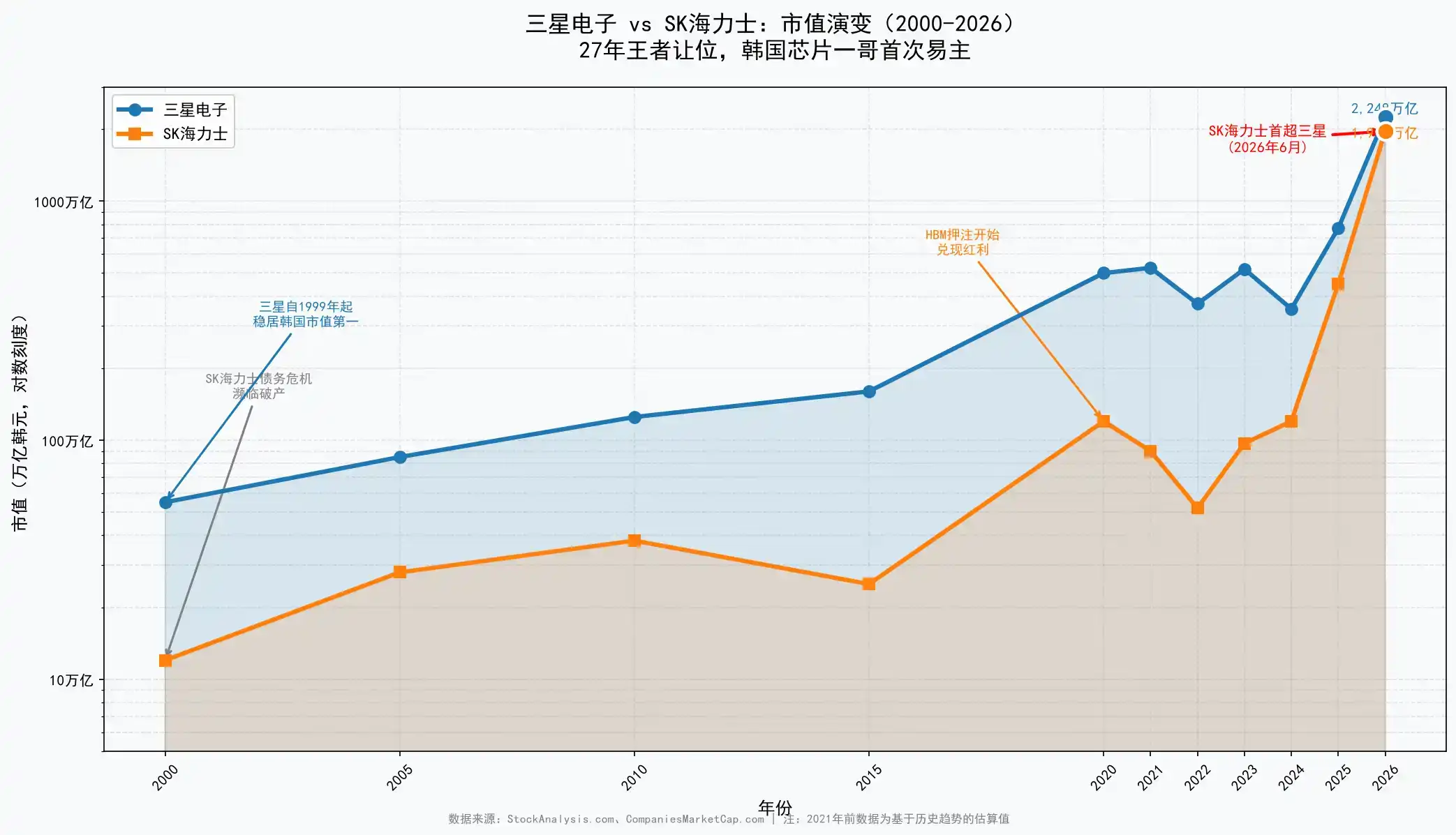
From a debt-ridden enterprise on the verge of collapse to a trillion-dollar empire surpassing the national symbol Samsung Electronics, SK Hynix accomplished one of the most astonishing comebacks in business history over two decades. This is not merely an exchange of rankings between two companies but also a microcosm of how the AI wave is reshaping the global semiconductor industry's power structure.

HBM: From Niche Product to Core Infrastructure of the AI Era

SK Hynix's comeback is essentially a history of "betting right on HBM."

High Bandwidth Memory (HBM) was once a niche category within memory chips. However, in the training of large AI models, GPUs require extremely high-speed data throughput with memory—an NVIDIA H100 requires 80GB of HBM, the H200 requires 141GB, and the latest B200 requires 192GB. Globally, only three companies can produce HBM: SK Hynix, Samsung, and Micron.

SK Hynix has established a near-monopoly advantage in this segment. According to TrendForce data, SK Hynix held a 59% share of the global HBM market in 2025. More critically, in the most lucrative HBM4 segment, Counterpoint Research predicts SK Hynix's market share will reach 54% in 2026 and has already secured over two-thirds of the HBM4 orders for NVIDIA's next-generation Vera Rubin platform, with some institutions predicting the share could exceed 70%.

This advantage is directly reflected in financial data. In the first quarter of 2026, SK Hynix's consolidated revenue reached 52.58 trillion won, a year-on-year increase of 198.1%, breaking the 50 trillion won mark for the first time; net profit reached 40.35 trillion won, nearly quadrupling year-on-year. A simple calculation shows that SK Hynix earned an average net profit of over 2 billion yuan per day in the first three months of this year.

An operating profit margin of 72% not only exceeded NVIDIA's but also far surpassed that of traditional DRAM business. According to Counterpoint Research estimates, the operating profit margin of SK Hynix's HBM business ranges between 75% and 83%, about 10 percentage points higher than its ordinary DRAM business. The HBM business now accounts for approximately 40% of the company's revenue, becoming a veritable profit engine.

Samsung's Dilemma: The Cost of Being Broad

Compared to SK Hynix's sharp focus, Samsung Electronics' problem lies in its "breadth" becoming a burden.

Samsung's business spans memory chips, smartphones, semiconductor foundry, home appliances, and more. Its 2025 revenue scale of 333.6 trillion won far exceeds that of SK Hynix, but the drag from non-memory businesses disperses resources and strategic focus.

In the memory chip sector, Samsung's layout in HBM is noticeably lagging. Although Samsung is also advancing the development of HBM3E and HBM4, it trails behind SK Hynix in customer certification and mass production progress. This has resulted in Samsung watching its competitor exclusively enjoy the premium during the period of most explosive AI computing demand.

What troubles Samsung even more is the simultaneous slowdown of its other businesses. The smartphone business's market share has declined from 54% to 45%; the semiconductor foundry business, due to technological gaps, has failed to secure orders from high-end customers, facing underutilization issues. The profits that the memory business should provide are continuously diluted by losses from other segments.

Furthermore, ongoing labor-management disputes between management and employees are intensifying. Following SK Hynix's milestone bonus agreement last year, Samsung's labor conflicts pose additional challenges to its profit recovery. While SK Hynix employees reap rich rewards from the AI红利, Samsung's organizational cohesion is being tested.

From $14 Billion in Debt to a Trillion-Dollar Empire

The story of SK Hynix's rise is almost a microcosm of the South Korean semiconductor industry.

Its origins can be traced back to Hyundai Electronics, founded in 1983. Relying on government support and chaebol capital injections, Hyundai Electronics rapidly caught up, focusing on DRAM chips, and grew into South Korea's second-largest semiconductor company by the 1990s. In 1999, Hyundai Electronics merged with LG Semiconductor to form Hynix, under the Hyundai Group.

However, the semiconductor downturn in the early 2000s almost pushed the company into bankruptcy. At that time, SK Hynix was saddled with $14 billion in debt and teetered on the brink of collapse. The South Korean government promoted industry consolidation, leading to a duopoly in the DRAM sector with Samsung and Hynix. Subsequently, through several key restructurings and counter-cyclical technological investments, Hynix gradually recovered.

The real turning point was the early bet on HBM. When the market still viewed HBM as a niche product, SK Hynix had already identified it as the future direction for high-performance computing. This strategic vision yielded超额回报 in the AI wave—today, HBM has transformed from a common commodity into a key infrastructure component supporting ChatGPT and advanced AI models.

SK Hynix's comeback has also altered the ecology of South Korea's capital market. The head of South Korea's Financial Supervisory Service recently expressed "regret over not preventing the launch of single-stock leveraged ETFs" and stated that the negative impact of high-risk products related to Samsung and SK Hynix has significantly increased. Retail investor demand for leveraged ETFs of these two stocks remains high, and regulators are considering separate stabilization measures.

Beyond Market Cap: Deep Restructuring of South Korea's Economic Landscape

The significance of SK Hynix's market cap surpassing Samsung extends far beyond a capital market ranking.

Bank of Korea Governor Shin Hyun-song recently stated explicitly that the benefits brought by the expansion of the semiconductor industry are increasingly being transmitted to the overall economy through corporate profits, consumption, and investment improvements. As companies like SK Hynix become new engines for the national economy, South Korea's growth model is shifting from being traditionally driven by consumer electronics to being driven by AI infrastructure.

From a global perspective, this event marks the transformation of the memory chip industry from "commoditization" to "high-value specialization." Traditional DRAM and NAND are highly cyclical commodities with volatile prices. However, HBM, deeply tied to AI computing power, is shedding its commodity attributes and becoming a high-end product with long-term pricing power.

Under the Cycle, No King Reigns Forever

However, SK Hynix's ascension does not mean it can rest easy.

Around 2028, new capacities from Micron's New York fab, SK Hynix's Yongin complex, and Samsung's Pyeongtaek expansion are expected to be released concurrently. TrendForce predicts that memory chip price increases will last at least until the end of 2027, but the landing of new capacity could alter the supply-demand balance. At that point, whether the scarcity premium of HBM will shrink will test the depth of SK Hynix's moat.

Furthermore, Samsung is unlikely to surrender its throne willingly. Samsung still possesses deep accumulation in 3D NAND and advanced process technologies. Once it achieves a breakthrough in HBM4, market competition will intensify rapidly. Today, the market cap difference is only about 14 trillion won, and the suspense over the change of the crown is far from over.

But on this day, June 22, 2026, SK Hynix indeed rewrote history. A company reborn from a debt crisis, through a precise bet on the core infrastructure of the AI era, surpassed the behemoth that had ruled South Korea's capital market for 27 years. This is not the终点, but the latest footnote in the ongoing reshuffle of power within the global semiconductor industry.


Criptomoedas em alta

Perguntas relacionadas

QWhat significant milestone did SK Hynix achieve on June 22, 2026?

AOn June 22, 2026, SK Hynix's market capitalization surpassed that of Samsung Electronics for the first time, making it the most valuable listed company in South Korea, ending Samsung's 27-year reign as the market leader.

QWhat key technology product is central to SK Hynix's rise and its advantage over competitors?

AHigh Bandwidth Memory (HBM) is the key technology product. SK Hynix holds a dominant 59% market share in HBM, which has become a core infrastructure component for AI computing, driving the company's massive financial growth and market value surge.

QWhat were the main financial results for SK Hynix in Q1 2026 that highlight its success?

AIn Q1 2026, SK Hynix reported consolidated revenue of 52.58 trillion won (a 198.1% year-on-year increase) and a net profit of 40.35 trillion won (a nearly fourfold increase). The company's operating profit margin reached 72%, and it was averaging a net profit exceeding 2 billion RMB per day.

QHow is Samsung Electronics' business strategy described as a contrast to SK Hynix's current success?

ASamsung Electronics' strategy is described as broad but burdensome. Its diverse portfolio, including non-memory businesses like smartphones and foundry services, has diluted focus and resources. This has led to slower progress and missed opportunities in the high-margin HBM market compared to the more focused SK Hynix.

QWhat future challenges are mentioned for SK Hynix despite its current market leadership?

AFuture challenges include the potential for increased HBM production capacity from competitors like Micron and Samsung by around 2028, which could reduce the current scarcity premium. Furthermore, Samsung is actively working to catch up in HBM technology, meaning intense competition is expected to continue.

Leituras Relacionadas

Goldman Sachs In-Depth Report: Who Will Be the Long-Term Winners in China's AI Large Model Industry?

Goldman Sachs Report: China's AI Models at an Inflection Point China's open-source/open-weight large language models (LLMs) have reached performance parity with top global proprietary models, according to a Goldman Sachs report. This is driven by architectural innovations and higher parameter efficiency, allowing Chinese models to achieve comparable capabilities at 2%-10% the parameter size and significantly lower cost. The market is evolving into a two-tiered structure: a high-end segment (e.g., GLM5.2, Qwen3.7 Max) with premium pricing and a low-end, price-sensitive segment for global SMEs and individual users. Key points: * **Cost & Performance:** Innovations like Mixture of Experts (MoE) enable high performance with smaller models. Projects like Meituan's LongCat 2.0, trained on domestic hardware, highlight progress in tech self-sufficiency. * **Open-Source Strategy:** Most Chinese players use open-source/open-weight models for flexibility and ecosystem growth. However, Goldman notes this may underreport actual deployment and revenue. A shift toward "open-weight + community license" models with revenue sharing (e.g., MiniMax) could improve monetization. * **Market Shift & Global Expansion:** Enterprise AI adoption is shifting from "token maximization" to "ROI-first." International expansion, especially in non-US markets, is a major growth driver. Chinese models are increasingly available on global platforms like AWS Bedrock and Microsoft Copilot. * **Competitive Landscape:** Using a framework based on pricing power, cost advantage, and financial strength, Goldman identifies **Zhipu AI and DeepSeek** as the strongest in foundational text models, and **ByteDance** as the leader in multimodal/video generation. The report maintains Buy ratings on MiniMax and Kuaishou. * **Market Growth:** China's AI model API and subscription revenue is projected to grow from an estimated ¥35 billion in 2026 to ¥879 billion by 2030.

marsbitHá 13m

Goldman Sachs In-Depth Report: Who Will Be the Long-Term Winners in China's AI Large Model Industry?

marsbitHá 13m

Goldman Sachs Deep Dive Report: Who Will Become the Long-Term Winners in China's AI Large Model Industry?

Goldman Sachs Report: Who Will Be the Long-Term Winners in China's AI Large Model Industry? China's AI large model sector is at a historic inflection point. Goldman Sachs argues that the intelligence of Chinese open-source/open-weight models is approaching top global proprietary models. Rapid adoption by domestic enterprises and global SMEs is creating a data flywheel effect that will further drive model iteration. The evolution is summarized as moving from "DeepSeek's cost-efficiency moment last year to GLM's model-intelligence moment this year." Chinese models achieve near-state-of-the-art performance at significantly lower cost, primarily due to architectural innovations like Mixture of Experts (MoE) and higher parameter efficiency. Models like DeepSeek V4 Pro (1.6T params), GLM5.2 (0.7T), and MiniMax M3 (0.4T) are much smaller than global leaders. Recent advancements in coding capability are attributed to better data curation and RLHF. Landmarks like Meituan's LongCat 2.0, trained fully on domestic AI chips, demonstrate progress in hardware stack independence. The market is forming a "two-tiered structure." The high-end tier (e.g., GLM5.2, Alibaba's Qwen3.7 Max) prices around $1 per million tokens, about 10-25% of US top models, with estimated inference gross margins of 10-20%. The low-end tier (priced as low as $0.06-$0.2 per million tokens) targets price-sensitive global SMEs and individuals. MiniMax derives 60-70% of revenue overseas. Goldman forecasts China's AI model API/subscription revenue to grow from an estimated RMB 35bn in 2026 to RMB 879bn by 2030. Most Chinese players adopt open-source/open-weight strategies for deployment flexibility and community feedback, though this limits monetization as deployments on third-party platforms (e.g., Alibaba Cloud) may not generate direct revenue. A shift towards "open-weight + community license" models with revenue-sharing agreements (like MiniMax's approach) could improve unit economics. International expansion, particularly in non-US markets, is the key growth driver. The global enterprise AI paradigm is shifting from "token maximization" to "ROI prioritization." Chinese models are already hosted on major global platforms like AWS Bedrock and are under consideration for integration into Microsoft Copilot. Using a competitive framework based on pricing power, cost advantage, and financial strength, Goldman identifies the strongest players: In foundational text models, Zhipu AI (initiated coverage) and DeepSeek lead. In multimodal/video generation, ByteDance's Seed is the frontrunner, with Kuaishou's Kling and MiniMax's Hailuo also well-positioned. Goldman maintains a Buy rating on MiniMax, citing its attractive valuation.

链捕手Há 18m

Goldman Sachs Deep Dive Report: Who Will Become the Long-Term Winners in China's AI Large Model Industry?

链捕手Há 18m

Is Ethereum Truly a "World Computer"?

Title: Is Ethereum Really a "World Computer"? Ethereum, envisioned as a "world computer" by its founder Vitalik Buterin, aims to be a decentralized platform for global applications. However, a recent analysis by Four Pillars raises questions about whether it is more accurately a "Western computer," based on the geographical distribution of its validators. Currently, the United States dominates with 38.19% of all validators, followed by Germany at 13.04%. Combined, these two countries account for over half of the network. In contrast, Asian representation is minimal, with Singapore holding only 3.15%. The concentration is partly due to affordable cloud hosting services like Hetzner and OVH in Europe and North America, as well as the prevalence of residential validators in the U.S., where individuals run nodes via home internet connections. When examining professionally operated validators, the distribution becomes more balanced. The U.S. share drops to 25.81%, while Asian countries like Singapore (7.28%), Hong Kong (6.44%), Japan (6.38%), and South Korea (4.59%) collectively approach the U.S. level. This shift reflects strategic deployments by institutions to meet regulatory requirements and reduce latency for local users. However, regions like South America, the Middle East, and Africa remain underrepresented. Ethereum's peer-to-peer network mechanisms, such as gossipsub, disadvantage areas with low node density, creating a feedback loop where delayed message propagation reduces validator performance and rewards. This imbalance challenges Ethereum's promises of censorship resistance and global accessibility. Despite these issues, opportunities exist for growth in underrepresented regions. As demand for localized staking infrastructure rises, early entrants in areas like the Middle East could establish dominant positions by offering compliant, low-latency solutions. The evolving validator landscape highlights both the structural challenges and the potential for Ethereum to move closer to its "world computer" ideal.

Foresight NewsHá 2h

Is Ethereum Truly a "World Computer"?

Foresight NewsHá 2h

Trading

Spot

Artigos em Destaque

Como comprar CHIP

Bem-vindo à HTX.com!Tornámos a compra de USD.AI (CHIP) simples e conveniente.Segue o nosso guia passo a passo para iniciar a tua jornada no mundo das criptos.Passo 1: cria a tua conta HTXUtiliza o teu e-mail ou número de telefone para te inscreveres numa conta gratuita na HTX.Desfruta de um processo de inscrição sem complicações e desbloqueia todas as funcionalidades.Obter a minha contaPasso 2: vai para Comprar Cripto e escolhe o teu método de pagamentoCartão de crédito/débito: usa o teu visa ou mastercard para comprar USD.AI (CHIP) instantaneamente.Saldo: usa os fundos da tua conta HTX para transacionar sem problemas.Terceiros: adicionamos métodos de pagamento populares, como Google Pay e Apple Pay, para aumentar a conveniência.P2P: transaciona diretamente com outros utilizadores na HTX.Mercado de balcão (OTC): oferecemos serviços personalizados e taxas de câmbio competitivas para os traders.Passo 3: armazena teu USD.AI (CHIP)Depois de comprar o teu USD.AI (CHIP), armazena-o na tua conta HTX.Alternativamente, podes enviá-lo para outro lugar através de transferência blockchain ou usá-lo para transacionar outras criptomoedas.Passo 4: transaciona USD.AI (CHIP)Transaciona facilmente USD.AI (CHIP) no mercado à vista da HTX.Acede simplesmente à tua conta, seleciona o teu par de trading, executa as tuas transações e monitoriza em tempo real.Oferecemos uma experiência de fácil utilização tanto para principiantes como para traders experientes.

364 Visualizações TotaisPublicado em {updateTime}Atualizado em 2026.06.02

Como comprar CHIP

Discussões

Bem-vindo à Comunidade HTX. Aqui, pode manter-se informado sobre os mais recentes desenvolvimentos da plataforma e obter acesso a análises profissionais de mercado. As opiniões dos utilizadores sobre o preço de CHIP (CHIP) são apresentadas abaixo.

活动图片