Interview With 3Commas CEO Yuriy Sorokin On Automated Trading, Tokenization, And What’s Next For Crypto Adoption

bitcoinistPublicado em 2024-11-08Última atualização em 2024-11-08

Resumo

Navigating the ever-changing crypto market can be challenging for investors, who often descend into the depths of the industry without...

Navigating the ever-changing crypto market can be challenging for investors, who often descend into the depths of the industry without any guidance. Some have taken on the task of developing tools to help traders steer their strategies and try to maximize their portfolio’s performance.

3Commas, a crypto trading bot automated platform, is one of those companies aiming to provide users with technology that helps their trading strategies. In a conversation with Bitcoinist, Yuriy Sorokin, 3Commas CEO, shared valuable insights on the role of automated trading tools in the market, what changed over the last couple of years, and where the industry might be headed in the next months.

Q: Can you tell us a bit about yourself and 3Commas for those unfamiliar with the platform?

A: I’m Yuriy Sorokin, the CEO and co-founder of 3Commas. Our platform launched in 2017 with the goal of empowering traders by making professional Wall Street class tools available to everyone.

Today, thousands of traders and developers use our platform to automate strategies and build their own products and services. And that is where we believe our core strength is – reliable and scalable infrastructure that simplifies complex trading operations for advanced and professional traders.

Q: If a trader is looking into an automated trading approach to navigate the different states of the market cycle, what must they consider before making their decision? How does 3Commas differentiate from similar tools available in the market?

A: When considering automated trading, traders need tools that offer precision, flexibility, and the ability to adapt to various market conditions. 3Commas is designed specifically for experienced traders who already know the market and need advanced solutions to optimize their strategies across multiple exchanges.

With flexible integration options like custom signals, webhooks, and TradingView strategies, we help traders focus on what really matters—executing their strategies efficiently without getting bogged down by technical hurdles. Our tools are built to make your trading life easier, which is why many traders trust 3Commas to keep them ahead of the curve. Since 2017, we’ve processed over $450 billion in trades, and that trust is what keeps experienced traders coming back to 3Commas as their go-to solution.

Q: Are you still “builders and tinkerers at heart”? You previously stated that 3Commas was born out of the need to manage your crypto portfolios, what has changed since the company’s inception, what new features and products are available for your users?

A: We’re definitely still builders and problem-solvers at heart. What started as a tool to simplify our own trading has evolved into a trusted solution used by thousands of traders. And we are now shifting towards institutional clients, such as fund managers and family offices, who require more advanced tools.

One of our biggest developments has been the launch of our Asset Management product, which is designed specifically for professionals managing multiple accounts. It enables them to implement advanced strategies efficiently at scale. And as we’ve grown, we’ve always kept reliability and performance at the heart of what we do. Our system now handles over one million active deals, giving advanced and institutional traders the speed, stability, and efficiency they need. We’re constantly working to stay ahead of the curve, building tools that evolve with the market and meet the changing demands of professional traders and investors.

Q: At EBC10, you discussed the future of asset management in a world where tokenization continues growing. What is most exciting about crypto and blockchain technology’s role in asset management? Do you feel tokenization will be the gateway for mainstream adoption in the long term? 

A: I believe tokenization will be a crucial driver of mainstream adoption, particularly as it bridges traditional finance and the crypto space. What’s exciting is how blockchain technology can create greater liquidity and accessibility for assets that were previously illiquid or out of reach for many investors. This opens new possibilities for asset managers and institutional players, offering a more efficient and transparent way to manage and transfer assets.

For us at 3Commas, this shift aligns perfectly with the tools we’re building, particularly in the asset management space. As tokenization grows, we’re focused on providing advanced traders and institutions with the automation and infrastructure they need to capitalize on these opportunities efficiently.

Q: Where is the crypto industry in terms of adoption? This year, we’ve seen the sector take crucial steps toward mainstream recognition and adoption with the approval of crypto-based spot exchange-traded funds (ETFs). What do you consider to be the next milestone that could further attract traditional investors?  

A: The crypto industry has seen two distinct types of adoption. In wealthier nations, it’s often part of an investment strategy, while in regions with less stable currencies and unreliable payment systems, crypto is becoming an essential part of the everyday economy.

This split adoption isn’t a disadvantage—it’s actually a testament to crypto’s versatility. For investors in developed markets, crypto offers portfolio diversification and a hedge against risks. In emerging markets, it provides a safer alternative to cash and allows access to global financial systems, enabling loans, currency transfers, and more.

Now that the ETF barrier has been broken for Bitcoin and Ethereum, the next major milestone will be the creation of ETFs for other promising coins like Solana, XRP, and Cardano. Following that, I see the next big step as the integration of crypto into more traditional investment vehicles, such as allowing people to include crypto in their 401(k) or Roth IRA portfolios. These developments could significantly increase mainstream adoption and draw in traditional investors.

Q: Lastly, as we start navigating the last quarter of 2024, how can investors better take advantage of automated trading platforms during the second leg of the bull run?

A: Timing is critical in a bull run, and it’s easy to get caught up in the hype. This is where automation comes into place. The key is to let automation handle the emotional side of trading and optimize bots for cost efficiency with the amount of risk you’re comfortable with. There are a lot of peaks and valleys during a bull run, and those are opportunities for sophisticated traders to find a lot of success.

Maybe the best part of automation, besides being able to use strategies that simply aren’t possible with manual trading, is the ability to walk away from your computer and go do something else while your bots keep working. For professional traders and asset managers, it means more time for technical analysis and client relations and less time spent inputting deal parameters.

If trading is a strong interest of yours, or it’s your profession, I’m inviting you to see our software for yourself and learn how 3Commas automation can make your trading more efficient.
3commas, BTC, BTCUSDT

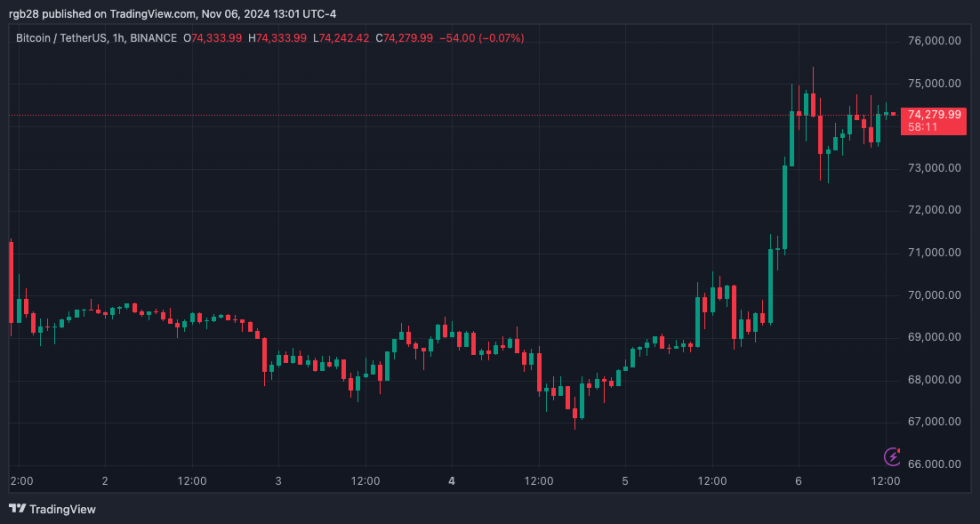
Bitcoin (BTC) is trading at $74,279 in the three-day chart. Source: BTCUSDT on TradingView
Featured Image from Pexels.com, Chart from TradingView.com
Rubmar Garcia

Rubmar Garcia

Rubmar is a crypto enthusiast who likes learning and improving constantly. She enjoys reporting on the latest news and developments in the crypto industry. Rubmar also enjoys scrapbooking, crafting, simulation games, and watching football.

Leituras Relacionadas

Circle: From Issuance to Infrastructure

Title: Circle: From Issuance to Infrastructure Circle, the issuer of the USDC stablecoin, is undergoing a strategic transformation to reduce its dependence on interest income from reserve holdings, which is declining due to falling interest rates. Historically, Circle's revenue came primarily from the yield on US Treasury reserves backing USDC. However, it also paid significant fees (approximately 60 cents of every dollar earned) to partners like Coinbase for distributing and settling USDC. To capture more value across the financial stack, Circle is vertically integrating into three new layers: 1. **Settlement Layer:** It is launching **Arc**, a native Layer-1 blockchain. Arc, which uses USDC as its gas token, aims to capture transaction fees currently paid to other blockchains (like Ethereum and Solana) and offers features like privacy for institutional payments. 2. **Distribution Layer:** The **Circle Payments Network (CPN)** connects financial institutions directly to Circle, reducing reliance on exchanges like Coinbase. While not yet monetized, CPN growth has improved Circle's margins. 3. **Application Layer:** Circle is building an **AI Agent Economy** infrastructure with products like Agent Wallets and Nanopayments. The goal is to capture fees from high-volume, automated transactions executed by AI agents, a market where USDC already dominates. These moves represent Circle's shift from a single-product company (USDC issuance) to a full-stack financial platform. The strategy faces challenges, including market competition from players like Stripe and Tether, and potential internal tension regarding how value created by the new Arc blockchain and token (ARC) will accrue to Circle's public shareholders (CRCL). Circle's long-term success depends on its ability to successfully execute this vertical integration and diversify its revenue streams away from interest income.

marsbitHá 5m

Circle: From Issuance to Infrastructure

marsbitHá 5m

Circle: From Issuance to Infrastructure

Title: Circle: From Issuance to Infrastructure Circle, the issuer of the USDC stablecoin, is undergoing a strategic transformation from a single-product company dependent on reserve interest income to a vertically integrated, full-stack financial platform. Its primary revenue source, earnings from US Treasury reserves backing USDC, is under pressure from declining Federal Reserve interest rates. Furthermore, Circle pays out a significant portion (~60 cents per dollar earned) to partners like Coinbase for distribution and settlement, leading to value leakage. To address these challenges and capture more value across the payment stack, Circle announced three key initiatives in Q1 2026: 1. **Settlement Layer**: Launching its own Layer-1 blockchain, **Arc**. Designed for institutional use with configurable privacy and quantum-resistant architecture, Arc uses USDC as its native gas token, allowing Circle to capture transaction fees currently paid to other blockchains like Ethereum. 2. **Distribution Layer**: Expanding the **Circle Payments Network (CPN)**, which connects financial institutions directly to Circle, reducing reliance on third-party exchanges for USDC distribution and on/off-ramps. 3. **Application Layer**: Building infrastructure for an **AI agent economy**, including tools for agent wallets, nanopayments, and a marketplace. Circle aims to monetize the high volume of AI-driven microtransactions predominantly settled in USDC. This vertical integration strategy aims to diversify Circle's revenue away from volatile interest income. However, a key challenge remains: aligning the value capture of the new ARC token with the interests of existing public market shareholders (CRCL) who invested primarily for reserve yields. The success of this stack-wide expansion hinges on Arc's adoption and Circle's ability to balance value distribution between its core corporate entity and its new blockchain ecosystem.

链捕手Há 11m

Circle: From Issuance to Infrastructure

链捕手Há 11m

Nvidia's Wednesday 'Big Test': The Battle That Will Determine the Fate of the AI Bull Market is Here!

NVIDIA Faces Key AI Bull Market Test with Wednesday Earnings Report NVIDIA is set to release its quarterly earnings after the market close on Wednesday, May 20th (US Eastern Time). This report is seen as a critical stress test for the current AI-driven bull market cycle. The semiconductor sector is technically severely overbought, with extremely bullish options positioning. The rare signal of stock prices and implied volatility rising simultaneously indicates significantly amplified two-way risk around this earnings event. The core tension identified by analysts is strong fundamental demand for AI versus mounting technical pressures. The Philadelphia Semiconductor Index (SOX) is trading approximately 60% above its 200-day moving average, a deviation not seen since the peak of the dot-com bubble in 1999/2000. While NVIDIA's current quarter revenue is expected to beat estimates by a substantial margin, market focus is intensely on the guidance for the next quarter. Historically, NVIDIA's stock has frequently declined on the day following its last five earnings reports. The options market presents contradictory signals: extreme bullish call skew persists, yet there is notable activity in tail-risk hedging via put options on broader indices and semiconductor ETFs. This suggests traders are chasing gains while simultaneously preparing for potential sharp volatility. A broader market concern is narrowing breadth. Despite the S&P 500's YTD gain, only about half of its constituents are positive, with leadership heavily concentrated in a few mega-cap AI and semiconductor names like NVIDIA. Analysts question whether this reflects market health or a "funding source" effect, where money flows out of lagging sectors into the AI trade. The earnings outcome and, crucially, the forward guidance will test the market's conviction in the AI compute super-cycle thesis. Given NVIDIA's high correlation with the semiconductor and broader tech sector, its results are poised to trigger widespread market moves in either direction.

marsbitHá 20m

Nvidia's Wednesday 'Big Test': The Battle That Will Determine the Fate of the AI Bull Market is Here!

marsbitHá 20m

The AI-Era Power Arms Race: Energy Order Reshuffle Behind NextEra's Acquisition of Dominion

The AI arms race is shifting from a focus on chips and models to a fundamental battle over electricity. NextEra Energy's proposed $66.8 billion acquisition of Dominion Energy highlights this profound change, as AI's explosive growth is rewriting the growth logic for the power sector. The deal is less about traditional utility consolidation and more about securing a strategic gateway to Virginia’s "Data Center Alley," a critical hub where tech giants have massive, signed load requirements. The core challenge is a growing disconnect: data center construction cycles are far shorter than the years needed to build new power generation and transmission infrastructure. Morgan Stanley predicts a 49GW gap in power availability for U.S. data centers by 2028. Electricity, once a taken-for-granted commodity, is now a scarce and strategic resource. This transforms the competitive landscape—future AI competitiveness may hinge not just on algorithms but on a company's ability to secure long-term, stable, and affordable power supply. The transaction signals a broader revaluation of the entire energy infrastructure chain, from natural gas and nuclear power for base load to storage and transmission equipment. However, the largest variable is regulation. Balancing rapid AI-driven grid expansion with public concerns over costs, fairness, and environmental impact will be a complex political and social challenge. The true value in the coming AI era may lie not just in power generation assets, but in owning the crucial infrastructure nodes, grid access rights, and the regulatory relationships needed to deliver electricity where it's needed most.

marsbitHá 26m

The AI-Era Power Arms Race: Energy Order Reshuffle Behind NextEra's Acquisition of Dominion

marsbitHá 26m

Trading

Spot
Futuros
活动图片