Farfetched Price Predictions: Shiba Inu To $1, Dogecoin To $50, And XRP Price To $1,000

bitcoinistPublicado em 2024-10-22Última atualização em 2024-10-22

Resumo

The crypto world is buzzing with bold predictions: the Shiba Inu price hitting $1, the Dogecoin price skyrocketing to $50,...

The crypto world is buzzing with bold predictions: the Shiba Inu price hitting $1, the Dogecoin price skyrocketing to $50, and the XRP price reaching $1,000. These predictions have highlighted the market’s speculative nature, even though they seem unrealistic. However, investors have discovered a more calculated way to profit from crypto through WallitIQ’s native token, WLTQ, an AI-powered Ethereum-based altcoin that offers massive gains.

Why WallitIQ (WLTQ) Offers A Smarter Alternative To Speculative Price Predictions

WallitIQ (WLTQ), a cutting-edge crypto wallet, is expected to outpace the market growth of well-known traditional wallets. This platform effortlessly manages, stores, and transacts with users’ digital assets by combining the power of AI and Machine Learning (ML).

By taking a proactive approach to security, WallitIQ (WLTQ) lowers the possibility of fraud or illegal access to users’ cryptocurrency wallets. Its incorporation of Escrow Connect Technology and other intelligent security systems like AES and ECC encryption tools will also improve users’ platform experiences while guaranteeing the protection of their assets and privacy.

To improve users’ security further, WallitIQ (WLTQ) will use AI-driven anomaly detection tools. This crypto wallet keeps track of all user activity in real-time, allowing it to detect and report any questionable activities quickly. SolidProof, a top security auditing firm also backed this claim after conducting a thorough audit on WallitIQ (WLTQ)’s smart contract.

Purchasing WallitIQ’s native token, WLTQ has several advantages, including access to premium features like trading analytics, real-time market insights, upgraded security options, and more. Predictive analytics, which forecasts and suggests the best investments in the market, was also incorporated into the wallet.

One of the most notable features of the WallitIQ (WLTQ) wallet is its Scan and Pay QR feature. This removes the time-consuming and sometimes error-prone process of manually entering lengthy wallet addresses by allowing investors to complete transactions with a simple QR code scan. 

WallitIQ (WLTQ) has also used behavioural and market analysis tools to forecast market trends and provide crypto traders with insightful information on portfolio management, yield farming, staking and liquidity provision.

The ongoing presale of the WLTQ token is expected to draw interest from institutional crypto investors, especially given the low entry price of $0.0171.

Crypto’s Sky-High Forecasts: Can The Shiba Inu Price Hit $1, Dogecoin Price Reach $50, And XRP Price Soar To $1,000?

The Shiba Inu price hitting $1 has become a point of fascination for investors. For the Shiba Inu price to reach this $1 Shiba Inu price target level, its market cap would need to surpass trillions of dollars, which would outsize the total market cap of Bitcoin and Ethereum combined. This raises questions about tokenomics and supply, which primarily determines the growth of the Shiba Inu price. Shiba Inu’s vast circulating supply of nearly 589 trillion tokens also challenges the Shiba Inu price growth. 

The Dogecoin price has experienced significant surges in the past, primarily driven by support from public figures like Elon Musk. However, reaching a $50 target Dogecoin price would require an extreme valuation rally. While Elon Musk’s influence on the Dogecoin price is undeniable, the coin’s utility and broader adoption in payments and services are critical factors for the Dogecoin price growth. Recent integrations like Tesla accepting Dogecoin for select purchases may help, but a $50 target Dogecoin price would require great market conditions.

The XRP price reaching $1,000 is a bold prediction that hinges on several complex factors, most notably its ongoing legal battle with the SEC, which is causing an imbalance in the XRP price. The case has impacted the XRP price, but should Ripple emerge victorious, it could fuel a significant rally in the XRP price. Still, the $1,000 XRP price tag would require an almost unimaginable market cap far beyond any current crypto.

Conclusion

The Shiba Inu price, Dogecoin price, and XRP price seem farfetched as investors are shifting their focus to a more realistic altcoin, WallitIQ (WLTQ). It is now listed on CoinMarketCap and selling fast in its presale. 

Join the WallitIQ (WLTQ) presale and community: 

Join WallitIQ (WLTQ) Presale

Join the WallitIQ (WLTQ) Community


Bitcoinist

Bitcoinist

Bitcoinist is the ultimate news and review site for the crypto currency community!

Leituras Relacionadas

Xing Bo Strikes Again: Last Time 'Critiquing' World Models, This Time It's Agents' Turn

Xing Bo, President of MBZUAI and professor at Carnegie Mellon University, along with co-authors Mingkai Deng and Jinyu Hou, has released a new paper, "Critique of Agent Model," critiquing the current state of artificial intelligence agents. The paper draws a crucial distinction between "agentic" systems, which rely on external toolchains, prompts, and workflows, and truly "agentive" systems capable of genuine autonomy driven by internal decision-making structures. To illustrate this, it references a real-world incident where an AI programming assistant, following an external prompt but lacking internalized judgment, caused a catastrophic data deletion. The authors propose a detailed analysis and a new framework, "Goal-Identity-Configurator" (GIC), for building truly autonomous agents. This framework systematically addresses five key dimensions where current "Agent" designs fall short: 1. **Goal:** Moving from step-by-step human instruction to a system capable of autonomously decomposing a single long-term goal and adapting sub-goals based on new information. 2. **Identity:** Evolving self-assessment updated by experience, rather than a static description in a system prompt. 3. **Decision Making:** Replacing textual Chain-of-Thought reasoning with "simulative reasoning" that uses a dedicated world model to predict real-world consequences before selecting actions. 4. **Cognitive Control:** Introducing a separate "System III" metacognitive module that dynamically decides when to deliberate, stick to a plan, or act quickly. 5. **Learning:** Enabling "continual autonomous learning," where the agent itself decides when to act, practice in simulation, or update its world model and self-perception. The GIC architecture integrates six components—a belief encoder, goal decomposer, identity evolver, configurator (System III), simulation-based planner (System II), and executor (System I)—to embody these principles. The paper argues that a growth path akin to pilot training (ground theory, simulator practice, real deployment) should be underpinned by a unified cognitive architecture, not separate workflows. On safety, the authors contend that the GIC framework's modular, explicit design enhances inspectability, allowing problematic behavior to be traced to specific components (e.g., flawed goal or poorly trained module) rather than emerging opaquely. However, they acknowledge that ultimate safety depends on correctly training these modules in the first place. In conclusion, the paper challenges the loose application of the term "Agent," asserting that task completion alone does not equal true autonomy. True autonomy requires goals, identity, and judgment to be genuinely internalized within the agent's architecture, not merely enforced by external scripts.

marsbitHá 3m

Xing Bo Strikes Again: Last Time 'Critiquing' World Models, This Time It's Agents' Turn

marsbitHá 3m

How Collector Crypt Uses 'Recirculating Buybacks' to Create an Illusion of Growth

Title: How Collector Crypt Creates a Growth Illusion with "Buyback Loops" Key Findings: Collector Crypt's (CC) net take rate has halved from 11.2% in Q3 2025 to 5.6% in Q2 2026, while GMV grew 4.7x. This growth is driven by higher-tier card packs ($250, $1,000, $2,500) which have lower platform dollar retention rates. The newly launched $2,500 Mythic tier captured 36.7% of June GMV within 13 days. Growth is fueled by a small cohort of high-spending, high-frequency wallets rather than broad user base expansion. The economic model faces pressure from three key areas: 1) **Shifting GMV Mix**: Pushing users towards larger, lower-retention card packs increases GMV but reduces overall profitability. 2) **Physical Redemptions**: Card redemptions for physical items remove reusable inventory from the system, creating costly replenishment needs. In May, redemptions consumed 41.6% of pre-redemption net income. Only 75 wallets drove redemptions in June. 3) **B2B/API Strategy**: Partner revenue remains negligible (cumulatively $1.83M) and dependent on CC for inventory, vaulting, and buyback services, failing to create a scalable, asset-light recurring revenue stream. The core product is a repetitive pack-buyback loop with limited secondary market activity and token value accrual. Sensitive modeling shows CC's economics turn negative when any two of the following pressures coincide: replenishment costs near market price, redemption rates exceeding 9%, or high-tier buyback rates around 93%. While CC operates in a large and growing collectibles market, its current growth levers—bigger packs, high buyback rates, and capital recycling by a few wallets—create a volume illusion without demonstrating sustainable collector engagement, deep secondary markets, or a viable path to improved margins. Future proof points include broadening collector participation, deepening secondary trading, and developing true asset-light B2B revenue channels.

Foresight NewsHá 25m

How Collector Crypt Uses 'Recirculating Buybacks' to Create an Illusion of Growth

Foresight NewsHá 25m

Grayscale's Latest Research: What is Solana's Next Growth Engine?

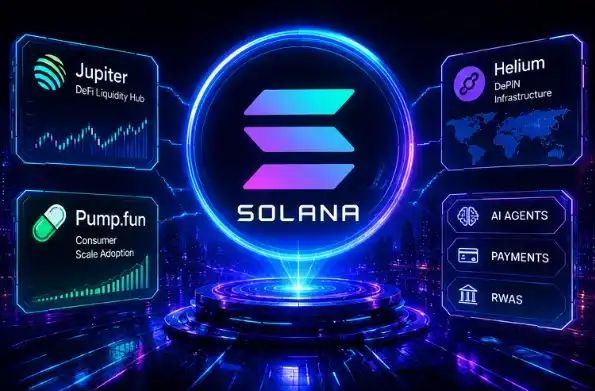
Grayscale's latest report, "Solana: Crypto's Financial Bazaar," signals a shift in how the market views Solana, moving beyond its high-performance and meme-centric reputation. The report frames Solana as an evolving application platform for large-scale economic activity, akin to a bustling digital marketplace. The analysis highlights that public chain competition has moved past raw throughput (TPS) to focus on genuine economic activity—daily users, transaction volume, and real revenue. Solana's metrics, such as over 1,000 dApps, 100M+ daily transactions, and ~4.3M daily active users, showcase this shift toward application-layer prosperity. The report identifies three key growth drivers: 1. **Jupiter**: Evolving from a DEX aggregator to a core liquidity hub and comprehensive financial platform for Solana's DeFi. 2. **Pump.fun**: Demonstrates Solana's capacity for consumer-scale applications, attracting millions of users and generating significant, sustainable revenue, validating network stability under high load. 3. **Helium & DePIN**: Represents expansion into real-world infrastructure, connecting blockchain to physical resources like wireless networks and positioning services, opening new long-term use cases. Solana Foundation's recent focus aligns with this broader vision, emphasizing AI Agents (for machine-to-machine transactions), payments, stablecoins, and Real-World Assets (RWA) to build a sustainable growth model beyond cyclical trends. While challenges remain—such as value capture for SOL and maintaining ecosystem sustainability beyond hot trends—institutional interest is growing due to Solana's maturing application business models, expanding payment/stablecoin ecosystem, and persistent developer activity. The competition is no longer about speed alone, but about which network can foster the most vibrant and valuable digital economy.

marsbitHá 46m

Grayscale's Latest Research: What is Solana's Next Growth Engine?

marsbitHá 46m

Trading

Spot
活动图片