Fully Functional Ripple Stablecoin (RLUSD) Will Not Launch This Year: Expert

bitcoinistPublicado em 2024-09-30Última atualização em 2024-10-01

Resumo

The XRP community is currently abuzz with speculation regarding the imminent release of the Ripple stablecoin, RLUSD. Contrary to widespread...

The XRP community is currently abuzz with speculation regarding the imminent release of the Ripple stablecoin, RLUSD. Contrary to widespread rumors, Vet (@Vet_X0), a recognized XRPL dUNL validator and co-founder of the leading NFT marketplace on the XRP Ledger “xrp.cafe,” has clarified that the RLUSD will not be fully functional on the XRPL this year.

Why The Ripple Stablecoin Will Not Be Fully Operational This Year

In a detailed post on X, Vet explains the technical constraints: “Expectation management! RLUSD will either only launch on ETH this year, or they launch also on the XRPL but without the ability to be used in the AMM on the XRP Ledger initially, but with the DEX orderbook. I expect, or rather hope, for the latter.”

Vet further elaborated on the reasons, pointing to the ‘clawback’ feature enabled on RLUSD, which the XRP Ledger currently does not support in its Automated Market Maker (AMM). “RLUSD is a stablecoin with clawback settings enabled. Tokens with this setting are denied by the XRP Ledger to be used in the AMM. There are amendments in the works to help solving this,” Vet added.

The key amendments cited by Vet include XLS-73 AMM Clawback and XLS-77, which are designed to enhance control over trustlines and restrict the transferability of RLUSD under certain conditions. XLS-73 aims to modify the AMM system to accommodate assets with clawback features, while XLS-77 is intended to allow for a more comprehensive freeze of Trustlines further securing the network against misuse by blacklisted accounts.

“In other words, because the XRPL is decentralized these amendments are impossible to predict when they will come, especially given the fatigue I observed. I love seeing people be excited about things happening on chain via the tracker I made, educating themselves on trustlines and IOUs on the XRPL is exactly where I want attention to go to, as opposed to screenshots of articles, partnerships and secret committee hot air talk,” Vet concluded.

Notably, Ripple Chief Technology Officer (CTO) David “JoelKatz” Schwartz did not dispute Vet’s overall assessment but did provide a clarification on a specific technical point in Vet’s explanation. In a commentary on X, Schwartz noted: “FWIW, I’m not sure I like the description of XLS-77 as a ‘deeper’ freeze. If anything, it’s less deep. Unless I’m missing something, in any case where XLS-77 makes a difference, an asset that would have been frozen is, instead, not frozen.”

Vet responded to Schwartz’s critique by refining his terminology, acknowledging the complexity of the terms and their implications across the XRPL infrastructure: “Good point…hmmm…in my mind it made sense because the freeze goes beyond the trustline, it includes the payment engine and dex – maybe that’s why ‘deep.'”

Daniel Keller, another well-known figure within the XRP community, sought further clarification if the core statement about the Ripple stablecoin is pure speculation or a fact. Vet confirmed the technical barriers: “Confirmed by the XRP Ledger that it’s not possible. Unconfirmed what way they will go, only ETH or ETH and XRPL but with the AMM restrictions.”

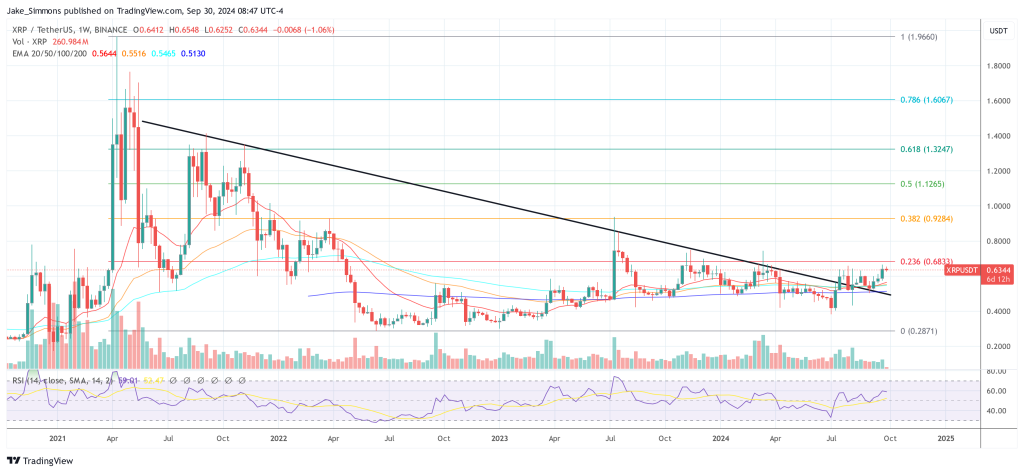
At press time, XRP traded at $0.6344.
XRP price
XRP faces the 0.236 Fib, 1-week chart | Source: XRPUSDT on TradingView.com
Featured image created with DALL.E, chart from TradingView.com
Jake Simmons

Jake Simmons

Jake Simmons has been a Bitcoin enthusiast since 2016. Ever since he heard about Bitcoin, he has been studying the topic every day and trying to share his knowledge with others. His goal is to contribute to Bitcoin's financial revolution, which will replace the fiat money system. Besides BTC and crypto, Jake studied Business Informatics at a university. After graduation in 2017, he has been working in the blockchain and crypto sector. You can follow Jake on Twitter at @realJakeSimmons.

Leituras Relacionadas

In the AI Era, What's Left for Bitcoin?

As Bitcoin falls below $60,000, the author reflects on the relationship between AI and Bitcoin, seeing them as two sides of the same coin. In the AI era, the cost of generating content has plummeted, making fake text, images, and videos increasingly easy and cheap to produce. This has led to a fundamental shift: while AI dramatically lowers the cost of information production, it also undermines trust and authenticity online. What becomes truly valuable is not more content, but the ability to verify what is real—"verifiability." This perspective offers a new lens for Bitcoin. Its massive energy consumption, often criticized as wasteful, is reinterpreted. While AI burns energy to enhance "capability" and efficiency, Bitcoin burns energy to produce "verifiability." Its purpose is not to be trusted but to enable a system where no trust in intermediaries—banks, platforms, or developers—is needed. Every transaction and the entire ledger's history is secured by cryptography and a decentralized network of nodes, making it independently verifiable. AI cannot forge a transaction on the Bitcoin network because the system is designed for proof, not generation. The author draws a historical parallel to the Renaissance: the printing press drastically reduced the cost of copying knowledge, while double-entry bookkeeping reduced the cost of trust in commerce. Today, AI is the new printing press, reducing content creation costs to near zero. Blockchain, and Bitcoin as its pioneer, may be the modern equivalent of double-entry bookkeeping—a foundational technology for verifying digital asset ownership and historical records without centralized authorities. Thus, AI and blockchain are not competitors. AI lowers the cost of creation; blockchain lowers the cost of verification. In an age where AI can generate anything, true scarcity may lie not in more content, but in independently verifiable facts. Whether the market will reprice Bitcoin accordingly remains uncertain, but its core value proposition as a "machine for producing verifiability" becomes strikingly relevant.

marsbitHá 22m

In the AI Era, What's Left for Bitcoin?

marsbitHá 22m

In the Age of AI, What's Left for Bitcoin?

Author: Sevclub, Seven Research Amid Bitcoin's recent drop below $60k, the author reflects on a growing sense that AI and Bitcoin are two sides of the same coin. Today, encountering any content triggers a new default question: "Was this made by AI?" The cost of generating convincing text, images, and video is now negligible. While the internet lowered information *distribution* costs, AI is crashing information *production* costs to near zero. The consequence is a flood of content where truth and falsehood are increasingly indistinguishable. In this environment, what becomes truly valuable is not more information, but the ability to verify what is real—"verifiability." This reframes the common criticism that Bitcoin "wastes electricity." AI consumes power to produce "capability" (e.g., more powerful models). Bitcoin consumes power to produce something else: "verifiability." Bitcoin's core purpose isn't about belief or trust in any institution, developer, or even its creator. It's about enabling independent verification. Every bitcoin's origin, every transaction, and the integrity of the entire ledger are secured by mathematics, cryptography, and a global network of nodes. AI can fabricate convincing media, but it cannot falsify a transaction on the Bitcoin network. The expended energy makes篡改历史 (tampering with history) prohibitively expensive, purchasing a globally verifiable ledger. The author draws a historical parallel to the Renaissance. The printing press drastically reduced the cost of copying knowledge, while double-entry bookkeeping reduced the cost of trust in commerce—one enabled creation, the other verification. Today, AI is the new printing press, driving content production costs toward zero. The question becomes: what is this era's "double-entry bookkeeping"? Blockchain appears to be the leading candidate. It doesn't verify which news is true or which image is real, but it provides a foundational layer for independently verifying asset ownership and historical records in the digital realm without centralized authorities. Therefore, AI and blockchain are not in competition. AI lowers the cost of *generation*. Blockchain (and Bitcoin as a prime example) lowers the cost of *verification*. One creates, the other proves. Whether Bitcoin ultimately succeeds remains uncertain, facing potential challenges from quantum computing, regulation, and technical evolution. However, the author now sees it less as a "machine for making bitcoin" and more as a "machine for making verifiability." In an age where AI can generate anything, true scarcity may no longer be "more content," but "more independently verifiable facts." Whether the market will price this accordingly is a separate question.

链捕手Há 31m

In the Age of AI, What's Left for Bitcoin?

链捕手Há 31m

Trading

Spot
活动图片