European Blockchain Convention 2024: Industry Experts Discuss What’s Next For Crypto Adoption, Blockchain Tech And Web3

bitcoinistPublicado em 2024-09-27Última atualização em 2024-09-27

Resumo

The European Blockchain Convention (EBC) took over Barcelona for its 10th edition. The two-day event featured a line-up of speakers...

The European Blockchain Convention (EBC) took over Barcelona for its 10th edition. The two-day event featured a line-up of speakers that fostered exciting dialogues between the industry experts.

The Catalan capital saw some of the crypto industry’s brightest minds discuss digital assets, Decentralized Finance (DeFi), tokenization, Web3, and sustainability, exploring the industry’s future amid the growing adoption and evolving regulatory framework worldwide.

Day 1: “Crypto Adoption Can’t Be Forced”

On September 25, EBC10 kickstarted its “biggest edition yet” with Daniel Salmeron and Victoria Gago, two of EBC’s founders, discussing why the world needs crypto. The day was followed by a debate between Alireza Siadat (Annerton), Yael Ossowski (Consumer Choice Center), and Vugar Adigozalov (Bidget).

The panelists discussed the slow adoption of the industry and the importance of user experience (UX) and self-custody, as Ossowski emphasized. He highlighted the need for “products that people can use every day,” which was countered by Adigozalov, who noted the challenges of privacy in a transparent ecosystem.

crypto, blockchain

Salmeron And Gago Welcome EBC10's attendees on Day 1.Source: EBC

During the ‘Will Crypto Payments Be THE Killer Use Case?’ panel, the experts noted that people in developing nations are “more willing” to “tolerate bad” UX to benefit from DeFi, emphasizing the “transformative power” of stablecoins in countries like Nigeria, where traditional finance (TradFi) lacks trust.

Zoltan Vardai (Cointelegraph EU) and Eric Demuth (Bitpanda) took the stage together to underscore the necessity of regulatory clarity for the industry’s long-term growth. Demuth also spoke about adoption, explaining that it can’t be forced. However, he argued that “when crypto becomes more efficient and cheaper, people will naturally switch.”

Day 2: Blockchain, A “Game-Changer” For Sustainability

On September 26, the agenda was packed with dialogues between the panelists. A crucial conversation, led by Laurent Marochini (Société Générale Securities Services), took place between Martijn Siebrand (ABN AMRO BANK N.V.) and Emilie Allaert (Luxembourg Blockchain Lab).

The panelists discussed Blockchain’s role in combating greenwashing, with Allaert highlighting the “game-changing benefits” of Distributed Ledger Technology (DLT) to prevent it. “With blockchain, you can verify if companies are truly following through on their sustainability claims,” she asserted.

Notably, the discussion tackled some misconceptions about Blockchain technology’s energy consumption. Allaert pointed out that the new technology has evolved to use 50 times less energy than before and noted that Artificial intelligence (AI) energy consumption is largely unchallenged.

Web 3 gaming and its future were discussed by Nirav Bakshi (Blockchain Founders Fund), Sebastian Borget (The Sandbox), Bay Backner (Decentraland), and Pablo Monti (BingX) in an engaging panel. Borget noted how players earn their first NFTs and experiment with blockchain through gaming, as blockchain games become a gateway to Web3.

He highlighted the industry’s shift toward empowering the creator economy, which offers a “fresh approach” from the challenges of traditional web2 gaming. Meanwhile, Monti underscored the sector’s maturity, moving from the “play-to-earn fever” to a service that “supports the broader gaming industry,” surpassing DeFi in daily wallet use.

Other panels discussed digital assets regulation in the UK, Europe, and the US. Lisa Cameron (House of Commons) passionately called for global regulatory collaboration in Web 3, remarking on the need for tailored solutions across all jurisdictions. Cameron also urged regulators to consult and engage with younger generations, highlighting the importance of shaping a beneficial future for the next generation.

Infrastructure and collaboration were also touched on EBC10’s second day. The discussion, led by Yves-Michel Leporcher (Renault), highlighted the “long-standing challenges” of each blockchain operating independently.

“There’s a digital generation, and we must ensure no one is left behind” – Lisa Cameron (House of Commons)

“Institutions are still catching up—ETFs have unlocked the door, but the best is yet to come” – Elliot Johnson (Evolve ETFs).
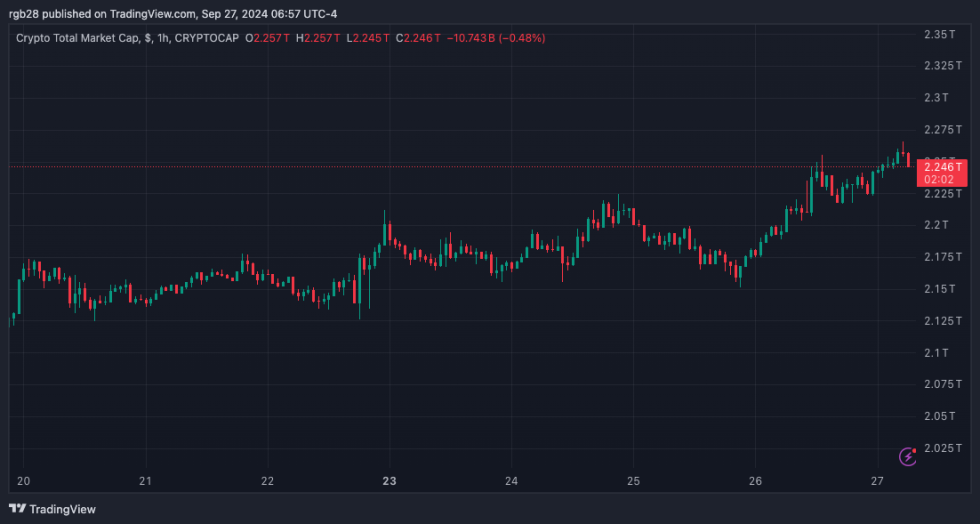
blockchain, crypto, TOTAL

Total crypto market capitalization is at $2.24 trillion in the 7-day chart. Source: TOTAL on TradingView

Bitcoinist Chats with a Gemini Top Executive on the Future of the Industry in the Old Continent

During the event, our team at Bitcoinist talked with Gillian Lynch, CEO of the crypto exchange Gemini for Ireland and Europe, about the upcoming MiCA regulation and its potential consequences for the industry and retail consumers.

During the conversation, Lynch highlighted the increase in adoption, claiming that the number of crypto holders in the region has increased from 1 in 10 to 1 in every 5 individuals over the last decade.

This rate could hike further with MiCA, the upcoming package of regulations set to be implemented by 2025 to oversee the nascent industry. Upon its implementation, crypto exchanges like Gemini, Lynch argued, and its users will finally have clarity.

The new regime of regulations could make the European region the new hub for digital assets as the US failed to provide certainty to its crypto sector. Furthermore, Lynch told us that the region and crypto actors like Gemini will benefit from increased investments as MiCA materializes.

The bigger challenge for Gemini and others will reside in educating its users on MiCA and the new regulatory regime, Lynch told us:

I think the challenge for the industry is to take regulation and educate people as to why it’s important (…) so that customers will know the difference between a regulated and a non-regulated company or exchange and make an informed choice then based on that. (…) I think we have a challenge to really educate.

Lynch said that to win the educational fight, crypto exchanges should rely on many tools, including social media and in-house educational programs such as Gemini’s CryptoPedia.

The next year will be decisive for the European crypto industry as MiCA enters the sector. Its consequences and future consequences, along with the progress of Web3, blockchain, and crypto, will be discussed during the European Blockchain Convention and its already-announced eleventh edition.

Cover image from Unsplash, chart from TradingView.com
Rubmar Garcia

Rubmar Garcia

Rubmar is a crypto enthusiast who likes learning and improving constantly. She enjoys reporting on the latest news and developments in the crypto industry. Rubmar also enjoys scrapbooking, crafting, simulation games, and watching football.

Leituras Relacionadas

Earning Six Figures and Still Struggling to Rent in San Francisco

A couple in San Francisco with a combined tech income over $360,000 struggled for months to find a one-bedroom apartment under $5,000 per month. Their story highlights how the AI wealth boom, driven by upcoming IPOs from companies like OpenAI and Anthropic, is dramatically escalating the city's cost of living. Even six-figure salaries are becoming insufficient for a comfortable lifestyle. The article details the financial reality for tech workers earning around $180,000 annually. After taxes, retirement contributions, and healthcare, take-home pay is roughly $7,000 per month. With average rents exceeding $3,800 and one-bedrooms often costing $4,500-$5,200, discretionary income shrinks to $1,500-$2,500. This contrasts sharply with reported median total compensations of $640,000 at OpenAI and $420,000 at Anthropic. The AI gold rush is identified as the primary driver. The scale of potential wealth from these IPOs, far surpassing previous tech booms, is flooding the housing market. Data shows San Francisco's average rent is now the highest in the U.S., with vacancy rates in desirable neighborhoods plummeting to around 3%. The overall cost of living is 65.6% above the national average. The piece features multiple professionals, including a 25-year-old with a $250,000 salary, facing housing instability, fierce competition for rentals, and a persistent, low-grade financial anxiety despite high earnings. It concludes that the rapid concentration of AI wealth is redefining what constitutes a "high salary" in San Francisco, pushing out mid-tier tech talent and creating a stark divide between those in the AI sector and everyone else.

marsbitHá 45m

Earning Six Figures and Still Struggling to Rent in San Francisco

marsbitHá 45m

Rate Hikes to Save STRC, Selling Bitcoin to Preserve Credit: Strategy Picks Its Two Most Expensive Paths

Over the past six weeks, Strategy has faced a significant crisis of confidence, with its core securities MSTR and STRC experiencing sharp price declines. The situation escalated as the company utilized dollar reserves intended for dividends and interest payments to repurchase debt, and then sold a small amount of Bitcoin for the first time since 2022—an action that contradicted its "never sell" narrative and signaled potential liquidity strain. In response, Strategy introduced a Digital Credit capital framework. This formalized a series of measures to manage the pressure down its capital structure: ordinary shareholders have already borne costs through equity dilution from an $11.5 billion ATM offering; new rules enforce a hard dollar reserve covering at least 12 months of expected dividend and interest payments; the STRC dividend rate was increased from 11.5% to 12%; and, most notably, Bitcoin was officially integrated into the capital toolkit, with board authorization to sell up to $1.25 billion worth if needed to support obligations and repurchase programs. The market reacted with a mix of relief and skepticism. While the announcement triggered a sharp single-day rally in both MSTR and STRC, the preferred shares still trade at a significant discount. Supporters view the framework as pragmatic crisis management that provides a price floor and clearer rules. Critics argue that institutionalizing Bitcoin sales undermines the core investment thesis and, with Bitcoin's price below the company's average cost basis, amounts to selling assets at a loss to maintain its financial structure. The broader context shows institutional Bitcoin buying drying up, highlighting that Strategy's challenges and new framework are now a key indicator for overall market risk sentiment. Ultimately, the framework buys time, but STRC's return to par value depends on market belief in the company's ability to cover dividends without further dilution or substantial Bitcoin sales—a task that would be easier if Bitcoin's price recovers.

链捕手Há 51m

Rate Hikes to Save STRC, Selling Bitcoin to Preserve Credit: Strategy Picks Its Two Most Expensive Paths

链捕手Há 51m

Has Bitcoin Bottomed? Unpacking 12 Key Data Indicators

Author: BitalkNews **Title: Has Bitcoin Bottomed? Analyzing 12 Key Data Indicators** The current Bitcoin price is around $59,600, representing a maximum drawdown of approximately 53% from the 2025 high. The market is in a deep correction phase. Multiple indicators suggest valuations are nearing historical lows, but a confirmed bottom requires more time. **Summary of Key Indicators:** 1. **Fear & Greed Index:** At 16, indicating "Extreme Fear," similar to levels seen during the 2022 FTX collapse. 2. **Rainbow Chart:** BTC has fallen into the "Bitcoin is dead" zone, only the second such occurrence historically. 3. **MVRV Ratio:** Currently around 1.13, near the lower historical band, pointing to a bottoming valuation area (approx. $53,200-$53,400). 4. **Realized Price:** The aggregate cost basis is ~$53,400; the current price is only about 12% above it but hasn't broken below yet. 5. **UTXO Profit/Loss Ratio:** Has dropped to its lowest level this cycle, signaling a potential "capitulation" event often seen near cycle bottoms. 6. **Long-Term Holder SOPR:** For holders >155 days, it's at 0.662, now negative, indicating seasoned investors are selling at a loss. 7. & 8. **Miner Health:** ~20% of miners are unprofitable, and actual miner revenue is below theoretical levels, indicating ongoing miner stress. 9. **ETF Flows:** U.S. spot BTC ETFs have seen sustained net outflows, including a 13-day streak with over $1.7B in weekly outflows. 10. **Strategy Risk:** Strategy's stock premium has significantly contracted, pressuring the traditional "borrow-to-buy" model. 11. **Bear Duration & Drawdown:** The correction has lasted >265 days with a ~52.5% drawdown, shorter in depth but lengthy in duration. 12. **Market Expectations (Polymarket):** Betting markets suggest an ~80% probability of BTC falling below $55,000 and a notable chance below $50,000. **Conclusion:** Bitcoin is in a deep correction with potential bottom formation. Valuation metrics are in historically low ranges, and on-chain capitulation signals are accumulating. However, a complete shakeout isn't finished—the realized price hasn't been breached, and ETF demand hasn't reversed. The area below $60,000 holds long-term appeal, but patience is advised. Key signals to watch for include a return to ETF inflows, a recovery in the Long-Term Holder SOPR, and easing miner pressure.

marsbitHá 59m

Has Bitcoin Bottomed? Unpacking 12 Key Data Indicators

marsbitHá 59m

Valuation Inversion Emerges, Bitcoin Treasury Companies Face Trust Crisis

"Valuation Inversion Emerges, Sparking Trust Crisis for Bitcoin Treasury Firms" The investment thesis for corporate Bitcoin treasury stocks has fundamentally shifted. Investors are no longer rewarding companies simply for accumulating more Bitcoin. Instead, the focus is now on net Bitcoin per share, with intense scrutiny on whether new financings truly benefit existing shareholders or merely dilute their stake. Key indicators highlight the new reality. Metaplanet's market capitalization has fallen below the total value of its Bitcoin holdings, indicating a valuation discount. While MicroStrategy maintains a premium, its core metric—Bitcoin per diluted share for common shareholders—has been declining due to dilution from financing activities, primarily through its STRAT permanent preferred shares. This marks a transition from a pure "asset accumulation" phase to an "equity attribution" phase. Investors now deduct costs like preferred dividends and debt to calculate the actual Bitcoin claim for common equity. The widespread adoption of spot Bitcoin ETFs has removed the scarcity value these stocks once held, forcing them to justify their structure with superior leverage, dividends, or capital efficiency. European entrants like France's Capital B and Sweden's BTC AB are testing this new environment with ambitious funding plans backed by relatively small Bitcoin holdings. They are asking investors to bear complex capital structures, betting future Bitcoin purchases will cover all dilution and dividend costs. The sector's core risk is a broken financing loop. Once a company's stock trades below its Bitcoin net asset value, it loses the ability to issue equity for accretive purchases. It is then left with unpalatable choices: dilutive financing at a discount, venturing into new businesses like Bitcoin lending, or selling assets. The winners in this next phase will be those that demonstrably increase Bitcoin per share for common shareholders with every financing move.

Foresight NewsHá 1h

Valuation Inversion Emerges, Bitcoin Treasury Companies Face Trust Crisis

Foresight NewsHá 1h

Trading

Spot
活动图片