牛市的疯狂与理智:市场繁荣莫忘风险管理,设定更长远的目标

深潮Publicado em 2024-09-25Última atualização em 2024-09-25

如果你在 2025 年赚到钱,你会把钱用在什么地方?

作者:Route 2 FI

编译:深潮TechFlow

今天我们来谈谈即将到来的牛市,以及你可能会成功的场景。

钱并不能解决你所有的问题,但它能解决你的财务问题。你有很多选择。

如果你追逐金钱,现在得到了它,却感到内心空虚,这可能并不是你的终极目标。你可能希望在生活中拥有更多的意义和影响。利用你的金钱来提升自我。设定新的目标,设定超越金钱的目标。

健康、健身、爱好、家庭和朋友等方面。你并不是为了只是待在同一个地方而赚了很多钱。要提升生活品质,拓宽视野,多去看看世界。

无论你多么富有,死亡是无法避免的。因此,唯一的有限资源就是时间。投资金钱来购买时间,利用钱去尝试不同的可能性,投资金钱来提高生活质量

很难想象加密货币牛市是多么疯狂。

我最近一直在思考自己的目标,思考我花这么多时间做什么,以及我想要朝哪个方向前进。

我想,偶尔思考这些事情是正常的,尤其是在市场波动不定的时期。我仍然梦想着再次经历一个即将来临的牛市。那种在高价位购买资产,睡觉后醒来看到价格更高的感觉简直让人难以置信。想象一下,这种感觉持续几个月,每天都在不断上涨。2021年真是疯狂,我记得周围的一切变得毫无意义。你没有时间做其他事。那些不在加密行业的人无法理解这一点。他们知道比特币上涨了几百个百分点,但对山寨币涨了几千个百分点一无所知,而且每天都有新的机会。

目前这些日子似乎已经过去,它们会再次回来吗?我们还会经历这样的经历吗?现在关于山寨币的分散情况存在争论,因为2021年与2024年的区别在于,当时只有少数几个可靠的山寨币,而在2024年,我们有数百个优质项目。但流动性不足以推动它们进入山寨季。这一次,散户更聪明,而不仅仅是散户。交易者更聪明,投资者更聪明,风险投资公司、KOL 等等,他们都比你拥有更多的经验和知识。他们拥有你所没有的资源和人脉。这让我想说,我认为在这次牛市中成功的难度会更大。人们了解“四年周期”,变得更加谨慎,随时准备抛售你手中的资产。你必须比以前的周期更加警惕。

但希望依然存在。因为在一个繁荣的牛市中,所有这些“规则”都会被忽视。人们会忘记风险管理,并做出非常不理性的决策,希望在短时间内获取巨额财富。而这正是你需要聪明的地方。在下一个达到 90,000% 年化收益率的收益项目出现时,保持冷静,不要失去理智。

如果你是一个新手,你知道 94,000% 的年化收益率意味着什么吗?

让我来告诉你。

如果你有 $100,经过 365 天后,你就会有 $94,000。

这意味着每天的利率为 1.9%。是的,天天如此。

好吧,人们不是投入 $100,而是投入 $100,000。

30 天的每日利率为 1.9% 意味着在 $100,000 上获得 $75,000 的利润。

而且,这个庞氏资产 TIME 的价格上涨得非常快,以至于人们在不到一个月的时间里就从 $1,000 成为百万富翁。

我一个加密货币朋友在这个项目上每天赚取 $30,000,并且实际上在接近顶峰时卖掉了,买了一栋新房子。这是一个励志故事。但正如我们所知,这种盈利情况不会永远持续下去,庞氏骗局最终还是崩溃了。

好吧,关于这个就够了。让我们继续。

你有什么目标,朋友?

如果没有更宏伟的目标,很容易就会漫无目的地漂流。

如果你每天只是醒来,没有任何计划,而是开始刷手机或电脑屏幕,你就输了。

我相信目标设定的金字塔结构。

基本上,从一个 20 年以上的使命开始,然后将其细分为 3 到 10 年的愿景。进一步地,要实现 3 年的目标,你需要将其细分为年度目标、季度目标等等。
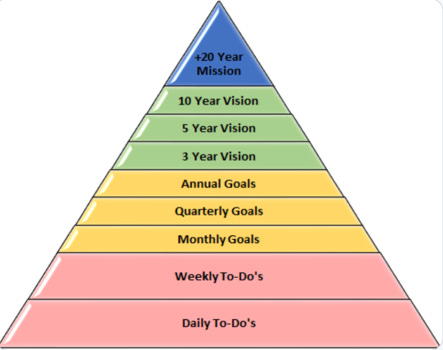
你每天和每周所做的事情决定了你几年后会在哪里发展。当然,我们都可能会有糟糕的日子。但是,与其继续拖延,不如试着重新回到正轨上。

如果你的目标无法激励你,那么它们可能并不是你真正想要的目标。

我有目标吗?有,但如果我们把它与加密货币相关联,我的目标是成为最优秀的作家之一,并在这个领域成为一个知识渊博的人。在上一个市场周期,钱对我来说是一个更重要的因素。这一周期我感觉更轻松,我不需要以同样的方式赚钱。不要误解我,我认为在场的每个人都希望赚更多的钱。但我并不绝望,也不会为了赚钱牺牲我的健康(就像我在上一个周期中感受到的那样)。

请查看我下面的帖子,看看我做了哪些反思。

情况糟糕到让我实际上对所有我关心的事情失去了兴趣。书籍、写作(除了加密货币相关的)、健身、跑步、见朋友、我的女朋友和家人都变得非常无趣。我对我的手机和电脑上瘾,以至于我试图避免所有无法查看我的 DeFi 头寸、Twitter、Discord、TG 等的情况。我的女朋友(当时)试图告诉我我有多么上瘾,但我根本不听。

这让我思考,如果你不利用钱来改善自己的生活,那么钱的意义是什么。

我在下面的推文中写了更多关于这个的看法。
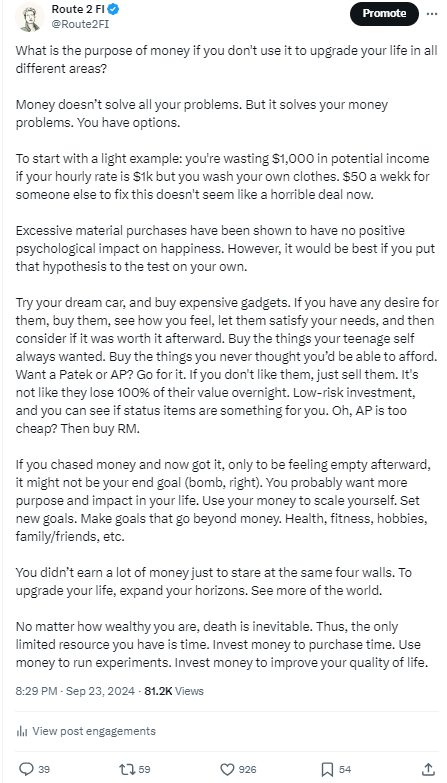
关键是,现在牛市再次加速,我开始重新感受到这一点。加密货币是如此重要,而其他事情只能暂时搁置。我把事情推迟,以便赚更多的钱(比我已经赚的还要多)。

听到其他人在加密货币 Twitter (CT) 上谈论他们打算花钱的事情感觉很自然,可以参考这条推文

我想你现在有足够的内容可以参考了,朋友。

就到这里吧。

但让我问你最后一个问题,你可以在下次之前好好想想。

如果你在 2025 年赚到钱,你会把钱用在什么地方?
Leituras Relacionadas

The AI Industrial Revolution: Where Are We Now?

This article explores the current stage of the AI industrial revolution, arguing we are still merely attaching new tools to old workflows rather than fundamentally redesigning production. The author compares this to the early Industrial Revolution, where factories simply replaced waterwheels with steam engines without changing their core structure. Similarly, today we embed AI chat windows into existing software but leave organizational processes unchanged. While massive investment floods into AI infrastructure (data centers, chips), akin to railway manias of the past, the real transformation lies in "dismantling the old workshop"—reorganizing companies around AI. Examples include Notion's use of hundreds of AI Agents and Y Combinator's experiments with self-improving AI systems that operate autonomously. The author notes a critical gap: while China has vast AI user growth, few companies have rebuilt core workflows. AI is beginning to impact entry-level jobs, and early adopters are gaining a compounding advantage. The conclusion is that the pivotal moment will not be the invention of better models, but when organizations decide to tear down old structures and rebuild around AI, shifting the bottleneck from human coordination to computing power. The future workplace and job titles are yet to be defined, but the imperative is to move away from legacy processes and position oneself where the new "railway" is being built.

marsbitHá 25m

The AI Industrial Revolution: Where Are We Now?

marsbitHá 25m

Morning Post | Hyperliquid Launches Off-chain Event Prediction Market Contract; Strategy Completes $1.5 Billion Debt Buyback; Kelp DAO Announces rsETH Fully Restored

Crypto Market Digest (May 27, 2026) Ondo Finance's founder Nathan Allman has passed away, with President Ian De Bode taking over as CEO. In regulatory news, Hong Kong authorities concluded a consultation on virtual asset service provider licensing, aiming to align rules with traditional finance. Kelp DAO announced its rsETH token has fully recovered five weeks after a $293 million hack by Lazarus Group, though the incident caused significant damage to DeFi lending protocols like Aave. Key industry developments include Hyperliquid launching off-chain event prediction market contracts, and the CME introducing futures for Avalanche and Sui. A report highlights the rise of AI Agent payments, with over $73 million settled on-chain in a year, predominantly using USDC. Meanwhile, blockchain detective ZachXBT exposed market manipulation involving several BSC tokens. In investment news, a firm referred to as "Strategy" completed a $1.5 billion debt buyback. Political contributions from the crypto sector for the 2026 U.S. elections have surpassed $500 million, heavily favoring Republican candidates. BitMEX founder Arthur Hayes revealed Zcash is his second-largest holding, citing the growing necessity for monetary privacy. The digest concludes with trending memecoins on Ethereum, Solana, and Base networks, and highlights in-depth articles covering the impending SpaceX IPO, Polymarket's regulatory challenges, and an analysis of the on-chain treasury landscape.

链捕手Há 26m

Morning Post | Hyperliquid Launches Off-chain Event Prediction Market Contract; Strategy Completes $1.5 Billion Debt Buyback; Kelp DAO Announces rsETH Fully Restored

链捕手Há 26m

Just Now, Chinese AI Enters Top 2 in Global Programming, Only Claude Remains Ahead

**China's AI Ranks Second Globally in Programming, Trailing Only Claude** Today, Alibaba's Qwen3.7-Max achieved a score of 1541 on the Code Arena benchmark, securing fourth place globally and surpassing top models like GPT-5.5 and Gemini 3.5 Flash. Among the top positions, it is now the only non-Claude model, placing second overall after Anthropic's Opus models. Before this official ranking, Qwen3.7-Max had already gained recognition overseas. In practical tests, it outperformed rivals on tasks like creating a self-training Tetris AI and generating complex 3D models, often at a significantly lower cost. Developers praised its ability, especially when integrated with tools like Hermes Agent and OpenCode, to effectively replace models such as GPT-5.5. In a hands-on challenge to create a 3D racing game from a detailed prompt, Qwen3.7-Max delivered a fully playable HTML file in the first attempt, requiring only minor bug fixes. It uniquely included a start menu and sound effects—details missed by other models. While competitors like Gemini 3.5 Flash and Claude Opus 4.6 produced less polished or functional versions, and GPT-5.5 had its own quirks, Qwen3.7-Max stood out for its initial completeness and playability. This performance stems from its design as an "Agent Base Model," built for long-duration, autonomous task execution. Internal tests show it can run continuously for 35 hours, making over 1158 tool calls without context degradation or instruction drift. Key technical advancements include "environment expansion" training, which improves adaptability across different frameworks, and "long-horizon autonomous execution" training, enabling sustained strategic decision-making. By entering the top tier of the programming arena, Qwen3.7-Max demonstrates that Chinese AI models are not just catching up but are becoming defining competitors, challenging the long-standing dominance of Silicon Valley in this field.

marsbitHá 1h

Just Now, Chinese AI Enters Top 2 in Global Programming, Only Claude Remains Ahead

marsbitHá 1h

From a Lunch Table to an Infinite Universe: Fei-Fei Li Bets on AI's Next Dimension

From a Lunch Table Conversation to an Infinite Universe: Fei-Fei Li Bets on AI's Next Frontier - Spatial Intelligence In an era dominated by large language models, AI pioneer Fei-Fei Li argues that true understanding requires spatial intelligence — the ability to perceive, reason, and interact within the physical 3D/4D world. She points to evolutionary history: spatial perception drove the Cambrian explosion 540 million years ago, while language is a far more recent, inherently "lossy" way to encode reality. Current models struggle with basic spatial tasks a child can do, like counting chairs in a video. Her company, World Labs, is pioneering this shift with "Marble," a model that generates navigable, consistent 3D worlds from text, images, or simple 3D inputs—distinct from video generators like Sora. Though smaller than models like GPT-5, due to scarce 3D data and early-stage scaling laws, Marble is already used in gaming, robot training (by NVIDIA), architectural design, and personalized therapy for conditions like OCD and acrophobia. Li envisions this technology enabling "infinite universes" for creativity, social interaction, and more. However, she cautions against utopian or dystopian extremes, advocating for a measured vision where AI enhances human dignity and prosperity, akin to how electricity transformed civilization. The journey is long — as evidenced by the 20-year path to viable autonomous vehicles — but the direction is clear: for AI to move from merely talking about the world to truly understanding and acting within it.

marsbitHá 1h

From a Lunch Table to an Infinite Universe: Fei-Fei Li Bets on AI's Next Dimension

marsbitHá 1h

Trading

Spot
Futuros
活动图片